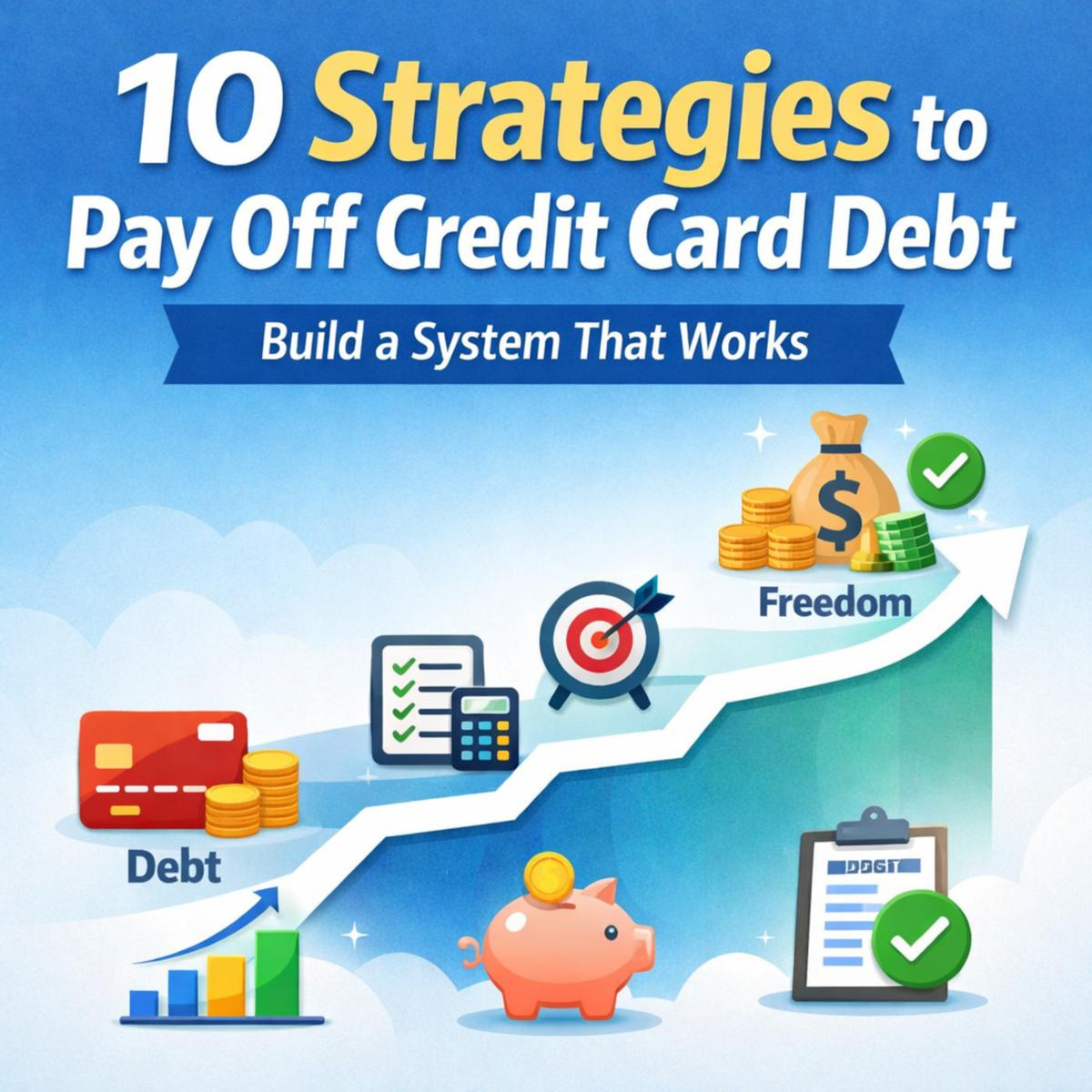
⚡ Quick Answer: How to Pay Off Credit Card Debt
The fastest way to pay off credit card debt is to follow a clear, consistent system:
- Stop adding new debt
Focus on stabilizing your finances before accelerating payoff. - Choose a credit card payment strategy
Use a structured approach like the Snowball Method (smallest balances first), the Avalanche Method (highest interest first), or a hybrid strategy. - Pay more than the minimum consistently
Even small additional payments can significantly reduce interest and shorten your payoff timeline. - Lower your interest rate if possible
Consider balance transfers, consolidation, or negotiating with your credit card issuer. - Build a system that supports long-term success
Combine your payoff strategy with budgeting, expense control, and consistent financial habits.
👉 The key to success isn’t choosing the “perfect” strategy—it’s choosing one you can follow consistently over time.
🔥 Key Takeaways
- Paying only the minimum can dramatically increase the total cost of your debt
- The best payoff strategy is the one you can stick with consistently
- Behavioral habits and mindset matter just as much as financial math
- Budgeting and cash flow are the foundation of successful debt repayment
- Combining multiple strategies often leads to faster and more sustainable results
🧭 How to Tackle Credit Card Debt Step-by-Step
If you’re unsure where to begin, the most effective way to tackle credit card debt is to follow a clear, structured process. Breaking it down into manageable steps makes the process more approachable and easier to sustain over time.
Step 1: Stop Adding New Debt
Before making progress, you need to stabilize your situation. Avoid new charges so your balances don’t continue to grow while you’re trying to pay them down.
Step 2: Understand Your Full Balance and Interest Rates
List all your credit cards, including:
- Current balances
- Interest rates (APR)
- Minimum payments
👉 This gives you a complete picture of your debt and helps you prioritize effectively.
Step 3: Choose a Credit Card Payment Strategy
Select a structured approach that fits your goals and behavior, such as:
- A momentum-based strategy (like the Domino Strategy™)
- An interest-focused strategy (like the Summit Strategy™)
- A hybrid approach (like the Balanced Path™)
👉 A clear strategy determines how you’ll attack your debt.
Step 4: Build a Budget That Supports Repayment
Create a realistic budget that:
- Covers essential expenses
- Identifies how much you can allocate toward debt each month
👉 Your budget is what fuels your payoff strategy.
Step 5: Increase Your Monthly Payments
Pay more than the minimum whenever possible. Even small increases can:
- Reduce interest costs
- Shorten your payoff timeline
👉 The more you can consistently contribute, the faster you’ll see progress.
Step 6: Stay Consistent and Track Progress
Track your balances regularly and celebrate milestones along the way.
- Monitor your progress monthly
- Adjust your plan as needed
- Stay focused on long-term results
👉 Consistency is what turns a strategy into real, measurable progress.
💡 Key Takeaway
Tackling credit card debt isn’t about a single decision—it’s about following a structured process and sticking with it over time.
👉 When you combine the right strategy with consistent action, meaningful progress becomes achievable.
📈 The Cost of Waiting
| Payment Type | Payoff Time | Interest Paid |
|---|---|---|
| Minimum Payment | Long (years/decades) | Very High |
| Accelerated Payment | Shorter | Much Lower |
💳 Understanding Credit Card Debt (Quick Overview)
Before choosing a strategy, it’s important to understand how credit card debt works—and why it can be so difficult to eliminate.
What Is Credit Card Debt?
Credit card debt is a type of revolving debt, meaning you can carry a balance from month to month instead of paying it off in full.
When you don’t pay your full balance:
- Interest is charged on the remaining amount
- New purchases may also begin accruing interest
- Your total balance can grow over time
👉 Unlike fixed loans, credit card debt can persist indefinitely without a structured repayment plan.
Common Causes of Credit Card Debt
Credit card debt often builds gradually rather than all at once. Some of the most common causes include:
- Unexpected expenses (medical bills, car repairs, emergencies)
- Overspending or lifestyle inflation
- High interest rates that outpace payments
- Relying on credit for everyday expenses
- Lack of a structured budget or financial plan
👉 In many cases, debt is not just a spending issue—it’s a combination of financial pressure and limited cash flow.
The Cost of Carrying a Balance
Carrying a credit card balance can be expensive due to compounding interest.
- Interest is added to your balance monthly (or daily)
- Future interest is charged on both the original balance and accumulated interest
- Minimum payments primarily cover interest early on
👉 This means:
- Your debt takes longer to pay off
- You pay significantly more over time
- Progress can feel slow, especially in the early stages
💡 Key Takeaway
Credit card debt isn’t just about what you owe—it’s about how interest, behavior, and financial structure interact over time.
👉 Understanding these fundamentals makes it much easier to choose the right strategy—and stick with it.
🧱 Part 1: Core Debt Payoff Strategies
Understanding how to pay off credit card debt starts with choosing the right strategy. While many approaches exist, most fall into a few core categories based on behavior, math, and financial structure.
The key is not just selecting a method—but selecting one that aligns with your habits, goals, and financial situation.
📊 Compare Credit Card Debt Payoff Strategies
Two of the most widely recognized approaches are the Snowball Method and the Avalanche Method. These strategies provide a clear structure for prioritizing which debts to pay off first.
| Strategy | Best For | Pros | Cons |
|---|---|---|---|
| Snowball Method | Staying motivated and building momentum | Quick wins; builds confidence and consistency | Higher total interest cost over time |
| Avalanche Method | Minimizing total interest and saving money | Lowest interest paid; more cost-efficient | Slower early progress may reduce motivation |
While both methods are effective, it’s important to understand that they are starting points—not complete solutions. Many successful debt payoff plans combine elements of both approaches and integrate broader financial strategies.
👉 This is where a more comprehensive system becomes essential.
💡 10 Proven Credit Card Payment Strategies
Paying off credit card debt isn’t about relying on a single method—it’s about building a system that works for your financial reality.
A credit card payment strategy is a structured approach that determines how you prioritize and repay your debt over time.
Below are 10 proven strategies, including both core payoff methods and supporting financial strategies that work together to accelerate results.
🔥 Core Debt Payoff Strategies
1. 💥 Domino Strategy™
Focus on paying off your smallest balances first to build momentum and confidence as you eliminate accounts.
2. 🧗 Summit Strategy™
Prioritize high-interest debt to reduce the total cost of borrowing over time.
3. 🧘 EQ Planner™
Target the debt that creates the most emotional stress to improve focus and mental clarity.
4. 🛤 Plains Strategy™
Eliminate low-interest debts to simplify your financial life and reduce the number of active accounts.
5. 🌀 Balanced Path™
Combine momentum-based and interest-based strategies for a more flexible and balanced approach.
6. 🔍 Expenditure Tracker™ (Foundation Method)
Track your spending in detail to identify opportunities to redirect money toward debt repayment.
🧩 Supporting Financial Strategies
7. 💰 Budget Optimization Strategy
Create a structured budget that ensures consistent cash flow for debt payments.
8. ✂️ Expense Reduction Strategy
Identify and eliminate unnecessary spending to free up additional funds.
9. 📈 Income Expansion Strategy
Increase your earning potential through side income, raises, or new opportunities.
10. 🔄 Interest Reduction Strategy
Lower your interest rates through balance transfers, consolidation, or negotiation.
👉 The most effective approach combines a payoff strategy with the financial systems that support it.
🚀 How to Aggressively Pay Off Credit Card Debt
If your goal is to eliminate debt as quickly as possible, a more aggressive approach can significantly shorten your timeline and reduce total interest paid.
This approach is best suited for individuals who are ready to make focused, short-term sacrifices for faster long-term results.
Key tactics include:
- Increase your payment percentage
Allocate 20–50% (or more) of your available surplus income toward debt repayment. - Combine strategies for maximum impact
Use approaches like the Balanced Path™ to gain both momentum and cost efficiency. - Temporarily reduce non-essential spending
Redirect discretionary expenses toward debt payoff during focused periods. - Increase your income
Add side work, freelance income, or additional hours to accelerate payments. - Apply lump-sum payments when possible
Use tax refunds, bonuses, or unexpected income to make large principal reductions.
👉 This approach is designed for those who want the fastest possible results and are willing to take decisive action.
💡 Practical Tips to Pay Off Credit Card Debt Faster
In addition to structured strategies, small tactical changes can significantly improve your results over time.
Simple but effective tips:
- Make multiple payments throughout the month to reduce interest accumulation
- Always pay more than the minimum whenever possible
- Prioritize high-interest balances to reduce overall cost
- Automate payments to ensure consistency and avoid missed due dates
- Use financial windfalls (tax refunds, bonuses) to accelerate progress
- Avoid adding new charges while working toward payoff
In addition to structured strategies, simple tips like making extra payments and avoiding new charges can help you pay down credit card debt faster.
👉 These practical adjustments, when combined with a structured strategy, can dramatically improve both your speed and consistency.
🚀 Ways to Pay Off Credit Card Debt Faster
| Action | Impact on Payoff Speed |
|---|---|
| Increase monthly payment | High |
| Reduce interest rate | High |
| Add extra income | Very High |
| Cut discretionary expenses | Medium–High |
| Use lump-sum payments | Very High |
| Automate payments | Medium |
🧩 Part 2: Build a Complete Debt Payoff System
Choosing a strategy is an important first step—but long-term success comes from building a system that supports consistent progress.
Without the right financial structure in place, even the most effective payoff strategy can stall or fail over time.
🔗 Why Payoff Strategies Alone Aren’t Enough
Many people struggle with debt not because they chose the wrong strategy—but because their overall financial system isn’t aligned to support it.
Here are the most common barriers:
- Cash flow constraints
If there isn’t enough money left after essential expenses, progress will be slow regardless of the strategy you use. - Ongoing spending habits
Continuing to add new debt can offset or completely eliminate your progress. - Interest drag
High interest rates can slow your payoff timeline significantly, especially on larger balances. - Lack of structure
Without a clear plan connecting income, expenses, and payments, consistency becomes difficult.
👉 The key distinction:
- Strategies answer how to pay off debt
- Systems determine whether it actually works
🧰 Build a Complete Debt Payoff System
To make meaningful progress, your debt payoff plan should be built on a structured foundation. This ensures that your strategy is supported by consistent financial habits and sustainable cash flow.
Step 1: Stabilize Spending
Before accelerating payoff, focus on eliminating new debt. This creates a stable starting point and prevents setbacks.
Step 2: Create a Working Budget
Develop a realistic budget that clearly outlines income, fixed expenses, and available funds for debt repayment.
Step 3: Choose a Payoff Strategy
Select a method that aligns with your financial goals and behavioral tendencies (e.g., Domino Strategy™, Summit Strategy™, or Balanced Path™).
Step 4: Optimize Interest Rates
Look for opportunities to reduce your interest burden through balance transfers, consolidation, or negotiation with creditors.
Step 5: Build Consistency
Set up systems such as automatic payments and regular check-ins to ensure steady progress over time.
👉 When these steps work together, your debt payoff plan becomes more predictable, manageable, and sustainable.
🧮 Preparing for Debt Repayment
Before you begin aggressively paying down debt, it’s important to understand your full financial picture.
Key preparation steps:
- List all debts
Include balances, interest rates, and minimum payments for each account. - Calculate your total debt
This gives you a clear starting point and helps track progress over time. - Identify available cash flow
Determine how much you can realistically allocate toward debt each month. - Set realistic payoff targets
Establish a timeline based on your budget, strategy, and financial priorities.
👉 This preparation phase turns your plan from a general idea into a structured, actionable roadmap.
💰 Example: How to Pay Off $20,000 in Credit Card Debt
To better understand how strategy and consistency impact results, let’s look at a simplified example.
Scenario:
- Total credit card debt: $20,000
- Average interest rate: 20% APR
Payment Comparison
Option 1: Pay $400 per month
- Estimated payoff time: ~7–8 years
- Total interest paid: Significant due to extended timeline
Option 2: Pay $800 per month
- Estimated payoff time: ~3–4 years
- Total interest paid: Substantially lower
Key Insights
- Doubling your monthly payment does more than cut your timeline in half
- Higher payments reduce both interest costs and financial stress over time
- Even modest increases in monthly payments can produce meaningful improvements
👉 The takeaway:
Your strategy matters—but your payment level and consistency have an even greater impact on how quickly you become debt-free.
🎯 Section Summary
At this stage, you’ve moved from simply choosing a strategy to building a complete, functional system that supports long-term success.
💡 Table: Monthly Budget Template for Debt Reduction
| Category | % of Income | Example: $4,000 Income | Notes |
|---|---|---|---|
| Housing | 30% | $1,200 | Rent/mortgage, utilities |
| Debt Repayment | 20% | $800 | Credit cards, personal loans |
| Savings | 10% | $400 | Emergency fund, investments |
| Groceries | 15% | $600 | Includes household essentials |
| Transportation | 10% | $400 | Gas, car payments, public transit |
| Discretionary Spending | 10% | $400 | Dining out, subscriptions, entertainment |
| Miscellaneous | 5% | $200 | Clothing, medical, other expenses |
🧠 Part 3: Behavioral & Financial Insights
Paying off credit card debt isn’t just a numbers problem—it’s a behavioral one.
Understanding how your habits, emotions, and decision-making patterns influence your finances can be just as important as choosing the right strategy. When you align both, your chances of long-term success increase significantly.
🧠 The Psychology Behind Debt
Many people approach debt repayment as a purely mathematical challenge. In reality, your behavior often plays an even bigger role than the numbers themselves.
Instant Gratification vs. Delayed Reward
Credit cards make it easy to prioritize immediate wants over long-term financial goals.
- Instant gratification leads to short-term satisfaction
- Delayed reward requires discipline but creates lasting financial stability
👉 The challenge is shifting from short-term thinking to long-term outcomes.
Emotional Triggers and Spending Patterns
Spending is often tied to emotions rather than necessity.
Common triggers include:
- Stress or anxiety
- Celebratory spending
- Lifestyle comparison (keeping up with others)
👉 Recognizing these patterns is the first step toward controlling them.
Motivation vs. Discipline
Motivation can help you get started—but it’s not reliable over time.
- Motivation is temporary and influenced by mood or circumstances
- Discipline is built through consistent habits and systems
👉 This is why strategies like the Domino Strategy™ (momentum) and EQ Planner™ (emotion-focused) can be powerful—they align with human behavior rather than working against it.
🧠 Key Insight
The most effective debt payoff plan isn’t just financially efficient—it’s behaviorally sustainable.
👉 When your strategy fits your habits and mindset, consistency becomes much easier to maintain.
📈 The Cost of Waiting
Delaying debt repayment may feel harmless in the short term—but over time, it can significantly increase both your costs and your payoff timeline.
How Interest Compounds Against You
Credit card interest compounds, meaning you pay interest on both your original balance and previously accrued interest.
For example:
- Balance: $5,000
- Interest Rate: 20% APR
If you only make minimum payments:
- A large portion of each payment goes toward interest
- Your balance decreases slowly
- Total repayment cost increases significantly over time
Minimum Payments vs. Accelerated Payoff
Minimum Payment Approach:
- Long repayment timeline
- High total interest cost
- Slower financial progress
Accelerated Payment Approach:
- Shorter payoff timeline
- Lower total interest paid
- Faster improvement in financial stability
Why Acting Early Matters
The earlier you increase your payments, the more you reduce:
- Total interest paid
- Time spent in debt
- Financial stress
👉 Even small increases in your monthly payment can lead to meaningful long-term savings.
💡 Key Takeaway
Time is one of the most powerful factors in debt repayment—and it can either work for you or against you.
👉 Taking action early, staying consistent, and aligning your strategy with your behavior can dramatically improve your financial outcomes.
🎯 Section Summary
At this stage, you’ve gained a deeper understanding of:
- How behavior and psychology influence debt
- Why motivation alone isn’t enough
- How interest compounds over time
- The real cost of delaying action
👉 Next, we’ll identify the most common mistakes and warning signs that can derail your progress—and how to avoid them.
⚠️ Part 4: Risks, Mistakes, and Warning Signs
Even with the right strategy in place, certain mistakes and warning signs can slow—or completely derail—your progress.
Recognizing these risks early allows you to adjust your approach, protect your progress, and stay on track toward becoming debt-free.
⚠️ Common Debt Payoff Mistakes to Avoid
Avoiding these common mistakes can significantly improve both your speed and success in paying off credit card debt.
Only Paying the Minimum
Making only minimum payments may feel manageable in the short term, but it dramatically extends your repayment timeline.
Why it matters:
A large portion of each payment goes toward interest, leaving very little to reduce your principal balance.
👉 Even small increases above the minimum can significantly reduce total interest and payoff time.
Ignoring Interest Rates
Not accounting for interest rates can make your strategy less effective.
Why it matters:
High-interest balances grow faster, increasing your total repayment cost if not prioritized or addressed.
👉 Strategies like the Summit Strategy™ or interest reduction tactics can help minimize long-term costs.
Not Having a Budget
Without a clear budget, it’s difficult to consistently allocate money toward debt repayment.
Why it matters:
A lack of structure often leads to inconsistent payments and missed opportunities to accelerate progress.
👉 A simple, realistic budget creates the foundation for consistent debt reduction.
Continuing to Take on New Debt
Adding new charges while trying to pay off existing balances can stall or reverse your progress.
Why it matters:
Debt payoff requires stabilization first—without it, even the best strategies won’t work effectively.
👉 Consider temporarily pausing credit card use while focusing on repayment.
Relying on Motivation Alone
Motivation can help you get started—but it often fades over time.
Why it matters:
Without systems and habits in place, progress can become inconsistent.
👉 Build discipline through automation, structured plans, and realistic expectations.
⚠️ Common Debt Payoff Mistakes
| Mistake | Why It Hurts |
|---|---|
| Paying only minimums | Extends timeline and increases interest |
| Ignoring interest rates | Leads to higher total cost |
| Not budgeting | Creates inconsistent payments |
| Taking on new debt | Cancels out progress |
| Relying on motivation alone | Leads to burnout and inconsistency |
🚨 Warning Signs Your Debt Is Becoming a Serious Problem
Recognizing early warning signs can help you take action before your situation becomes more difficult to manage.
Rising Balances Over Time
If your total debt continues to increase month after month, it may indicate that spending is outpacing repayment.
👉 This is often a sign that your current strategy or budget needs adjustment.
Using Credit for Essential Expenses
Relying on credit cards to cover basic needs such as groceries, utilities, or rent can signal deeper financial strain.
👉 This suggests that your income and expenses may be out of balance.
Missed or Late Payments
Missing payments can lead to fees, higher interest rates, and long-term damage to your credit profile.
👉 Consistent missed payments are a strong indicator that your current system isn’t sustainable.
High Credit Utilization
Using a large percentage of your available credit (typically above 30–50%) increases both financial risk and credit score impact.
👉 High utilization can make it harder to qualify for lower interest rates or refinancing options.
💡 Key Takeaway
Mistakes and warning signs are not failures—they are signals.
👉 The earlier you recognize and address them, the easier it is to adjust your strategy and regain control.
🎯 Section Summary
At this stage, you now understand:
- The most common mistakes that slow debt payoff
- Early warning signs of financial strain
- How to identify when your current approach needs adjustment
👉 Next, we’ll look at what progress actually looks like over time—and the real benefits of becoming debt-free.
📊 Part 5: Progress, Benefits, and Expectations
Paying off credit card debt is a process—and understanding what progress looks like can help you stay motivated and consistent over time.
Many people expect quick results, but in reality, debt payoff follows a predictable pattern. Recognizing this pattern can help you stay focused, even when progress feels slow.
⏳ What Debt Payoff Looks Like Over Time
Debt repayment typically unfolds in three distinct phases:
Early Stage: Slow Progress
At the beginning, progress may feel minimal.
- A large portion of your payments goes toward interest
- Your balances may decrease slowly
- Motivation can be challenged due to limited visible results
👉 This stage is where many people feel discouraged—but it’s also where consistency matters most.
Mid Stage: Building Momentum
As your balances begin to decrease, progress becomes more noticeable.
- Interest charges start to decline
- More of each payment goes toward the principal
- Paid-off accounts free up additional cash flow
👉 This is where strategies like the Domino Strategy™ and Balanced Path™ begin to accelerate results.
Late Stage: Rapid Payoff
In the final phase, progress speeds up significantly.
- Remaining balances are smaller
- Payments have a greater impact
- Payoff timelines shorten rapidly
👉 This stage often feels rewarding, as your efforts begin to compound in your favor.
⏳ Debt Payoff Journey Overview
| Phase | What Happens | What to Expect |
|---|---|---|
| Early | Payments mostly go to interest | Slow progress |
| Mid | Balances begin to drop faster | Momentum builds |
| Late | Payments hit principal heavily | Rapid payoff |
🎯 Benefits of Paying Off Credit Card Debt
Eliminating credit card debt provides more than just financial relief—it creates opportunities for long-term stability and growth.
💰 Financial Benefits
- Lower overall costs by eliminating high-interest payments
- Increased cash flow that can be redirected toward savings, investing, or other goals
- Reduced financial risk from unexpected expenses
🧠 Emotional Benefits
- Reduced stress and anxiety related to debt obligations
- Greater confidence in your financial decisions
- Improved sense of control over your financial future
🌱 Long-Term Benefits
- Improved credit profile through lower utilization and consistent payments
- Greater financial flexibility to pursue goals such as homeownership, investing, or career changes
- Stronger financial habits that support long-term success
💡 Key Takeaway
Debt payoff is not just about eliminating balances—it’s about transforming your financial foundation.
👉 As you move through each stage, your progress builds on itself, creating momentum that becomes easier to sustain over time.
🎯 Section Summary
At this stage, you now understand:
- What realistic debt payoff progress looks like
- Why early stages can feel slow—but are critical
- How momentum builds over time
- The financial, emotional, and long-term benefits of becoming debt-free
👉 Next, we’ll answer the most common questions about paying off credit card debt and help you take your next step forward.
⏳ Debt Payoff Phases: What to Expect on Your Journey
Paying off credit card debt doesn’t happen all at once—it follows a predictable pattern. Understanding these phases can help you stay motivated, set realistic expectations, and avoid frustration along the way.
📊 Overview of the Debt Payoff Journey
| Phase | What Happens | Typical Timeline |
|---|---|---|
| Awareness & Control | You stabilize spending and stop adding new debt | Month 1–3 |
| Momentum Building | Small balances are paid off and progress becomes visible | Month 3–12 |
| Acceleration | Larger payments reduce balances faster as interest declines | Year 1+ |
| Financial Stability | Debt is eliminated and long-term financial habits take hold | Ongoing |
📍 Phase 1: Awareness & Control (Month 1–3)
This is where your journey begins.
- You stop adding new debt
- Track your spending and understand your finances
- Build a basic budget
- Choose a payoff strategy
👉 Progress may feel slow, but this phase is critical—it sets the foundation for everything that follows.
📍 Phase 2: Momentum Building (Month 3–12)
As you begin paying down balances, progress becomes more noticeable.
- Smaller debts are eliminated
- Monthly payments start making a visible impact
- Motivation increases as you see results
👉 Strategies like the Domino Strategy™ are especially effective during this phase.
📍 Phase 3: Acceleration (Year 1+)
At this stage, your efforts begin to compound.
- Interest charges decrease
- More of each payment goes toward the principal
- Payoff speed increases significantly
👉 This is where consistency pays off and your system starts working in your favor.
📍 Phase 4: Financial Stability (Debt-Free Stage)
Once your credit card debt is eliminated, your focus shifts to maintaining long-term financial health.
- Redirect former debt payments toward savings or investing
- Build or strengthen your emergency fund
- Maintain disciplined financial habits
👉 This phase represents more than being debt-free—it’s the foundation for long-term financial independence.
💡 Key Takeaway
Debt payoff is a process, not a single event.
👉 Understanding these phases helps you stay patient in the early stages, motivated in the middle, and disciplined through the finish.
❓ Part 6: FAQs and Final Guidance
As you work toward paying off credit card debt, it’s natural to have questions about strategy, timing, and next steps. Below are answers to some of the most common questions to help guide your decisions.
💬 Frequently Asked Questions
What is the fastest way to pay off credit card debt?
The fastest way to pay off credit card debt is to combine a structured payoff strategy with increased payments and strong financial habits.
This typically includes:
- Paying significantly more than the minimum
- Prioritizing high-interest balances or using a hybrid approach
- Reducing expenses and increasing income where possible
- Avoiding new debt during the payoff process
👉 The key is consistency—larger, regular payments will dramatically shorten your timeline.
Should I use the Domino Strategy™ or Summit Strategy™ method?
Both methods are effective, but the best choice depends on your priorities:
- Domino Strategy™: Best if you need motivation and quick wins
- Summit Strategy™: Best if you want to minimize total interest costs
👉 Many people benefit from a hybrid approach, such as the Balanced Path™, which combines both momentum and efficiency.
Is debt consolidation worth it?
Debt consolidation can be helpful if it lowers your interest rate or simplifies your payments.
It may be worth considering if:
- You qualify for a lower interest rate
- You want to combine multiple payments into one
- You are committed to avoiding new debt
👉 Consolidation is most effective when paired with a clear repayment plan and disciplined spending habits.
How much should I pay each month?
At a minimum, you should always pay more than the required minimum payment.
A practical approach is to:
- Allocate as much of your available cash flow as possible
- Set a fixed monthly payment target based on your budget
- Increase payments whenever your income or expenses change
👉 Even small increases can significantly reduce your total interest and payoff timeline.
Can I invest while paying off debt?
In many cases, it makes sense to prioritize paying off high-interest credit card debt before investing.
Why:
- Credit card interest rates often exceed potential investment returns
- Paying off debt provides a guaranteed return equal to your interest rate
👉 Once high-interest debt is under control, you can begin balancing debt repayment with long-term investing.
🏁 Conclusion: Your Path to Becoming Debt-Free
Paying off credit card debt is not about finding a perfect solution—it’s about building a system that works for your life and sticking with it over time.
Start Where You Are
You don’t need to have everything figured out today. Begin with a clear understanding of your current situation and take the first step forward.
Focus on Consistency
Small, consistent actions—repeated over time—create meaningful financial progress. What matters most is staying committed to your plan.
Build a System, Not Just a Strategy
A strategy tells you what to do. A system ensures that you actually follow through.
👉 When you combine the right strategy with a strong financial foundation and consistent habits, becoming debt-free moves from a goal to an achievable outcome.
🚀 Next Step
Take action today:
- Choose a payoff strategy that fits your situation
- Review your budget and identify available cash flow
- How to Negotiate Better Loan Rates — Insider Strategies to Lower Your Borrowing Costs
- Credit Utilization Explained: How to Lower It Fast and Improve Your Score
👉 Your progress starts with a single step—and builds from there.
How to Create a Financial Plan -A practical, structured guide to organizing goals, priorities, and long-term financial strategy.
Life Insurance Planning Hub Foundational insurance principles and strategic planning considerations.
Back to Credit & Debt Management Hub
Continue reading more in Managing Credit Card Debt Effectively