
How to Create a Comprehensive Financial Plan: Step-by-Step Planning Guide
Your Complete Roadmap to Building a Financial Life You Can Trust and Control
🧭 1. Introduction
Financial planning isn’t just about budgeting, investing, or saving—it’s about building a complete system that connects every part of your financial life into a clear, intentional strategy.
When your finances are structured as a system rather than a series of isolated decisions, you gain something far more valuable than short-term results: clarity in your choices, control over your direction, and long-term resilience in the face of uncertainty.
This guide is designed to move you beyond fragmented advice and into a practical, step-by-step framework you can actually follow. Whether you’re just starting out or refining an established plan, this page serves as your complete financial planning roadmap—built to support real financial decisions, not just theory.
⚡ 2. Quick Answer
What Is a Comprehensive Financial Plan?
A comprehensive financial plan is a structured strategy that integrates all major areas of personal finance—budgeting, saving, investing, insurance, tax planning, retirement planning, and estate planning—into a unified system designed to achieve your short-term and long-term financial goals.
Rather than focusing on individual decisions in isolation, it ensures every financial action supports a broader, coordinated plan for stability, growth, and long-term success.
Key Components of a Comprehensive Financial Plan:
- Budgeting – Managing income, expenses, and overall cash flow
- Saving – Building reserves for emergencies and short-term goals
- Investing – Growing wealth through disciplined, long-term strategies
- Insurance – Protecting income, assets, and financial stability
- Taxes – Minimizing tax impact through strategic planning
- Retirement – Preparing for long-term financial independence
- Estate Planning – Protecting assets and planning for wealth transfer
🔥 3. Key Takeaways
- Financial planning is an ongoing process, not a one-time event
- A strong plan integrates all areas of your financial life, not just one or two
- Every effective plan begins with clear visibility into your cash flow
- Risk management and insurance are essential to protect your progress
- Investing is the engine of long-term wealth growth
- Tax efficiency can significantly improve overall financial outcomes
- Regular reviews help ensure your plan stays aligned with your goals and life changes
🧭 4. Start Here: Your Financial Planning Roadmap
Choose Your Starting Point
Financial planning doesn’t have to be overwhelming. Instead of trying to do everything at once, start with the phase that best matches your current situation.
Use the roadmap below to jump directly to the section that matters most to you right now.
🔰 Foundation — Build Stability First
If you’re just getting started or want to gain control over your finances, begin here.
- Understand your financial situation
- Track income, expenses, and net worth
- Set clear financial goals
- Build an emergency fund
👉 Jump to: Phase 1 – Financial Foundation
🛡️ Protection — Safeguard Your Progress
If you have debt, limited savings, or lack financial protection, focus on reducing risk.
- Pay down high-interest debt
- Improve your credit profile
- Build essential insurance coverage
👉 Jump to: Phase 2 – Protect Your Financial Life
📈 Growth — Start Building Wealth
If your finances are stable and protected, it’s time to grow.
- Begin investing consistently
- Understand asset allocation and risk
- Use tax-efficient strategies
👉 Jump to: Phase 3 – Grow Your Wealth
🕰️ Income — Plan for Financial Independence
If you’re focused on the future, shift toward income planning.
- Set retirement goals
- Build sustainable income strategies
- Plan for Social Security and withdrawals
👉 Jump to: Phase 4 – Financial Independence
🌍 Advanced Planning — Align With Your Life Goals
If your financial foundation is strong, refine your strategy to match your long-term priorities.
- Estate planning and wealth transfer
- Education funding
- Philanthropy and legacy planning
- Business and healthcare considerations
👉 Jump to: Phase 5 – Advanced & Lifestyle Planning
♻️ Optimization — Keep Your Plan on Track
If you already have a plan, focus on maintaining and improving it.
- Review your finances regularly
- Adjust for life changes
- Optimize investments and tax strategies
👉 Jump to: Phase 6 – Review & Optimize
🧠 A Simple Way to Think About It
If you’re unsure where to begin, follow this progression:
Stability → Protection → Growth → Income → Legacy → Optimization
Start where you are, move forward step-by-step, and build your financial plan with confidence.
🧭 5. The Financial Planning Framework
The 5 Pillars of a Comprehensive Financial Plan
A strong financial plan isn’t built by focusing on one area at a time—it’s built by integrating multiple components into a structured system that works together.
To simplify this process, financial planning can be broken down into five core pillars. Each pillar represents a critical function in your financial life, and together they form a complete, balanced strategy for long-term success.
This framework helps you:
- Understand how each part of your finances connects
- Identify gaps in your current plan
- Build a structured path toward financial stability and independence
📊 The 5 Pillars of Financial Planning
| Pillar | Focus | What It Covers |
|---|---|---|
| Foundation | Stability | Budgeting, cash flow management, emergency fund building |
| Protection | Risk | Insurance planning, debt management, credit health |
| Growth | Wealth | Investing strategies, asset allocation, tax efficiency |
| Income | Future | Retirement planning, income strategies, long-term financial independence |
| Legacy | Transfer | Estate planning, wealth transfer, philanthropic giving |
🧠 How the Pillars Work Together
Each pillar builds on the others:
- Without a strong Foundation, it’s difficult to maintain financial stability
- Without Protection, unexpected events can undo years of progress
- Without Growth, your money may not keep up with inflation or long-term goals
- Without an Income strategy, financial independence becomes uncertain
- Without Legacy planning, your wealth may not be preserved or transferred effectively
A comprehensive financial plan aligns all five pillars into a coordinated system, where every decision supports your broader financial goals.
🎯 Why This Framework Matters
Many people approach finances in a fragmented way—focusing only on budgeting, debt, or investing—without understanding how those decisions impact the bigger picture.
This framework shifts your mindset from:
“What should I do next?”
to:
“How does this decision fit into my overall financial strategy?”
That shift is what separates short-term financial activity from long-term financial success.
Now that you understand the core pillars, let’s turn this framework into a step-by-step execution plan you can follow.
🧭 6. Financial Planning Process
Step-by-Step Overview of the Planning Process
Understanding financial planning is important—but results come from execution.
This roadmap transforms the 5 Pillars of Financial Planning into a clear, step-by-step system you can follow. Each phase builds on the last, helping you move from financial uncertainty to long-term stability, growth, and independence.
You don’t need to complete everything at once. Start with your current situation and progress forward over time.
🔰 Phase 1: Build Your Financial Foundation
Every successful financial plan begins with clarity and control. This phase focuses on understanding your current financial position and creating a stable base for future decisions.
What to Focus On:
- Assess your current financial situation
- Track your income, expenses, and net worth
- Set clear financial goals using the SMART framework
- Build an emergency fund to handle unexpected expenses
Why It Matters:
Without a strong foundation, every other financial decision becomes more fragile. This phase gives you visibility, structure, and stability.
👉 Continue with:
- Net worth tracking and financial assessment tools
- Budgeting & Money Management hub
- Emergency fund strategy guide
🛡️ Phase 2: Protect Your Financial Life
Once your foundation is in place, the next step is protecting it from risks that could derail your progress.
What to Focus On:
- Manage and reduce high-interest debt
- Understand and improve your credit health
- Build essential insurance coverage, including:
- Life insurance
- Disability insurance
- Property coverage
- Personal liability protection
Why It Matters:
Financial setbacks can undo years of progress. This phase helps you reduce risk and safeguard your financial stability.
👉 Continue with:
📈 Phase 3: Grow Your Wealth
With stability and protection in place, you can begin focusing on long-term growth and wealth building.
What to Focus On:
- Investment fundamentals:
- Asset allocation
- Risk tolerance
- Time horizon
- Tax-efficient strategies:
- Retirement accounts (401(k), IRA, Roth IRA)
- Tax diversification
- Basic tax planning techniques
Why It Matters:
This phase positions your money to grow over time through compounding, helping you build wealth and achieve long-term financial goals.
👉 Continue with:
🕰️ Phase 4: Prepare for Long-Term Financial Independence
At this stage, the focus shifts from accumulation to sustainability—ensuring your wealth can support your future lifestyle.
What to Focus On:
- Define your retirement goals and timeline
- Establish savings targets based on future income needs
- Develop sustainable withdrawal strategies
- Plan for income sources, including:
- Retirement accounts
- Investment income
- Social Security benefits
Why It Matters:
Financial independence depends on your ability to generate reliable income without running out of money.
👉 Continue with:
- Retirement Planning hub
- Retirement income and withdrawal strategies
- Retirement Savings Strategies and Calculators
🌍 Phase 5: Advanced & Lifestyle Planning
As your financial plan matures, it should evolve to reflect your broader life goals, priorities, and long-term impact.
What to Focus On:
- Estate planning:
- Wills, trusts, and powers of attorney
- Education planning:
- 529 plans and funding strategies
- Philanthropy:
- Charitable giving and legacy strategies
- Business and healthcare planning:
- Business succession (if applicable)
- Long-term care considerations
- Lifestyle and digital assets:
- Life transitions
- Digital account management and protection
Why It Matters:
This phase ensures your financial plan supports not just your wealth—but your life, family, and legacy goals.
👉 Continue with:
- Estate Planning and Wealth Transfer guides
- College Planning resources
- Wealth and Financial Independence Strategies
♻️ Phase 6: Review, Adjust, and Optimize
Financial planning is not a one-time task—it’s an ongoing process that evolves with your life.
What to Focus On:
- Quarterly financial check-ins
- Annual comprehensive plan reviews
- Adjustments for major life events:
- Career changes
- family changes
- relocation or major purchases
- Updates based on market and economic conditions:
- Investment rebalancing
- Tax strategy adjustments
Why It Matters:
Even the best plan becomes outdated without updates. This phase keeps your strategy aligned, flexible, and effective over time.
👉 Continue with:
- Annual Financial Planning Checklist
- Financial plan review and optimization guides
🧭 Bringing It All Together
Each phase builds on the last, creating a structured system that guides you from financial uncertainty to confidence and control.
Start where you are. Move forward step-by-step. Stay consistent.
That’s how a comprehensive financial plan is built—and sustained over time.
🧭 7. Where Should You Start?
Start Your Financial Plan Based on Your Situation
One of the biggest challenges in financial planning is knowing where to begin. The right starting point depends on your current financial situation—not someone else’s.
Use the guide below to quickly identify your next step and take action with confidence.
👤 Beginner → Start with Financial Assessment
If you’re new to financial planning, begin by understanding where you stand.
- Review your income, expenses, assets, and liabilities
- Calculate your net worth
- Identify your financial priorities
👉 Start with: Financial assessment and net worth tracking
💸 Cash Flow Issues → Budgeting + Emergency Fund
If money feels tight or inconsistent, focus on stabilizing your finances.
- Build a simple, realistic budget
- Identify spending patterns
- Start a small emergency fund
👉 Start with: Budgeting strategies and emergency fund planning
💳 High Debt → Debt Strategy
If debt is holding you back, reducing it should be your top priority.
- Focus on high-interest balances first
- Choose a structured payoff strategy
- Avoid accumulating new debt
👉 Start with: Credit & Debt Management and payoff strategies
📈 Ready to Invest → Investing Basics
If your finances are stable, it’s time to focus on growth.
- Begin investing consistently
- Understand risk and asset allocation
- Use tax-advantaged accounts
👉 Start with: Investment Basics & Strategies
🕰️ Near Retirement → Income Planning
If retirement is approaching, shift toward sustainability.
- Estimate your retirement income needs
- Develop withdrawal strategies
- Plan for Social Security and other income sources
👉 Start with: Retirement income and planning strategies
🧠 A Simple Rule to Follow
If you’re unsure where to begin, follow this progression:
Stability → Protection → Growth → Income → Legacy → Optimization
This sequence ensures you build your financial plan in the right order.
🧰 8. Build Your Financial Plan
Start Building Your Plan Today
Most people never complete a financial plan because they lack a system—these tools solve that.
Use the resources below to organize your finances, clarify your goals, and start building a plan you can actually follow.
📥 Tools & Templates
📊 Net Worth Tracker
Track everything you own and owe in one place. Measure your financial progress over time and build clarity around your starting point.
🎯 SMART Goals Worksheet
Turn broad financial ideas into clear, actionable goals you can track and achieve.
💵 Cash Flow Template
Understand where your money goes each month and identify opportunities to improve spending and saving habits.
🛡️ Insurance Checklist
Evaluate your current coverage and identify gaps to ensure your income, assets, and family are protected.
♻️ Annual Review Checklist
Stay on track with a structured system for reviewing and updating your financial plan each year.
🧭 Printable Financial Plan Builder
Bring everything together into a complete, organized financial plan you can revisit and refine over time.
🚀 Take Action
- You don’t need to do everything at once.
- Start with one tool. Build momentum. Then expand.
- That’s how real financial progress happens.
📊 9. Financial Planning Checklist
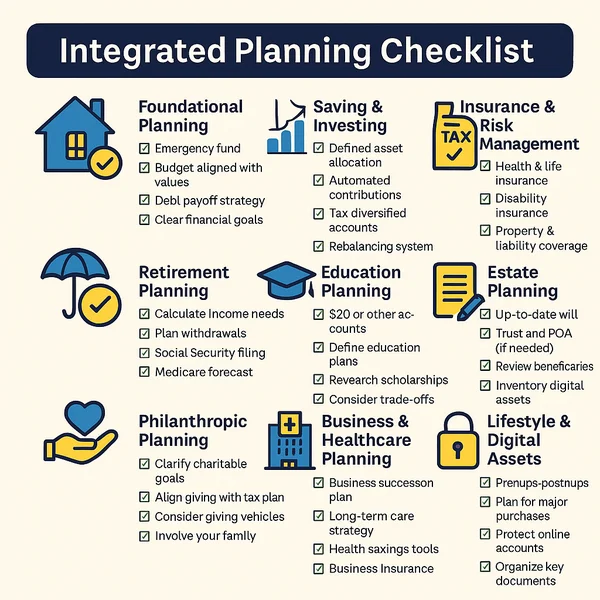
Integrated Financial Planning Checklist
A comprehensive financial plan works best when every part of your financial life is connected. The Integrated Financial Planning Checklist helps you bring everything together into one structured system.
🧠 How to Use It
- Work through your financial plan step-by-step
- Use it alongside each phase of the roadmap
- Identify what’s complete and what needs attention
- Revisit regularly as your finances evolve
This checklist is not a one-time exercise—it’s a living framework that grows with you.
🎯 Why It Matters
Most financial mistakes don’t come from lack of effort—they come from lack of structure.
This checklist helps you:
- Avoid missing critical areas of your financial plan
- Connect budgeting, investing, insurance, taxes, and retirement into one strategy
- Stay organized as your financial life becomes more complex
- Build confidence by following a complete, proven system
🔗 Put It All Together
When combined with the Financial Planning Roadmap, this checklist turns planning into execution.
👉 Start with your current phase
👉 Follow the Integrated checklist step-by-step
👉 Revisit and refine over time
🔗 10. Explore Each Step in Detail -Full Financial Planning Series
A comprehensive financial plan is built step-by-step. Each of the topics below expands on a key part of the Financial Planning Roadmap, giving you deeper guidance and actionable strategies.
Use this section to explore each stage in detail and continue building your plan with confidence.
🔰 Why You Need a Comprehensive Financial Plan
Understand what financial planning is, what it covers, and why a holistic approach beats one-size-fits-all advice.
👉 Learn why you need comprehensive planning
📊 Assessing Your Financial Situation
Understand where you stand today by calculating your net worth, organizing your accounts, and tracking your cash flow. This step provides the clarity needed to make informed financial decisions.
👉 Read the full guide on assessing your financial situation
🎯 Setting Financial Goals
Turn your financial goals into clear, actionable steps using the SMART framework. This ensures your plan is focused, measurable, and aligned with your priorities.
👉 Learn how to set effective financial goals
💰 Emergency Fund
Build a financial safety net to protect against unexpected expenses and income disruptions. Learn how much to save and where to keep your emergency funds.
👉 Explore emergency fund strategies
💳 Debt Management
Develop a strategy to reduce and eliminate debt while maintaining a healthy credit profile. Prioritize high-interest balances and improve your financial flexibility.
👉 Master debt management strategies
🛡️ Insurance Planning
Evaluate your risk exposure and build a protection strategy that includes life, disability, property, and liability coverage.
👉 Plan your insurance coverage
📈 Investment Planning
Learn how to invest with purpose using asset allocation, risk tolerance, and long-term strategies designed for growth.
👉 Start building your investment strategy
🧾 Tax Planning
Reduce your tax burden through strategic planning, tax-advantaged accounts, and efficient financial decisions.
👉 Optimize your tax strategy
🕰️ Retirement Planning
Define your retirement goals, calculate your savings needs, and build a sustainable income strategy for the future.
👉 Plan for retirement with confidence
🏡 Estate Planning
Protect your assets and ensure your wishes are carried out through wills, trusts, and proper beneficiary designations.
👉 Secure your estate plan
🎓 Education Planning
Plan for future education costs using tools like 529 plans and savings strategies that reduce financial stress over time.
👉 Explore education planning strategies
💪 Philanthropy
Align your financial plan with your values through charitable giving strategies and legacy-focused planning.
👉 Give with purpose
🏢 Business & Healthcare Planning
Prepare for business transitions, healthcare costs, and long-term care needs to protect your financial future.
👉 Plan for business and healthcare needs
🧬 Lifestyle & Digital Assets
Account for life transitions and protect your digital footprint, including online accounts, intellectual property, and personal data.
👉 Plan for lifestyle and digital assets
♻️ Review & Adjustment
Keep your financial plan up to date with regular reviews and adjustments as your life and goals evolve.
👉 Learn how to review and adjust your plan
🛍️Bringing It All Together
How to integrate each area into a single, customized plan — and sustain it with confidence over time.
🔗Read the Post →
🧭 Keep Building Your Plan
Each step builds on the last. As you explore these guides, you’ll strengthen your financial plan and move closer to long-term clarity, control, and confidence.
11. 🧩 Expand Your Financial Knowledge
Dive deeper into key financial planning topics and strengthen your strategy with these related guides.
-
Integrated Financial Planning Checklist – Bringing It All Together
🧭 Bringing It All Together Integrated planning isn’t just about checking off boxes—it’s about ensuring your entire financial life functions as a unified, strategic system. This post transforms our checklist into a living, breathing guide to managing your finances holistically. Whether you’re just getting started or fine-tuning an existing plan, here’s how to build, maintain, […]
-
How to Build an Integrated Financial Plan – Bringing All the Pieces Together
Introduction Financial planning is often described in terms of individual components — budgeting, saving, investing, insurance, retirement, taxes, and estate documents. But the real power of financial planning doesn’t come from managing these areas separately. It comes from understanding how they work together. True financial confidence emerges when your decisions are connected to your values, […]
-
Regular Review and Adjustment – Keep Your Financial Plan Agile and Aligned
♻️ Keep Your Financial Plan Agile and Aligned Financial planning is not a one-time event—it’s a lifelong process. As your circumstances, goals, and market conditions change, so too should your financial plan. A proactive approach that incorporates regular reviews and thoughtful adjustments ensures your strategies remain effective and aligned with your values. 📅 1. Set […]
-
Lifestyle and Digital Assets Planning: From Prenups to Passwords
🏡 From Prenups to Passwords As our lives evolve through marriage, career changes, homeownership, and increased digital integration, it’s no longer enough to plan just for retirement or emergencies. You must also plan for your lifestyle goals and the growing list of digital assets you manage. This guide walks you through how to protect what […]
-
Business and Healthcare Planning: Secure Your Health, Wealth, and Legacy
5 Key Takeaways 🏥 Secure Your Health, Wealth, and Legacy Business succession and healthcare planning are often overlooked until it’s too late. But for self-employed individuals, small business owners, and those approaching retirement, combining these two strategies is essential. By proactively planning for healthcare expenses and business transitions, you not only safeguard your financial independence […]
-
Philanthropic Planning – Give with Purpose, Leave a Legacy
💪 Philanthropic Planning: Give with Purpose, Leave a Legacy Philanthropic planning goes beyond writing a check to your favorite cause. It’s about aligning your values, maximizing your impact, and creating a lasting legacy that reflects what matters most to you. Whether you want to give during your lifetime or as part of your estate plan, […]


🧠 12. Frequently Asked Questions
What is included in a financial plan?
A financial plan includes budgeting, saving, investing, insurance planning, tax strategy, retirement planning, and estate planning. These components work together to support both short-term stability and long-term financial goals.
How often should you update a financial plan?
You should review your financial plan at least once a year and update it whenever you experience major life changes, such as a new job, marriage, home purchase, or significant income shift.
What is the first step in financial planning?
The first step is assessing your current financial situation. This includes understanding your income, expenses, assets, liabilities, and overall net worth to establish a clear starting point.
Do I need a financial advisor?
No, many people can successfully build and manage their own financial plan using structured tools and reliable resources. However, a financial advisor can be helpful for complex situations or personalized guidance.
How long does it take to build a financial plan?
You can create a basic financial plan in a few hours, but building a comprehensive and effective plan is an ongoing process that evolves over time as your goals and financial situation change.
Can I create a financial plan on my own?
Yes, with the right structure and tools, most individuals can build a strong financial plan independently. The key is following a clear roadmap and consistently applying sound financial principles.
🏁 13. Conclusion
Financial planning isn’t something you complete once—it’s a system you build, refine, and improve over time.
The goal isn’t perfection. It’s progress.
You don’t need everything figured out today. What matters most is getting started and building momentum:
- Start with where you are
- Focus on one phase at a time
- Take consistent, intentional action
Over time, those small steps compound into something far more powerful: clarity, control, and long-term financial confidence.
🚀 Take the First Step
You now have the framework. The tools are available. The next move is yours.
👉 Start building your financial education today
🧭 Guided Financial Planning Paths
Begin with a structured path designed to help you take action and move forward with clarity.
🗺️ Financial Planning Roadmap
Follow a complete framework that guides each stage of financial stability and growth.
→ View the Roadmap
🧾 Tax Planning Roadmap
Learn how to reduce tax impact and improve long-term financial efficiency.
→ Start The Tax Planning Roadmap
🛡️ Life Insurance Planning Hub
Explore key insurance strategies to protect your income, family, and long-term financial plan.
👉 → Start the Life Insurance Path
🔗 Continue Your Financial Learning
Strengthen your plan by exploring these core areas of personal finance.
🧱 Mortgages & Homeownership
Understand mortgage options, prepare for a down payment, and evaluate housing affordability.
→ Explore Mortgages & Homeownership
🎥 Content Creators & Digital Earners
Manage irregular income, plan for taxes, and build sustainable financial systems as an independent creator.
→ Explore the Creator Hub
🎓 College Planning
Navigate tuition costs, financial aid, scholarships, and long-term education funding strategies.
→ Explore the College Planning Hub
🏈 Financial Planning for College Athletes (NIL)
Understand the financial opportunities and responsibilities tied to Name, Image, and Likeness income.
→ Explore the NIL Planning Hub
💼 Career & Income Growth
Increase your earning potential through career development, negotiation strategies, and income diversification.
→ Explore the Career Hub
Looking for strategies tailored to your situation? Explore more targeted financial resources.
About the Author — Jason Bryan Ball
Financial Educator | Founder of Jason’s Fin Tips
Read more about Jason Bryan Ball →