
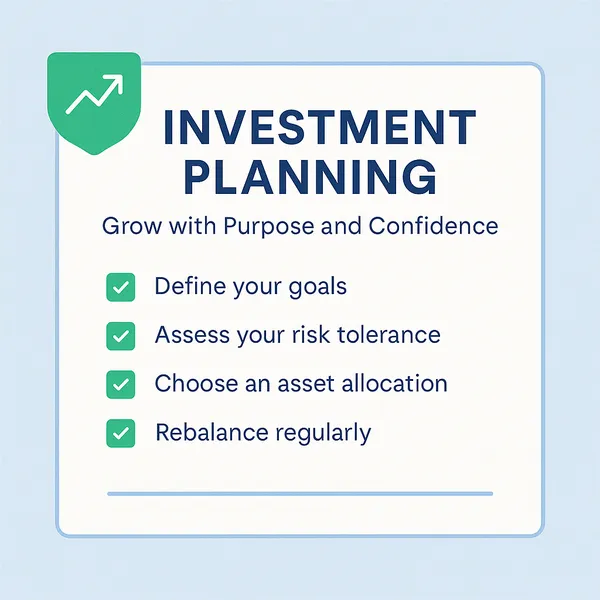
📊 Grow with Purpose and Confidence
Investing isn’t just about chasing returns. It’s about building a strategy that aligns with your goals, timeline, and tolerance for risk. Whether you’re new to investing or fine-tuning a portfolio, this guide walks you through the foundational pillars of a strong investment plan.
🌍 Why Investment Planning Matters
Investing is how you build wealth beyond what saving alone can do. While saving keeps your money safe, investing helps it grow. A sound investment plan gives you direction, confidence, and a way to turn today’s income into tomorrow’s freedom.
🧱 1. Understanding Your Risk Tolerance
Risk tolerance is your emotional and financial ability to handle losses in the market. It impacts every investment decision you make.
Key Factors:
- Age and time horizon
- Income stability and savings cushion
- Comfort with volatility
- Financial goals and urgency
Quick Self-Assessment:
- How would you feel if your investments dropped 20% next month?
- Are you investing for retirement 30 years away or a home in 2 years?
- Could you sleep at night during a market downturn?
📊 2. Asset Allocation Basics
Asset allocation is how you divide your investments across categories like stocks, bonds, and cash. This mix influences more than 90% of your portfolio’s performance.
| Risk Profile | Stocks | Bonds | Cash | Alternatives |
|---|---|---|---|---|
| Conservative | 30% | 50% | 20% | 0% |
| Balanced | 60% | 30% | 5% | 5% |
| Aggressive | 80% | 15% | 0% | 5% |
Diversifying your assets helps reduce risk without sacrificing potential returns.
🧰 Portfolio Building Blocks
| Asset Class | Example Instruments |
| U.S. Stocks | S&P 500 Index Funds (e.g., VFIAX, FXAIX) |
| Bonds | U.S. Treasury Bonds, Bond ETFs (e.g., BND) |
| Cash | High-Yield Savings, CDs, Treasury Bills |
| Real Estate | REIT ETFs (e.g., VNQ) |
| International | Total International Index Funds (e.g., VXUS) |
⏳ Goal-Based Investment Timeline Matrix
| Goal Type | Time Horizon | Suggested Asset Mix (Example) | Notes |
| Emergency Fund | 0–1 years | 100% cash | Prioritize liquidity and safety |
| Short-Term Goal | 1–3 years | 20% stocks / 80% bonds/cash | Conservative mix to limit volatility |
| Medium-Term Goal | 3–10 years | 60% stocks / 40% bonds | Moderate mix balances growth and stability |
| Long-Term Goal | 10+ years | 80% stocks / 20% bonds | Aggressive mix for maximum long-term growth |
| Retirement (30+ yrs) | Life-long | Varies over time | Shift allocation as retirement approaches (glidepath) |
🏦 3. Choosing the Right Account Types
Where you invest is just as important as what you invest in. Account types determine your tax benefits and access.
| Account Type | Tax Status | Contribution Limit | Early Withdrawal Rules | Best For |
| Roth IRA | Tax-free growth | $7,000 (2025) | No tax on qualified withdrawals | Young investors, low-tax years |
| 401(k) | Pre-tax | $23,000 (2025) | Penalty if withdrawn before 59½ | Employees with employer match |
| Brokerage | Taxable | No limit | No penalty, but gains are taxed | Flexibility and access |
Use a combination of tax-deferred, tax-free, and taxable accounts to gain flexibility in retirement.
🧭 Investor Personas
| Persona | Key Traits | Strategy Focus |
| The Starter | New to investing, limited funds | Roth IRA, target-date funds |
| The Builder | Stable income, focused on retirement | 401(k) + Roth, diversified ETFs |
| The Side-Gigger | Variable income, needs flexibility | Brokerage accounts, automation |
| The Legacy Planner | Thinking about heirs and tax efficiency | Trusts, stepped-up basis investments |
💼 Tax Efficiency of Investment Account Types
| Investment Type | Tax-Deferred Account | Roth Account | Taxable Account |
| Stocks (Growth) | Taxed on withdrawal | Tax-free growth | Taxed on capital gains |
| Bonds (Interest) | Taxed on withdrawal | Tax-free interest | Taxed as ordinary income |
| REITs | Taxed on withdrawal | Tax-free if qualified | Taxed as ordinary income |
| Mutual Funds | Taxed on withdrawal | Tax-free if qualified | Taxed on distributions |
| ETFs | Taxed on withdrawal | Tax-free if qualified | Tax-efficient |
Note: Use tax-efficient investments in taxable accounts and place income-generating assets in tax-advantaged accounts.
🌟 4. Investing with Purpose
Tie your investments to real goals:
- Retirement
- College savings
- Buying a home
- Launching a business
Key tip: Match your timeline to your strategy. Don’t invest money in stocks that you’ll need within the next 3 years.
📄 Creating Your Invest📄 Creating Your Investment Policy Statement (IPS)
An Investment Policy Statement (IPS) is your personal roadmap for investing—documenting your goals, strategies, and rules for making decisions under pressure. It helps keep you disciplined, especially when markets get volatile or life circumstances change.
“If your portfolio is your engine, the IPS is your GPS.”
🧭 What Is an IPS?
An IPS is a written guide that outlines:
- Your financial goals
- Risk tolerance and time horizon
- Asset allocation strategy
- Account types and tax considerations
- Rebalancing schedule
- Behavioral guardrails to avoid emotional mistakes
It’s not legally binding, but it’s a powerful behavioral anchor.
✍️ Sample IPS Template
You don’t need a financial advisor to build one. Here’s a simplified structure you can copy into a Google Doc or notebook:
| Section | Sample Entry |
|---|---|
| 1. Objectives | “Accumulate $1.2M by age 60 for retirement. Save $20,000 for a home down payment by 2029.” |
| 2. Time Horizon | “Primary investment horizon is 25 years. Short-term goal is 5 years.” |
| 3. Risk Tolerance | “Moderate. Can tolerate a 15–20% decline without selling. Prefer diversified index funds.” |
| 4. Asset Allocation | “70% stocks, 25% bonds, 5% cash. Rebalance annually.” |
| 5. Account Strategy | “Max Roth IRA, invest excess in taxable brokerage. Utilize 401(k) match.” |
| 6. Behavioral Triggers | “Will not make changes due to market news alone. Pause 24 hours before selling anything.” |
| 7. Review Plan | “Revisit allocation and goals every January or after major life events.” |
🔒 Why It Matters
Having an IPS:
- Reduces the temptation to react emotionally to market swings
- Helps family members or partners stay on the same page
- Creates consistency even if your income or job situation changes
- Serves as a foundation if you later work with an advisor or robo-platform
🧪 Scenario Examples Turning Strategy into Action
Abstract investment strategies are helpful—but real-life examples make them stick. Below are a few practical scenarios showing how investors tailor their approach based on goals, timelines, and personality.
🏡 Jamie (Age 27): First-Time Homebuyer + Long-Term Retirement Saver
Goals:
- Buy a home in 5 years
- Retire at age 65
- Maintain flexibility in case of a career change
Strategy Breakdown:
- Short-Term Goal (Home): Jamie allocates $20,000 into a 5-year bond ladder, investing in a mix of U.S. Treasury notes and high-quality corporate bonds that mature annually. This ensures a reliable and low-risk stream of funds to coincide with her projected home purchase.
- Long-Term Goal (Retirement): Jamie contributes $500/month to a Roth IRA, invested in an 80/20 stock/bond allocation using low-cost index funds. Because she’s young, she prioritizes growth with a tilt toward U.S. and global equities.
- Why it works: The plan balances short-term certainty with long-term growth, using tax-advantaged accounts for efficiency and minimizing emotional stress from market volatility.
🎓 Carlos (Age 35): Parent Saving for College + Building Retirement
Goals:
- Save $100,000 for his daughter’s college in 10 years
- Retire at 65 with a stable income stream
Strategy Breakdown:
- College Savings: Carlos uses a 529 Plan, contributing $400/month, primarily invested in a moderate 60/40 target-date portfolio aligned with his daughter’s graduation year.
- Retirement: He maximizes his 401(k) contributions through work, investing aggressively in a target-date fund for 2055 with automatic rebalancing.
- Why it works: The 529 offers tax-free growth for education, while the target-date funds simplify allocation management and reduce risk as retirement nears.
💼 Tanya (Age 42): Freelancer with Irregular Income
Goals:
- Build wealth for early retirement by age 58
- Maintain liquidity for potential slow months
Strategy Breakdown:
Why it works: Flexibility is key for variable income earners. Tanya prioritizes automation, liquidity, and investment diversity without overcommitting during lean months.
Emergency + Buffer: Keeps 6 months of expenses in a high-yield savings account
Investments: Contributes to a Roth IRA and a taxable brokerage account, using automated contributions when cash flow allows. Allocation is 70/30 stock/bond with some REIT exposure for diversification.
📈 5. Rebalancing & Staying on Track
As markets move, your portfolio shifts. Rebalancing resets your asset allocation to its intended mix.
When to Rebalance:
- Quarterly
- Annually
- When an asset class drifts 5%+ from target
📅 Rebalancing Decision Framework
| Scenario | Rebalance Action | Why It Matters |
| Equities grew rapidly | Sell stocks, buy bonds/cash | Reduces risk exposure |
| Bonds now overweight | Shift into higher-return assets | Restores growth orientation |
| Major life event (job, baby, etc.) | Reevaluate entire allocation | Aligns plan with new financial reality |
| Portfolio deviates 5%+ from target | Adjust back to original allocation | Maintains risk discipline |
Checklist for Rebalancing:
- Review target vs. actual allocations
- Sell overweighted assets
- Buy underweighted ones
- Avoid taxable gains where possible
Consider using target-date funds or robo-advisors to automate this process.
🧠 6. Behavioral Pitfalls to Avoid
Even seasoned investors make emotional mistakes. Stay mindful of these common traps:
- Market timing: Trying to buy low and sell high rarely works
- Recency bias: Assuming recent trends will continue
- Overconfidence: Believing you can beat the market
“The best portfolio isn’t the one that performs best on paper. It’s the one you can stick with during a storm.”
📌 FAQ Section
Q: Should I invest if I still have debt?
A: Often yes, especially if your debt has low interest and you have an emergency fund. But prioritize high-interest debt first.
Q: What if the market crashes?
A: Don’t panic sell. Stick to your plan, rebalance if needed, and stay the course.
Q: How much should I invest each month?
A: Aim for 15–20% of your income if possible. Automate to build consistency.
🛋️ 7. Tools and Resources
To build and monitor your plan:
- Use an investment policy statement (IPS)
- Try risk profiling calculators
- Explore robo-advisors for low-cost, automated management
- Track progress with apps like Personal Capital, YNAB, or Morningstar
✅ Conclusion – Build Your Plan, Adjust with Confidence
Investment planning isn’t about having a perfect portfolio. It’s about aligning your actions with your goals and staying adaptable. Start with what you know, grow as you learn, and always invest with purpose.
Action Steps:
- Complete a risk tolerance assessment
- Choose an allocation model that fits your timeline
- Open the right investment accounts
- Automate contributions and rebalancing
🧾 Investment Planning Checklist Example
✅ Define Your Goals
☐ What are your short-, medium-, and long-term financial goals?
☐ What is the time horizon for each goal?
✅ Assess Your Risk Tolerance
☐ Can you emotionally handle market volatility?
☐ Do you have a financial cushion for unexpected losses?
✅ Choose an Asset Allocation
☐ Have you selected a mix of stocks, bonds, and other assets based on your goals and comfort level?
☐ Have you reviewed a model portfolio that aligns with your risk profile?
✅ Select the Right Account Types
☐ Have you opened the proper tax-advantaged accounts (Roth IRA, 401(k), HSA, etc.)?
☐ Are your accounts diversified across tax-deferred, taxable, and tax-free?
✅ Build a Portfolio
☐ Did you select low-cost, diversified index funds or ETFs?
☐ Have you included exposure to U.S. stocks, bonds, international markets, and other asset classes?
✅ Automate Your Investments
☐ Have you set up recurring monthly contributions?
☐ Are you reinvesting dividends where appropriate?
✅ Rebalance Regularly
☐ Will you review your portfolio quarterly or annually?
☐ Do you have a plan for when allocations shift more than 5%?
✅ Avoid Emotional Mistakes
☐ Do you have a plan to stay the course during market downturns?
☐ Have you outlined behavioral pitfalls to avoid?
✅ Use the Right Tools
☐ Are you tracking your progress with apps or dashboards?
☐ Do you have an Investment Policy Statement (IPS) or documented plan?
✅ Commit to Review & Adjust
☐ Have you scheduled regular financial check-ins (quarterly or semi-annually)?
☐ Are you adapting as your life circumstances change?
📍 Up Next: Tax Planning: Integrate Strategy, Minimize Taxes, Maximize Wealth →
⬅️ Go Back: Insurance Planning – Protect What Matters Most
