
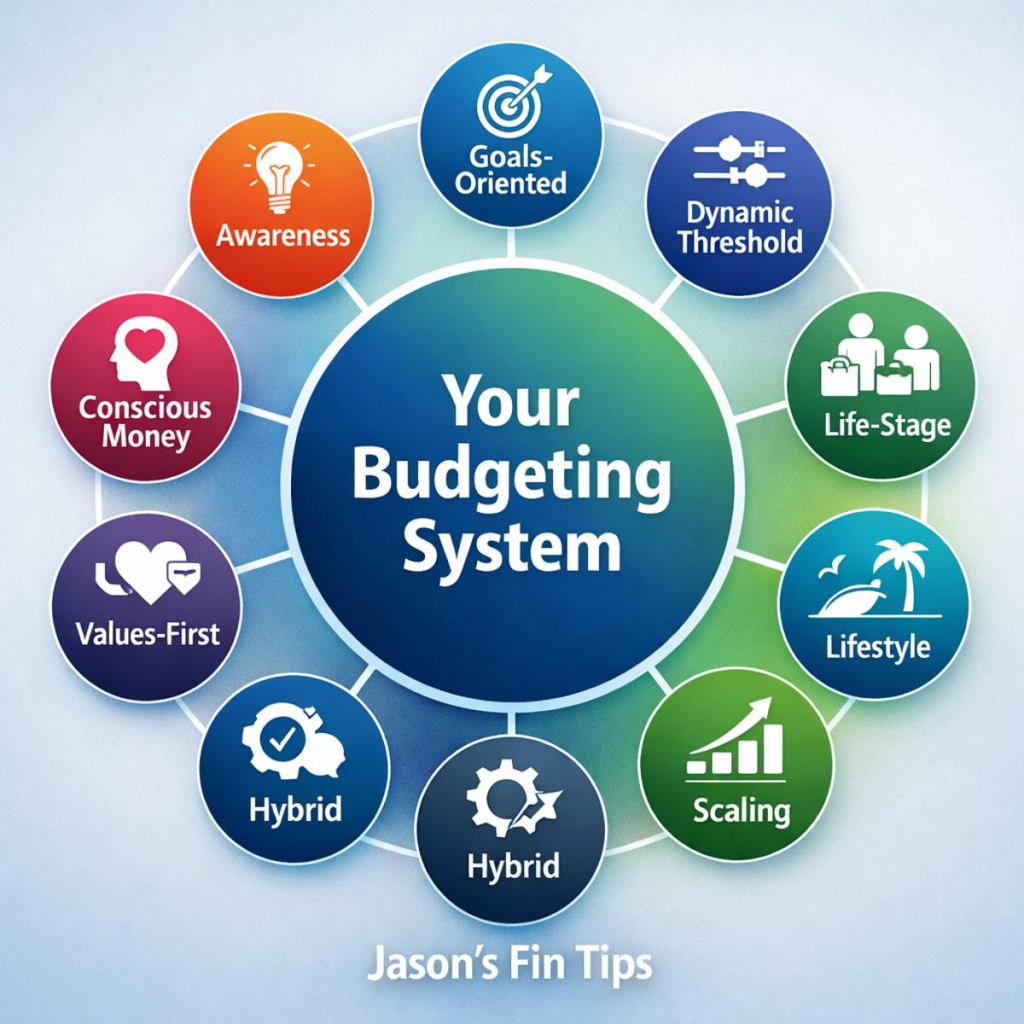
Jason’s Fin Tips Budgeting Frameworks: 10 Proven Systems to Build a Personalized Budget
💡 1. Introduction — Build a Budget That Actually Fits Your Life
There’s no single “perfect” way to budget—because there’s no single way to live.
Your income, goals, habits, and priorities are unique. A budgeting method that works for one person can feel restrictive, unrealistic, or unsustainable for another. That’s why effective budgeting isn’t about following a rigid formula—it’s about building a system that aligns with your life.
At its core, budgeting is not about restriction. It’s about direction.
A well-designed budget helps you:
- Allocate money with purpose
- Align spending with your values
- Build consistency toward your financial goals
But the key to long-term success isn’t choosing the “best” budgeting method—it’s choosing the one that fits you.
Personalization is what turns budgeting from a short-term effort into a sustainable financial habit. When your system reflects your behavior, income patterns, and priorities, it becomes easier to maintain—and far more effective over time.
Instead of forcing yourself into a one-size-fits-all approach, the goal is to adopt a framework that adapts to your life and evolves as your financial situation changes.
👉 This page introduces a structured system of budgeting frameworks designed to help you do exactly that—choose, apply, and refine a budgeting strategy that works for you.
🧭 2. The Jason’s Fin Tips Budgeting Framework System
Traditional budgeting advice often focuses on fixed methods—rules you’re expected to follow regardless of your financial reality. But real life doesn’t operate on fixed rules. Income changes. Priorities shift. Unexpected expenses happen.
That’s why the approach here is different.
The Jason’s Fin Tips Budgeting Framework System is a structured, adaptable method for managing money—built around the idea that no single budgeting style works for everyone. Instead of prescribing one solution, it provides a set of frameworks that allow you to choose—and evolve—your approach over time.
Each framework represents a distinct way to organize your finances based on:
- Your goals
- Your income stability
- Your lifestyle and values
- Your level of financial awareness
Rather than locking you into a rigid structure, this system allows you to:
- Start with a framework that fits your current situation
- Adjust as your income, goals, and responsibilities change
- Combine elements from multiple frameworks to create a personalized system
Key Principles of the Framework System:
- Not rigid rules — flexible systems
Each framework provides guidance without forcing a one-size-fits-all structure. - Designed for real-world behavior
These approaches account for how people actually earn, spend, and make decisions—not just ideal scenarios. - Built for long-term evolution
Your budgeting system should grow with you, adapting to new goals, income levels, and life stages.
This is not about finding a perfect budget.
It’s about building a financial system that works now—and continues to work as your life evolves.
🧠 3. Why Traditional Budgeting Advice Falls Short
Most budgeting advice is built around a simple assumption:
If you follow the right method, your finances will fall into place.
In reality, it’s not that simple.
Traditional budgeting approaches often fail because they overlook the complexity of real financial lives. They tend to focus on structure without considering behavior, income variability, and changing priorities.
1. The One-Size-Fits-All Problem
Many budgeting methods are presented as universal solutions. But a system designed for someone with a stable salary may not work for a freelancer, business owner, or anyone with irregular income. Without flexibility, even well-designed budgets can break down.
2. Behavioral Differences
Two people with identical incomes can have completely different financial outcomes. Why? Because budgeting isn’t just mathematical—it’s behavioral.
Some individuals thrive with detailed tracking and structure. Others need simplicity and flexibility to stay consistent. A budgeting system that doesn’t align with your natural tendencies is difficult to maintain long term.
3. Income Variability
Traditional budgeting assumes predictable cash flow. But many people today earn through variable income streams—freelance work, commissions, or seasonal income.
Without an adaptable system, income fluctuations can disrupt even the most carefully planned budget.
4. Life-Stage Shifts
Your financial priorities change over time. Early career goals look very different from those of a growing family or someone approaching retirement.
A static budgeting method doesn’t account for these transitions. A flexible framework does.
🔑 The Bottom Line
Budgeting doesn’t fail because people lack discipline.
It fails because the system doesn’t fit the person.
That’s why a framework-based approach—one that adapts to behavior, income, and life stage—is far more effective for building long-term financial stability.
📊 4. Overview Table — Budgeting Frameworks at a Glance
Before diving deeper, use this table as a quick reference to understand how each budgeting framework works and who it’s best suited for. This overview is designed to help you quickly identify which approaches may align with your financial situation and goals.
| Framework | Core Focus | Best For | Primary Benefit | Challenge |
|---|---|---|---|---|
| Goals-Oriented Budget™ | Achievement & clarity | Goal-driven planners | Tracks measurable progress | Can feel rigid |
| Dynamic Threshold Budgeting™ | Flexibility & control | Variable income earners | Adapts to income changes | Requires active tracking |
| Life-Stage Budgeting™ | Adaptability | Families & professionals | Evolves with life changes | Needs regular updates |
| Lifestyle Budgeting™ | Balance & enjoyment | Purpose-driven individuals | Aligns spending with lifestyle | Risk of overspending |
| Freedom Budget™ | Autonomy & independence | Long-term planners | Encourages financial freedom | Requires discipline |
| Conscious Money Budget™ | Mindfulness | Reflective spenders | Builds awareness and intention | Slower progress initially |
| Scaling Budget™ | Growth & expansion | High earners & entrepreneurs | Prevents lifestyle inflation | Requires recalibration |
| Hybrid Budgeting™ | Personalization | Experienced planners | Combines multiple strategies | Can become complex |
| Values-First Budgeting™ | Meaning & purpose | Values-driven individuals | Aligns money with priorities | Requires introspection |
| Awareness Budgeting™ | Self-understanding | Beginners | Builds foundational habits | Limited early structure |
🧭 5. How to Choose the Right Budgeting Framework
Choosing the right budgeting framework isn’t about finding the “best” method—it’s about finding the one that fits your financial reality, mindset, and goals.
The right system should feel sustainable, adaptable, and aligned with how you naturally manage money. Use the factors below to guide your decision.
5.1 Financial Goals
Start with clarity around what you’re trying to achieve.
- Debt-focused: Structured approaches like the Goals-Oriented Budget™ help create clear payoff plans
- Savings-focused: Systems that prioritize allocation and consistency support steady progress
- Wealth-building: Scalable frameworks like the Scaling Budget™ or Freedom Budget™ help grow long-term assets
👉 Your budget should function as a roadmap—not just a tracking tool.
5.2 Income Stability
Your income pattern plays a major role in determining the right level of structure.
- Stable income: Fixed frameworks provide consistency and automation
- Variable income: Flexible systems like Dynamic Threshold Budgeting™ adapt to fluctuations
👉 A mismatch here is one of the most common reasons budgets fail.
5.3 Lifestyle & Values
Your budget should reflect what matters most—not just what’s left over.
- Purpose-driven individuals: Values-First or Conscious Money Budget™ align spending with meaning
- Efficiency-focused individuals: Structured frameworks prioritize optimization and results
👉 When your budget aligns with your values, consistency becomes easier.
5.4 Life Stage
Financial priorities evolve over time, and your budgeting system should evolve with them.
- Early career: Focus on awareness, control, and building habits
- Mid-career / family stage: Balance growth, protection, and expenses
- Later stages: Shift toward preservation, optimization, and long-term planning
👉 A static budget won’t serve a dynamic life.
5.5 Financial Awareness Level
Your experience with money management determines how complex your system should be.
- Beginner: Start with Awareness Budgeting™ to build understanding
- Intermediate: Transition to structured approaches like Goals-Oriented or Lifestyle Budgeting™
- Advanced: Use Hybrid or Scaling strategies for optimization
👉 Mastery comes from progression—not complexity at the start.
✅ 6. Quick Start Decision Guide
If you’re unsure where to begin, use this quick guide to match your current situation with a starting framework.
| If you are… | Start with… |
|---|---|
| New to budgeting | Awareness Budgeting™ |
| Have irregular income | Dynamic Threshold Budgeting™ |
| Highly goal-driven | Goals-Oriented Budget™ |
| Want flexibility | Hybrid Budgeting™ or Lifestyle Budgeting™ |
| Focused on values and purpose | Values-First Budgeting™ |
| Scaling income or growing wealth | Scaling Budget™ |
👉 You don’t need to choose perfectly—you just need to start.
As your financial awareness grows, your system can evolve with you.
🧩 7. The 10 Budgeting Frameworks
Each framework below represents a distinct approach to managing money. These are not rigid systems—they are flexible structures designed to help you align your finances with your goals, income, and lifestyle.
Use this section to explore your options. Then dive deeper into the frameworks that best fit your needs.
1. Goals-Oriented Budget™ Framework
Focus: Achievement and measurable progress
Best For: Goal-driven planners
Core Principle: Structure drives accountability
This framework aligns every dollar with a specific financial goal—whether it’s paying off debt, building an emergency fund, or investing for the future. Instead of tracking expenses in isolation, each category is tied directly to progress.
At a high level, you define clear objectives, assign money intentionally, and monitor progress consistently. This creates visibility and motivation, helping you stay focused on outcomes rather than just spending behavior.
It’s particularly effective for individuals who are motivated by milestones and measurable success. However, it can feel restrictive if too detailed, so periodic adjustments are important.
👉 Read the full guide: Goals-Oriented Budget™ Framework
2. Dynamic Threshold Budgeting™ Framework
Focus: Flexibility and income-based control
Best For: Freelancers and variable income earners
Core Principle: Adaptability creates stability
Dynamic Threshold Budgeting™ adjusts your spending and saving targets based on your income fluctuations. Instead of fixed allocations, it uses thresholds—minimum and maximum levels—to maintain balance.
This approach protects essential expenses and savings even when income varies. During higher-income periods, you can scale contributions. During lower-income periods, the system adjusts to preserve stability.
It’s ideal for those with inconsistent cash flow, but it requires regular tracking and awareness to function effectively.
👉 Read the full guide: Dynamic Threshold Budgeting™ Framework
3. Life-Stage Budgeting™ Framework
Focus: Adaptability across life phases
Best For: Individuals navigating major transitions
Core Principle: Your budget evolves with your life
Life-Stage Budgeting™ aligns your financial priorities with your current phase of life—whether that’s early career, family building, or retirement planning.
Instead of using a static structure, this framework shifts focus over time. For example, early stages emphasize cash flow and debt management, while later stages prioritize investing and wealth preservation.
It’s particularly valuable for long-term planning, but requires periodic review to stay aligned with changing priorities.
👉 Read the full guide: Life-Stage Budgeting™ Framework
4. Lifestyle Budgeting™ Framework
Focus: Balance between enjoyment and responsibility
Best For: Individuals seeking fulfillment and flexibility
Core Principle: Spend intentionally on what matters
Lifestyle Budgeting™ prioritizes alignment between spending and personal satisfaction. Instead of focusing solely on restriction, it encourages intentional trade-offs.
You allocate money toward what brings the most value—while still maintaining financial stability. This approach helps reduce guilt and increase consistency.
However, without clear boundaries, there’s a risk of overspending. Discipline and awareness are key.
👉 Read the full guide: Lifestyle Budgeting™ Framework
5. Freedom Budget™ Framework
Focus: Financial independence and autonomy
Best For: Long-term planners and independence seekers
Core Principle: Structure creates freedom
The Freedom Budget™ is designed to reduce financial stress and increase autonomy by prioritizing savings, debt reduction, and automation.
It simplifies decision-making by focusing on key categories and long-term outcomes. Over time, this creates more flexibility and control over your financial future.
It requires consistency and discipline, but the payoff is increased financial independence.
👉 Read the full guide: Freedom Budget™ Framework
6. Conscious Money Budget™ Framework
Focus: Mindfulness and awareness
Best For: Reflective individuals
Core Principle: Awareness drives better decisions
This framework emphasizes understanding your financial behavior—not just tracking numbers. It connects spending to emotions, habits, and values.
By increasing awareness, it helps you make more intentional decisions over time. It’s particularly useful for those who want to improve their relationship with money.
Progress may feel slower initially, but it builds strong long-term habits.
👉 Read the full guide: Conscious Money Budget™ Framework
7. Scaling Budget™ Framework
Focus: Growth and wealth expansion
Best For: Professionals and entrepreneurs
Core Principle: Control growth to build wealth
The Scaling Budget™ adjusts your financial structure as your income increases. Instead of allowing lifestyle inflation, it directs additional income toward savings and investments.
This ensures that financial progress accelerates as earnings grow. It’s especially effective for high-income earners or those with increasing income streams.
However, it requires intentional planning and consistent monitoring.
👉 Read the full guide: Scaling Budget™ Framework
8. Hybrid Budgeting™ Framework
Focus: Customization and flexibility
Best For: Experienced budgeters
Core Principle: Combine what works
Hybrid Budgeting™ blends multiple frameworks to create a personalized system. For example, you might combine goal tracking with flexible spending thresholds.
This allows you to tailor your system to complex financial needs and multiple priorities.
While highly effective, it can become complex without clear structure and regular review.
👉 Read the full guide: Hybrid Budgeting™ Framework
9. Values-First Budgeting™ Framework
Focus: Meaning and purpose
Best For: Purpose-driven individuals and families
Core Principle: Money follows priorities
Values-First Budgeting™ starts with what matters most—then builds your financial plan around those priorities.
Instead of allocating money after expenses, it ensures that your core values are funded first.
This creates strong alignment between your financial decisions and your long-term vision, but requires clarity and reflection.
👉 Read the full guide: Values-First Budgeting™ Framework
10. Awareness Budgeting™ Framework
Focus: Understanding and habit-building
Best For: Beginners
Core Principle: Awareness precedes control
Awareness Budgeting™ is the foundation of financial improvement. It focuses on tracking spending and understanding patterns before applying structure.
This helps you build a realistic view of your financial behavior, which is essential for long-term success.
It’s simple to start but intentionally limited in structure—making it a stepping stone to more advanced frameworks.
👉 Read the full guide: Awareness Budgeting™ Framework
🔄 8. How These Budgeting Frameworks Work Together
These frameworks are not meant to be used in isolation—and they’re not designed as permanent choices.
Your financial system should evolve as your life, income, and goals change.
Most people naturally progress through different frameworks over time.
Example Progression:
- Start: Awareness Budgeting™ (build understanding)
- Next: Goals-Oriented Budget™ (create structure and direction)
- Then: Hybrid Budgeting™ (customize your system)
- Later: Scaling Budget™ (optimize growth and wealth building)
You may also combine elements along the way. For example:
- Pair Awareness with Lifestyle Budgeting™
- Combine Goals-Oriented with Dynamic Threshold for variable income
👉 The goal is not to find one perfect system—it’s to build one that evolves with you.
⚖️ 9. Pros & Cons Comparison Table
To make a confident decision, it helps to compare how each budgeting framework performs in real-world use. The table below highlights the core strengths and potential challenges of each approach—so you can choose a system that aligns with your goals, lifestyle, and level of discipline.
| Framework | Key Strength | Primary Challenge | Best Fit |
|---|---|---|---|
| Goals-Oriented Budget™ | Clear targets and measurable progress | Can feel rigid if over-structured | Goal-driven individuals |
| Dynamic Threshold Budgeting™ | Adapts to income changes | Requires ongoing tracking | Variable income earners |
| Life-Stage Budgeting™ | Evolves with life transitions | Needs regular updates | Individuals in transition phases |
| Lifestyle Budgeting™ | Balances enjoyment and responsibility | Risk of overspending without limits | Those seeking flexibility |
| Freedom Budget™ | Encourages long-term independence | Requires discipline and consistency | Long-term planners |
| Conscious Money Budget™ | Builds awareness and intentional spending | Slower results initially | Reflective, mindful individuals |
| Scaling Budget™ | Accelerates wealth as income grows | Requires planning and recalibration | High earners and entrepreneurs |
| Hybrid Budgeting™ | Highly customizable and adaptable | Can become complex without structure | Advanced budgeters |
| Values-First Budgeting™ | Aligns money with personal priorities | Requires clarity and introspection | Purpose-driven individuals |
| Awareness Budgeting™ | Simple starting point for habit-building | Limited structure at first | Beginners |
👉 Use this table as a quick reference—but remember, the best choice depends on how well the framework fits your behavior and financial reality.
🧠 10. Common Budgeting Mistakes (And How to Avoid Them)
Even the best budgeting framework can fail if it doesn’t align with how you actually manage money. Avoiding these common mistakes can significantly improve your chances of long-term success.
1. Choosing the Wrong Structure
Many people adopt a budgeting method because it’s popular—not because it fits their situation.
- A highly structured system may overwhelm someone who prefers flexibility
- A loose system may not provide enough control for someone with debt or tight cash flow
👉 Fix: Choose a framework based on your goals, income stability, and behavior—not trends.
2. Overcomplicating the System
More detail doesn’t always mean better results.
Overly complex budgets—with too many categories, rules, or tracking requirements—can lead to burnout and inconsistency.
👉 Fix: Start simple. Build complexity only as your confidence and habits improve.
3. Ignoring Behavior and Habits
Budgeting isn’t just about numbers—it’s about behavior.
If your system doesn’t account for your spending habits, emotional triggers, or lifestyle preferences, it won’t be sustainable.
👉 Fix: Choose a framework that aligns with how you naturally make financial decisions.
4. Failing to Adapt Over Time
A budget that worked last year may not work today.
Changes in income, responsibilities, and goals require adjustments to your system. Many people fail because they try to force an outdated structure to fit a new reality.
👉 Fix: Review and adjust your budgeting framework regularly—at least quarterly or after major life changes.
🎯 Final Insight
Budgeting success isn’t about finding the perfect system.
It’s about using the right system at the right time—and being willing to evolve as your financial life changes.
❓ 11. Frequently Asked Questions About Budgeting Frameworks
What is the best budgeting method?
There is no single “best” budgeting method. The most effective approach depends on your goals, income stability, lifestyle, and financial habits. A framework that aligns with your behavior and priorities is far more sustainable than a generic method.
How do I choose a budgeting system?
Start by identifying your financial goals, income type, and personal preferences. If you’re new, begin with a simple framework like Awareness Budgeting™. As your confidence grows, you can transition to more structured or flexible systems that better match your needs.
Can I combine budgeting strategies?
Yes. Many people use a hybrid approach—combining elements from multiple frameworks. For example, you might use a Goals-Oriented Budget™ for savings while applying Dynamic Threshold Budgeting™ for variable income. The goal is to build a system that works for you.
What budget works best for irregular income?
Dynamic Threshold Budgeting™ is often the most effective for irregular income because it adjusts based on fluctuations. Hybrid approaches can also work well by combining flexibility with structure.
🎯 Final Strategic Note
These sections complete your page by:
- Reinforcing your core philosophy (system over rules)
- Driving internal linking and topical authority
- Supporting FAQ schema eligibility for rich results
- Encouraging user progression deeper into your site
🏁 Conclusion — Your Budget Is a System, Not a Rule
There’s no single budgeting method that works for everyone—and that’s exactly the point.
The most effective budget isn’t a rigid set of rules. It’s a system—one that adapts to your goals, income, and life circumstances over time.
Start simple.
Focus on consistency.
Refine as you go.
You don’t need the perfect plan on day one. You need a system you can follow, adjust, and grow with.
As your financial awareness increases, your budgeting framework can evolve—from basic tracking to structured planning, and eventually to optimization and wealth building.
👉 Explore each framework to build a personalized budgeting system that works for your life—not against it.
🔗 Continue Your Financial Journey
Budgeting is just one part of a larger financial system. To build long-term stability and growth, it’s important to connect your budgeting strategy with other key areas of personal finance.
Continue learning with these resources:
- Explore Debt Budgeting Frameworks
Discover a broader range of budgeting strategies designed for navigating debt situations - Budgeting & Money Management Hub → Build a complete system for managing cash flow and expenses
- Expense Tracking Guide → Learn how to monitor spending and identify patterns
- Financial Planning Roadmap → Create a step-by-step plan for achieving your financial goals
- Saving & Investing → Turn consistent budgeting into long-term wealth-building strategies
👉 The more these areas work together, the stronger your financial foundation becomes.