💡 Introduction — Why Financial Freedom Needs Structure
Earning more money doesn’t always mean feeling financially free. Many people bring home solid incomes yet still live paycheck to paycheck, juggling credit cards and worrying about unexpected expenses. The problem isn’t necessarily how much they earn — it’s how their money flows. Without structure, even good income can slip through the cracks.
Financial freedom isn’t about luxury or luck. It’s about control, flexibility, and peace of mind. True freedom comes from knowing your bills are covered, your savings are growing, and your lifestyle reflects your priorities — not your stress level.
That’s where the Freedom Budget™ comes in.
This system helps you spend intentionally, save consistently, and eliminate debt strategically — all without feeling deprived. It’s not a spreadsheet exercise; it’s a philosophy of financial independence that grows with you.
Created by Jason Bryan Ball, CFP®, as part of the Financial Planning Roadmap series, the Freedom Budget™ provides a step-by-step structure for turning income into opportunity — so you can live well today and still build the life you want tomorrow.
🧭 Key Takeaways — The Freedom Budget™ at a Glance
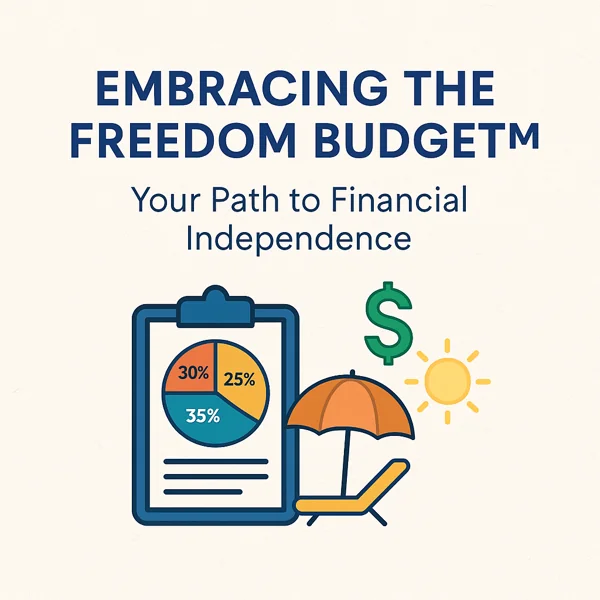
- Prioritize Debt Freedom: Dedicate around 30% of your income to paying off high-interest debt and eliminating financial drag.
- Build Sustainable Wealth: Save and invest 25% of your income to fund emergency reserves, retirement accounts, and long-term goals.
- Live Comfortably, Spend Intentionally: Use 35% of income for essentials like housing, transportation, and insurance—without inflating lifestyle costs.
- Preserve Joy and Flexibility: Keep 10% for experiences and personal fulfillment, ensuring financial discipline doesn’t come at the expense of happiness.
- Adapt with Life’s Changes: Review your Freedom Budget™ quarterly to align it with new goals, income shifts, or priorities.
- Focus on Progress, Not Perfection: Financial freedom grows through consistent action, not unrealistic restriction.
🧩 Section 1: What Is the Freedom Budget™?
Concept and Philosophy
The Freedom Budget™ is a flexible, percentage-based budgeting model designed to strike a balance between living comfortably now and building sustainable wealth for the future. Instead of restricting every dollar, it guides you to allocate your income across four key pillars — debt repayment, savings, living expenses, and lifestyle spending — in a way that reflects your values and long-term goals.
It’s not about saying “no” to what you enjoy. It’s about saying “yes” to what truly matters.
The Freedom Budget™ empowers you to spend with intention, save with purpose, and enjoy your life while moving closer to independence.
Its core philosophy is simple but powerful:
Freedom is built through structure and consistency — not chaos.
When you give every dollar a direction, you gain the ability to shape your future instead of reacting to it.
Why It’s Different from Traditional Budgeting
Most traditional budgets start with restriction: cutting expenses, tracking every coffee, and creating guilt around spending. The Freedom Budget™ takes the opposite approach.
It begins with your goals and values — using structure to enable the life you want rather than limit it.
Here’s what sets it apart:
- Purpose-driven focus: It’s not about slashing costs; it’s about aligning money with priorities.
- Proactive, not reactive: You plan for growth instead of apologizing for spending.
- Built for real life: The model adjusts naturally as your income, goals, or family situation change.
This approach turns budgeting from a burden into a tool for clarity and confidence — a framework that evolves as you do.
Who Can Benefit
The Freedom Budget™ is designed for people who want balance — not burnout. It fits seamlessly across income levels and life stages because it focuses on proportion, not perfection.
It’s especially effective for:
- Freelancers and gig workers who need flexibility to handle irregular income while still building savings.
- Families looking to balance immediate expenses with long-term financial security.
- Professionals aiming to accelerate debt payoff, invest consistently, and maintain lifestyle freedom.
Whether you’re starting out, expanding a family, or approaching retirement, the Freedom Budget™ provides a clear path to align your spending with your values — and your future with your goals.
⚙️ Section 2: How the Freedom Budget™ Works
The Freedom Budget™ isn’t about rigid rules — it’s about creating a living framework that adapts to your goals and lifestyle. By following six simple steps, you’ll learn to direct your income with purpose, eliminate unnecessary stress, and move closer to financial independence.
Step 1: Assess Your Financial Situation
Start by taking a clear, honest look at your finances. Gather the essentials:
- Net income: What you take home after taxes.
- Debt: List balances, minimum payments, and interest rates.
- Savings and investments: Emergency funds, retirement accounts, brokerage accounts.
Next, identify your financial friction points — the places where money leaks out without meaning. These could be recurring subscriptions, impulse purchases, or habits that drain progress. Awareness is the first step toward control.
A Freedom Budget™ begins with clarity, not judgment. Knowing where you stand allows you to build from a position of strength.
Step 2: Allocate Using the Freedom Budget™ Model
Once you understand your numbers, apply the Freedom Budget™ framework. This percentage-based model helps you distribute income across your financial priorities while staying flexible enough to fit your lifestyle.
| Category | Recommended Allocation | Purpose |
|---|---|---|
| Debt Repayment | 30% | Eliminate high-interest debt and free up future income |
| Savings & Investing | 25% | Build security through emergency savings, retirement funds, and long-term investments |
| Living Expenses | 35% | Cover essentials — housing, food, transportation, utilities, insurance |
| Lifestyle & Discretionary | 10% | Enjoy life intentionally — dining out, hobbies, travel, personal rewards |
These ratios aren’t fixed — they’re guidelines.
As your income grows or life circumstances change, shift your percentages to match your goals. For instance:
- Someone tackling credit card debt may temporarily raise debt repayment to 40%.
- A high-income professional may boost investments to 30–35% while trimming living expenses.
The power of the Freedom Budget™ lies in its adaptability. It moves with your financial journey.
Step 3: Track Spending and Adjust Regularly
Budgeting isn’t “set it and forget it.” Tracking helps you stay aligned — not restricted. The goal is awareness, not punishment.
Use tools that fit your comfort level:
- Digital apps: Mint, YNAB (You Need a Budget), or Empower (formerly Personal Capital).
- Spreadsheets: A custom Freedom Budget™ tracker or Google Sheets template.
- Automation: Schedule transfers for savings and debt payments to make progress effortless.
Review your spending monthly to ensure each category reflects your true priorities. Over time, this awareness becomes second nature — and that’s when freedom starts to take root.
Step 4: Prioritize Debt Repayment
Debt is the biggest obstacle to financial independence. The Freedom Budget™ dedicates up to 30% of your income to eliminating high-interest balances so your money can start working for you instead of against you.
Choose the strategy that motivates you most:
- Debt Snowball: Pay off the smallest debts first for quick wins and psychological momentum.
- Debt Avalanche: Target the highest-interest debts first to save the most money over time.
Whichever approach you use, consistency is key. As you clear debt, redirect those payments toward savings or investing — turning old burdens into new opportunities.
Step 5: Build and Maintain Savings
Saving is your bridge between survival and stability. Divide your savings into short-term protection and long-term growth:
- Short-term savings: Build an emergency fund covering 3–6 months of expenses to protect against job loss, medical bills, or major repairs.
- Long-term investing: Fund your future through IRAs, 401(k)s, Roth accounts, or brokerage portfolios.
- Mid-term goals: Save for home ownership, education, or travel — goals that enrich life while staying financially responsible.
Each dollar you save today expands your freedom tomorrow.
Step 6: Evaluate and Refine Over Time
Life changes — your budget should too. Review your Freedom Budget™ every quarter or whenever a major event occurs, such as a job change, new family member, or housing shift.
Ask yourself:
- Are my goals still aligned with my spending?
- Have my debt or savings ratios changed?
- Am I living intentionally or slipping into autopilot?
Remember: Freedom comes from adaptation, not rigidity.
A successful budget evolves with you — reflecting growth, priorities, and purpose over time.
📊 Section 3: Breaking Down the Freedom Budget™ Allocation
Understanding where your money goes is at the heart of the Freedom Budget™. This framework transforms your income into a tool for independence — giving every dollar a purpose without trapping you in rigid spending rules.
Below is a breakdown of how the Freedom Budget™ allocates your income, why each category matters, and how to tailor it to your life stage.
Freedom Budget™ Allocation Table
| Category | Recommended % | Purpose |
|---|---|---|
| Debt Repayment | 30% | Eliminate high-interest debt to remove financial drag and free up future income. |
| Savings & Investments | 25% | Build emergency reserves, retirement accounts, and long-term wealth through consistent contributions. |
| Living Expenses | 35% | Cover essential needs — housing, utilities, transportation, insurance, and groceries — without inflating lifestyle costs. |
| Lifestyle & Discretionary Spending | 10% | Preserve enjoyment and mental well-being through intentional personal spending (travel, dining, hobbies). |
This 30-25-35-10 model provides a balanced structure between security, growth, and lifestyle flexibility.
It’s not about perfection — it’s about direction.
Adjustments for Different Income Levels
Every income bracket brings unique challenges and opportunities. The Freedom Budget™ adapts easily to your circumstances so you can stay on track at any stage.
Lower-Income Earners
- Focus: Stability first. Prioritize essential living expenses and debt reduction.
- Adjustment:
- Debt Repayment: 35–40%
- Savings: Start small (5–10%) and build gradually.
- Lifestyle: Keep minimal but meaningful — even $20 for self-care counts.
- Tip: Automate transfers, even small ones. Consistency builds habits faster than large, inconsistent efforts.
Mid-Income Households
- Focus: Balance between growth and lifestyle.
- Adjustment:
- Debt Repayment: 25–30%
- Savings: 20–30%, split between emergency reserves and investments.
- Lifestyle: Maintain healthy discretionary spending to avoid burnout.
- Tip: Begin maxing out employer 401(k) matches and increase investment contributions yearly.
High-Income Professionals
- Focus: Optimize wealth-building and create passive income.
- Adjustment:
- Debt Repayment: 15–20% (if debt remains)
- Savings & Investments: 30–40% or more.
- Lifestyle: Keep below 20% to avoid lifestyle creep.
- Tip: Consider advanced strategies — brokerage diversification, tax-advantaged accounts, and real estate investments — to accelerate independence.
Interpreting the Numbers
Your Freedom Budget™ is a framework — not a formula. These percentages are meant to guide, not dictate.
Here’s how to interpret them:
- Flexibility is built in. Adjust ratios as your goals evolve — more toward savings when income rises, more toward essentials when life costs surge.
- Focus on alignment, not accuracy. The goal isn’t to hit exact percentages but to ensure your money supports your purpose.
- Track trends, not transactions. If you’re consistently overspending in one category, that’s a signal to reassess priorities — not a reason for guilt.
- Celebrate progress. Every percentage point shifted toward debt reduction or savings is a step closer to freedom.
Ultimately, your Freedom Budget™ is personalized structure with purpose. It evolves as your life changes — helping you stay grounded today while creating long-term independence tomorrow.
🌟 Section 4: Freedom Budget™ in Action — Examples
Numbers only tell part of the story. The real power of the Freedom Budget™ is how it adapts to individual lives — helping people move from financial stress to financial strength while preserving what makes life meaningful.
Below are four scenarios showing how this flexible model works in action across different life stages and goals.
Example 1: Taylor — The Young Professional Building Momentum
Profile:
Taylor, age 26, is a graphic designer earning $60,000 a year. She’s juggling student loans and rent but wants to start investing and traveling occasionally.
Challenge:
Taylor feels stuck between paying debt and enjoying her new financial independence. Each month ends with little to save — and plenty of guilt.
Freedom Budget™ Solution:
Taylor applies the 30/25/35/10 model to her take-home pay:
- 30% ($1,350) → Student loan repayment and credit card payoff
- 25% ($1,125) → Emergency fund and Roth IRA contributions
- 35% ($1,575) → Rent, transportation, and living essentials
- 10% ($450) → Travel and personal growth
Within a year, she pays down a credit card, builds a $5,000 emergency fund, and still enjoys two short trips. The structure gives her confidence and momentum — not restriction.
Lesson:
Freedom starts when you give every dollar a purpose. Even modest progress compounds quickly when guided by structure.
Example 2: Marcus & Leah — The Family Balancing Today and Tomorrow
Profile:
Marcus and Leah, both in their mid-30s, earn $110,000 combined. They’re raising two kids, saving for college, and recently bought a home.
Challenge:
They want to save more for retirement but struggle with fluctuating expenses and the feeling that “something always comes up.”
Freedom Budget™ Solution:
Using the Freedom Budget™, they reframe their spending:
- 30% → Mortgage and student loan repayments
- 25% → Savings and 529 college funds
- 35% → Living expenses (utilities, childcare, groceries)
- 10% → Family activities and date nights
By automating transfers to savings and reducing streaming subscriptions, they free up $300 monthly. Now, their budget supports both their family life and their future.
Lesson:
Financial freedom isn’t about cutting joy — it’s about organizing it. When you automate good decisions, freedom becomes sustainable.
Example 3: Dana — The Mid-Career Professional Seeking Balance
Profile:
Dana, 42, earns $90,000 as a project manager. She’s built retirement savings but struggles with burnout and wants more room for personal passions.
Challenge:
Her old “tight” budget leaves no space for creative hobbies or travel, leading to frustration and fatigue.
Freedom Budget™ Solution:
Dana reshapes her budget to match her values, not just her numbers:
- 25% → Mortgage and small personal loan
- 30% → Investments and 401(k) contributions
- 35% → Living expenses
- 10% → Art classes, weekend getaways, and experiences
By reducing overfunding in low-interest debt and adding discretionary space, she rekindles motivation and finds balance — without losing financial progress.
Lesson:
A budget that ignores joy is unsustainable. The Freedom Budget™ ensures life’s richness and security coexist.
Example 4: Eric — The Pre-Retiree Seeking Stability
Profile:
Eric, 57, earns $140,000 and hopes to retire within 10 years. He’s paid off his mortgage but wants to maximize investment growth while keeping his lifestyle steady.
Challenge:
He’s worried about market volatility and unsure how to balance investing more without losing liquidity.
Freedom Budget™ Solution:
Eric customizes his Freedom Budget™ ratios:
- 15% → Remaining debts and maintenance costs
- 40% → Retirement investments (401(k), brokerage)
- 35% → Living expenses
- 10% → Travel and hobbies
He also increases contributions to tax-advantaged accounts and sets a rebalancing schedule for his portfolio. His plan now focuses on wealth preservation and predictable cash flow.
Lesson:
Freedom at this stage comes from confidence and control. The structure transforms anxiety into a clear, actionable path toward retirement readiness.
💬 The Takeaway
The Freedom Budget™ isn’t one-size-fits-all — it’s a framework for financial alignment.
Each story shows how you can modify your ratios, reallocate priorities, and still move toward the same goal: true financial independence built on balance, intention, and adaptability.
🧾 Section 5: Freedom Budget™ Toolkit
The Freedom Budget™ Toolkit turns your plan into action. These simple, repeatable steps will help you build lasting financial freedom through structure, consistency, and awareness.
Freedom Budget™ Template
Use this four-step template to organize your income, prioritize goals, and measure progress:
- Define Your Financial Snapshot
List your total take-home pay, debts, savings, and recurring expenses. Identify financial pressure points and where adjustments can create momentum. - Apply the Freedom Budget™ Percentages
Use the 30-25-35-10 framework (Debt Repayment / Savings & Investing / Living Expenses / Lifestyle Spending) as a starting point. Adjust to fit your goals and stage of life. - Track and Review Monthly
Use a spreadsheet or budgeting app to log spending and progress. Look for trends—where are you overspending, and where are you under-funding your priorities? - Reflect and Refine Quarterly
Each quarter, revisit your ratios. Have your goals or income changed? Are you closer to debt freedom or saving milestones? Adapt as your life evolves.
How to Use This Template Effectively
- Keep categories broad. Over-categorizing leads to burnout; aim for simplicity.
- Automate progress. Schedule automatic transfers to savings and debt payments so discipline becomes effortless.
- Pair it with your “Annual Financial Review Checklist.” A yearly review reinforces accountability and ensures your Freedom Budget™ aligns with updated goals.
- Document changes. Keeping notes on what worked or didn’t builds a record of improvement—valuable for long-term planning and financial coaching.
Implementation Checklist
Before putting your Freedom Budget™ into motion, confirm these essentials:
- Identify income sources and current debt levels.
- Allocate percentages using the Freedom Budget™ model.
- Automate payments and savings contributions.
- Review your progress monthly to stay aware.
- Re-evaluate every quarter or after major life events such as job changes, marriage, or relocation.
Consistency, not perfection, drives results. The more often you review and refine, the closer you move toward genuine financial independence.
❓ Section 6: Frequently Asked Questions
How does the Freedom Budget™ differ from other budgeting methods?
Traditional budgets emphasize restriction—cutting back to survive. The Freedom Budget™ focuses on purpose—structuring money to support your values, pay down debt, and build wealth simultaneously.
Can it work for any income level?
Yes. Because it’s percentage-based, the framework scales up or down. Lower-income earners can start with smaller savings targets, while higher-income professionals can increase investment ratios for accelerated growth.
How often should I review it?
Perform a brief check each month and a deeper review every quarter. Life changes fast—your budget should evolve with it.
What if I have significant debt?
Focus first on eliminating high-interest obligations. Direct up to 40 percent of income to repayment if needed, then shift those dollars into savings once debts are cleared. Freedom begins with debt freedom.
Can I still enjoy life while following it?
Absolutely. The Freedom Budget™ protects 10 percent—or more—for meaningful, joyful spending. Intentional enjoyment prevents burnout and keeps motivation high.
How does it support long-term financial independence?
By combining disciplined savings, proactive debt reduction, and flexible spending, the Freedom Budget™ creates sustainable cash-flow control. Over time, these habits compound into true independence—where work becomes a choice, not a necessity.
Is it a replacement for traditional financial planning?
No. It’s a complementary foundation. The Freedom Budget™ handles day-to-day money management, while comprehensive financial planning addresses taxes, insurance, investments, and estate strategy. Together, they create a complete path to lifelong security and freedom.
🧠 Section 7: The Mindset That Builds Freedom
The Freedom Budget™ isn’t just a financial framework — it’s a philosophy built on values, purpose, and self-direction. True financial freedom doesn’t start in your bank account; it starts in your mindset.
Freedom grows from intentional habits and long-term thinking. It’s the quiet confidence of knowing where your money is going and why. Every decision — from paying down debt to setting aside savings — becomes a vote for your future independence.
Reframe financial discipline not as restriction, but as self-respect.
When you choose structure, you’re not limiting your options — you’re creating them. Each intentional choice opens new doors: the freedom to change careers, travel, build wealth, or simply sleep better at night.
Financial independence isn’t about perfection. It’s about progress with purpose — moving forward even when the pace is slow. When your habits align with your values, freedom follows naturally.
“The Freedom Budget™ isn’t about control — it’s about clarity.
The clearer you are about your priorities, the freer your life becomes.”
🏁 Final Thoughts — Start Living Your Freedom Budget™ Today
The Freedom Budget™ gives you the blueprint to turn financial stress into financial confidence.
It blends structure (a clear framework), flexibility (room for life’s changes), and growth (a path toward lasting independence).
Remember — financial freedom isn’t about having more.
It’s about needing less, managing well, and aligning your money with your purpose.
Start with awareness. Build consistency. Stay adaptable.
Each step you take moves you closer to a life where money supports your choices instead of dictating them.
📥 Ready to take the next step?
Download the Freedom Budget™ Template and begin your 30-day Freedom Budget™ trial today.
Test it. Track it. Feel the results of living intentionally — because the first step toward freedom is taking control of your plan.
🔗 Related Budgets
- Awareness Budgeting™
- Scaling Budget™
- Goals-Oriented Budget™
- Dynamic Threshold Budgeting™
- Life-Stage Budgeting™
- Hybrid Budgeting™
- Values-First Budgeting™
- Conscious Money Budget™
Back to Jason’s Fin Tips Budgeting Frameworks
Back to Creating A Budget