I. Introduction — Why Budgeting Requires a System
Many people want to manage their money better, but budgeting often feels overwhelming or restrictive. Some try to create a budget once or twice, only to abandon it after a few weeks when the numbers don’t seem to work or unexpected expenses appear.
The problem usually isn’t the idea of budgeting itself—it’s the lack of a clear system.
Budgeting works best when it follows a structured process. Instead of randomly adjusting spending or reacting to financial stress month by month, a structured approach helps you understand your income, control expenses, prioritize goals, and build long-term financial stability.
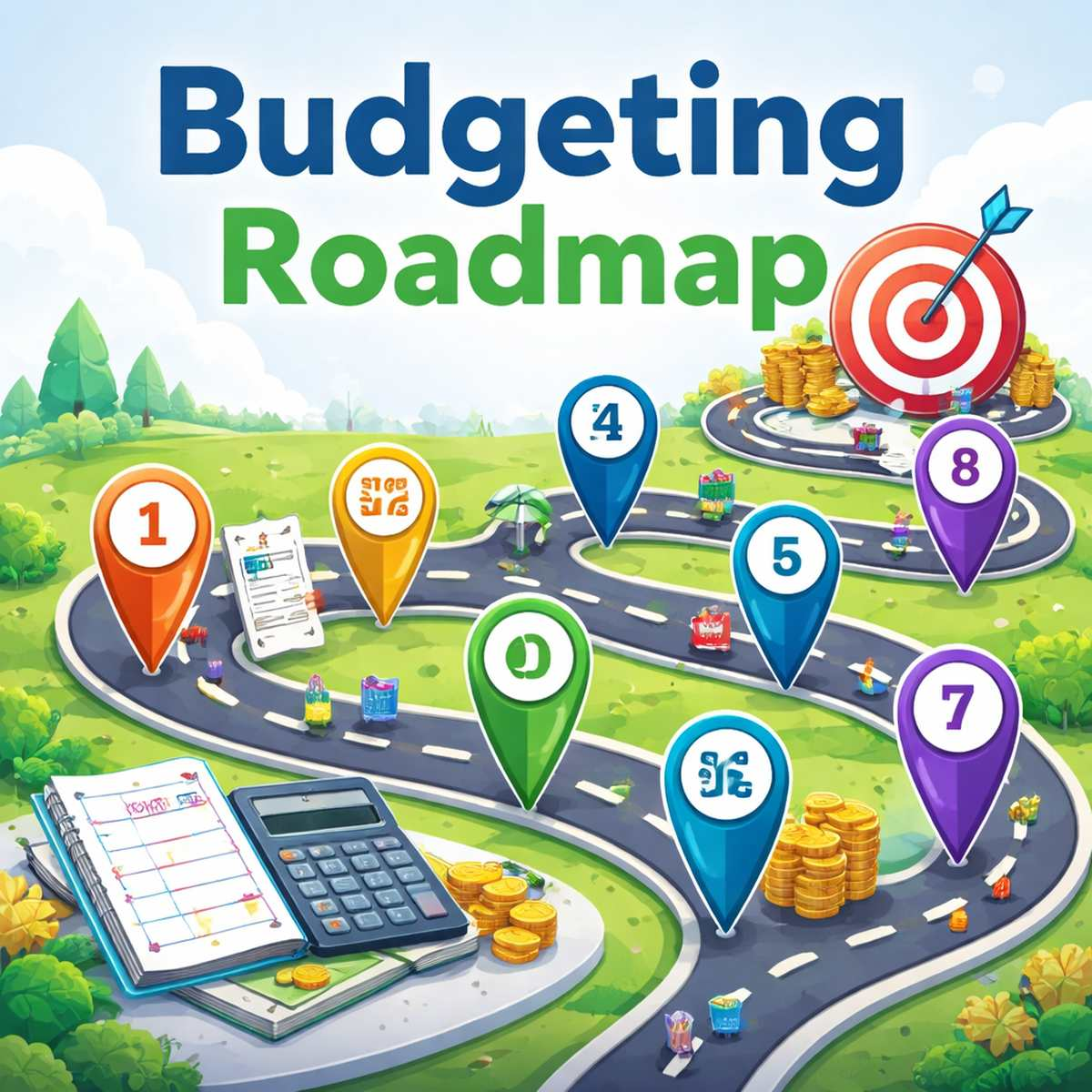
Think of budgeting as a financial roadmap rather than a rigid set of rules. A roadmap provides direction. It helps you understand where you are today, where you want to go financially, and the steps required to move forward.
When budgeting is approached systematically, it becomes easier to:
- understand where your money is going
- reduce unnecessary spending
- build consistent savings habits
- pay down debt more efficiently
- make progress toward long-term financial goals
Many successful financial plans follow a similar sequence of steps. Each step builds on the previous one, gradually improving financial clarity and control.
The budgeting roadmap outlined in this guide walks through those steps in a practical order. Whether you are creating your first budget or refining an existing one, following a structured roadmap can make managing your money far more manageable and effective.
Key Takeaways
The budgeting roadmap provides a structured process for building stronger financial habits and improving long-term financial stability. While each person’s financial situation is unique, the core principles of effective budgeting remain consistent.
Key ideas from this guide include:
- Budgeting works best when approached systematically. Following a clear sequence of steps helps simplify financial decision-making.
- Understanding income is the starting point. Accurate knowledge of monthly cash flow provides the foundation for every budgeting plan.
- Tracking and categorizing expenses reveals spending patterns. Awareness is essential for identifying opportunities to improve financial habits.
- Saving and debt management strengthen financial stability. Emergency funds and structured repayment plans protect long-term financial health.
- Financial goals give direction to budgeting decisions. Connecting everyday spending with long-term objectives makes budgeting more meaningful.
- Regular reviews help budgets remain effective. Adjusting your budget as circumstances change ensures that it continues supporting your financial priorities.
By following these principles, budgeting
II. What a Budgeting Roadmap Actually Is
A budgeting roadmap is a structured guide that outlines the key steps required to take control of your finances. Rather than focusing on a single budgeting technique or tool, a roadmap organizes the entire budgeting process into a logical sequence.
The goal is not simply to track spending, but to build a sustainable financial system that helps you manage income, control expenses, reduce debt, and make steady progress toward financial goals.
Without a roadmap, many people approach budgeting in a fragmented way. They might download a budgeting app, cut a few expenses, or try to save more money, but without a clear structure these efforts often lose momentum.
A budgeting roadmap helps solve this problem by creating a step-by-step path forward.
Instead of trying to fix everything at once, the roadmap breaks the process into manageable stages:
- Understanding how much income you actually have available each month
- Tracking expenses to identify spending patterns
- Organizing spending into meaningful categories
- choosing a budgeting system that fits your lifestyle
- building financial stability through savings
- reducing debt strategically
- setting financial goals that guide your decisions
- reviewing and improving your budget over time
Each step strengthens your financial foundation.
Over time, this structured approach turns budgeting from a stressful chore into a powerful financial habit. Rather than constantly wondering where your money went, you develop a clear understanding of your financial situation and the confidence to make informed decisions.
III. Step 1 — Understand Your Income
Every effective budget begins with a clear understanding of your income. Before you can plan how to allocate money, you need to know exactly how much money is available to work with each month.
Many budgeting mistakes happen because people base their spending plans on estimated or inconsistent income numbers. A successful budget relies on accurate information.
The most important number to focus on is your net income, which is the amount of money you receive after taxes and payroll deductions. While gross income may look impressive on paper, it does not represent the money that actually reaches your bank account.
When calculating your income for budgeting purposes, consider all consistent sources of cash flow.
Types of Income for Budget Planning
| Income Type | Description | Examples |
|---|---|---|
| Primary employment income | Regular salary or hourly wages | Employer paycheck |
| Self-employment income | Income from freelance or contract work | Consulting, freelancing |
| Side income | Secondary earnings outside primary job | Gig work, online sales |
| Passive income | Income generated from assets | Dividends, interest |
| Irregular income | Income that fluctuates month to month | Commission, seasonal work |
For individuals with stable salaries, this step may be relatively straightforward. However, people with irregular income—such as freelancers, contractors, or commission-based workers—may need to estimate their average monthly income based on several months of past earnings.
A practical approach is to review the past three to six months of income and calculate an average. This helps create a more realistic baseline for budgeting.
Understanding your income also helps reveal opportunities to improve your financial situation. As you track income sources over time, you may discover patterns that allow you to increase earnings, diversify income streams, or stabilize variable income.
Once you clearly understand how much money is available each month, you can move to the next step of the budgeting roadmap: identifying where that money is actually going.
IV. Step 2 — Track Your Expenses
Once you understand how much income you have available each month, the next step is identifying where that money actually goes. Expense tracking is one of the most important parts of building a successful budget because it reveals spending patterns that are often overlooked.
Many households underestimate how much they spend on small purchases, subscriptions, and everyday expenses. Without tracking spending, it is easy for money to disappear without a clear understanding of where it went.
Tracking expenses helps replace uncertainty with clarity.
By reviewing your spending habits, you can begin to answer important questions such as:
- How much am I spending on essential expenses each month?
- Which categories consume the largest portion of my income?
- Are there small recurring expenses that add up over time?
- Where could spending adjustments improve my financial situation?
A practical way to begin tracking expenses is to review recent financial statements. Looking at the past one to three months of bank and credit card transactions often provides a clear picture of spending patterns.
Common Expense Categories
| Expense Category | Examples |
|---|---|
| Housing | Rent, mortgage, property taxes |
| Utilities | Electricity, water, internet |
| Transportation | Fuel, car payments, insurance |
| Food | Groceries and dining out |
| Lifestyle | Entertainment, subscriptions |
| Financial obligations | Debt payments, insurance |
Expense tracking does not have to be complicated. Some people prefer spreadsheets or budgeting apps, while others simply review their bank statements each month.
The goal is not perfection—it is awareness. Once you understand how money flows through your household finances, you can begin organizing those expenses into a clear budget structure.
V. Step 3 — Categorize Your Spending
After tracking your expenses, the next step in the budgeting roadmap is organizing spending into meaningful categories. Categorizing expenses helps transform raw transaction data into a clear financial picture.
Instead of viewing spending as a long list of individual purchases, categorizing expenses allows you to see how much of your income is allocated to different areas of your financial life.
Most budgets group expenses into four primary categories.
Typical Spending Categories
| Category | Description | Examples |
|---|---|---|
| Fixed expenses | Costs that remain relatively stable each month | Rent, mortgage, insurance |
| Variable expenses | Costs that fluctuate depending on usage | Utilities, groceries |
| Discretionary spending | Lifestyle spending that can be adjusted | Dining out, entertainment |
| Savings & financial priorities | Money allocated toward financial security | Savings, investments, debt repayment |
This categorization helps reveal whether spending is aligned with financial priorities.
For example, some households discover that a significant portion of their income is going toward discretionary spending without realizing it. Others may find that fixed expenses such as housing or transportation consume more of their income than expected.
By organizing expenses into categories, you gain a clearer view of how your financial resources are distributed. This insight makes it easier to adjust spending habits and build a more balanced financial plan.
Once spending categories are established, the next step is choosing a budgeting system that helps allocate income effectively.
VI. Step 4 — Choose a Budgeting Method
With income understood and expenses categorized, the next step is selecting a budgeting method that helps manage spending and savings consistently.
A budgeting method provides a structure for deciding how income should be allocated each month. Different systems work for different financial situations, and the most effective method is the one that fits your lifestyle, financial goals, and spending habits.
Some people prefer simple rules that provide flexibility, while others benefit from detailed systems that track every dollar.
Common Budgeting Methods
| Budgeting Method | Description | Best For |
|---|---|---|
| 50/30/20 Budget | Divides income between needs, wants, and savings | Simple budgeting |
| Zero-Based Budgeting | Assigns every dollar of income a specific purpose | Detailed financial control |
| Envelope Budgeting | Uses spending limits within categories | Managing discretionary spending |
| Pay-Yourself-First | Prioritizes saving and investing before spending | Long-term wealth building |
| Automated Budgeting | Uses automatic transfers and tracking tools | Convenience and consistency |
These traditional budgeting methods provide a useful starting point. However, budgeting can also be personalized to reflect individual financial priorities, lifestyles, and long-term goals.
Personalized Budgeting Strategies
Beyond traditional budgeting frameworks, some individuals benefit from more customized approaches that align financial decisions with personal values, income patterns, or life stages.
Below are several examples of personalized budgeting strategies that can help individuals design a system that fits their financial circumstances.
| Strategy | Core Idea | Best For |
|---|---|---|
| Goals-Oriented Budget™ | Connects every dollar to a specific financial milestone | Goal-focused planners |
| Dynamic Threshold Budgeting™ | Adjusts spending targets based on income variability | Freelancers and creators |
| Life-Stage Budgeting™ | Aligns financial priorities with life transitions | Families and professionals |
| Lifestyle Budgeting™ | Balances enjoyment and financial responsibility | Intentional spenders |
| Freedom Budget™ | Focuses on financial independence and flexibility | Debt-free or FIRE-minded individuals |
| Conscious Money Budget™ | Encourages mindful and reflective spending decisions | Values-based budgeting |
| Scaling Budget™ | Increases savings as income grows | Professionals and entrepreneurs |
| Hybrid Budgeting™ | Combines multiple budgeting methods | Advanced planners |
| Values-First Budgeting™ | Allocates money according to life priorities | Purpose-driven individuals |
| Awareness Budgeting™ | Builds financial awareness through consistent tracking | Beginners developing habits |
Each framework represents a different way of organizing your finances. In practice, many people combine elements from multiple systems to create a budgeting approach that works best for them.
For a deeper explanation of these approaches, see our guide:
→ 10 Budgeting Strategies to Fit Your Lifestyle
Once you have selected a budgeting framework that fits your financial habits, the next step in the roadmap focuses on strengthening financial stability by building an emergency fund.
VII. Step 5 — Build an Emergency Fund
Once you have a budgeting method in place, the next priority is building financial stability through an emergency fund. An emergency fund acts as a financial safety net that helps protect your budget from unexpected expenses.
Life is full of financial surprises. Car repairs, medical bills, home maintenance issues, or temporary job disruptions can quickly derail a household budget. Without savings set aside for emergencies, many people are forced to rely on credit cards or high-interest loans when these situations arise.
An emergency fund helps prevent this cycle by providing readily available cash for unexpected expenses.
Most financial planners recommend building an emergency fund gradually in stages.
Emergency Fund Milestones
| Savings Target | Purpose |
|---|---|
| $500–$1,000 | Starter emergency cushion |
| 1 month of expenses | Basic financial stability |
| 3–6 months of expenses | Full emergency protection |
For many households, the first goal is simply building a starter emergency fund. Even a relatively small savings cushion can prevent minor financial setbacks from turning into larger debt problems.
Consistency is more important than speed when building an emergency fund. Setting aside a small amount each month can steadily grow savings over time without placing excessive pressure on your budget.
Once a basic emergency fund is established, the next step in the budgeting roadmap focuses on addressing one of the largest financial burdens many households face: debt.
VIII. Step 6 — Manage Debt Strategically
Debt can significantly affect financial stability, especially when high-interest balances consume a large portion of monthly income. Managing debt effectively is therefore an essential part of any budgeting strategy.
While some forms of borrowing—such as mortgages or student loans—may support long-term goals, high-interest consumer debt can quickly become a barrier to financial progress. When a large share of income goes toward interest payments, it becomes more difficult to save, invest, or pursue future opportunities.
Budgeting helps address this challenge by creating a clear repayment structure that aligns with your financial goals and behavioral preferences.
Rather than relying on a single repayment formula, many people benefit from choosing a budgeting system that fits their personality, lifestyle, and financial situation.
Below are several strategic budgeting approaches designed to support debt reduction and long-term financial stability.
Debt-Focused Budgeting Strategies
These Budgeting Systems™ provide different approaches to tackling debt while maintaining sustainable financial habits.
| Strategy | Focus | Best For |
|---|---|---|
| Expenditure Tracker™ | Track every expense to reveal spending patterns | Beginners building awareness |
| Balanced Path™ | Balance debt reduction, savings, and lifestyle priorities | Families or multi-goal households |
| EQ Planner™ | Connect emotional patterns with financial behavior | Emotional or stress-based spenders |
| Summit Strategy™ | Prioritize high-interest debt to reduce total cost | Credit card or high-rate debt |
| Plains Strategy™ | Maintain simple, consistent debt repayment | Stable income households |
| Domino Strategy™ | Eliminate debts sequentially to build momentum | Motivation-driven individuals |
Each system approaches debt management from a slightly different perspective. Some prioritize mathematical efficiency, while others focus on psychological momentum or financial awareness.
The most effective strategy is the one that you can maintain consistently over time. When combined with a structured budget, these approaches can gradually reduce debt while improving overall financial stability.
For a deeper explanation of these systems and how they work, see our guide:
→ Six Proven Budgeting Strategies for Real Financial Change
Once debt is being managed strategically, the next step in the budgeting roadmap focuses on defining the financial goals that guide your decisions.
IX. Step 7 — Set Financial Goals
A budget becomes far more meaningful when it is connected to clear financial goals. Without goals, budgeting can feel like a restrictive exercise focused only on controlling spending. With goals, budgeting becomes a tool for building the future you want.
Financial goals give direction to your financial decisions. They help determine how much you should save, how aggressively you should reduce debt, and how to prioritize competing financial demands.
Goals are often grouped into three general time horizons.
Types of Financial Goals
| Goal Horizon | Examples |
|---|---|
| Short-term (1–2 years) | Emergency fund, paying off small debts |
| Medium-term (3–10 years) | Home down payment, starting a business |
| Long-term (10+ years) | Retirement savings, financial independence |
One helpful way to define financial goals is by using the SMART framework, which encourages goals that are:
- Specific
- Measurable
- Achievable
- Relevant
- Time-bound
For example, instead of saying “I want to save more money,” a SMART goal might be:
“Save $5,000 for an emergency fund within 18 months by setting aside $300 per month.”
Clear goals make budgeting more motivating because each financial decision becomes connected to meaningful progress.
Once financial goals are established, the final step in the budgeting roadmap focuses on maintaining and improving the system over time.
X. Step 8 — Review and Adjust Your Budget Monthly
A successful budget is not something you create once and then forget about. Financial situations change over time, and your budget should evolve with them. Reviewing your budget regularly helps ensure that your spending, savings, and financial priorities remain aligned.
A monthly budget review allows you to evaluate how well your plan is working. During this review, you can compare your planned expenses with your actual spending and identify areas where adjustments may be needed.
Some questions to consider during a monthly review include:
- Did my spending stay within my planned budget categories?
- Were there unexpected expenses that affected my financial plan?
- Am I making consistent progress toward my savings or debt reduction goals?
- Are there areas where I could reduce spending or improve efficiency?
These reviews help transform budgeting from a static plan into a flexible financial management system.
Many people find it helpful to schedule a specific time each month to review their finances. This might involve reviewing bank statements, updating budgeting apps or spreadsheets, and evaluating progress toward financial goals.
Over time, regular reviews help build stronger financial awareness and confidence. As your income grows, expenses change, or financial priorities shift, your budget can be adjusted to reflect those new circumstances.
Budgeting is not about perfection—it is about continuous improvement. Even small adjustments each month can lead to meaningful long-term financial progress.
XI. Common Budgeting Mistakes to Avoid
While budgeting is a powerful financial tool, certain mistakes can make it more difficult to maintain. Recognizing these challenges in advance can help you avoid common obstacles that cause many budgets to fail.
One frequent mistake is underestimating expenses. Many people initially forget to include irregular costs such as car maintenance, annual subscriptions, or occasional travel expenses. These irregular costs can disrupt a budget if they are not planned for.
Another common issue is creating unrealistic spending limits. If a budget is too restrictive, it may become difficult to maintain over time. Successful budgets allow room for reasonable lifestyle spending while still prioritizing financial goals.
Other common budgeting mistakes include:
- ignoring small recurring expenses such as subscriptions
- failing to track spending consistently
- relying too heavily on credit to cover shortfalls
- abandoning the budget after a single setback
Budgeting works best when it is viewed as a long-term habit rather than a short-term experiment. Even if a month does not go as planned, reviewing the results and adjusting the budget can help improve the process going forward.
By recognizing these potential pitfalls, you can create a budgeting system that remains realistic, flexible, and sustainable over time.
XII. Helpful Budgeting Tools and Resources
Budgeting does not have to be complicated. A wide range of tools and resources are available to help individuals organize their finances and maintain consistent budgeting habits.
Some people prefer simple methods such as spreadsheets or written budgets, while others use digital tools designed to automate financial tracking.
Below are several common types of budgeting tools.
Common Budgeting Tools
| Tool Type | Description | Examples |
|---|---|---|
| Budgeting apps | Track spending automatically and categorize expenses | Digital finance apps |
| Spreadsheets | Customizable budgeting templates for detailed tracking | Personal spreadsheet systems |
| Expense trackers | Simple tools for recording daily spending | Manual expense logs |
| Financial dashboards | Platforms that provide a complete view of financial accounts | Account aggregation tools |
The best budgeting tool is the one that fits your preferences and encourages consistent use. Some individuals prefer automation through apps, while others feel more engaged when manually tracking spending.
Regardless of the tool you choose, the goal remains the same: building awareness of how money flows through your financial life and maintaining control over spending decisions.
Budgeting tools are most effective when combined with the structured approach outlined in this roadmap. Together, they help transform budgeting from a one-time activity into a reliable financial management system.
XIII. Budgeting Roadmap Example — Putting the System Into Practice
Understanding the budgeting roadmap conceptually is helpful, but seeing how it works in practice can make the process clearer. The following hypothetical example illustrates how a household might apply the roadmap to organize their finances.
Imagine a household with a monthly after-tax income of $5,000. After reviewing their income and tracking expenses for several months, they organize their spending into categories aligned with their financial priorities.
Example Monthly Budget Allocation
| Category | Monthly Amount | Percentage |
|---|---|---|
| Housing | $1,500 | 30% |
| Transportation | $600 | 12% |
| Food | $600 | 12% |
| Utilities & Insurance | $400 | 8% |
| Debt Payments | $500 | 10% |
| Savings & Emergency Fund | $750 | 15% |
| Lifestyle & Discretionary | $650 | 13% |
| Total | $5,000 | 100% |
Using this structure, the household can clearly see how income is distributed across essential expenses, savings goals, and discretionary spending.
Over time, the budgeting roadmap helps them:
- increase their emergency savings
- reduce outstanding debt balances
- maintain control over discretionary spending
- make steady progress toward long-term financial goals
This example highlights an important principle of budgeting: the goal is not to follow a perfect formula, but to build a system that reflects your own financial priorities and circumstances.
As income grows or financial obligations change, the budget can be adjusted while still following the same structured roadmap.
Budgeting Roadmap Summary Table
| Step | Focus | Goal |
|---|---|---|
| 1 | Understand income | Know available cash flow |
| 2 | Track expenses | Identify spending patterns |
| 3 | Categorize spending | Organize financial priorities |
| 4 | Choose budgeting method | Create spending structure |
| 5 | Build emergency fund | Increase financial stability |
| 6 | Manage debt | Reduce interest burden |
| 7 | Set financial goals | Provide financial direction |
| 8 | Review monthly | Maintain financial control |
XIV. Final Thoughts — Turning Budgeting Into a Lifelong Habit
Budgeting is not about achieving perfection. Instead, it is about building a set of financial habits that help you make better decisions over time.
Many people initially view budgeting as a short-term task designed to fix a financial problem. In reality, budgeting is most effective when it becomes an ongoing part of everyday financial life. The goal is not simply to control spending for a few months, but to create a system that supports financial stability throughout different stages of life.
As your career progresses, your income grows, and your financial priorities evolve, your budget should evolve as well. What matters most is maintaining awareness of how your money is used and ensuring that it aligns with your long-term goals.
Small improvements in financial habits—such as consistently tracking expenses, saving regularly, or reducing unnecessary spending—can produce significant results over time. These habits build the foundation for financial security, allowing you to handle unexpected challenges while still working toward future opportunities.
The budgeting roadmap outlined in this guide provides a starting point for that journey. By following these steps and adapting them to your personal circumstances, you can build a financial system that supports both your present needs and your long-term financial future.
Back to