
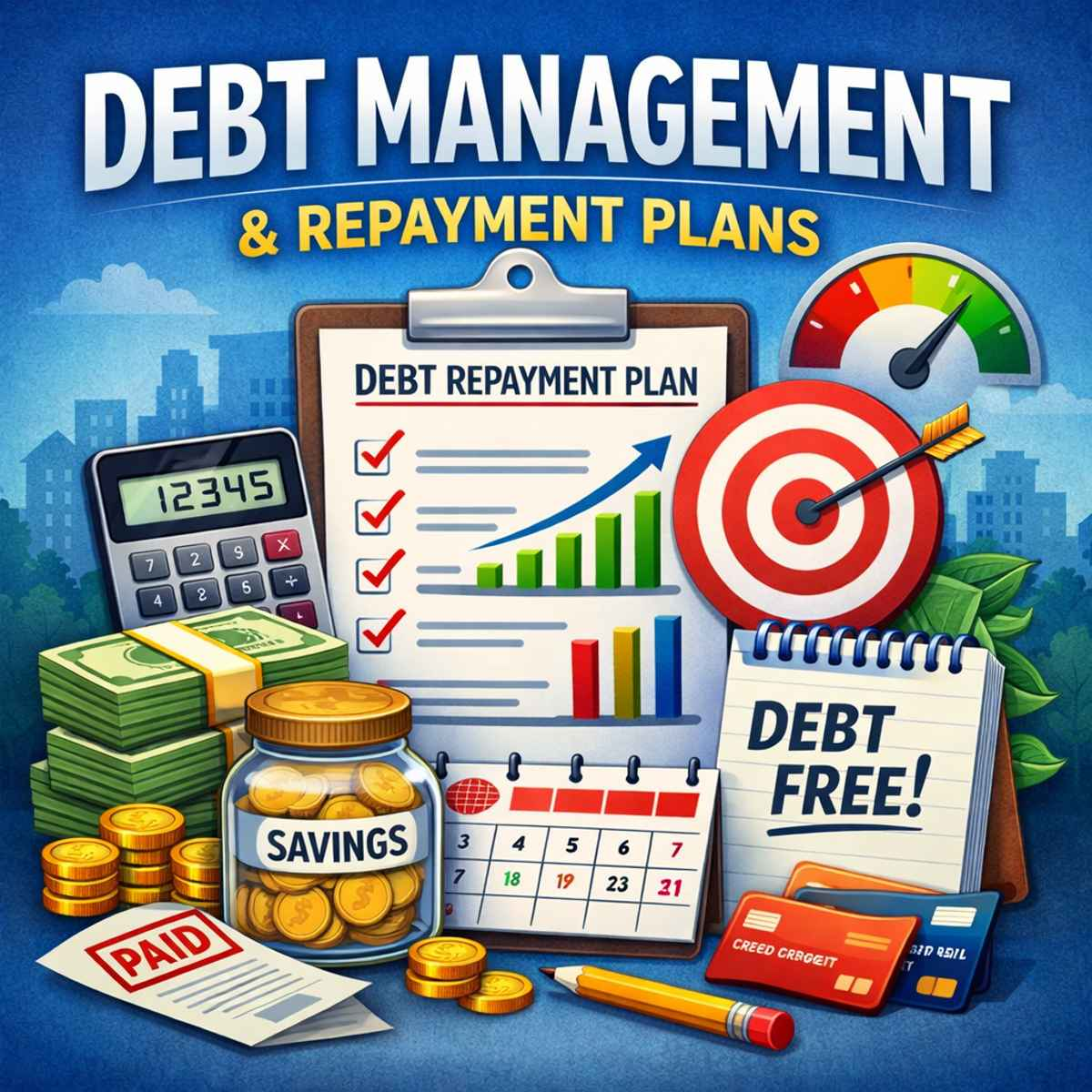
🧱 Debt Management and Repayment Plans
💰 Debt Management and Repayment Plans
Take Control of Debt and Build a Clear Path to Financial Freedom
Managing debt isn’t just about making payments—it’s about creating a system that reduces interest, improves cash flow, and supports long-term financial stability.
Whether you’re dealing with credit cards, student loans, personal loans, or other obligations, the right strategy can help you regain control and make measurable progress. This section is designed to guide you through the key concepts, strategies, and tools needed to build a personalized debt repayment plan that works within your broader financial life.
🧠 What Is Debt Management?
Debt management is the process of organizing, prioritizing, and systematically repaying your financial obligations in a way that minimizes interest costs, reduces financial risk, and aligns with your broader financial goals.
It’s not just about making minimum payments—it’s about building a clear, repeatable system that helps you take control of your money and make steady progress toward becoming debt-free.
At its core, effective debt management connects three critical elements:
- Cash flow (your income and expenses)
- Debt structure (interest rates, balances, and terms)
- Behavior (your habits, consistency, and financial decisions)
When these elements work together, debt shifts from being overwhelming to manageable and predictable.
🔍 Key Components of Effective Debt Management
1. Understand Your Debt Structure
Before you can create a plan, you need a complete picture of what you owe.
- Identify all debts (credit cards, loans, etc.)
- Separate secured vs. unsecured debt
- Note interest rates, minimum payments, and due dates
👉 Clarity is the foundation—without it, strategy is guesswork.
2. Prioritize High-Impact Debts
Not all debt carries the same cost or urgency.
- High-interest debt (like credit cards) often requires immediate focus
- Lower-interest debt (like student loans or mortgages) may allow for longer-term strategies
👉 Prioritization helps you reduce total interest and accelerate progress.
3. Choose a Repayment Strategy
A structured approach improves both efficiency and consistency.
Common strategies include:
- Debt Snowball (focus on smallest balances first)
- Debt Avalanche (focus on highest interest rates first)
- Consolidation or refinancing (simplify or lower costs)
👉 The right strategy depends on your financial situation and behavioral preferences.
4. Maintain Consistent Payments
Consistency is what turns a plan into results.
- Make at least minimum payments on all debts
- Apply extra payments strategically
- Use automation to avoid missed payments
👉 Small, consistent actions create long-term financial momentum.
5. Control New Debt Accumulation
Progress can quickly reverse if new debt is added.
- Align spending with your budget
- Build awareness of financial habits
- Avoid relying on credit for everyday expenses
👉 Debt management isn’t just repayment—it’s also prevention.
6. Integrate Your Plan Into Your Financial System
Debt repayment should not exist in isolation.
- Coordinate with your budgeting system
- Maintain a basic emergency fund
- Align repayment with long-term goals
👉 This ensures your plan is sustainable—not just temporary.
🎯 Why Debt Management Matters
Without a structured approach, debt can:
- Accumulate faster due to compounding interest
- Limit your ability to save and invest
- Increase financial stress and uncertainty
With a clear system, you can:
- Reduce interest costs over time
- Improve cash flow and flexibility
- Build confidence and financial stability
💡 Final Insight
When done correctly, debt management becomes more than a repayment plan—it becomes a financial control system.
Instead of reacting to bills, you’re making intentional decisions that move you closer to financial independence.
👉 The goal isn’t just to eliminate debt—it’s to build a system that prevents it from returning.
📊 Common Types of Debt and Their Impact
| Debt Type | Interest Level | Risk Level | Key Consideration |
|---|---|---|---|
| Credit Cards | High | Medium | Prioritize payoff quickly |
| Personal Loans | Medium | Medium | Fixed payments, structured payoff |
| Student Loans | Low–Medium | Low | Long-term strategy matters |
| Auto Loans | Medium | Medium | Depreciating asset |
| Mortgages | Low | Low | Long-term, strategic debt |
👉 Not all debt is equal—your strategy should reflect cost, risk, and timeline.
⚙️ Debt Repayment Strategies (Compare Your Options)
Choosing the right repayment method can significantly impact both your progress and motivation.
| Strategy | Best For | Key Benefit |
|---|---|---|
| Debt Snowball | Motivation-focused | Quick wins build momentum |
| Debt Avalanche | Cost-focused | Minimizes total interest paid |
| Debt Consolidation | Simplification | Combines multiple payments into one |
| Balance Transfer | Credit optimization | Temporary 0% interest periods |
👉 The best strategy is the one you can stick with consistently over time.
🧭 Debt Management Roadmap (Start Here)
If you’re unsure where to begin, follow this structured roadmap. Debt repayment isn’t a single decision—it’s a sequence of intentional steps that build on each other over time.
This roadmap breaks the process into clear phases, helping you move from financial stress and uncertainty to long-term stability and financial flexibility. Each phase has a specific focus, key actions, and a defined outcome.
🔥 Roadmap at a Glance
| Phase | Focus | Key Actions | Outcome |
|---|---|---|---|
| 1. Awareness | Understand your full debt picture | List all debts, balances, rates, and payments | Clarity |
| 2. Control | Stop new debt accumulation | Build a budget, reduce unnecessary spending | Stability |
| 3. Strategy | Choose a repayment approach | Select snowball, avalanche, or consolidation | Direction |
| 4. Execution | Consistently pay down balances | Automate payments, apply extra funds strategically | Progress |
| 5. Optimization | Reduce interest and improve efficiency | Refinance, negotiate rates, adjust strategy | Savings |
| 6. Freedom | Eliminate debt and rebuild capacity | Redirect payments to savings and investing | Financial flexibility |
🔹 Phase 1: Understand Where You Stand (Awareness)
Goal: Build clarity before taking action
Key Actions:
- List every debt (credit cards, loans, etc.)
- Identify interest rates and minimum payments
- Calculate your total debt load
👉 You can’t create an effective plan without a complete and accurate picture.
🔹 Phase 2: Stabilize Your Finances (Control)
Goal: Prevent the problem from getting worse
Key Actions:
- Create or refine your budget
- Cut unnecessary or high-impact expenses
- Avoid adding new debt
👉 Stability ensures your repayment efforts actually move you forward—not backward.
🔹 Phase 3: Choose Your Strategy (Direction)
Goal: Create a clear, intentional repayment plan
Key Actions:
- Select a payoff strategy:
- Debt Snowball (behavior-focused)
- Debt Avalanche (cost-focused)
- Evaluate consolidation or refinancing options
👉 A defined strategy removes guesswork and improves consistency.
🔹 Phase 4: Take Consistent Action (Execution)
Goal: Build momentum through disciplined repayment
Key Actions:
- Automate minimum payments
- Apply extra payments toward priority debts
- Track your progress over time
👉 Consistency—not perfection—is what drives long-term results.
🔹 Phase 5: Improve Efficiency (Optimization)
Goal: Accelerate progress and reduce total cost
Key Actions:
- Refinance or consolidate when beneficial
- Negotiate interest rates or terms
- Reallocate extra income toward debt
👉 Small optimizations can significantly reduce interest and shorten your timeline.
🔹 Phase 6: Transition to Financial Growth (Freedom)
Goal: Replace debt payments with wealth-building actions
Key Actions:
- Redirect former debt payments into savings
- Build or strengthen your emergency fund
- Begin or increase investing
👉 Becoming debt-free isn’t the end—it’s the beginning of financial expansion.
🎯 Final Insight: Debt Repayment Is a System
This roadmap transforms debt management from a reactive process into a structured, repeatable system.
Instead of feeling overwhelmed by balances and payments, you follow a clear path:
- Understand → Stabilize → Strategize → Execute → Optimize → Grow
👉 The result is not just becoming debt-free—but building a financial system that supports long-term success.
🧠 Behavioral Strategies for Debt Success
Debt repayment isn’t just math—it’s behavioral.
Common Challenges:
- Financial stress and overwhelm
- Inconsistent payment habits
- Lifestyle inflation
- Decision fatigue
What Works:
- Automating payments
- Setting clear milestones
- Tracking progress visually
- Aligning repayment with personal goals
👉 Building the right habits is what transforms short-term effort into long-term success.
🧰 Tools and Systems That Support Debt Repayment
- Budgeting systems to control cash flow
- Expense tracking tools to identify savings opportunities
- Debt payoff calculators to plan timelines
- Automation tools to ensure consistency
👉 The right tools reduce friction and help you stay on track.
📚 Explore Debt Management Topics
Dive deeper into the strategies and concepts that support effective debt repayment:
- Understanding different types of debt and their financial impact
- Prioritizing high-interest debt to reduce long-term costs
- Building a structured and realistic repayment plan
- Exploring consolidation and refinancing options
- Negotiating repayment terms with creditors
- Integrating emergency funds into your debt strategy
- Using technology and systems to stay organized
📚 Explore Debt Management Strategies and Guides
-
How to Budget for Faster Debt Repayment – Strategies to Get Out of Debt Quickly
Key Takeaways Introduction Debt can feel overwhelming, but with the right budgeting strategies, you can take control of your finances and accelerate your debt repayment. Whether you’re dealing with credit cards, student loans, or personal loans, an effective budget is the foundation of a successful debt-free plan. In this guide, we’ll walk you through step-by-step […]
-
Freelancer’s Guide to Debt Management: Strategies for Irregular Income
Key Takeaways The Debt Challenge for Freelancers The rise of the gig economy has given freelancers the freedom to work on their own terms, but with that freedom comes financial uncertainty. Unlike salaried employees, freelancers face irregular income, making it difficult to manage expenses and debt. Traditional debt repayment methods, such as fixed monthly payments, […]
-
Navigating the Emotional Journey of Debt Repayment: Coping Strategies and Practical Tips
Key Takeaways Introduction Debt can feel overwhelming, not just financially but emotionally. If you’ve ever felt stressed, ashamed, or hopeless because of your debt, you’re not alone. In today’s world, financial obligations often cast a long shadow, affecting personal well-being, relationships, and even professional productivity. This guide will help you navigate the emotional ups and […]
-
Debt Consolidation vs Refinancing – Which Saves You More Money?
5 Key Takeaways Introduction In today’s financial landscape, individuals juggling multiple debts are often faced with a critical decision: should they consolidate their debts or opt for refinancing? Understanding the nuances of each option can be the linchpin in crafting a sustainable debt management strategy. This blog post aims to demystify these two pivotal financial […]
-
Navigating High-Interest Debt – Effective Strategies for Financial Freedom
Key Takeaways Introduction High-interest debt is a growing burden for many individuals and families, often stemming from credit cards, personal loans, and payday advances. With average credit card interest rates around 20%, debt can quickly spiral out of control, hindering financial stability and future goals such as homeownership and retirement. Managing high-interest debt is essential […]
-
Credit Card Debt – Innovative Repayment Solutions
Key Takeaways Introduction In today’s financial landscape, credit card debt presents a significant challenge, often acting as a barrier to financial freedom and stability. This issue is widespread, affecting individuals across various demographics, from young adults new to credit to experienced consumers facing unexpected financial hurdles. The repercussions of credit card debt extend beyond just […]
-
Strategies for Handling and Reducing Debt
5 Key Takeaways In today’s fast-paced financial world, debt has become a common yet complex challenge for many. Whether it’s credit card balances that seem to never dwindle or loans that linger longer than expected, debt can feel like a never-ending maze. Simultaneously, the unpredictability of life underscores the need for a robust safety net—an […]
-
What Borrowers Should Know About No Credit Check Loans
Key Takeaways What Borrowers Should Know About No Credit Check Loans When unexpected expenses arise, finding quick financial solutions becomes a priority. No-credit-check loans may seem like an easy fix, especially for those with poor or no credit history. However, these loans come with significant risks that can impact your financial health in the long […]
-
The Ultimate Guide to Understanding Your Debt Types
Introduction Navigating the realm of personal finance can often feel like charting a course through a labyrinth, particularly when it comes to understanding and managing debt. Debt is a double-edged sword in the world of financial planning; it can be a tool for building a future or a trap that can hinder financial freedom. With […]
-
5 Steps to Design Your Personal Debt Repayment Strategy
Introduction In today’s financial climate, debt is a commonality rather than an anomaly. From mortgages and student loans to credit card balances, the specter of debt looms large over many personal finance landscapes. Yet, the journey towards financial freedom is not just about acknowledging the presence of debt but actively engaging in strategies to mitigate […]






🔗 Continue Your Financial Journey
Debt management works best as part of a complete financial system. Strengthen your overall plan by exploring:
- Budgeting & Money Management Hub
- Saving Strategies and Techniques
- Financial Goal Setting and Prioritization
- Credit & Debt Management Foundations
❓ Frequently Asked Questions
What is the fastest way to pay off debt?
The fastest method typically involves prioritizing high-interest balances (debt avalanche) while maintaining consistent, above-minimum payments.
Should I save money or pay off debt first?
A balanced approach works best—build a small emergency fund first, then focus on high-interest debt.
Is debt consolidation a good idea?
It can be helpful if it reduces interest rates or simplifies payments—but it requires discipline to avoid accumulating new debt.
How long does it take to become debt-free?
It depends on your income, debt level, and strategy. A structured plan can significantly accelerate the timeline.
🎯 Final Insight: Debt Is a System You Can Control
Debt doesn’t have to define your financial future.
With the right strategy, consistent habits, and a structured plan, you can reduce financial stress, eliminate high-cost debt, and create a stronger foundation for long-term wealth.
👉 Start with a clear plan, stay consistent, and build momentum over time.