
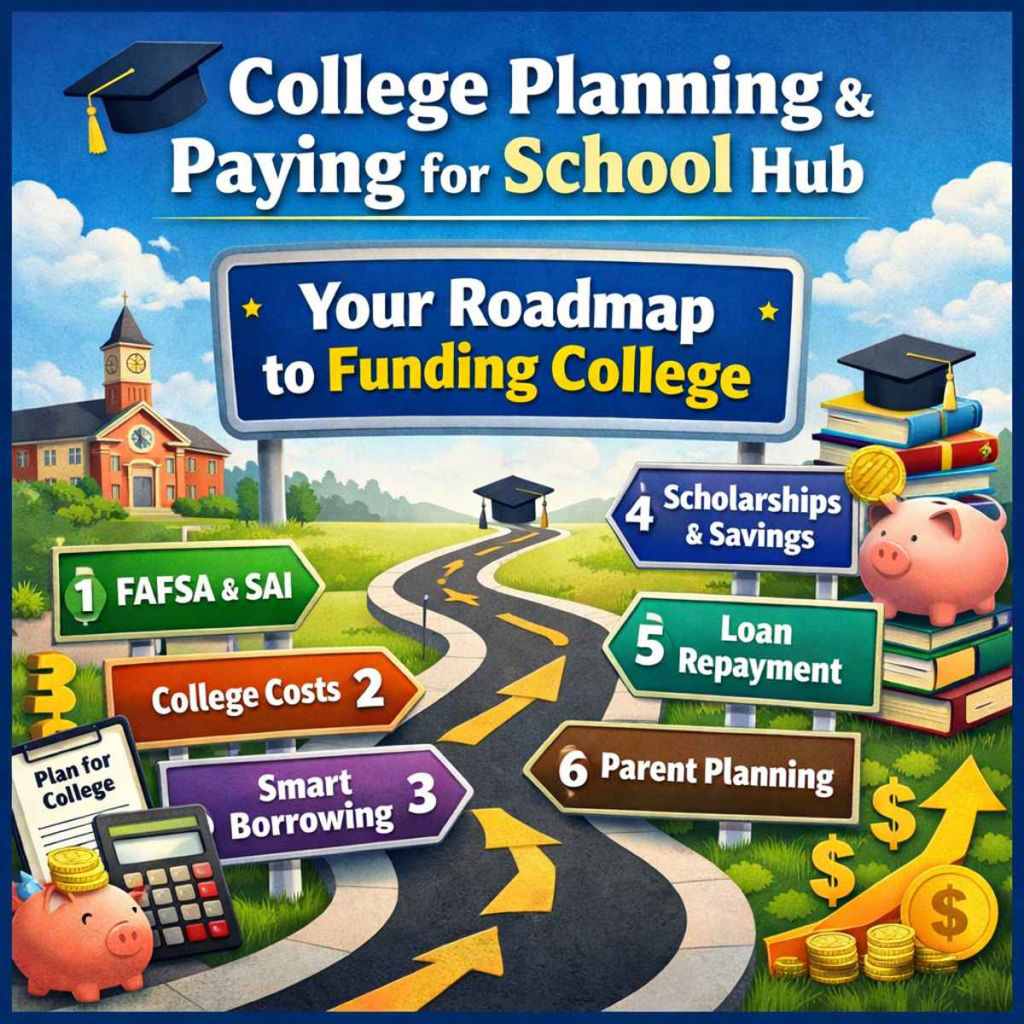
📘 College Planning & Paying for School Hub
Your Complete Guide to FAFSA, SAI, College Costs, Student Loans, Scholarships, and Smart Planning
🎓 A Clear Path to Paying for College
Paying for college shouldn’t feel like guesswork.
Families often hear “just fill out the FAFSA,” but rarely get the critical information that actually determines how affordable college will be:
- How much school will really cost
- What fees can be reduced or declined
- How loan decisions impact future payments
- How the new OB3 FAFSA rules change financial aid
- How to avoid borrowing more than you need
- How repayment will work after graduation
This hub gives you practical, numbers-based guidance—the kind families rarely receive at college nights or financial aid presentations.
It combines clear explanations, real math, and step-by-step resources so you can make confident decisions about one of the biggest financial commitments you’ll ever face.
👉 Learn More: FAFSA & Aid Determination
🧭 College Planning & Paying for School Roadmap (Start Here)
Paying for college isn’t a single decision—it’s a series of financial choices made over several years.
This roadmap breaks the process into clear, step-by-step phases so you can move from understanding financial aid to minimizing debt and planning for repayment. Each phase builds on the previous one, helping you avoid costly mistakes and make informed decisions.
🔥 Roadmap at a Glance
| Phase | Focus | Key Outcome |
|---|---|---|
| 1. Understanding Aid | Learn how FAFSA & SAI work | Clarity |
| 2. Cost Analysis | Understand real college costs | Awareness |
| 3. Borrowing Strategy | Decide what to borrow | Control |
| 4. Cost Reduction | Lower total college cost | Savings |
| 5. Repayment Planning | Prepare for life after graduation | Readiness |
| 6. Parent Strategy | Align family finances | Long-term stability |
🔹 Phase 1: Understanding Aid — Learn How FAFSA & SAI Really Work
Start by understanding how financial aid is calculated and why FAFSA results often don’t reflect the true cost of college.
👉 Read More: What SAI Really Means Under OB3
👉 Explore: FAFSA, SAI & OB3 Explained
🔹 Phase 2: Cost Analysis — Understand the True Cost of College
Move beyond sticker price and focus on real, term-by-term costs—including what you can decline or adjust.
👉 Read More: Understanding Cost of Attendance: What You Can Decline
👉 Explore: Cost of Attendance & Billing Math
🔹 Phase 3: Borrowing Strategy — Make Smart Loan Decisions
Decide how much to borrow, which loans to use, and how to avoid over-borrowing.
👉 Read More: How Federal Student Loans Work (Step-by-Step)
👉 Explore: Federal Student Loans Explained
🔹 Phase 4: Cost Reduction — Reduce What You Pay
Use strategies like scholarships, community college pathways, and enrollment planning to lower total costs.
👉 Read More: Scholarship Stacking Strategy
👉 Explore: Scholarship Strategies That Work
🔹 Phase 5: Repayment Planning — Prepare Before Graduation
Understand how repayment works before you graduate so there are no surprises.
👉 Read More: Choosing the Right Repayment Plan
👉 Explore: Repayment Planning After Graduation
🔹 Phase 6: Parent Strategy — Plan Across All Four Years
Parents play a major role in college financing. Plan cash flow, borrowing, and long-term impact across all four years.
👉 Read More: 4-Year College Cost Planning Worksheet
👉 Explore: Parent Financial Strategies to Reduce Borrowing
📌 Why This Roadmap Matters
Most families make college decisions in isolation—without seeing the full financial picture.
Following a structured roadmap helps you:
- Understand how aid actually works
- Calculate real costs—not estimates
- Avoid over-borrowing
- Reduce total college expenses
- Plan for repayment before it begins
- Protect long-term financial stability
🔍 What You’ll Find in This Guide
Below, you’ll find organized sections covering the most important parts of college planning:
- FAFSA & SAI Under OB3
- Cost of Attendance & Billing Math
- Federal Student Loans Explained
- Scholarship Strategies That Work
- Repayment Planning After Graduation
- Parent Financial Strategies to Reduce Borrowing
Think of this page as your navigation map to everything you need.
📑 Topics Covered
📑 Section 1 — FAFSA, SAI & OB3 Explained
Understand how the system works—and where the gaps are.
Learn:
- What FAFSA collects
- How the Student Aid Index (SAI) is calculated
- How OB3 changes eligibility
- Why FAFSA doesn’t equal real affordability
Explore:
- What SAI Really Means Under OB3
- FAFSA vs Real Cost of Attendance — Why They Don’t Match
- How Parent Income & Assets Affect Aid
- Common FAFSA Mistakes Parents Make
💵 Section 2 — The True Cost of Attendance (COA)
College has a sticker price—but term-by-term math is what families actually pay.
COA Includes:
- Tuition
- Fees
- Housing
- Meal plans
- Books & supplies
- Transportation
- Personal expenses
Key Insights:
👉 Many fees can be declined
👉 You can return student loans you don’t need
👉 Term-by-term bills matter more than annual estimates
Explore:
- Understanding Cost of Attendance: What You Can Decline
- Term-by-Term Billing Explained
- How to Lower College Costs Without Scholarships
- Should You Accept the Full Loan Offer? (Math Inside)
💳 Section 3 — Federal Student Loans & Borrowing Strategy
College borrowing shouldn’t be guesswork.
Learn:
- Subsidized vs unsubsidized loans
- PLUS loans and risks
- Private loan considerations
- Interest accrual while in school
Explore:
- How Federal Student Loans Work (Step-by-Step)
- How Interest Accrues in School
- Parent PLUS Loan Warning Signs
- The Smart Borrowing Strategy for All Four Years
🎯 Section 4 — Scholarship Planning & Alternatives
Scholarships matter—but strategy matters more.
Learn:
- How to stack scholarships
- Timing strategies
- Cost-reduction alternatives
Explore:
- Scholarship Stacking Strategy
- Community College + Transfer Math (2+2)
- Dual Enrollment Savings
- Certificate and Trades Pathways That Reduce Debt
📘 Section 5 — Repayment & Life After Graduation
This is the part financial aid rarely explains.
Learn:
- Standard vs income-driven repayment
- How IDR payments are calculated
- What happens after the grace period
Explore:
- Choosing the Right Repayment Plan
- How IDR Really Works (With Examples)
- How to Budget for Repayment After Graduation
👨👩👧 Section 6 — Parent Planning Strategies
Parents often carry more of the financial load than expected.
Learn:
- Multi-year planning strategies
- Cash flow management
- Protecting retirement while helping with college
Explore:
- 4-Year College Cost Planning Worksheet
- How to Reduce Borrowing Each Year
- Parent Cash Flow Strategies for College
- Should Parents Co-Sign Private Loans?
🧩 Additional Resources
- 🏀 College NIL & Athlete Financial Planning
- 🎓 Student Loans & Paying for College
- 📊 Tools, Resources & Templates
📊 Tools, Resources & Templates
This hub will include downloadable tools to support your planning:
- College Cost Calculator
- Term-by-Term COA Breakdown Worksheet
- Borrowing Decision Matrix
- Scholarship Strategy Calendar
- Loan Return Checklist
- Financial Aid Appointment Prep Sheet
📰 Recent Blog Posts
Explore the latest articles covering FAFSA, borrowing strategies, scholarships, and repayment planning.
-
The Real ROI of a College Degree – How to Choose a Program That Pays You Back
Introduction — Understanding the Real ROI of a College Degree For decades, earning a college degree was considered the surest path to financial security. But rising tuition costs, shifting job markets, and growing student debt have changed the equation. Today, families are asking a far more important—and financially responsible—question: Is the degree I’m paying for […]
-
The Complete Guide to 529 Plans: How to Save for College the Smart Way (2025-2026 Edition)
1. Introduction – Why 529 Plans Matter More Than Ever in 2025 Saving for college has always been a major financial milestone, but the education landscape in 2025 makes proactive planning even more critical. Tuition continues to rise faster than general inflation, federal student aid has become more competitive, and families are increasingly searching for […]
-
Where to Save Money for College – The Complete Guide for Parents (2025 Edition)
1. Introduction – Why Choosing the Right College Savings Plan Matters The cost of higher education continues to rise faster than household income, making college planning one of the most important long-term financial decisions for families. Over the past two decades, tuition and fees have grown at an average rate of 5%–7% per year, outpacing […]


📌 Final Thoughts — Making College Affordable Requires Clarity, Not Confusion
Most families get instructions, not explanations.
This hub exists to fill the gap — with real math, clear planning, and honest guidance that helps students and parents make informed financial decisions.
Whether you’re a high school parent planning ahead or a college student trying to reduce borrowing, you’ll find everything you need right here.
👉 Bookmark this page.
👉 Share it with your student.
👉 Explore the sections above at your own pace.
Your college journey should be built on clarity — not guesswork.
🔗 Explore Related Financial Topics
Planning for college involves several interconnected financial decisions, from saving for education to managing student loans and preparing for future career income. Explore these related topics to understand how college costs fit into your broader financial journey.
- Student Loans – Learn how education loans work, explore repayment options, and understand how borrowing affects long-term financial planning.
- Budgeting & Money Management – Effective budgeting helps families manage tuition costs, living expenses, and education savings.
- Financial Education & Literacy – Understanding financial fundamentals helps students and families make informed decisions about education costs and borrowing.
- Career & Income Growth – Future career opportunities and income potential play an important role in evaluating the return on investment of higher education.
- Saving & Investing – Education savings plans and long-term investing strategies can help families prepare for rising college costs.
About the Author — Jason Bryan Ball
Financial Educator | Founder of Jason’s Fin Tips
Read more about Jason Bryan Ball →