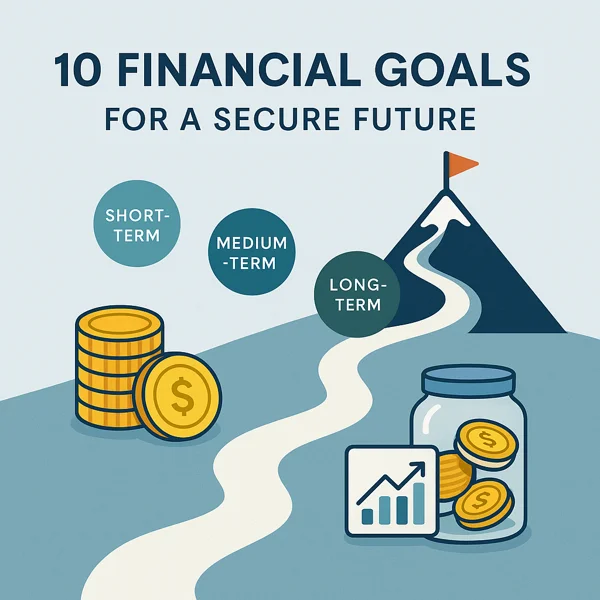
Introduction – Navigating Your Financial Journey
Every successful financial plan starts with a clear destination. Setting well-defined goals is like charting a course before setting sail—without them, managing money can feel like drifting in open waters without a compass. Goals give direction to your financial choices, transforming vague hopes into actionable steps that lead toward stability, security, and lasting freedom.
Whether you’re just beginning to budget, saving for a major purchase, or planning your retirement, financial goals keep you focused and accountable. They motivate consistent action and serve as measurable milestones to track your progress along the way.
This guide will help you turn financial aspirations into achievable results. We’ll explore ten common financial goals, explain why each matters, and outline practical strategies to accomplish them. From building an emergency fund to creating generational wealth, you’ll learn how to design a financial roadmap that supports the life you envision.
5 Key Takeaways
- Set Clear and Balanced Goals
Define short-, medium-, and long-term objectives that align with your vision. Use the Balanced Path™ to organize them by urgency and purpose — creating steady progress without neglecting future security. - Prioritize What Matters Most
Tackle immediate needs like an emergency fund or high-interest debt first. Then, align your goals with your personal values to ensure your money supports what truly matters to you. - Invest Early in Your Future
Start saving for retirement as soon as possible. Maximize employer 401(k) matches, explore traditional and Roth IRAs, and use the Summit Strategy™ to build momentum and consistency over time. - Build Wealth Intentionally Through Diversification
Invest across multiple asset classes — including index funds, real estate, and mutual funds — to grow wealth and reduce risk. Use the Expenditure Tracker™ to free up investable cash flow and keep contributions steady. - Avoid Common Financial Pitfalls
Stay realistic, flexible, and adaptive. Revisit your goals regularly, account for inflation, and refine your plan as your life evolves — ensuring your strategy grows with you.
Why Setting Financial Goals Matters
Setting financial goals isn’t just about saving or paying off debt—it’s about defining your purpose and creating a plan to make it real. Goals serve as the foundation of sound financial management by providing:
- Direction: A structured plan that helps you make informed decisions and stay on course.
- Motivation: A sense of purpose that keeps you committed, even when progress feels slow.
- Measurement: Tangible benchmarks that let you assess your growth and celebrate milestones.
When you establish clear financial goals, you transform abstract ambitions into a personalized roadmap—one that guides not only your money but also your mindset. Each goal achieved strengthens your confidence and moves you closer to financial independence and the life you truly want.
The Psychological Benefits of Setting Financial Goals
Setting financial goals isn’t just a budgeting exercise — it’s a powerful psychological tool that shapes behavior, reduces anxiety, and builds long-term financial confidence. When your goals are clear, measurable, and connected to your personal values, they create the mental structure needed to make consistent progress. Here’s how goal setting strengthens both your financial health and emotional well-being.
1. Goals Create Clarity and Reduce Decision Fatigue
Money decisions appear constantly — what to spend, what to save, what to delay. Without clear goals:
- Every choice feels equally urgent
- You default to convenience, habits, or emotions
- You feel overwhelmed by competing priorities
Psychologists call this decision fatigue, and it drains willpower.
Financial goals act as a filter that automatically answers:
- Does this move me closer to what I want?
- Is this expense worth delaying my bigger priorities?
This reduces mental clutter and helps you make decisions with more confidence and less stress.
2. Goals Transform Vague Intentions Into Actionable Steps
Saying “I need to save more” is too abstract for the brain to act on.
But saying “Save $300 per month until I reach a $3,000 emergency fund” activates the brain’s goal-achievement system, giving you:
- A clear target
- Defined steps
- A measurable timeline
- Built-in progress markers
This taps into the SMART goal principle, which neuroscientific research shows improves follow-through by as much as 70%.
3. Goals Provide Motivation and Momentum
Clear goals create internal motivation because they give your efforts meaning.
For example:
- Saving for a home becomes a picture of your future stability
- Paying off debt becomes a path to freedom and control
- Investing for retirement becomes a commitment to future security
Psychologists call this “intrinsic motivation,” and it’s far more powerful than external pressure.
Even small wins — paying off a credit card, hitting a savings milestone — release dopamine, reinforcing positive habits and helping you stay consistent.
4. Goals Reduce Financial Anxiety and Build a Sense of Control
Financial stress often comes from uncertainty:
- Not knowing where your money is going
- Not knowing whether you’re saving enough
- Not knowing how to handle emergencies
When you set clear financial goals, you create a sense of control and predictability.
This reduces anxiety because:
- You know what you’re working toward
- You know how far you’ve come
- You know what the next step is
Studies show that a higher sense of financial control correlates strongly with lower levels of stress and higher life satisfaction.
5. Goals Align Your Money With Your Personal Values
People are happiest when their spending and saving reflect what matters most to them. Financial goals let you:
- Support the lifestyle you envision
- Prioritize relationships, experiences, and stability
- Avoid wasteful or emotionally driven spending
- Invest in the future you want for your family
This value-based alignment increases satisfaction because your money decisions feel purposeful — not reactive.
6. Goals Create Accountability and Long-Term Consistency
When your goals are written down, tracked, and reviewed, you naturally become more accountable to yourself.
This leads to:
- Better follow-through
- Fewer impulse purchases
- Consistent saving and investing habits
- Long-term progress that compounds over time
Research from the American Society of Training & Development found that people who declare and track goals increase success rates to 65%, and adding regular accountability boosts it to 95%.
Types of Financial Goals: Short-, Medium-, and Long-Term
Not all financial goals are created equal. Some can be accomplished in months, while others take years of discipline and consistency. Understanding the time frame of each goal helps you prioritize effectively and maintain balance across your financial life.
Short-Term Goals (Within 12 Months)
Short-term goals build momentum and create early wins that keep you motivated.
Examples:
- Paying off a small credit card balance
- Building a $1,000 emergency fund
- Sticking to a monthly budget
- Starting a side hustle to increase income
- Saving for a vacation or holiday expenses
These goals are immediate, measurable, and help establish positive financial habits.
Medium-Term Goals (1–5 Years)
Medium-term goals require more planning and patience but pave the way for major life milestones.
Examples:
- Saving for a down payment on a home
- Paying off student loans or a car loan
- Building a 6-month emergency fund
- Investing for a child’s education
- Launching or expanding a small business
This stage bridges your short-term financial actions with your long-term vision.
Long-Term Goals (5+ Years)
Long-term goals represent the bigger picture—the achievements that define financial independence.
Examples:
- Funding your retirement accounts (401(k), IRA, Roth IRA)
- Achieving mortgage freedom
- Creating passive income streams
- Leaving a charitable or family legacy
- Reaching full financial independence
Balancing goals across all three time horizons ensures that you’re building stability today while investing in tomorrow’s security.
Financial Goal Time Horizon Table
| Goal Type | Timeframe | Examples | Purpose |
|---|---|---|---|
| Short-Term | Within 12 months | Pay off small debt, start emergency fund, plan a vacation | Build quick wins and stability |
| Medium-Term | 1–5 years | Save for a home, pay off student loans, build 6-month emergency fund | Bridge short-term progress and long-term planning |
| Long-Term | 5+ years | Retirement, wealth building, financial independence | Achieve lasting financial freedom |
How to Prioritize Your Financial Goals
With multiple goals competing for attention, prioritization becomes the key to progress. The most effective financial plans don’t attempt everything at once—they focus strategically.
1. Start with Urgent Needs
Address immediate vulnerabilities first, such as:
- Paying off high-interest credit card debt
- Building an emergency fund
- Ensuring adequate insurance coverage
These foundational steps protect you from financial setbacks that could derail other plans.
2. Align Goals with Your Core Values
Your financial plan should reflect what matters most to you—whether that’s family, freedom, or stability. Ask yourself:
- What makes me feel secure?
- What would make the biggest difference in my quality of life?
- What future do I want to create for my loved ones?
When goals are tied to personal meaning, motivation naturally follows.
3. Apply the SMART Framework
Make your goals:
- Specific: Define what you’re working toward.
- Measurable: Quantify your progress.
- Achievable: Set realistic expectations.
- Relevant: Align with your life priorities.
- Time-bound: Set clear deadlines.
SMART goals turn vague aspirations into actionable steps with built-in accountability.
Financial Goals Examples by Life Stage
Your priorities change as life evolves. Here’s how financial goals typically shift across life stages—and examples that resonate with real readers looking for clear benchmarks.
Young Adults (18–30)
Early habits have outsized long-term benefits.
- Build a starter emergency fund ($1,000 → 1 month → 3 months)
- Establish credit and aim for a 700+ score
- Pay off student loans or refinance for better rates
- Save first $10,000 invested in index funds or Roth IRA
- Build consistent side-income to diversify earnings
- Save for a car without relying on high-interest auto loans
- Start saving 5–10% for retirement (target: increase annually)
Families & Mid-Career Adults (30–50)
Growing responsibilities require structured planning.
- Grow emergency fund to 3–6 months
- Pay off high-interest debt
- Save for home purchase, upgrades, or repairs
- Increase retirement savings to 15% of income
- Set up or expand 529 plan contributions
- Build life and disability insurance coverage
- Start a sinking fund for annual expenses (insurance, holidays, travel)
- Build a mid-term investment account for future goals
- Create a wealth-building plan using diversified investment vehicles
Pre-Retirees (50–65)
This stage is about maximizing savings and minimizing risk.
- Eliminate remaining non-mortgage debt
- Max out retirement accounts, including catch-up contributions
- Conduct a Social Security timing analysis
- Build a projected retirement budget
- Rebalance investment portfolio to reduce volatility
- Fund healthcare savings (HSA strategy)
- Evaluate long-term care insurance
- Downsize housing or plan for relocation
Retirees (65+)
The focus shifts from accumulation to income stability and legacy planning.
- Implement a safe-withdrawal strategy (e.g., 4% Rule with adjustments)
- Reassess portfolio risk given longevity and market conditions
- Create or update estate plan (will, trust, beneficiaries)
- Plan tax-efficient RMD withdrawals
- Prepare for medical, long-term care, and assisted living costs
- Establish giving or charitable plans
- Optimize retirement income sources (pension, Social Security, investments)
Financial Goal #1: Build a Strong Emergency Fund
Why It’s Important
An emergency fund is your foundation for financial resilience. It protects against life’s uncertainties — from medical bills and car repairs to unexpected job loss — without forcing you into high-interest debt. According to the Federal Reserve’s 2024 survey, over one-third of U.S. households would struggle to pay a $400 emergency expense. Building a reserve changes that narrative: it transforms financial stress into financial confidence.
How to Achieve It
- Define Your Safety Threshold: Calculate essential monthly costs (housing, food, utilities, insurance, transportation). Multiply that by 3–6 months to establish your ideal savings target.
- Automate Consistency: Set up recurring transfers from checking to a high-yield savings account or money market fund every payday.
- Start Small, Scale Up: Begin with $25–$100 per paycheck and gradually increase contributions as income grows.
- Redirect Discretionary Spending: Use the Expenditure Tracker™ to identify unnecessary expenses and reallocate them toward your emergency fund.
- Preserve Liquidity: Keep funds accessible but separate from everyday accounts to avoid impulsive withdrawals.
| Monthly Expenses ($) | 3-Month Goal ($) | 6-Month Goal ($) |
|---|---|---|
| 2,000 | 6,000 | 12,000 |
| 3,000 | 9,000 | 18,000 |
| 4,000 | 12,000 | 24,000 |
💡 Pro Tip: Use a separate high-yield savings account earning at least 4–5% APY to let your emergency fund grow passively while remaining fully liquid.
Financial Goal #2: Eliminate High-Interest Debt
Why It’s Important
High-interest debt silently drains wealth and limits long-term progress. Each month you carry a balance, compounding interest reduces your ability to save, invest, or achieve meaningful goals. Freeing yourself from this cycle not only improves your credit profile — it increases your monthly flexibility and accelerates your journey toward true financial independence.
How to Achieve It
- Start with the Balanced Path™:
Assess all debts, interest rates, and minimum payments, then align repayment with your core priorities — stability, momentum, and sustainability. The Balanced Path™ emphasizes progress without sacrificing essentials. - Track and Redirect:
Use your Expenditure Tracker™ to identify where small savings can be redirected to high-impact payments. A 5% reallocation from discretionary spending (e.g., dining out or streaming services) can accelerate payoff timelines dramatically. - Implement the Summit Strategy™:
Once the budget is balanced, channel all available surplus toward one primary repayment goal — your “Summit.” This focused approach allows measurable progress and visible milestones, reinforcing motivation and control. - Negotiate and Optimize:
Contact lenders to request reduced rates or temporary hardship accommodations. Pair this with a consistent, automated payment plan to maintain momentum. - Reward Each Milestone:
Celebrate when balances reach major checkpoints — for example, every $1,000 reduction — to maintain engagement and positive reinforcement.
💬 Example: A household that applies the Balanced Path™ framework to redirect $200 monthly from discretionary expenses could shorten payoff timelines by several months and save over $1,000 in interest, depending on balance size.
Financial Goal #3: Saving for Retirement
Why It’s Important
Retirement planning isn’t just about age — it’s about freedom. The earlier you begin, the more powerful compound growth becomes, allowing your money to work for you over decades. A consistent retirement strategy ensures long-term financial security, reduces reliance on Social Security, and gives you the flexibility to design your ideal future — whether that’s travel, part-time work, or simply peace of mind.
Starting early means every contribution compounds upon the last. For example, investing $500 a month at 7% annual growth from age 25 can grow to nearly $1.2 million by age 65, while starting at 35 yields about half that.
How to Achieve It
- Follow the Balanced Path™:
Begin by analyzing your income, spending, and debt obligations to determine how much can be consistently directed toward retirement savings without compromising stability. - Contribute Consistently:
Aim to save at least 15% of your gross income through employer-sponsored plans (401(k), 403(b)) or individual accounts (IRA, Roth IRA). - Maximize Employer Benefits:
If your employer offers a 401(k) match, contribute at least enough to receive the full match — it’s effectively free money toward your retirement. - Understand IRA Options:
Choose the account type that best aligns with your goals and tax situation: FeatureTraditional IRARoth IRATax TreatmentContributions may be tax-deductible (subject to income limits)Contributions are made with after-tax dollarsWithdrawal TaxesTaxed as income upon withdrawalWithdrawals are tax-free in retirementIncome LimitsDeductibility phases out at higher incomesContributions phase out for high earnersBest ForReducing current taxable incomeSecuring tax-free income in retirement - Leverage the Summit Strategy™:
Once debt and cash flow are balanced, shift focus toward maximizing your long-term investment horizon. Use retirement calculators such as Fidelity’s Retirement Score or Vanguard’s Nest Egg Calculator to set precise savings targets.
Traditional IRA vs. Roth IRA Comparison
| Feature | Traditional IRA | Roth IRA |
|---|---|---|
| Tax Treatment | Tax-deductible contributions (subject to income limits) | After-tax contributions |
| Withdrawal Taxes | Taxed as income in retirement | Tax-free withdrawals |
| Income Limits | Deductibility phases out at higher incomes | Contributions phase out for high earners |
| Best For | Reducing current taxable income | Tax-free income in retirement |
💡 Tip: Automate contributions and increase your savings rate 1–2% annually or after every raise — this simple adjustment can add tens of thousands to your future nest egg.
Financial Goal #4: Buying a Home
Why It’s Important
Homeownership remains one of the most effective ways to build long-term wealth. Beyond providing stability and personal fulfillment, a home is an appreciating asset that contributes to your overall net worth. For many families, it’s also a cornerstone of intergenerational financial planning.
Owning a home under the Balanced Path™ approach isn’t about rushing to buy — it’s about aligning affordability, timing, and personal goals for lasting security.
How to Achieve It
- Save for a Down Payment:
Aim for 20% of the home’s price to avoid private mortgage insurance (PMI) and secure better loan terms. If that’s out of reach, explore low-down-payment options responsibly. - Plan Beyond the Purchase Price:
Budget for closing costs, property taxes, maintenance, and insurance. Too many buyers focus on the mortgage alone and overlook ongoing ownership costs. - Strengthen Your Credit Profile:
Improve mortgage eligibility by:- Paying all bills on time
- Reducing revolving debt
- Reviewing your credit report for errors and disputing inaccuracies
- Determine Affordability Realistically:
Use a mortgage affordability calculator to evaluate your comfort zone, not just lender approval amounts. Include utilities, HOA fees, and potential lifestyle trade-offs in your estimate. - Explore Assistance Programs:
First-time buyers can leverage FHA loans, state assistance grants, or local programs to make ownership more accessible without compromising financial stability.
| Cost Type | Description | Estimated Amount ($) |
|---|---|---|
| Down Payment | Typically 20% of the home’s price | Varies |
| Closing Costs | Loan, inspection, appraisal, and title fees | 2–5% of the home’s price |
| Maintenance Costs | Repairs and ongoing upkeep | 1–3% of home value annually |
💡 Tip: Use your Expenditure Tracker™ to simulate homeownership costs before you buy. Track projected mortgage payments, utilities, and maintenance for 90 days to confirm true affordability.
Financial Goal #5: Funding a Child’s Education
Why It’s Important
Investing in your child’s education is one of the most impactful financial decisions you can make. Tuition and related costs continue to rise — according to the College Board, the average annual cost of attendance in 2025 exceeds $28,000 for in-state universities and more than $50,000 for private institutions.
By planning early, you reduce the need for student loans, protect your own financial stability, and empower your child with greater freedom and opportunity. Education savings isn’t just a parental duty — it’s an act of long-term financial legacy building.
How to Achieve It
- Start with the Balanced Path™:
Begin by reviewing your household cash flow and ensuring core financial priorities (emergency fund, debt, retirement) are stable. Education funding should enhance — not compete with — your long-term financial security. - Open a 529 Plan Early:
A 529 College Savings Plan allows tax-deferred growth and tax-free withdrawals for qualified education expenses (tuition, books, housing, and more). Many states also offer tax deductions or credits for contributions. - Automate Contributions:
Schedule monthly or quarterly deposits, even if modest — consistency and compounding matter more than perfection. - Leverage Investment Growth:
Start early to allow market growth to work in your favor. Even $100 per month at 7% annual growth can grow to nearly $24,000 in 15 years. - Diversify Educational Savings:
Combine 529 savings with custodial accounts (UGMA/UTMA) or Coverdell ESAs for flexibility across different educational needs. - Balance Priorities:
Never sacrifice your own retirement plan to fund education. Use the Summit Strategy™ to allocate income strategically — focusing first on long-term independence, then on educational legacy.
💡 Pro Tip: Encourage family participation. Grandparents or relatives can contribute to your child’s 529 plan directly, expanding the long-term funding base without affecting annual gift tax limits.
Financial Goal #6: Achieving Financial Independence
Why It’s Important
Financial independence is the point where your assets generate enough income to cover your lifestyle, freeing you from the need to work for a paycheck. It’s not just about retiring early — it’s about creating options: the freedom to change careers, start a business, travel, or spend more time with family without financial stress.
True independence comes from designing a system where your money works harder than you do.
How to Achieve It
- Define Your Independence Number:
Use the Balanced Path™ to calculate your target: typically, 25× your annual living expenses (the “4% rule” benchmark). Adjust based on lifestyle, risk tolerance, and expected healthcare or housing costs. - Track and Optimize Expenses:
Use the Expenditure Tracker™ to identify waste, streamline recurring costs, and redirect savings toward long-term investments. Small, consistent improvements compound significantly over time. - Build Multiple Income Streams:
Diversify income beyond employment — consider:- Dividend-paying stocks or ETFs
- Real estate or REITs
- Digital products, royalties, or content creation
- Business ownership or freelance consulting
- Invest Intentionally:
Follow the Summit Strategy™ by prioritizing consistent investing in tax-advantaged accounts first (401(k), IRA, HSA), then expanding into brokerage and passive income assets. - Automate Growth:
Set up recurring contributions and reinvest all dividends. Automating removes emotion and builds discipline — key pillars of sustained financial freedom.
💡 Example: A creator earning $75,000 annually who invests 20% per year into diversified portfolios could reach financial independence in roughly 20–25 years, assuming 7% average returns and moderate expense growth.
Financial Goal #7: Planning for Major Life Events
Why It’s Important
Major life milestones — whether getting married, starting a family, launching a business, or taking a sabbatical — are exciting but often expensive. Without preparation, these joyful moments can become financial setbacks.
The key is intentionality. By planning early, separating funds, and using structured savings systems, you can enjoy life’s biggest moments without sacrificing your long-term financial goals.
How to Achieve It
- Create Dedicated Savings Buckets:
Use your Balanced Path™ framework to allocate a portion of income toward future milestones. Keep separate high-yield savings or money market accounts for each event — weddings, home renovations, business startups, or large purchases. - Use Realistic Budgeting:
Research the true cost of your goal and apply the Expenditure Tracker™ to test affordability. Example: for a $25,000 wedding in two years, saving $1,000 monthly makes the goal achievable without debt. - Automate and Adjust:
Set up automatic transfers so progress happens quietly in the background. Reassess contributions annually as income or priorities shift. - Balance Timing and Priorities:
Don’t fund milestones at the expense of emergency reserves or retirement. Use the Summit Strategy™ to align short-term celebrations with long-term security. - Leverage Tax-Advantaged or Business Tools:
For major goals like launching a business, explore small business savings or tax-deductible startup expense tracking to maintain efficiency.
💡 Pro Tip: For business or wedding savings, consider a joint high-yield account with clear contribution goals and spending caps — it builds accountability and prevents emotional overspending.
Financial Goal #8: Building Wealth Through Investments
Why It’s Important
Saving protects your money — investing grows it. Long-term investing is how individuals outpace inflation, generate passive income, and build generational wealth.
According to Morningstar’s 2025 outlook, diversified portfolios have historically averaged 6–8% annual returns, far exceeding the long-term inflation rate of ~3%. By staying invested and disciplined, your wealth compounds — quietly and powerfully — over time.
How to Achieve It
- Start Small, Start Now:
Begin with manageable amounts — even $100 per month — through a brokerage account or retirement plan. Time in the market matters more than timing the market. - Follow the Balanced Path™:
Assess your budget, risk tolerance, and liquidity before investing. Ensure your emergency fund and debt obligations are stabilized first. - Diversify Across Asset Classes:
Use the Summit Strategy™ to build layers of investments over time — balancing safety, growth, and opportunity. Avoid concentrating all assets in one category. - Explore Common Investment Types: Investment TypeRisk LevelTypical Returns (%)Key ConsiderationsReal EstateModerate8–12Generates rental income and appreciation but requires capital and managementIndex Funds / ETFsLow to Moderate6–9Low fees, diversified exposure to marketsMutual FundsLow to Moderate6–8Professionally managed, may include higher feesIndividual StocksModerate to High7–15+Requires research; higher volatilityCryptocurrencyHigh20+ (volatile)High risk and regulatory uncertainty
- Invest Consistently:
Automate contributions through payroll deductions or recurring transfers. The habit of investing regularly — even in small amounts — drives success more than sporadic market timing. - Reinvest and Review:
Reinvest dividends, periodically rebalance your portfolio, and review asset performance annually to stay aligned with your goals and risk tolerance.
💡 Pro Tip: Think of investing as a long climb. Use your Summit Strategy™ to set milestones — such as first $10,000 invested, first $100,000 portfolio value, or achieving your target asset allocation — and celebrate each step toward long-term wealth.
Investment Types and Risk Levels Table
| Investment Type | Risk Level | Typical Returns (%) | Key Considerations |
|---|---|---|---|
| Real Estate | Moderate | 8–12 | Requires upfront capital and management |
| Index Funds / ETFs | Low–Moderate | 6–9 | Low fees, diversified exposure |
| Mutual Funds | Low–Moderate | 6–8 | Professionally managed portfolios |
| Individual Stocks | Moderate–High | 7–15+ | Higher volatility, requires research |
| Cryptocurrency | High | 20+ (volatile) | High risk, speculative market |
Financial Goal #9: Protecting Your Finances with Insurance
Why It’s Important
Building wealth is only half the equation — protecting it is equally essential. Insurance serves as the financial shield that prevents unexpected events from derailing your progress. From medical emergencies to income loss or property damage, the right coverage safeguards your assets, supports your family, and preserves financial stability.
According to the Insurance Information Institute, nearly 60% of Americans are underinsured, leaving families vulnerable to costly setbacks. A proactive insurance strategy is a cornerstone of a balanced financial plan.
How to Achieve It
- Assess Your Coverage Needs with the Balanced Path™:
Begin by reviewing your core protection areas — life, health, disability, auto, homeowners, and liability. Prioritize coverage that protects both income and essential assets. - Focus on Income Continuity:
- Life Insurance: Provides for loved ones in case of premature death. Term life offers affordable protection for specific timeframes, while permanent policies (whole or universal life) can include cash value components.
- Disability Insurance: Replaces income if illness or injury prevents you from working — often overlooked but crucial for financial security.
- Health Insurance: Protects against medical debt, the leading cause of bankruptcy in the U.S.
- Compare and Customize:
Shop multiple providers, review deductibles, and compare coverage limits. Look for bundle discounts (home + auto) or employer-provided benefits that enhance value. - Use the Expenditure Tracker™:
Log current insurance costs and evaluate whether policies align with your household’s risk exposure and income level. Overlapping or outdated policies waste resources that could strengthen your savings goals. - Review Regularly:
Reassess coverage annually or after major life events — marriage, new dependents, home purchase, or job change — to ensure your protection plan evolves with your life.
💡 Pro Tip: Treat insurance as a dynamic component of your financial plan — not a set-it-and-forget-it product. Align your protection strategy with your Summit Strategy™ milestones to ensure every stage of growth is properly shielded.
Financial Goal #10: Leaving a Legacy Through Estate Planning
Why It’s Important
Estate planning transforms your lifetime of financial discipline into a lasting legacy. It ensures your assets are distributed according to your wishes, reduces family conflict, and minimizes taxes and legal costs.
Without proper planning, state laws determine who receives your assets — often delaying or diminishing your legacy. A clear estate plan gives your loved ones clarity, stability, and peace of mind during difficult times.
How to Achieve It
- Start with the Balanced Path™:
Inventory all assets — real estate, investments, life insurance, business interests, and digital property. Determine which should transfer directly, which require trust management, and how to align beneficiary designations with your overall plan. - Create or Update a Will:
A will is the foundation of your estate plan. It defines how property will be distributed, who will serve as executor, and who will care for minor children if applicable. - Establish Trusts for Control and Protection:
Trusts provide flexibility and privacy while helping minimize estate taxes and avoid probate.- Revocable Living Trusts allow you to manage and adjust assets during your lifetime.
- Irrevocable Trusts can protect assets from creditors and reduce taxable estate value.
- Designate Beneficiaries Strategically:
Regularly update designations on retirement accounts, life insurance, and investment portfolios to ensure they align with your will or trust. Outdated beneficiary designations can override even a current will. - Plan for Healthcare and Decision-Making:
Include a power of attorney and advance healthcare directive to ensure trusted individuals can act on your behalf if you become incapacitated. - Coordinate with Professionals:
Work with a CERTIFIED FINANCIAL PLANNER™ professional, estate attorney, or tax specialist to integrate your estate plan with your broader financial roadmap and Summit Strategy™ milestones.
💡 Pro Tip: Revisit your estate plan every 3–5 years or after major life changes. Legacy planning isn’t about documents — it’s about ensuring your values and financial vision endure for generations.
💡 Bonus – The Psychology of Money and Knowing Yourself
Why Mindset Matters as Much as Math
Financial planning isn’t just about spreadsheets and strategies — it’s about behavior. The way we think about money drives every decision we make, from saving and spending to investing and giving. Understanding your financial psychology helps you align choices with your values and reduce the emotional friction that often derails good intentions.
Money triggers powerful emotions — fear, pride, guilt, security, even identity. Recognizing those emotional patterns is the first step toward mastering them.
Understanding Your Financial Mindset
Ask yourself:
- What does money represent to me? Security, freedom, control, love, or status?
- How do I respond to financial stress? Do I plan, avoid, or overcorrect?
- Which habits do I repeat — and why? Many behaviors come from childhood money scripts or cultural influences that we’ve never questioned.
Awareness turns unconscious reactions into deliberate strategy. Once you understand your financial tendencies, you can design systems that work with your personality, not against it.
Applying the Balanced Path™
The Balanced Path™ isn’t just about allocating income — it’s about finding emotional equilibrium between stability and growth.
- Security: Build the foundation — emergency savings, insurance, and a sustainable lifestyle.
- Confidence: Replace anxiety with informed action through education and measurable progress.
- Fulfillment: Align spending with your values — spend intentionally on what enriches your life, not what distracts from it.
When your money aligns with your mindset, financial success becomes sustainable, not stressful.
The Summit Strategy™ and Long-Term Motivation
The Summit Strategy™ teaches that the journey to financial independence isn’t linear — it’s a climb with rest points, recalibrations, and perspective shifts along the way.
- Celebrate small victories — the first $1,000 saved, debt milestones, or your first investment.
- Reflect on setbacks without judgment — they’re data, not defeat.
- Reconnect your financial goals to your “why.” Purpose fuels persistence far better than pressure.
Emotional Triggers to Watch
- Fear of Missing Out (FOMO): Leads to impulsive investing or spending.
- Analysis Paralysis: Delaying decisions due to perfectionism or overthinking.
- Lifestyle Creep: Expanding spending as income rises, reducing long-term savings potential.
- Comparison Trap: Measuring success against others instead of your own benchmarks.
Use the Expenditure Tracker™ not just to track numbers, but to observe patterns — moments when emotion overrides reason. Awareness of these triggers empowers you to course-correct early.
Practical Ways to Know Yourself Financially
- Journal your emotional responses to money decisions for one month.
- Review your top five monthly expenses and ask: Does this bring genuine value or temporary relief?
- Discuss money goals openly with your partner or family to uncover unspoken values and fears.
- Revisit your goals quarterly to ensure they still align with who you’re becoming, not who you were.
The Goal: Financial Self-Awareness
Financial literacy without self-awareness is like a map without a compass.
When you understand your own money psychology — your motivations, fears, and habits — you make better, calmer, and more confident decisions.
Mastering the psychology of money isn’t about perfection — it’s about progress. The more you understand yourself, the less your emotions control your financial future, and the more empowered you become to design a life that reflects your values and vision.
Practical Tools and Resources for Achieving and Prioritizing Your Financial Goals
Having the right tools transforms financial goals from abstract ideas into measurable progress. Whether you prefer digital automation or hands-on tracking, the following methods help you stay focused, organized, and accountable.
1. Budgeting Frameworks
Use proven budgeting systems to allocate income intentionally and maintain balance across needs, wants, and savings.
- 50/30/20 Rule: Spend 50% on needs, 30% on wants, and save or invest 20%.
- Zero-Based Budgeting: Assign every dollar a purpose, ensuring no income goes untracked.
- Balanced Path™ Integration: Adapt either method using your personal income rhythm and financial priorities for sustainable results.
2. Goal-Tracking and Money Management Apps
Leverage technology to monitor spending, set financial goals, and automate savings.
- Mint: Ideal for expense tracking and goal progress visualization.
- YNAB (You Need a Budget): Focuses on proactive money management and financial discipline.
- PocketGuard: Simplifies cash flow management and shows how much is safe to spend.
- Personal Capital (Empower): Great for long-term investors who want to track net worth and portfolio growth.
💡 Pro Tip: Choose one app that aligns with your personality. Simplicity fosters consistency — and consistency drives results.
3. Financial Spreadsheets and Ranking Systems
For those who prefer a manual approach, create a personalized spreadsheet to:
- Rank your goals by urgency, importance, and feasibility.
- Track contributions and progress visually through charts or milestone trackers.
- Integrate your Expenditure Tracker™ categories for unified insight into cash flow and savings.
4. Visualization and Motivation Tools
Turn your goals into something tangible:
- Build a financial vision board — digital or physical — to keep objectives visible.
- Use printable goal charts or apps that track visual milestones for debt payoff or savings growth.
- Pair each milestone with a small reward to reinforce momentum and motivation.
5. Professional and Educational Resources
Knowledge and guidance accelerate success:
- Financial Planners: Work with a CERTIFIED FINANCIAL PLANNER™ professional for personalized guidance on complex financial decisions.
- Books & Podcasts: Explore titles like The Psychology of Money by Morgan Housel, Your Money or Your Life by Joe Dominguez, or I Will Teach You to Be Rich by Ramit Sethi for continued learning.
- Trusted Blogs & Courses: Follow reputable sources like Jason’s Fin Tips for actionable insights, updates, and strategic planning tools.
Goal-Tracking Tools Comparison Table
| Tool Type | Examples | Purpose / Best Use |
|---|---|---|
| Budgeting Apps | Mint, YNAB, PocketGuard | Automate expense tracking and categorize spending |
| Financial Planners | CFP® professionals | Personalized, comprehensive planning |
| Visualization Tools | Vision boards, digital trackers | Keeps goals visible and motivational |
| Spreadsheets | Google Sheets, Excel | Customizable manual tracking |
| Educational Resources | Jason’s Fin Tips, books, podcasts | Continuous learning and strategy refinement |
Takeaway
Setting goals is essential — but tracking, reviewing, and refining them is what drives long-term success. The right tools make progress visible, habits automatic, and your financial plan sustainable.
Common Pitfalls to Avoid When Setting Financial Goals
Even the best financial plan can falter if it’s built on unclear or unsustainable foundations. Understanding common mistakes helps you stay on course and adapt as your circumstances evolve.
1. Setting Vague or Unrealistic Goals
Goals like “save more” or “get out of debt” lack the clarity needed for measurable progress. Use the SMART framework — Specific, Measurable, Achievable, Relevant, and Time-bound — to turn good intentions into actionable milestones.
💡 Example: Replace “save more” with “save $500 per month toward a $3,000 emergency fund within six months.”
2. Ignoring Life Changes
Financial priorities shift with major life events — marriage, career transitions, parenthood, or health challenges. Review and adjust goals at least once a year using the Balanced Path™ approach to ensure your objectives reflect your current values and resources.
3. Neglecting the Impact of Inflation
Prices rise, lifestyles evolve, and what feels adequate today may fall short tomorrow. Build inflation assumptions (typically 2–3% annually) into long-term goals like retirement, education funding, or real estate planning.
📈 Pro Tip: Revisit your savings targets annually using the Summit Strategy™ to adjust for cost-of-living and income growth.
4. Overlooking Behavior and Mindset
Numbers matter, but emotions drive behavior. Fear, procrastination, or perfectionism can derail even a solid plan. The Expenditure Tracker™ can reveal emotional spending patterns and help you redirect small, consistent savings toward your larger goals.
5. Failing to Celebrate Progress
Financial success is a journey, not a race. Recognizing milestones builds confidence and reinforces positive habits — whether that’s your first $1,000 saved, your first debt payoff, or your first month under budget.
Common Pitfalls vs. Solutions Table
| Pitfall | Why It’s a Problem | Better Approach |
|---|---|---|
| Vague or unrealistic goals | Hard to measure or sustain | Use SMART goals and define timelines |
| Ignoring inflation | Erodes future purchasing power | Adjust long-term savings by 2–3% annually |
| Not revisiting goals | Life changes make goals obsolete | Review yearly using the Balanced Path™ |
| Emotional decisions | Fear and FOMO derail plans | Apply the Expenditure Tracker™ to stay data-driven |
| Failing to celebrate wins | Low motivation over time | Reward milestones to reinforce good habits |
💪 How to Stay Motivated on Your Financial Journey
Progress Is Built, Not Found
Staying motivated is often the hardest part of personal finance. In the beginning, it’s exciting — new goals, fresh plans, and momentum. But over time, life happens: unexpected expenses, distractions, and fatigue.
Motivation fades when goals feel distant or progress isn’t visible. That’s why the key is not constant inspiration — it’s building systems that carry you forward when energy dips.
Stay on the Balanced Path™
The Balanced Path™ isn’t just about money — it’s about mental balance. It encourages steady effort over perfection by combining structure with flexibility.
- Focus on Small Wins: Build momentum with achievable short-term goals.
- Track Progress Visually: Use the Expenditure Tracker™ to see your growth in real time — not just your spending, but your saving and debt reduction milestones.
- Reward Consistency: Celebrate progress, not just outcomes. Each month of disciplined action deserves recognition.
Use the Summit Strategy™ for Long-Term Focus
Think of your financial plan like climbing a mountain. The Summit Strategy™ teaches that each milestone — an emergency fund, debt freedom, the first $10,000 invested — is a “summit.”
- Reflect after reaching each one.
- Reset your next target intentionally.
- Avoid burnout by taking rest phases to evaluate and realign.
💡 Pro Tip: Keep a short journal of financial reflections each month. A single page can reinforce your progress, re-center your goals, and keep your “why” in focus.
🎯 Financial Goal Examples by Life Stage
Your Financial Priorities Evolve with You
Money goals look different at 22 than they do at 52. Understanding how priorities shift by life stage helps you set realistic and meaningful benchmarks. Use this as a flexible guide — not a rulebook.
| Life Stage | Common Goals | Core Focus |
|---|---|---|
| Young Adults (18–29) | Build credit, start emergency fund, manage student loans, begin investing | Establish habits & discipline |
| 30s | Save for a home, grow career income, start family planning, fund retirement | Balance growth with security |
| 40s | Maximize retirement contributions, save for children’s education, pay off major debts | Strengthen stability & protection |
| 50s–60s | Catch up on savings, reduce liabilities, finalize estate plan, explore semi-retirement | Preservation & transition |
| Retirement (65+) | Maintain income streams, manage withdrawals, optimize taxes, give back | Sustainability & legacy |
💬 Insight: The Balanced Path™ adapts across all life stages — it’s not about age, but alignment between your values, responsibilities, and goals.
🔁 How to Review and Adjust Your Goals Each Year
Financial Planning Is a Living Process
Your financial goals should evolve just as your life does. Annual reviews keep your plan relevant and resilient, ensuring every goal still reflects your priorities.
1. Conduct a Year-End Review
Use your Expenditure Tracker™ to assess:
- Total income, savings, and investments over the past year
- Spending trends and categories that shifted
- Whether your emergency fund, debt payoff, or investment targets are still aligned
2. Revisit the Balanced Path™
Ask yourself:
- Have my top three priorities changed?
- Am I spending and saving in alignment with what matters most?
- Which habits felt sustainable, and which created stress?
This reflection ensures your strategy grows with your life — not against it.
3. Update the Summit Strategy™ Milestones
Adjust your timeline for new realities:
- Career changes
- Major life events (home purchase, new family member, health change)
- Shifts in income or expenses
4. Refresh Motivation
Set one inspiring challenge each year — such as increasing retirement contributions, achieving a debt milestone, or launching a side income stream. Momentum thrives on purpose.
💡 Pro Tip: Schedule a “Financial Review Day” each December or January. Treat it as a personal planning retreat — a time to reset, recharge, and recommit.
Conclusion – Turning Financial Dreams into Reality
Setting clear goals isn’t just a financial exercise — it’s an act of self-determination. Every step you take, from tracking expenses to investing consistently, shapes the life you’re building.
By combining strategic planning with self-awareness, you turn dreams into tangible results. The Balanced Path™ keeps your foundation steady, the Summit Strategy™ ensures steady upward progress, and the Expenditure Tracker™ keeps your daily habits aligned with your long-term vision.
Your Next Step
- Identify your top three priorities — whether that’s debt freedom, emergency savings, or early retirement.
- Write them down, assign a timeline, and commit to your first action today.
- Track progress weekly and celebrate every milestone along the way.
Remember: financial freedom isn’t achieved overnight — it’s earned through consistent, intentional action.
Good Reading
- Financial Goal Setting for Couples – A Comprehensive Guide to Building Your Dream Life Together
- Emergency Funds – Your First Safety Goal For Financial Stability
- How to Set and Achieve Financial Goals – A Step-by-Step Guide for Long-Term Success
- Thriving Through Turbulence – How to Manage Your Money When the Economy Feels Unsteady
Back to Back to Financial Goal Setting and Prioritization