
📈 Introduction
The U.S. stock market is once again flirting with record highs. AI-driven profits, resilient consumer spending, and easing inflation have fueled investor optimism throughout 2025. Yet beneath the headlines, one long-term valuation measure is sending a familiar cautionary signal — the Shiller CAPE ratio, or cyclically adjusted price-to-earnings ratio.
Unlike the standard P/E ratio, which looks only at the past year’s profits, the Shiller CAPE smooths earnings over a full decade and adjusts them for inflation. By doing so, it filters out the noise of temporary booms or recessions, offering a clearer view of how expensive the market truly is relative to its long-run fundamentals.
As of late 2025, the CAPE sits near 39–40, a level reached only once before — during the dot-com bubble of the late 1990s. That doesn’t mean a crash is imminent. Markets can stay overvalued for years, especially in eras of technological disruption and low real interest rates. But it does mean investors should temper expectations, plan for modest long-term returns, and stay alert to risk concentration in high-growth sectors.
The Shiller CAPE ratio doesn’t scream ‘sell’—it whispers ‘be cautious.
🏁 5 Key Takeaways on the Shiller CAPE Ratio (2025 Edition)
1. CAPE Looks Beyond the Noise
Unlike a standard P/E ratio, the Shiller CAPE adjusts for inflation and averages corporate earnings over 10 years. This smoothing process filters out temporary profit spikes or recessions, providing a clearer picture of long-term market valuation.
2. U.S. Valuations Remain Historically Elevated
With the CAPE ratio hovering around 39–40 in late 2025, the U.S. stock market remains among the most expensive in history—comparable to the late-1990s tech boom. High valuations don’t guarantee a crash, but they signal lower value and thinner future margins of safety.
3. High CAPE, Lower Future Returns
History is consistent: when CAPE is high, 10- to 15-year real returns tend to fall to roughly 3–5% annually or less. When CAPE is low, future returns rise sharply. CAPE helps investors anchor their expectations, not chase unrealistic double-digit growth assumptions.
4. CAPE Is a Compass, Not a Stopwatch
The CAPE ratio can’t time the next correction. Valuations can stay high for years—especially in low-rate or high-innovation periods. It’s best used as a strategic compass to guide diversification, savings rates, and long-term planning, not short-term trading.
5. Prepare, Don’t Panic
High valuations call for discipline and diversification, not fear. Investors should stay invested, rebalance periodically, and set realistic expectations for returns over the next decade. CAPE reminds us that time in the market—not timing it—remains the foundation of wealth building.
What Is the Shiller CAPE Ratio?
The Shiller CAPE ratio was developed by Nobel Prize–winning economist Robert Shiller as a way to evaluate long-term stock market value.
- Formula: CAPE = Price of the S&P 500 ÷ average of inflation-adjusted earnings over the past 10 years.
- Purpose: By averaging a decade of earnings, CAPE smooths out temporary booms and busts that distort the standard P/E ratio.
- Key difference: The regular P/E often swings wildly with short-term earnings. CAPE tells us whether stocks are expensive or cheap compared to long-term fundamentals.
🧭 Why the Shiller CAPE Ratio Matters
The Shiller CAPE ratio isn’t just another number on a finance chart—it’s a long-term signal about how expensive or cheap the market really is. While short-term price swings grab headlines, the CAPE ratio provides a broader perspective on market cycles, helping investors stay grounded amid hype and fear.
1. It Filters Out Short-Term Noise
Traditional P/E ratios fluctuate wildly from quarter to quarter as corporate earnings rise and fall. The CAPE ratio smooths out those ups and downs by averaging real, inflation-adjusted earnings over a ten-year period.
- Why that matters: It gives investors a more stable, realistic view of corporate profitability over time—useful for evaluating whether stock prices are justified.
2. It Helps Forecast Long-Term Returns
Decades of research by Robert Shiller and others show that high CAPE ratios tend to correlate with lower future real returns over 10–15 years, while low CAPE ratios historically precede stronger returns.
- Example: When the CAPE ratio exceeded 30 (as it did before the dot-com crash), average real returns over the next decade were around 2–4%. When CAPE was below 15, those returns often doubled.
- Investor takeaway: CAPE doesn’t predict what will happen next month, but it helps set realistic expectations for what your portfolio may earn over time.
3. It Offers Perspective on Market Euphoria and Fear
The CAPE ratio acts as a behavioral compass. High readings often reflect optimism and speculation, while low readings appear during pessimism and undervaluation.
- For long-term investors, understanding where we are on that spectrum helps counter herd mentality—encouraging disciplined, contrarian decision-making when everyone else is chasing the trend.
4. It Encourages Smarter Asset Allocation
CAPE awareness can guide strategic rebalancing. When valuations soar, it may be time to trim equity exposure slightly or diversify globally. When valuations plunge, it could be a buying opportunity.
- It’s not about timing the market—it’s about managing risk and positioning your portfolio for long-term resilience.
5. It Informs Broader Economic Insight
Because it integrates earnings, inflation, and price data, the CAPE ratio reflects the overall health of the corporate sector. Policymakers, economists, and institutional investors often reference CAPE when assessing systemic risk and sustainable growth trends.
💬 Key Takeaway
The Shiller CAPE ratio matters because it bridges short-term excitement with long-term reality. It reminds investors that valuations are the foundation of future returns—and that understanding where we stand in the cycle is crucial for making informed, disciplined financial decisions.
The Math Behind the Shiller CAPE Ratio
The Shiller CAPE ratio—short for Cyclically Adjusted Price-to-Earnings Ratio—smooths earnings over time to show how much investors are paying for each dollar of sustained profits.
Formula:
CAPE = Price Index S&P 500 / Average of 10 Years of Real Earnings (Inflation-Adjusted)
- Price Index: Current S&P 500 level.
- Real Earnings: Past decade of corporate earnings adjusted for inflation (using CPI).
- Average: Smoothed across 10 years to cancel out recessions or booms.
Example:
If the S&P 500 is 5,200 and the 10-year average of real earnings is $130,
CAPE =5200 / 130 = 40 CAPE
That’s near the upper historical boundary—signaling expensive valuations.
📊 Source: Robert Shiller’s publicly available dataset at Yale University.
A Historical Perspective
Looking back over more than a century of market data, the CAPE ratio provides a powerful lens:
- Long-term average: ~17–18.
- Major lows: Around 5 during the Great Depression and early 1980s recession.
- Major highs: ~44 in 1999 during the dot-com bubble.
- 2008 crisis: Dropped to ~15.
- Today (2025): Around 39–40.
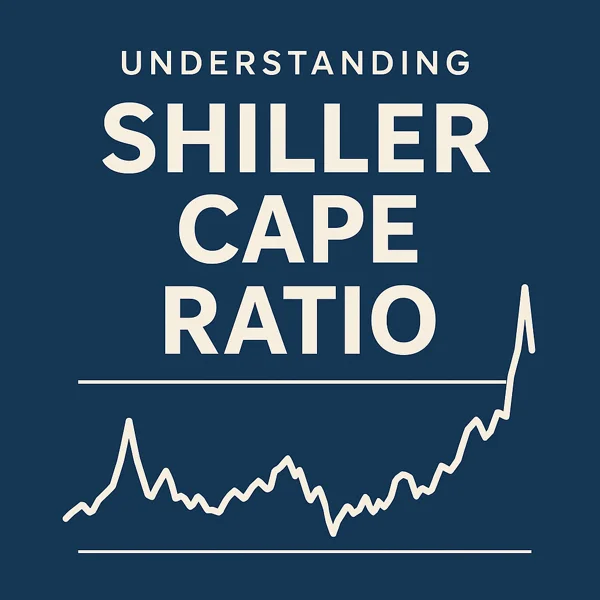
👉 Visual Suggestion: Insert a chart of CAPE ratio from 1880–2025, highlighting key peaks and troughs.
The historical pattern is clear: when CAPE is high, future long-term returns are lower. When it’s low, returns are higher.
Table – Historical CAPE Ratio at Major Market Turning Points
| Year / Event | CAPE Ratio | Market Context |
|---|---|---|
| 1929 (Pre–Great Crash) | ~32 | Market at euphoric highs before Depression |
| 1982 (Recession Low) | ~7 | Stocks cheap, high inflation and unemployment |
| 1999 (Dot-com Peak) | ~44 | Tech bubble, valuations stretched |
| 2008 (Financial Crisis) | ~15 | Market bottomed after housing collapse |
| 2025 (Today) | ~39–40 | Near record highs, tech/AI driven rally |
High CAPE levels are the market’s way of saying future returns may be thinner than the headlines suggest.
A Global Comparison – CAPE Ratios Around the World (2025)
Understanding CAPE globally puts U.S. valuations in perspective. As of late 2025:
| Market | CAPE Ratio | Historical Average | Comment |
|---|---|---|---|
| U.S. (S&P 500) | ~39–40 | 27 | Among the highest globally |
| Europe (STOXX 600) | ~22 | 18 | Moderately elevated |
| Japan (TOPIX) | ~27 | 25 | Gradual reform-driven gains |
| U.K. (FTSE All-Share) | ~18 | 16 | Fairly valued |
| Emerging Markets (MSCI EM) | ~17 | 20 | Discounted, but volatile |
Investor Insight:
When U.S. valuations run hot, international diversification becomes a powerful tool to reduce risk and capture better value opportunities elsewhere.
CAPE vs. Other Valuation Metrics
The CAPE ratio isn’t the only way to value stocks. Let’s compare:
- Forward P/E: Based on projected next-year earnings. Useful for analysts, but relies on estimates that may prove wrong.
- Price-to-Book: Compares stock prices to company book value. Helpful for asset-heavy industries, less so for tech.
- Dividend Yield: Dividends per share ÷ stock price. Valuable for income investors, but not always reflective of growth.
Strength of CAPE: Long-term smoothing makes it a reliable indicator of broad valuation.
Weakness: It’s backward-looking and doesn’t always account for structural economic changes.
Table – Average 10-Year Returns by CAPE Level
(Based on long-run U.S. historical data, rounded estimates)
| CAPE Range | Avg. 10-Year Real Return | What It Suggests |
|---|---|---|
| <10 | 10–12% per year | Excellent buying opportunity |
| 10–20 (avg.) | 6–8% per year | Normal valuation zone |
| 20–30 | 3–5% per year | Cautious zone, muted returns |
| 30–40 | 0–3% per year | Expensive, expect weak returns |
| >40 | Often negative | Rare; bubble territory |
A lofty CAPE ratio doesn’t end a bull market, but it does remind us that gravity still exists in investing.
Why Is the CAPE Ratio So High Today?
Several factors explain why today’s CAPE ratio is elevated:
- Interest rates and bond yields: With the Federal Reserve lowering rates, equities look more attractive compared to bonds. This pushes valuations higher.
- Corporate profitability: Tech giants and platform businesses generate massive profits relative to capital employed.
- Global liquidity: Central banks around the world continue accommodative policies, which supports risk-taking.
- Investor psychology: “TINA” (There Is No Alternative) still applies—many investors feel equities are the only place for returns.
Some argue “this time is different” because today’s tech economy justifies higher valuations. Others note that similar arguments appeared before past bubbles burst.
CAPE doesn’t forecast the weather of next week’s market—it sets the climate for the next decade.
Historical CAPE and Long-Term Return Correlations
History reveals a strong link between CAPE levels and future 10-year real returns.
| CAPE Range | Subsequent 10-Year Annualized Real Returns (Avg.) |
|---|---|
| Below 15 | 8–10% |
| 15–25 | 5–7% |
| 25–35 | 3–5% |
| Above 35 | 1–3% |
Example:
Investors entering the market at CAPE 40 (like in 1999) saw average real returns near 2% over the next decade.
Those investing at CAPE 13 (like in 2009) earned 8–9% annually over ten years.
📈 Takeaway: CAPE doesn’t time markets—it contextualizes long-term return potential.
Sector-Level Insights: Where Valuations Differ
While CAPE applies to the broad market, valuations vary widely by sector.
| Sector | CAPE / P-E Trend (2025) | Comment |
|---|---|---|
| Technology | 40+ | Still priced for perfection |
| Consumer Discretionary | 35 | Supported by resilient spending |
| Industrials | 28 | Stable margins, cyclical risk |
| Energy | 15 | Attractive relative valuations |
| Financials | 17 | Reasonable amid higher rates |
| Utilities | 22 | Defensive, but not cheap |
Investor Implication:
High overall CAPE doesn’t mean every sector is overvalued. Rebalancing toward undervalued areas or global markets can improve future returns without timing the market.
What High CAPE Levels Mean for Future Returns
History doesn’t repeat, but it rhymes.
- When CAPE >30, forward 10- to 15-year returns have historically been muted, often in the 3–5% annual range.
- When CAPE <10, future returns have averaged well above 10% annually.
Possible scenarios today:
- Soft landing: Market continues to climb moderately, but returns remain below historical averages.
- Correction: Elevated valuations adjust downward if earnings falter or interest rates rise.
- Melt-up: Markets ignore valuations and climb higher short-term, but that sets up more downside risk later.
Table – Investor Takeaways Based on CAPE Levels
| CAPE Level | Investor Approach |
|---|---|
| <15 (cheap) | Aggressive equity allocation; long-term buyers rewarded |
| 15–25 (fair) | Balanced portfolio; reasonable return expectations |
| 25–35 (expensive) | Diversify more; prepare for muted returns |
| 35+ (very expensive) | Focus on quality stocks, defensive assets, DCA strategies |
CAPE and Interest Rates – The Discount-Rate Connection
One key reason today’s CAPE remains high is historically low real interest rates.
When yields are low, investors accept higher valuations because future profits, when discounted, appear more valuable. However, if real rates rise—as they have in 2024–2025—the same profits become less attractive, compressing valuations.
Illustration:
- In 1982, CAPE ≈ 7 → 10-year Treasury yield ≈ 14%.
- In 2025, CAPE ≈ 39 → 10-year Treasury yield ≈ 4.4%.
🧩 Key Idea: CAPE and yields move inversely. As rates normalize, high CAPE markets face revaluation risk.
⚖️ Limitations and Criticisms of the Shiller CAPE Ratio
While the Shiller CAPE ratio offers invaluable perspective on long-term market valuations, it’s not without flaws. Understanding its limitations helps investors interpret it correctly—as a compass, not a crystal ball.
1. Accounting and Earnings Changes
Corporate accounting standards have evolved dramatically since the early 20th century.
- Modern earnings now reflect share buybacks, lower corporate taxes, and higher margins, all of which boost reported profitability relative to earlier decades.
- As a result, CAPE may appear artificially elevated, even if valuations aren’t as extreme in real economic terms.
2. Interest Rates and the Discount-Rate Effect
CAPE doesn’t directly incorporate interest rates or inflation expectations.
- In periods of low real yields, investors are willing to pay more for future earnings, justifying higher CAPE ratios.
- Critics argue that comparing today’s CAPE to historical norms—like the 1980s, when yields were above 10%—is not an apples-to-apples comparison.
3. Sector and Structural Shifts
The economy has transformed from industrial to digital, with intangible assets (like software and data) now driving value.
- Traditional measures of “book value” and even “earnings” can understate the profitability of tech and service firms.
- This makes historical CAPE comparisons less precise, especially when comparing 1950s manufacturing markets to today’s tech-dominated landscape.
4. Backward-Looking Nature
CAPE relies on the past 10 years of earnings, which means it adjusts slowly to structural economic change.
- For instance, temporary recessions or pandemic-era earnings collapses can skew the denominator, exaggerating valuations for several years afterward.
5. Not a Market-Timing Tool
Perhaps the most important limitation: CAPE doesn’t tell you when markets will correct.
- High CAPE readings can persist for years, as seen from 2015 through 2025, when valuations remained elevated while markets still advanced.
- Its value lies in setting long-term expectations and guiding risk-aware decisions, not calling tops or bottoms.
📊 Table: CAPE vs. Other Valuation Metrics
| Metric | What It Measures | Strengths | Weaknesses |
|---|---|---|---|
| Shiller CAPE | Price ÷ 10-yr avg. inflation-adjusted earnings | Smooths cycles, captures long-term valuation context | Backward-looking, doesn’t reflect rate environment |
| Forward P/E | Price ÷ forecast next-year earnings | Forward-looking, incorporates growth outlook | Relies on analyst estimates, often overly optimistic |
| Price-to-Book (P/B) | Price ÷ book value of equity | Useful for financials or asset-heavy sectors | Less relevant for tech or service firms with intangibles |
| Dividend Yield | Dividends ÷ price | Easy to calculate, income indicator | Yields are structurally low; poor return predictor alone |
| EV/EBITDA | Enterprise value ÷ operating cash flow | Neutral to capital structure, good for comparisons | Ignores capital intensity and long-term growth |
📈 Investor takeaway: The CAPE ratio complements—not replaces—other valuation tools. Use it alongside forward P/E, earnings yield, and macro indicators for a well-rounded view of market valuation.
🧠 Behavioral Finance – Why Investors Ignore CAPE
Despite strong evidence linking high CAPE ratios to lower long-term returns, investors often downplay or dismiss these warnings. The reasons lie more in human psychology than in financial theory.
1. Recency Bias
Investors tend to believe that the recent past will continue indefinitely. After years of strong market gains, it’s easy to assume, “This time, it’s different.”
- CAPE contradicts this comfort—it reminds investors that valuations eventually revert to historical norms.
2. Overconfidence
Many believe they can “get out in time” before a correction. In reality, very few do.
- Behavioral studies show that overconfidence leads to late exits, poor timing, and missed rebounds once fear sets in.
3. Herd Behavior
Market optimism feeds itself. When others are buying, fear of missing out (FOMO) overrides caution.
- This collective behavior inflates valuations well beyond fundamentals, keeping CAPE elevated longer than logic would suggest.
4. Present Bias and Reward Chasing
Investors prioritize immediate gains over long-term prudence.
- A CAPE reading warning of 3–5% long-term returns feels abstract compared to this quarter’s rally or next month’s earnings report.
5. “This Time Is Different” Thinking
Every generation finds reasons to believe the rules of valuation no longer apply—whether it’s the internet boom, the housing bubble, or the AI revolution.
- While innovation changes the economy, it rarely changes the math of long-term returns.
💡 Smart Investor Insight
CAPE is a behavioral guardrail. It doesn’t tell you when to sell—it tells you how much optimism is already priced in.
The disciplined investor uses CAPE not as a market call, but as a reality check—a reminder to stay diversified, patient, and humble when markets feel invincible.
How Individual Investors Should Use CAPE
The CAPE ratio is a compass, not a stopwatch. It tells us where we stand in broad terms but doesn’t say when the market will move.
Practical applications:
- Set realistic expectations: High CAPE = lower long-term returns. Don’t base retirement plans on 10% annual returns if CAPE is near 40.
- Diversify: Consider bonds, international stocks, or alternatives to balance U.S. equity exposure.
- Dollar-cost averaging: Spreads risk over time and avoids lump-sum exposure at high valuations.
- Stay disciplined: Focus on your financial plan, not short-term market predictions.
Table – Factors Driving High CAPE Today
| Factor | Impact on Valuations |
|---|---|
| Low interest rates & bond yields | Push investors toward stocks, boosting P/Es |
| Strong corporate profits | Higher earnings support higher multiples |
| Global liquidity & central banks | Easy money sustains risk-taking |
| Tech sector dominance | Higher profitability, but raises concentration risk |
| Investor psychology (TINA) | “There Is No Alternative” mindset keeps money in stocks |
🧩 Conclusion — Interpreting the Shiller CAPE Ratio
The Shiller CAPE ratio continues to flash caution. At nearly 40, valuations across U.S. equities are among the highest on record—levels historically linked with lower future real returns.
But high CAPE readings don’t guarantee an imminent correction. Markets can remain elevated for years, especially during periods of innovation, global capital inflows, and structurally lower interest rates.
What CAPE Really Tells Us
CAPE is best understood not as a market-timing alarm, but as a strategic planning tool. It offers perspective, helping investors align their portfolios with long-term reality rather than short-term emotion.
When CAPE is high, the message isn’t “sell”—it’s “be selective, diversified, and disciplined.”
When it’s low, it’s often the moment to lean in with confidence and consistency.
How to Use CAPE Wisely
- Set Realistic Return Expectations: Adjust financial plans to reflect likely 10–15 year returns closer to 3–5% instead of historical averages of 8–10%.
- Diversify Broadly: Consider global equities, bonds, and alternative assets where valuations are more reasonable.
- Rebalance and Stay Invested: Periodically trimming overperforming sectors and reinvesting in undervalued areas maintains balance through cycles.
- Plan, Don’t Predict: CAPE is most powerful when it shapes expectations—not short-term actions.
Final Thought
A high CAPE ratio isn’t a reason to panic. It’s a reason to plan.
Investors who stay informed, maintain discipline, and commit to a long-term strategy will continue building wealth—even in a richly valued market.
The lesson of CAPE is timeless: focus on what you can control—diversification, savings, and patience—and let valuation awareness guide your decisions, not dictate them.
