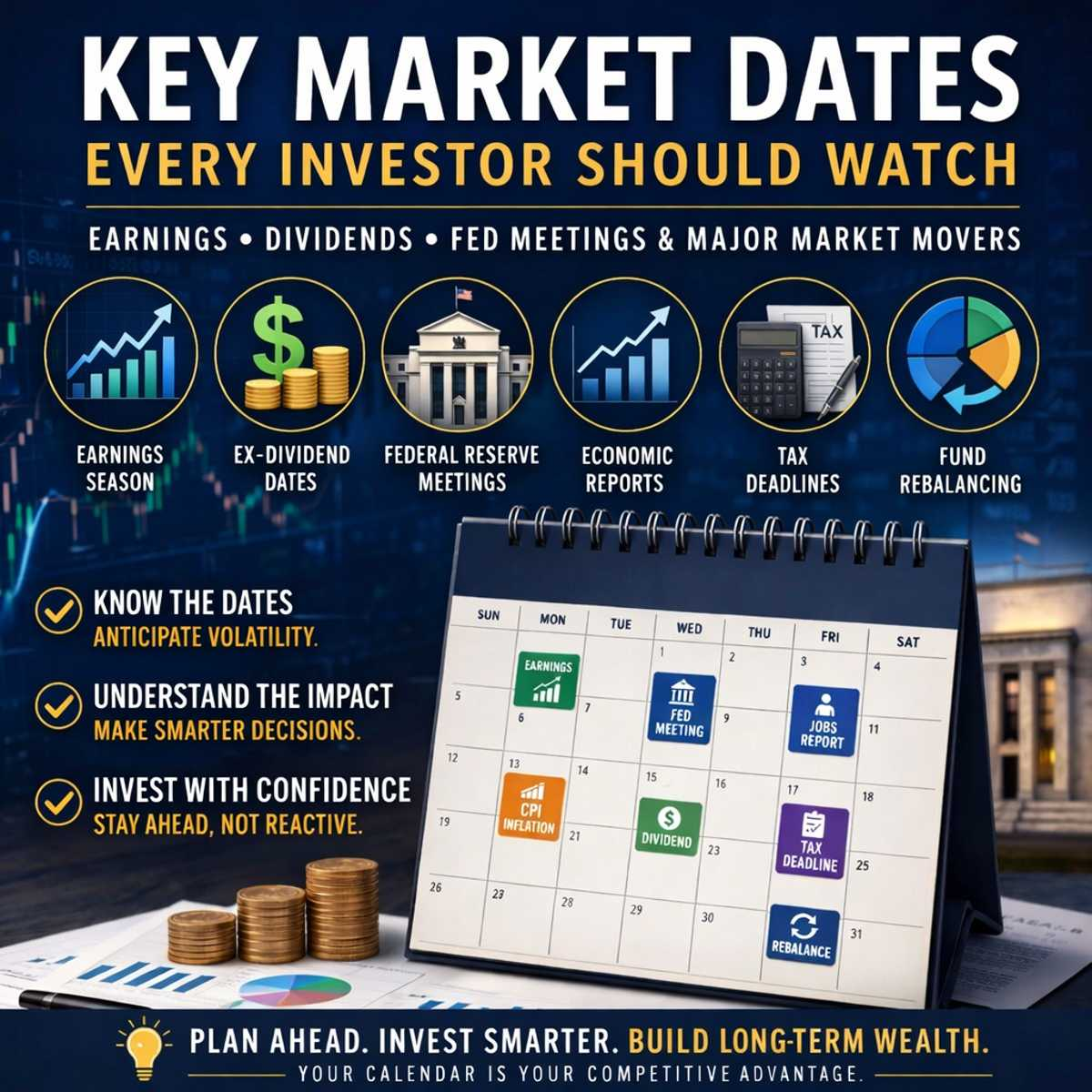
📅 Introduction — Why Market Timing Starts With the Calendar
Markets don’t move randomly—they follow a calendar.
Earnings reports, Federal Reserve decisions, dividend payouts, and tax deadlines all act as predictable catalysts that influence market volatility, investor sentiment, and long-term returns.
For investors, understanding these key market dates isn’t about trying to time the market perfectly—it’s about preparing for what’s already scheduled.
By recognizing when major financial events occur, you can anticipate periods of volatility, plan investment decisions more strategically, and avoid reacting emotionally to market noise.
In this guide, you’ll learn:
- The most important financial events that move markets
- When they occur throughout the year
- How to use them to make more informed, strategic investment decisions
👉 Whether you’re a long-term investor or actively managing a portfolio, building awareness around the market calendar helps you stay proactive—not reactive.
🧭 Key Takeaways
- Financial markets follow predictable cycles driven by earnings, policy decisions, and economic data
- Earnings season is a major driver of volatility and reveals underlying business performance
- Ex-dividend dates determine income eligibility and often influence short-term stock pricing
- Federal Reserve meetings frequently trigger significant market movement
- Economic reports (inflation, employment, GDP) shape interest rate expectations and investor sentiment
- Building a personal investor calendar helps reduce emotional decision-making and improve consistency
👉 Investors who prepare for key market dates tend to make more disciplined, long-term financial decisions.
📅 Annual Market Calendar Snapshot
Understanding the rhythm of the financial markets starts with knowing when key events typically occur. Use this snapshot as a high-level reference point throughout the year:
| Event Type | Typical Timing | Why It Matters |
|---|---|---|
| Earnings Season | Jan–Feb, Apr–May, Jul–Aug, Oct–Nov | Drives stock volatility and valuation changes |
| Federal Reserve Meetings | ~8 times per year | Impacts interest rates, liquidity, and market direction |
| Ex-Dividend Dates | Ongoing (quarterly/monthly cycles) | Determines income eligibility and affects stock pricing |
| Inflation Reports (CPI/PCE) | Monthly | Signals potential interest rate changes |
| Jobs Reports (Nonfarm Payrolls) | Monthly | Measures economic strength and labor market trends |
| Tax Deadlines | April + year-end | Influences investment timing and tax strategy decisions |
| Fund Rebalancing | Quarterly + year-end | Creates institutional buying and selling pressure |
📈 How to Use This Snapshot
Think of this table as your baseline investing framework:
- Use it to anticipate periods of higher volatility
- Align investment decisions with known catalysts instead of headlines
- Build a repeatable system for tracking market-moving events
👉 The more familiar you become with these cycles, the more confident and disciplined your investment decisions will become.
1. Why Market Dates Matter
Financial markets follow a pattern that blends corporate behavior, macroeconomic policy, and investor psychology.
By learning when these forces typically align, you can avoid emotional decisions and take a more strategic approach to investing.
Here’s why key dates matter:
1. Some Volatility Isn’t Random — It’s Rhythmic
Price swings often cluster around known events: quarterly earnings, inflation reports, and interest rate announcements. These are not surprises — they’re scheduled market stress tests. Understanding when they occur helps you stay calm during the noise.
Example: When the Federal Reserve releases its interest rate decision, the S&P 500’s average intraday move historically doubles compared to non-Fed days. (Source: CME Group Volatility Data)
2. Long-Term Returns Are Built on Planning
Dividends, rebalancing, and tax deadlines affect portfolio cash flow and after-tax returns. Investors who coordinate reinvestments, capital gains realization, and contributions with these cycles can compound wealth more efficiently.
Example: Missing an IRA contribution deadline or reinvesting dividends late can cost thousands in long-term compounding value.
3. Opportunities Hide in Predictable Patterns
Market pullbacks during earnings season or year-end volatility can create discounted entry points for patient investors. Recognizing these recurring patterns turns uncertainty into opportunity.
Example: Historically, equities under pressure during late October earnings often rebound into year-end as funds rebalance and holiday optimism boosts sentiment.
Bottom Line:
Investing success isn’t about predicting the future — it’s might be starting to include preparing for the calendar. By aligning your strategy with key market dates, you shift from reacting to headlines to proactively managing your portfolio like a professional.
2. Earnings Season – The Market’s Report Card
Earnings season is when publicly traded companies “open their books” to investors, releasing quarterly financial results that reveal how well the business performed. These updates form the heartbeat of the stock market — shaping valuations, investor sentiment, and even the direction of the broader economy.
When It Happens
Companies report earnings four times a year:
- Q4 results: January–February
- Q1 results: April–May
- Q2 results: July–August
- Q3 results: October–November
Each period corresponds to the previous quarter’s business performance. For example, Q4 earnings released in January reflect results from October through December.
Why It Matters
Earnings season isn’t just about profits — it’s about expectations versus reality.
Stocks move when actual results differ from Wall Street forecasts:
- Earnings beats often trigger short-term rallies.
- Earnings misses can lead to sharp sell-offs.
- Guidance (the company’s forward outlook) can be even more influential than past results.
For instance, a company might beat current earnings but issue a weak forecast — causing the stock to drop despite good news.
What to Watch
- Market Bellwethers:
Companies like Apple, Microsoft, JPMorgan, and Amazon are considered market “thermometers.” Their results can influence entire sectors — or even the entire index.- Strong tech earnings often boost the NASDAQ.
- Robust bank earnings early in the season tend to set the tone for the S&P 500.
- Weak industrial or transportation numbers can hint at slowing growth.
- Earnings Trends:
Look beyond a single company. Are margins expanding or shrinking across the sector? Are firms beating on revenue or relying on cost cuts? These patterns often foreshadow the next quarter’s economic conditions. - Earnings Calls:
Listen for management tone and language — especially mentions of inflation, demand, or layoffs. Subtle wording can move markets before official numbers do.
Investor Tips
- Don’t trade emotionally. Prices can swing wildly on earnings day due to short-term speculation. Focus on fundamentals and long-term positioning.
- Monitor implied volatility. Options pricing often spikes before major reports — signaling expected turbulence.
- Create an “Earnings Calendar.” Use resources like Yahoo Finance, Nasdaq, or Investing.com to track companies you own or plan to buy.
- Use volatility to your advantage. Long-term investors can buy quality stocks at discounted prices after overreactions.
Example Insight
During the 2024 Q3 earnings season, roughly 78% of S&P 500 companies beat analyst expectations, yet the index moved modestly. Why? Many companies beat on cost-cutting rather than revenue growth — showing that not all “beats” are equal. Understanding why earnings surprise helps you distinguish true growth from temporary boosts.
🎯 How to Use Earnings Season Strategically
- Review holdings before earnings announcements
- Avoid short-term emotional trading based on headlines
- Look for overreactions as potential buying opportunities
- Focus on revenue growth and forward guidance, not just earnings beats
👉 Long-term investors benefit most by using earnings volatility as an opportunity—not a signal to panic
3. Ex-Dividend Dates and Payout Cycles – Timing Your Income Strategy
Dividends may not make headlines like earnings reports, but for long-term investors, they are a cornerstone of steady, compounding wealth.
Knowing how and when companies pay dividends can help you plan for cash flow, reinvestment, and even tax efficiency.
Definition
The ex-dividend date is the key cutoff date for receiving a company’s next dividend payment.
If you purchase the stock on or after the ex-dividend date, you won’t receive that upcoming payout — it goes to the seller.
The dividend timeline typically follows this order:
- Declaration Date: Company announces the dividend amount and payment schedule.
- Ex-Dividend Date: Buyers after this date don’t receive the dividend.
- Record Date: The company confirms shareholders eligible for payment.
- Payment Date: Dividend is deposited into shareholder accounts.
Why It Matters
On the ex-dividend date, a stock’s price often drops by roughly the dividend amount. For example, if a stock trades at $100 and issues a $1 dividend, it may open around $99 the next day.
This adjustment reflects the fact that new buyers won’t receive the upcoming payout.
However, many factors — including investor sentiment, buybacks, or earnings momentum — can affect the actual price move.
Key Timing Cycles
Most companies follow a quarterly dividend cycle, typically paying in March, June, September, and December.
Some firms (especially REITs and ETFs) pay monthly, providing more frequent income streams for investors seeking consistent cash flow.
Investor Tips
- Track dividend schedules. Use reliable calendars such as Nasdaq Dividend Calendar, MarketBeat, or Seeking Alpha to monitor ex-dividend and payment dates.
- Reinvest strategically. Automatic Dividend Reinvestment Plans (DRIPs) can significantly boost long-term returns through compounding.
- Mind the taxes. Qualified dividends often enjoy lower tax rates, while non-qualified dividends (such as REITs or certain foreign stocks) may be taxed as ordinary income.
- Avoid dividend traps. Exceptionally high yields can indicate financial distress or unsustainable payout ratios.
Example Insight
If you held shares of Coca-Cola before its ex-dividend date of September 13, 2025, you’d be eligible for the next quarterly payment of $0.46 per share — even if you sold the stock a few days later. Understanding this sequence helps investors plan purchases and sales around predictable income events.
Educational Takeaway:
Both earnings announcements and dividend dates reveal critical parts of a company’s financial story — one shows growth, the other shows stability.
Successful investors track both to balance opportunity with reliability, aligning short-term volatility with long-term goals.
💡 Strategic Dividend Planning Tips
- Align dividend income with your cash flow needs
- Use DRIPs selectively—not automatically in all market conditions
- Evaluate yield vs. sustainability, not just high payouts
4. 🏦 Federal Reserve Meetings and Interest Rate Announcements — The Market’s Pulse
Few events move global markets more consistently—and more predictably—than the meetings of the Federal Open Market Committee (FOMC), the policy-making arm of the Federal Reserve.
These meetings act as a central control point for the financial system, influencing everything from mortgage rates and bond yields to stock valuations and global capital flows.
For investors, Federal Reserve decisions aren’t surprises—they’re scheduled catalysts that can be anticipated and strategically managed.
📅 When Federal Reserve Meetings Occur
The FOMC typically meets eight times per year, approximately every six weeks, to evaluate economic conditions and determine monetary policy.
🗓 Typical Meeting Months:
- January
- March
- May
- June
- July
- September
- November
- December
Each meeting concludes with:
- An official policy statement (2:00 p.m. ET)
- A press conference from the Fed Chair (selected meetings)
- A Summary of Economic Projections (SEP) published quarterly
📊 What Is the “Dot Plot”?
The SEP includes the widely watched “dot plot,” which shows where policymakers expect interest rates to move in the future.
👉 Markets often react more strongly to these forward expectations than to the current rate decision itself.
📊 Why Federal Reserve Decisions Move Markets
Interest rates represent the cost of money—and when that cost changes, it affects nearly every part of the economy.
🔄 Impact of Interest Rate Changes
| Area | Impact of Rising Rates | Impact of Falling Rates |
|---|---|---|
| Loans & Mortgages | Higher borrowing costs slow demand | Lower costs stimulate borrowing |
| Bond Yields | New bonds offer higher yields; existing bond prices fall | Yields decline; bond prices rise |
| Stock Valuations | Growth stocks often decline due to higher discount rates | Growth and tech stocks tend to rally |
| U.S. Dollar | Strengthens as investors seek higher yields | Weakens as capital flows outward |
| Inflation | Helps cool demand and price pressures | Can reaccelerate inflation if too loose |
👉 Even small rate adjustments can trigger broad market repricing across asset classes.
⚡ How Markets React to Fed Announcements
Understanding the timeline of market reactions is critical for staying disciplined:
📉 Before the Meeting
- Markets “price in” expectations based on data like inflation and employment
- Volatility may increase as uncertainty builds
⚡ During the Announcement
- Sharp movements often occur within minutes of the 2:00 p.m. ET release
- Additional volatility follows during the Fed Chair’s press conference
📈 After the Meeting
- Markets reassess based on long-term implications
- Initial reactions may reverse once investors digest the full message
📊 Historically, the S&P 500 experiences significantly larger intraday swings on FOMC days compared to typical sessions (CME Group volatility data).
👉 These are not random spikes—they are structured repricing events driven by new policy signals.
🧠 What Matters Most: Policy Direction, Not Headlines
Many investors focus on whether the Fed raised or cut rates—but the real signal lies in direction and communication.
Key elements to monitor:
- Forward Guidance: Signals about future rate changes
- Economic Projections: Inflation, unemployment, and GDP outlook
- Dot Plot Trends: Shifts in policymakers’ expectations
- Language & Tone: Subtle wording changes can move markets quickly
👉 Markets often react more to what the Fed suggests is coming next than what it just did.
🎯 Investor Strategy — How to Navigate Fed Meetings
Disciplined investors treat Fed meetings as planned checkpoints, not surprises.
✅ Before the Meeting
- Review portfolio exposure to interest-rate-sensitive assets
- Avoid large speculative moves based on short-term predictions
- Understand what the market has already priced in
✅ During the Event
- Expect volatility—it’s normal and temporary
- Avoid reacting to headlines without full context
✅ After the Meeting
- Focus on trends rather than initial reactions
- Look for opportunities created by overreactions
💡 Practical Portfolio Adjustments
- Rising Rate Environment:
- Favor short-duration bonds and cash equivalents
- Be cautious with high-growth, high-valuation stocks
- Falling Rate Environment:
- Longer-duration bonds become more attractive
- Growth stocks and risk assets often benefit
- Watch the Yield Curve:
- An inverted yield curve has preceded every U.S. recession since the 1970s
🧾 Educational Takeaway
You don’t need to predict the Federal Reserve to invest successfully.
What matters is understanding how its decisions flow through the financial system—impacting borrowing costs, asset prices, and economic momentum.
👉 By aligning your strategy with interest rate trends, you move from reacting to market noise to positioning for long-term opportunity.
5. Economic Data That Moves Markets – Reading the Economy’s Dashboard
While company earnings and Fed meetings grab headlines, the heartbeat of the market comes from government economic reports. These releases guide Federal Reserve policy, shape investor sentiment, and set the tone for each trading week.
Understanding what these reports measure — and how markets interpret them — helps investors connect the dots between economic trends and portfolio performance.
The Most Market-Moving Reports
| Report | Frequency | Typical Release Timing | Why It Matters to Investors |
|---|---|---|---|
| Jobs Report (Nonfarm Payrolls) | Monthly | First Friday | Measures employment growth and wage trends. Strong numbers suggest a healthy economy — but may also signal inflation pressures. |
| Consumer Price Index (CPI) | Monthly | Mid-month | The most watched inflation gauge. Rising CPI often fuels expectations for higher interest rates. |
| Producer Price Index (PPI) | Monthly | Mid-month | Tracks wholesale prices. Helps forecast future inflation at the consumer level. |
| Gross Domestic Product (GDP) | Quarterly | End of each quarter | Reflects the overall pace of economic growth or contraction. A key measure for recession risk. |
| Retail Sales | Monthly | Mid-month | Indicates consumer spending strength, which drives about 70% of U.S. GDP. |
| Consumer Confidence & ISM Surveys | Monthly | Early to mid-month | Gauges sentiment among consumers and businesses — often early signals of future spending and hiring trends. |
How Markets Interpret the Data
- Strong reports (e.g., hot CPI or robust jobs data) may cause bond yields to rise and stocks to pull back — as investors expect tighter Fed policy.
- Weak reports (e.g., slowing retail sales or rising unemployment) may spark rallies in bonds and defensive sectors like healthcare or utilities.
- Mixed signals often lead to short-term volatility but longer-term opportunity as investors reassess fundamentals.
Example:
When the CPI came in lower than expected in July 2024, growth stocks surged as markets priced in a potential Fed pause — demonstrating how one data point can shift sentiment across asset classes.
Investor Tips
- Know the release calendar. Reports like CPI, PPI, and Nonfarm Payrolls are pre-scheduled — you can find dates on the Bureau of Labor Statistics or U.S. Census Bureau websites.
- Watch revisions. Markets often move more on data revisions than the original report, especially for jobs and GDP.
- Think sector-by-sector. Inflation-sensitive sectors (tech, consumer discretionary) react differently than defensive ones (utilities, staples).
- Stay diversified. These reports affect asset classes differently — diversification helps cushion against overreaction.
Educational Takeaway
Economic data tells the story of where we’ve been — but the market trades on where we’re going.
By tracking key reports and understanding their implications, you gain perspective on why markets move and develop the patience and confidence that define successful long-term investors.
6. Mutual Fund and ETF Rebalancing Dates – The Quiet Market Movers
Many investors focus on headlines from earnings reports or the Federal Reserve, but institutional portfolio rebalancing can move billions of dollars in a single day.
When mutual funds and ETFs adjust their holdings to maintain target weightings — by sector, style, or index — it can trigger large-scale buying or selling across entire markets.
When It Happens
- Quarterly (March, June, September, December):
Most index-tracking and balanced mutual funds realign portfolios near the end of each quarter, typically in the last 3–5 trading days. - Semiannually (June & December):
Many target-date funds and pension plans rebalance mid-year and at year-end. - Annually (December):
Broad rebalancing coincides with tax-loss harvesting, window dressing, and year-end fund reporting.
Why It Matters
- Increased Volume and Volatility: Rebalancing often leads to noticeable spikes in trading volume and intraday price swings — especially in large-cap indices like the S&P 500 and Nasdaq 100.
- Index Adjustments: When major benchmarks (e.g., S&P, Russell) add or remove stocks, institutional funds tracking those indexes must rebalance accordingly.
- Sector Shifts: Shifts from growth to value, or domestic to international exposure, can subtly redirect flows that influence short-term market performance.
Investor Tip
- Watch for index reconstitution dates, such as the Russell Index rebalancing in late June — one of the year’s largest single-day trading events.
- If you’re a long-term investor, avoid impulsive trades during these weeks.
- For active traders, short-term dislocations around these events can present tactical opportunities.
7. Tax Deadlines and Year-End Planning Dates
Tax dates can shape both short-term cash flow and long-term wealth.
Key milestones for investors:
- April 15: Federal tax filing deadline (and last day to make prior-year IRA contributions).
- October 15: Extension filing deadline.
- December 31:
- Deadline for Roth conversions and Required Minimum Distributions (RMDs).
- Final day for tax-loss harvesting and charitable donations that count for the year.
Pro tip: Set quarterly reminders to review your taxable accounts and rebalance before December rushes in.
8. Market Seasonality – Understanding Historical Trends
While no pattern guarantees results, historical data shows recurring behaviors:
| Period | Trend | Typical Reasoning |
|---|---|---|
| January | “January Effect” — small-cap strength | Tax-loss selling reversal |
| May–August | Lower trading volumes | Summer slowdown; “Sell in May” |
| October | High volatility month | Earnings + election fears |
| November–December | “Santa Claus Rally” | Optimism, fund rebalancing |
Awareness of these tendencies helps you set realistic expectations and avoid panic during seasonal pullbacks.
9. Global and Geopolitical Market Movers
Even domestic investors should pay attention to global catalysts:
- OPEC meetings → oil price volatility
- European Central Bank (ECB) rate decisions → currency and global bond effects
- Major elections or wars → heightened volatility and safe-haven flows (gold, treasuries, USD)
Diversifying across regions and sectors can cushion your portfolio from sudden shocks.
10. Building Your Personalized Investor Calendar
Turn this knowledge into a practical system:
- Use tools like Google Calendar, Yahoo Finance, or Seeking Alpha alerts.
- Categorize by color:
🟢 Earnings | 🔵 Dividends | 🔴 Fed Meetings | 🟣 Tax Deadlines - Schedule monthly reviews to stay aligned with both market cycles and personal financial goals.
Proactive investors don’t just watch markets — they anticipate them.
Takeaways
✅ Track quarterly earnings to anticipate volatility.
✅ Know your ex-dividend dates to time income investing.
✅ Watch FOMC meetings and inflation reports for rate clues.
✅ Align your year-end tax and retirement moves with the calendar.
✅ Use alerts to stay proactive, not reactive.
🗓 Key 2025 Market Dates Every Investor Should Know
The following list outlines the most important recurring events investors should track during 2025.
While exact release times may vary, these dates provide a reliable framework for planning, analysis, and portfolio reviews.
1. Quarterly Earnings Seasons
Public companies typically report results a few weeks after each fiscal quarter ends.
| Earnings Season | Approximate Period | Focus Sectors to Watch |
|---|---|---|
| Q4 2024 Results | Jan 10 – Feb 28, 2025 | Banking, Tech, Industrials |
| Q1 2025 Results | Apr 10 – May 31, 2025 | Tech, Consumer, Healthcare |
| Q2 2025 Results | Jul 10 – Aug 30, 2025 | Energy, Industrials, Consumer |
| Q3 2025 Results | Oct 10 – Nov 30, 2025 | Tech, Financials, Retail |
Investor Tip:
Track earnings release dates for your holdings on platforms like Nasdaq Earnings Calendar or Yahoo Finance. Volatility tends to rise during the first two weeks of each season.
2. Federal Reserve (FOMC) Meeting Schedule
The Fed meets eight times a year to set monetary policy.
(Source: FederalReserve.gov — official 2025 calendar)
| Meeting # | Dates | Announcement Time (ET) |
|---|---|---|
| 1 | January 28–29, 2025 | 2:00 p.m. |
| 2 | March 18–19, 2025 | 2:00 p.m. |
| 3 | May 6–7, 2025 | 2:00 p.m. |
| 4 | June 17–18, 2025 | 2:00 p.m. |
| 5 | July 29–30, 2025 | 2:00 p.m. |
| 6 | September 16–17, 2025 | 2:00 p.m. |
| 7 | November 5–6, 2025 | 2:00 p.m. |
| 8 | December 16–17, 2025 | 2:00 p.m. |
Investor Tip:
Mark these dates — markets often experience large intraday moves within hours of Fed statements and press conferences.
3. Major Economic Data Release Windows
| Report | Frequency | Typical Release Date (Monthly/Quarterly) | Impact Focus |
|---|---|---|---|
| Jobs Report (Nonfarm Payrolls) | Monthly | First Friday of each month | Employment, wage growth, inflation |
| Consumer Price Index (CPI) | Monthly | Around the 12th–14th | Inflation and Fed rate expectations |
| Producer Price Index (PPI) | Monthly | 1–2 days after CPI | Wholesale price trends |
| Retail Sales Report | Monthly | Around the 15th | Consumer spending, GDP outlook |
| GDP Growth (Advance Estimate) | Quarterly | Jan 30, Apr 30, Jul 30, Oct 30 | Economic expansion/contraction |
| Consumer Confidence Index | Monthly | Last Tuesday of the month | Sentiment and spending outlook |
Investor Tip:
Economic calendars like Investing.com or MarketWatch provide real-time release schedules and analyst forecasts.
4. U.S. Tax Deadlines for Investors
| Date | Event | Details |
|---|---|---|
| January 31, 2025 | Form 1099 Issued | Brokers send out annual tax documents |
| April 15, 2025 | Tax Filing Deadline | File 2024 federal return and fund IRA/HSA contributions |
| June 16, 2025 | Q2 Estimated Tax Payment | For self-employed or investment income |
| September 15, 2025 | Q3 Estimated Tax Payment | Avoid underpayment penalties |
| October 15, 2025 | Extended Return Filing | Final deadline for tax extensions |
| December 31, 2025 | Year-End Moves | RMDs, tax-loss harvesting, Roth conversions, charitable donations |
Investor Tip:
Tax-efficient investing includes timing capital gains and losses strategically before December 31.
5. Mutual Fund & ETF Rebalancing Periods
Institutional funds and ETFs adjust holdings quarterly or semiannually to maintain index weighting and risk targets.
| Event | Typical Timing | Market Impact |
|---|---|---|
| Quarterly Fund Rebalancing | Last week of Mar, Jun, Sep, Dec | Sector rotation, increased volume |
| Semiannual Pension & Target-Date Fund Rebalancing | June & December | Broad-based equity/bond adjustments |
| Russell Index Reconstitution | Friday, June 27, 2025 | One of the highest trading-volume days of the year |
| S&P 500 & Nasdaq Quarterly Rebalances | Mid-March, mid-June, mid-September, mid-December | Adjustments to index components and weights |
Investor Tip:
Expect volatility and higher volume during rebalancing windows — these are often opportunities to accumulate shares of temporarily pressured stocks.
6. Dividend Payment Cycles
Most U.S. dividend-paying companies follow a quarterly payout schedule, but ex-dividend dates vary by company.
| Quarter | Typical Ex-Dividend Months | Common Payment Month |
|---|---|---|
| Q1 | March | April |
| Q2 | June | July |
| Q3 | September | October |
| Q4 | December | January (of following year) |
Investor Tip:
Check company announcements 2–3 weeks in advance. To receive the next dividend, investors must own the stock before the ex-dividend date.
7. Year-End Portfolio Planning Milestones
| Month | Action Item | Purpose |
|---|---|---|
| January | Review goals, rebalance allocations | Set strategy for new year |
| April | Tax filing and IRA funding | Maximize deductions and contributions |
| June | Mid-year checkup | Adjust for performance or risk drift |
| September | Review estimated tax and Q3 positioning | Prepare for Q4 volatility |
| December | Final portfolio review | Harvest losses, meet RMDs, donate appreciated assets |
Investor Tip:
Schedule portfolio reviews quarterly — aligning them with earnings or rebalancing cycles increases consistency and discipline.
Educational Takeaway
Markets aren’t random — they operate on a structured calendar of predictable events.
By tracking these key dates, you transform your investing approach from reactive to strategic — allowing you to plan entries, adjust risk, and capitalize on opportunities before they make headlines.
🗓 2025 Investor Market Calendar – Key Dates to Watch All Year
This timeline brings together the most important earnings cycles, Federal Reserve meetings, economic reports, rebalancing events, and tax deadlines — all in one place.
Use it as your financial roadmap to anticipate volatility, plan investments, and align year-end tax and retirement strategies.
🕊 January 2025 – The Market Reset
- Jan 1: New Year’s Day (markets closed).
- Jan 10–Feb 28: Q4 2024 Earnings Season begins — focus on banks, retail, and tech.
- Jan 12–14: CPI and PPI inflation reports.
- Jan 24: Advance Q4 GDP estimate (first look at 2024 growth).
- Jan 28–29: FOMC Meeting #1 — first rate decision of 2025.
- Jan 31: Brokers issue Form 1099s for tax season.
📊 Investor Focus: Start-of-year rebalancing, IRA/401(k) contributions, and early guidance from corporate earnings.
💼 February 2025 – Post-Earnings Positioning
- Feb 2: January Jobs Report (first Friday).
- Feb 12–14: CPI/PPI inflation updates.
- Feb 20: FOMC minutes from January meeting (insight into rate path).
- All month: Late Q4 earnings from tech giants and industrials.
📊 Investor Focus: Analyze forward guidance and earnings quality; prepare for potential bond yield shifts if inflation surprises.
💰 March 2025 – Fed, Funds, and Fiscal Deadlines
- Mar 1–31: Typical mutual fund and ETF Q1 rebalancing period begins.
- Mar 7: February Jobs Report.
- Mar 12–14: CPI/PPI data.
- Mar 18–19: FOMC Meeting #2 — includes updated “dot plot” and projections.
- Mar 30: End of Q1; institutional portfolio rebalancing.
📊 Investor Focus: Expect volatility around the Fed meeting and quarter-end adjustments. Reassess bond duration and equity exposure.
🌷 April 2025 – Taxes and Transitions
- Apr 1–30: Q1 2025 Earnings Season begins (financials report first).
- Apr 10–12: CPI/PPI releases.
- Apr 15: Tax Filing Deadline – also last day to fund 2024 IRA or HSA contributions.
- Apr 30: Q1 GDP report.
📊 Investor Focus: Combine tax planning with portfolio review. Consider deploying refunds or rebalancing before next Fed cycle.
🏡 May 2025 – Mid-Spring Market Moves
- May 2: April Jobs Report.
- May 6–7: FOMC Meeting #3.
- May 12–14: Inflation data.
- May 31: Q1 earnings wrap-up.
📊 Investor Focus: Watch for tech and retail guidance; May volatility often foreshadows summer slowdowns (“Sell in May?”).
🌞 June 2025 – Midyear Checkpoint
- June 6: May Jobs Report.
- June 12–14: CPI/PPI data.
- June 16: Q2 estimated tax payments due.
- June 17–18: FOMC Meeting #4.
- June 27: Russell Index Reconstitution Day — one of the highest-volume trading days of the year.
- June 30: Quarter-end mutual fund/ETF rebalancing.
📊 Investor Focus: Midyear portfolio audit; prepare for possible interest rate shifts and large index-driven volatility.
📈 July 2025 – Earnings Heat Up Again
- July 4: U.S. Independence Day (markets closed).
- July 10–Aug 30: Q2 2025 Earnings Season begins — watch tech and consumer discretionary.
- July 12–14: Inflation data.
- July 29–30: FOMC Meeting #5.
- July 30: Q2 GDP advance estimate.
📊 Investor Focus: Earnings quality and Fed commentary drive summer sentiment; inflation surprises may redirect market leadership.
🏖 August 2025 – The Quiet Volatility
- Aug 1: July Jobs Report.
- Aug 12–14: CPI/PPI reports.
- Aug 30: End of Q2 earnings.
📊 Investor Focus: Historically thin summer trading can exaggerate market swings — avoid overreacting to headlines.
🍂 September 2025 – Fed and Fund Adjustments
- Sept 5: August Jobs Report.
- Sept 12–14: CPI/PPI data.
- Sept 15: Q3 estimated tax payment due.
- Sept 16–17: FOMC Meeting #6.
- Sept 30: Quarter-end mutual fund and ETF rebalancing.
📊 Investor Focus: Volatility often spikes in September — a prime time for disciplined investors to accumulate long-term holdings.
🏛 October 2025 – Earnings and Election Energy
- Oct 1–31: Q3 2025 Earnings Season begins.
- Oct 3: September Jobs Report.
- Oct 12–14: CPI/PPI updates.
- Oct 30: Advance Q3 GDP.
📊 Investor Focus: October historically brings both corrections and recoveries; monitor forward guidance closely heading into year-end.
💵 November 2025 – The Policy Pivot
- Nov 5–6: FOMC Meeting #7.
- Nov 7: October Jobs Report.
- Nov 12–14: CPI/PPI data.
- Nov 27: Thanksgiving (markets closed).
📊 Investor Focus: Fed tone often shifts before year-end; pay attention to commentary on inflation, labor markets, and potential 2026 policy moves.
🎁 December 2025 – The Year-End Playbook
- Dec 5: November Jobs Report.
- Dec 12–14: Inflation data.
- Dec 16–17: FOMC Meeting #8.
- Dec 15–20: Semiannual pension and target-date fund rebalancing.
- Dec 20–31: Final mutual fund/ETF rebalancing and tax-loss harvesting window.
- Dec 31: Year-End Deadline for RMDs, Roth conversions, and charitable gifts.
📊 Investor Focus: Tax efficiency, rebalancing, and strategic reinvestment define smart year-end planning.
Historically, the “Santa Claus Rally” can lift equities in the final two weeks.
Educational Takeaway
This calendar illustrates that the market operates on a cycle — not chaos.
When you align your portfolio reviews, tax moves, and investment decisions with the market’s natural rhythm, you become a proactive investor rather than a reactive one.
Conclusion
Every investor has access to the same information — but not everyone uses it wisely.
By aligning your investment strategy with key market dates, you move from guessing to planning. This is how disciplined investors stay ahead of the curve, capitalize on opportunities, and protect their portfolios during turbulence.
Next Step:
Download the free “Investor Calendar” PDF from Jason’s Fin Tips to track all major market, dividend, and tax events in one easy place — and never miss a market-moving moment again.
📈 Continue Your Investment Journey
Strengthen your understanding of market timing and long-term investing with these guides:
- Investment Basics & Strategies Hub
Build a complete foundation for investing, portfolio construction, and long-term wealth building - How the Stock Market Works
Understand what drives prices, volatility, and investor behavior - Dividend Investing for Beginners
Learn how to generate income and build compounding returns - Long-Term Investment Strategy Guide
Align your investments with your financial goals and time horizon
👉 Use these resources to turn market knowledge into a structured investment system.
Back to our Saving & Investing Hub