
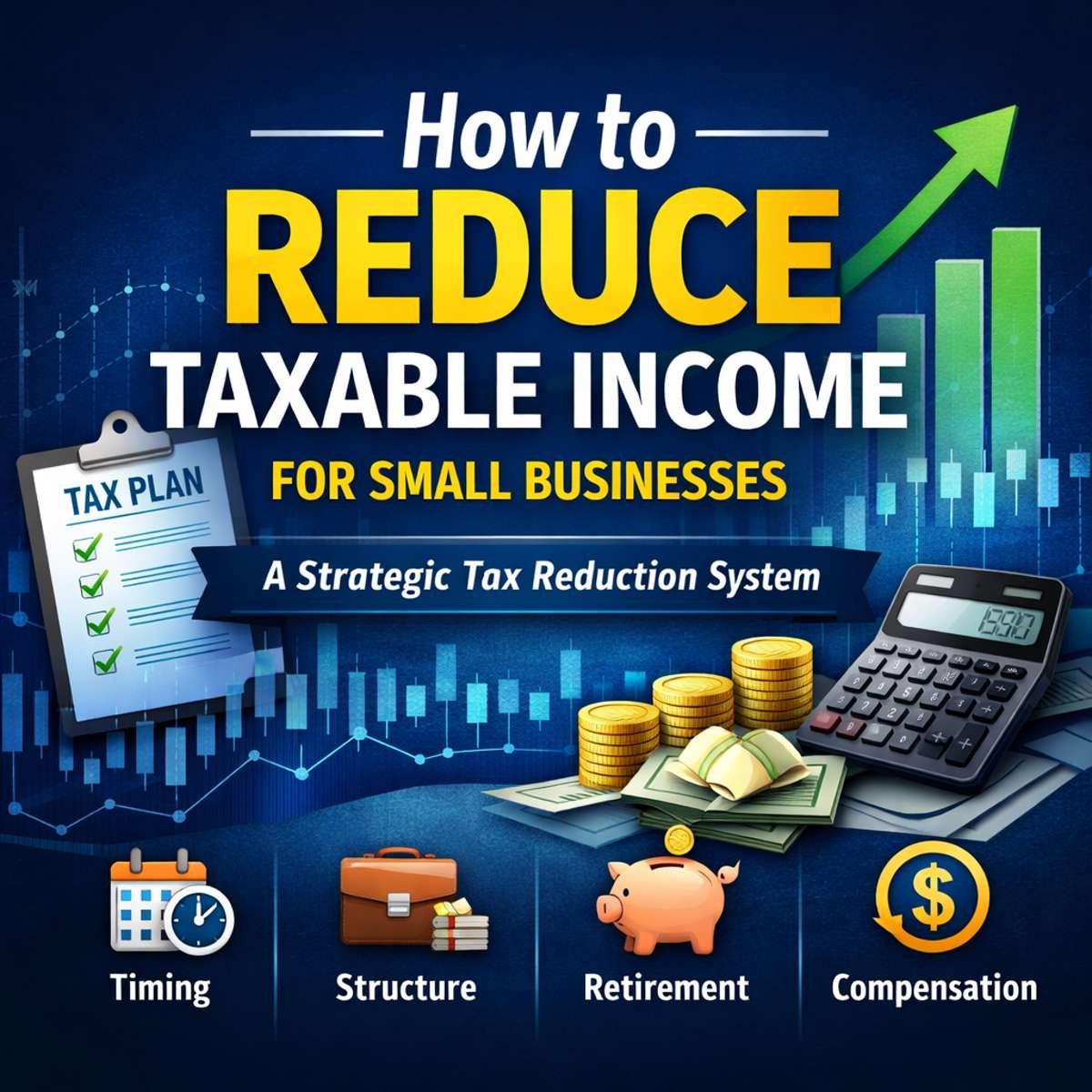
📌 Introduction: Stop Reacting to Taxes—Start Controlling Them
Most business owners approach taxes the same way every year:
They calculate what they owe—and then look for ways to reduce the damage.
But that approach misses a critical truth:
👉 Taxes are not just calculated—they are influenced.
In reality, taxable income is highly controllable when you understand how the system works.
🔄 Shift Your Mindset
- From: “What do I owe?”
- To: “How do I control what gets taxed?”
This shift is what separates reactive taxpayers from strategic business owners.
🎯 Positioning This Guide
This is not a basic overview of deductions or credits.
Instead, this guide focuses on active tax reduction strategies—the systems and decisions that allow you to legally reduce taxable income over time.
🔥 Key Takeaways
- Reducing taxable income requires strategy, timing, and structure—not just deductions
- Income timing is one of the most powerful and immediate tax levers
- Retirement contributions provide a dual benefit: tax reduction + long-term wealth building
- Business structure (such as S-Corp elections) can significantly reduce self-employment taxes
- Strategic compensation planning improves both tax efficiency and cash flow control
🎯 What Is a Strategic Tax Reduction System?
A strategic tax reduction system is a proactive approach to managing taxable income by controlling:
- When income is recognized
- How your business is structured
- Where profits are allocated
- How compensation is distributed
When used together, these levers allow business owners to legally reduce taxes, improve cash flow, and build long-term wealth.
🧠 Section 1: The Strategic Tax Reduction Framework
To effectively reduce taxable income, you need a system—not isolated tactics.
🧭 The 4-Part Tax Reduction System
At the core of every effective tax strategy are four key levers:
1. Timing
When income and expenses are recognized
This determines which tax year income is taxed in—making it one of the most immediate ways to reduce tax liability.
2. Structure
How your business is taxed
Your business structure determines how income flows through to your personal taxes and whether you are subject to self-employment taxes or payroll taxes.
3. Allocation
Where income is directed
Allocating income into tax-advantaged areas—such as retirement accounts or business reinvestment—can reduce current taxes while supporting future growth.
4. Compensation
How and when you pay yourself
The way you take income (salary, distributions, benefits) directly impacts how much tax you pay and when you pay it.
📊 Table: Deductions vs Strategic Tax Reduction
| Approach | Focus | Impact |
|---|---|---|
| Deductions | Reduce taxable income | Limited |
| Timing strategies | Shift income/expenses | High |
| Structure optimization | Change tax treatment | Very high |
| Allocation strategies | Redirect income | Long-term |
🔄 How These Work Together
These four levers are most powerful when used together—not in isolation:
- Timing reduces taxes this year
- Structure reduces taxes every year
- Allocation reduces taxes while building wealth
- Compensation reduces taxes on how money flows to you
👉 When combined, they create a repeatable system for long-term tax efficiency
📊 Tax Reduction Levers (At a Glance)
| Lever | What It Controls | Impact |
|---|---|---|
| Timing | Income & expenses | Immediate tax reduction |
| Structure | Tax treatment | Long-term savings |
| Allocation | Where income goes | Deferred taxation |
| Compensation | How you get paid | Efficiency |
🧠 Strategic Insight
Most small business owners focus only on deductions—which is just one piece of the puzzle.
But the real advantage comes from understanding:
👉 You don’t just reduce taxes by what you deduct—
you reduce taxes by how you structure and control your income.
If you’re ready, the next step is where the real opportunity begins:
👉 Timing strategies—your most powerful and immediate tax lever
⏳ Section 2: Timing Strategies
Why Timing Matters
Most business owners focus on how much they earn.
But from a tax perspective, when you earn it can matter just as much—if not more.
👉 The tax system is built around when income is recognized, not just how much exists.
This creates a powerful opportunity:
- Small timing shifts can lead to meaningful tax savings
- The same income, earned at a different time, can produce different tax outcomes
🔹 Cash vs Accrual
Understanding your accounting method is key to unlocking timing strategies.
- Cash Basis Accounting
- Income is recognized when money is received
- Expenses are recognized when paid
- 👉 Provides greater control over timing (used by most small businesses)
- Accrual Basis Accounting
- Income is recognized when earned (even if not received)
- Expenses are recognized when incurred
- 👉 Offers less flexibility for timing strategies
🔹 Income Deferral Strategies
Income deferral allows you to legally shift taxable income into a future tax year.
This can be especially valuable if:
- You expect lower income next year
- You are trying to manage tax brackets
- You want to improve short-term cash flow flexibility
Common Approaches
- Delay invoicing (when appropriate)
- Send invoices in January instead of late December
- Push income into the next tax year
- Structure payments to be received after year-end
- Adjust subscription or payment timing
- Shift billing cycles when possible
👉 The goal is simple:
Control when income becomes taxable—not just when it is earned
🔹 Expense Acceleration Strategies
If deferring income lowers taxable income, then accelerating expenses increases deductions in the current year.
This is especially effective in high-income or highly profitable years.
Common Approaches
- Prepay business expenses
- Software subscriptions, rent, insurance
- Purchase equipment before year-end
- Tools, technology, or necessary upgrades
- Bundle planned expenses into one tax year
- Combine multiple smaller purchases for a larger deduction impact
👉 The key principle:
Take deductions when they provide the most tax benefit
🔹 Year-End Tax Moves
The final weeks of the year are one of the most important windows for tax planning.
Strategic Actions to Consider
- “Use it or lose it” deductions
- Certain opportunities disappear after December 31
- Strategic charitable contributions
- Can reduce taxable income while aligning with personal values
- Planned purchases before year-end
- Accelerate necessary expenses into the current year
👉 Waiting until tax season is often too late—
most tax outcomes are determined before the year ends
📊 Timing Strategy Examples
| Strategy | Action | Result |
|---|---|---|
| Delay income | Invoice in January | Lower current taxable income |
| Accelerate expenses | Buy equipment early | Increase deductions now |
📊 Timing Strategy: Risk vs Impact
| Timing Move | When to Use | Risk | Impact |
|---|---|---|---|
| Delay income | Late in year | Cash flow delay | High |
| Accelerate expenses | Profitable year | Over-spending | High |
| Prepay expenses | Predictable costs | Deduction limits | Medium |
🧠 Strategic Insight
Timing strategies are often overlooked because they seem simple.
But in practice, they are one of the most powerful and immediate ways to reduce taxes—without changing what you earn.
🏦 Section 3: Retirement Strategies
Why Retirement Is a Tax Strategy
Retirement planning is often viewed as a long-term goal.
But for business owners, it is also one of the most effective tax reduction tools available today.
Key Benefits
- Reduces taxable income immediately
- Builds long-term wealth for the future
- Creates compounding tax advantages over time
🔹 The “Double Benefit” Strategy
Retirement contributions offer a unique advantage:
- Immediate tax deduction → lowers current taxable income
- Tax-deferred growth → allows investments to compound over time
👉 This is one of the few strategies that improves both your present tax situation and future financial security
🔹 Key Retirement Accounts
SEP IRA
- Simple to set up
- Contribution limits based on income
- Ideal for solo business owners
Solo 401(k)
- Higher contribution potential
- Combines employee + employer contributions
- Strong option for maximizing tax deferral
Traditional IRA
- Additional tax-deferred savings
- May supplement other retirement plans
🔹 Contribution Strategies
- Maximize allowable contributions
- Use catch-up contributions (if eligible)
- Align contributions with high-income years
👉 The goal is to smooth taxable income over time—reducing taxes during peak earning periods
📊 Retirement Contribution Impact
| Income | Contribution | Taxable Income |
|---|---|---|
| $100,000 | $20,000 | $80,000 taxable |
🧠 Strategic Insight
Retirement accounts are not just savings tools—they are tax management tools.
Used strategically, they allow you to:
- Reduce taxes today
- Build wealth for tomorrow
- Create long-term financial flexibility
🏢 Section 4: Business Structure Optimization
Why Structure Matters
Your business structure is one of the most important—and often overlooked—drivers of tax outcomes.
It determines:
- How income is taxed
- Whether you pay self-employment taxes
- How profits flow to your personal return
🔹 S-Corporation Optimization
For many growing businesses, electing S-Corporation status can provide meaningful tax advantages.
Key Concept
- Split income between:
- Salary (subject to payroll taxes)
- Distributions (not subject to self-employment tax)
👉 This can reduce overall tax liability when structured properly
🔹 When an S-Corp Starts Making Sense
An S-Corp is not right for every business—but it often becomes beneficial when:
- Profit reaches approximately $50,000–$100,000+
- Income is consistent and predictable
- You are willing to handle payroll and administrative requirements
📊 Structure Comparison (High-Level)
| Structure | Tax Treatment | Key Benefit |
|---|---|---|
| Sole Proprietor | Full SE tax | Simplicity |
| S-Corp | Split income | Tax savings |
📊 Simplified S-Corp Tax Savings Example
| Scenario | Salary | Distribution | SE Tax Applied | Estimated Savings |
|---|---|---|---|---|
| Sole Proprietor | $100,000 | $0 | $100,000 | — |
| S-Corp | $60,000 | $40,000 | $60,000 | Lower SE tax |
🧠 Strategic Insight
Business structure is not just a legal decision—it’s a tax strategy decision.
Choosing the right structure—and revisiting it as your income grows—can lead to significant long-term savings.
💰 Section 5: Compensation Strategies
Paying Yourself Strategically
How you pay yourself is one of the most overlooked—but most powerful—tax decisions you can make as a business owner.
Many small business owners focus on how much they earn.
But from a tax perspective, what matters just as much is:
👉 How that income is structured and distributed
The goal is not just to get paid—it’s to get paid efficiently.
🧠 Compensation Optimization Formula
At a high level, an optimized compensation strategy follows a simple framework:
- Pay a reasonable salary
- Ensures compliance with tax rules
- Covers required payroll obligations
- Take remaining income as distributions (if applicable)
- May reduce exposure to self-employment or payroll taxes
- Layer in tax-advantaged benefits
- Health insurance
- Retirement contributions
- Other allowable business-paid benefits
👉 This combination helps balance:
- Compliance
- Tax efficiency
- Cash flow management
🔹 Key Strategies
Salary vs Distribution Balance
For businesses structured to allow it (such as S-Corporations), income can often be split between:
- Salary → subject to payroll taxes
- Distributions → not subject to self-employment tax
The objective is to maintain a reasonable salary while avoiding unnecessary payroll tax exposure.
Hiring Family Members (Within Legal Limits)
In certain situations, hiring family members can create tax advantages:
- Income is shifted within the household
- Compensation may be taxed at lower rates (depending on circumstances)
- Work performed must be legitimate and properly documented
👉 This strategy requires careful implementation but can improve overall tax efficiency.
Fringe Benefits (Tax-Advantaged Compensation)
Certain benefits can be paid through the business in a more tax-efficient way than direct compensation.
Common examples include:
- Health insurance
- Retirement contributions
- Qualified business-related expenses
👉 These benefits can:
- Reduce taxable income
- Provide personal value
- Improve overall financial planning outcomes
📊 Compensation Strategy Impact
| Strategy | Benefit |
|---|---|
| Salary optimization | Lower payroll taxes |
| Family hiring | Income distribution |
| Benefits | Tax-efficient compensation |
🧠 Strategic Insight
Compensation is not just about income—it’s about how income flows through the tax system.
A well-structured approach can:
- Reduce unnecessary taxes
- Improve cash flow flexibility
- Align business income with long-term financial goals
📈 Section 6: Reinvestment & Business Growth Strategies
Reinvesting to Reduce Taxable Income
Another powerful way to reduce taxable income is to reinvest profits back into your business.
Instead of taking all income as profit, you can redirect funds into activities that:
- Support business growth
- Create future revenue opportunities
- Reduce current taxable income
Common Reinvestment Strategies
- Equipment upgrades
- Improve efficiency, productivity, or service quality
- Marketing investments
- Advertising, branding, or audience growth initiatives
- Business expansion
- Hiring, scaling operations, or entering new markets
Strategic Considerations
Reinvestment can be effective—but it must be approached thoughtfully.
⚖️ Balance ROI vs Tax Savings
- A deduction is only valuable if the underlying expense makes sense
- Focus on investments that generate long-term value, not just short-term tax benefits
🚫 Avoid Spending Purely for Deductions
A common mistake is spending money just to reduce taxes.
👉 Remember:
- A $1 deduction does not equal $1 in savings
- Unnecessary spending can reduce overall profitability
📊 Table: Reinvestment Decision Framework
| Scenario | Tax Deduction | Business Impact | Recommendation |
|---|---|---|---|
| Needed equipment | High | High | Strong buy |
| Marketing test | Medium | Medium | Evaluate ROI |
| Unnecessary purchase | Low | Low | Avoid |
🧠 Strategic Insight
The goal is not just to reduce taxes—it’s to allocate capital intelligently.
The best reinvestment strategies:
- Strengthen your business
- Improve future income potential
- Create sustainable long-term growth
⚠️ Section 7: Advanced Considerations (High-Level Overview)
As your business grows, additional strategies may become available.
These are more advanced concepts and should be approached with appropriate guidance and planning.
🔹 Examples of Advanced Strategies
Cost Segregation (Real Estate)
- Accelerates depreciation on certain property components
- Can significantly increase deductions in earlier years
Captive Insurance (Advanced Risk Strategy)
- Involves creating a self-insurance structure
- May provide both risk management and tax planning benefits
Research & Development (R&D) Positioning
- Certain business activities may qualify for tax incentives
- Applies to innovation, product development, and process improvements
🧠 Strategic Insight
Advanced strategies can offer meaningful benefits—but they also introduce:
- Greater complexity
- Additional compliance requirements
- Increased need for professional coordination
👉 At this stage, the focus should remain on understanding the concepts, not implementing them prematurely.
🎯 Key Takeaway
As your business evolves, so should your tax strategy.
Start with foundational systems:
- Timing
- Structure
- Allocation
- Compensation
Then expand into advanced strategies as your income, complexity, and opportunities grow.
🚫 Section 8: Common Mistakes to Avoid
Even with the right strategies available, many small business owners miss opportunities to reduce their taxable income—not because the tools are complex, but because the approach is reactive rather than strategic.
Avoiding these common mistakes can make a significant difference in your long-term tax outcomes.
❌ Waiting Until Year-End
One of the most common mistakes is treating tax planning as a last-minute activity.
By the time December arrives:
- Many strategic opportunities are limited or no longer available
- Income has already been earned and recognized
- Key decisions can no longer be adjusted
👉 Tax outcomes are largely determined throughout the year—not just at year-end
❌ Over-Relying on Deductions Alone
Deductions are important—but they are only one part of the system.
Focusing only on deductions often leads to:
- Missed opportunities in timing strategies
- Inefficient business structures
- Underutilized retirement and allocation strategies
👉 True tax efficiency comes from combining multiple levers—not just maximizing write-offs
❌ Ignoring Business Structure
Your business structure directly impacts how income is taxed.
Failing to evaluate or update your structure as your income grows can result in:
- Paying unnecessary self-employment taxes
- Missing opportunities for income splitting
- Reduced overall tax efficiency
👉 What worked when you started your business may not be optimal as you scale
❌ Poor Income Timing
Not paying attention to when income and expenses are recognized can lead to higher taxes than necessary.
Common issues include:
- Recognizing income too early
- Missing opportunities to defer income
- Failing to accelerate expenses during high-income periods
👉 Timing is one of the simplest—but most underutilized—tax strategies
❌ Not Seeking Professional Guidance When Needed
As strategies become more advanced, complexity increases.
Trying to implement everything independently can lead to:
- Compliance issues
- Missed opportunities
- Inefficient execution
👉 Strategic guidance can help ensure that your tax plan is both effective and compliant
📊 Table: Reactive vs Strategic Tax Behavior
| Reactive Approach | Strategic Approach |
|---|---|
| Wait until tax season | Plan throughout the year |
| Focus only on deductions | Use multiple tax strategies |
| Ignore structure | Optimize structure as income grows |
| Spend just to reduce taxes | Invest with purpose |
🧠 Strategic Insight
Most tax mistakes don’t come from lack of effort—they come from lack of strategy.
Shifting from reactive decisions to a system-based approach is what creates consistent, long-term tax efficiency.
🧩 Section 9: Example Scenario
Understanding strategy is important—but seeing how it works in practice is what makes it actionable.
📊 Before Strategy
- Income: $120,000
- Taxable Income: $120,000
At this stage, no strategic adjustments have been made.
📊 After Strategy Implementation
By applying a combination of timing, allocation, and structural strategies:
- Timing adjustments: –$10,000
- Retirement contributions: –$20,000
- Structure optimization savings: –$8,000
👉 New Taxable Income: $82,000
📊 Table: Estimated Tax Savings Impact
| Strategy | Income Reduction | Estimated Tax Savings (22% Rate) |
|---|---|---|
| Timing adjustments | $10,000 | $2,200 |
| Retirement contributions | $20,000 | $4,400 |
| Structure optimization | $8,000 | $1,760 |
| Total Impact | $38,000 | $8,360 |
💡 Key Insight
This example highlights a critical takeaway:
👉 Small, strategic adjustments can lead to significant reductions in taxable income
And more importantly:
- These strategies are repeatable year after year
- The impact compounds over time
- The result is improved cash flow, tax efficiency, and long-term financial positioning
🧠 Strategic Takeaway
Tax reduction is not about one big move—it’s about combining multiple smaller decisions into a cohesive system.
📊 Section 10: Strategy Comparison
Not all strategies require the same level of effort or provide the same level of impact.
This table helps you prioritize where to focus first.
| Strategy Type | Complexity | Impact | Best For |
|---|---|---|---|
| Timing | Low | High | Most businesses |
| Retirement | Medium | High | Profitable businesses |
| S-Corp | Medium | High | Growing income |
| Compensation | Medium | Medium | Structured businesses |
🧠 How to Use This Table
- Start with timing strategies → easiest to implement, immediate impact
- Add retirement strategies → builds both tax savings and wealth
- Evaluate structure as income grows → unlocks long-term efficiency
- Refine compensation strategies → optimize how income flows to you
🎯 Strategic Insight
The most effective tax plans are built in layers:
- Start simple
- Add complexity as income grows
- Optimize continuously
🔗 Section 11: How This Fits Into Your Tax Strategy
A strong tax plan is not built on a single tactic—it’s built in layers.
This guide represents your execution layer—the point where strategy turns into action.
But before execution, you need a solid foundation.
🧱 Step 1: Build Your Foundation
Start with understanding the basics:
- What qualifies as a deduction
- Which credits you may be eligible for
- How documentation and eligibility rules work
👉 This is where your Deductions & Credits Guide comes in.
It gives you the fundamental knowledge needed to identify opportunities.
⚙️ Step 2: Apply Strategic Tax Reduction
Once you understand the foundation, the next step is applying strategy:
- Control when income is taxed (timing)
- Optimize how your business is structured
- Direct income into tax-efficient allocations
- Manage how you pay yourself
👉 This is where this guide fits in.
It helps you move from:
- Knowing what’s deductible
to - Actively reducing what gets taxed
🔄 How These Layers Work Together
- Deductions & Credits → Identify opportunities
- Strategic Tax Reduction → Maximize and control outcomes
👉 Together, they form a complete tax system—not just isolated tactics
🧠 Strategic Insight
Most business owners stop at the foundation.
But real tax efficiency comes from applying strategy consistently over time.
📚 Section 12: Strategic Tax Reduction Checklist
Use this checklist as a simple, repeatable framework to guide your tax planning throughout the year.
✔ Core Action Steps
✔ Review income timing opportunities
- Identify income that can be deferred or shifted
✔ Plan expenses before year-end
- Accelerate necessary purchases when it makes sense
✔ Maximize retirement contributions
- Reduce current taxable income while building future wealth
✔ Evaluate business structure regularly
- Ensure your structure still aligns with your income level and goals
✔ Optimize your compensation strategy
- Balance salary, distributions, and benefits for efficiency
📊 Table: When to Apply Each Strategy
| Strategy | When to Review | Frequency |
|---|---|---|
| Timing strategies | Year-end + quarterly | Quarterly |
| Retirement contributions | Year-end planning | Annually |
| Business structure | Income milestones | Annually |
| Compensation strategy | Payroll review | Quarterly |
🧠 How to Use This Checklist
- Review quarterly—not just at year-end
- Adjust based on income fluctuations
- Use it as a guide for proactive decision-making
🎯 Strategic Insight
Consistency is what turns strategy into results.
👉 Small, repeated actions—applied year after year—create the biggest tax advantages over time.
❓ FAQ Section
How can a small business reduce taxable income?
A small business can reduce taxable income by combining multiple strategies, including:
- Timing income and expenses strategically
- Maximizing retirement contributions
- Choosing the right business structure
- Optimizing how compensation is taken
The most effective approach is not relying on a single tactic, but using a coordinated system of tax strategies.
What is the best way to lower taxes legally?
The best way to lower taxes legally is to:
- Use all available deductions and credits
- Apply timing strategies to control when income is taxed
- Contribute to tax-advantaged retirement accounts
- Structure your business and compensation efficiently
👉 Legal tax reduction comes from understanding and using the system—not avoiding it
When should I switch to an S-Corp?
An S-Corporation may start to make sense when:
- Your business generates consistent profits (often around $50,000–$100,000+)
- You are willing to manage payroll and administrative requirements
- You want to reduce self-employment tax exposure
👉 The decision depends on your specific situation and should be evaluated carefully.
Can I defer income to reduce taxes?
Yes—income deferral is a common and legal strategy.
You may be able to:
- Delay invoicing
- Push payments into the next tax year
- Adjust billing cycles
This allows you to shift taxable income into a future period, potentially reducing your current tax liability.
How do retirement contributions reduce taxes?
Retirement contributions reduce taxes by:
- Lowering your current taxable income
- Allowing investments to grow tax-deferred
For example, contributing $20,000 to a qualified retirement account reduces taxable income by that same amount (subject to applicable rules and limits).
What is the safest way to reduce taxable income?
The safest strategies are those that are:
- Clearly supported by tax rules
- Properly documented
- Consistently applied
Examples include:
- Retirement contributions
- Legitimate business expenses
- Structured compensation strategies
👉 The key is compliance + documentation + consistency
How much can I realistically reduce my taxes?
The amount you can reduce your taxes depends on:
- Your income level
- Your business structure
- The strategies you implement
In many cases, combining multiple strategies can reduce taxable income by 10%–30% or more, though results vary based on individual circumstances.
🧠 Final FAQ Insight
The biggest takeaway:
👉 Tax reduction is not about finding one loophole—it’s about building a system that works over time.
🎯 Conclusion: Taxes Are a System You Can Control
Taxes aren’t just an obligation—they’re a system you can manage.
When you shift from reacting to taxes to strategically planning for them, everything changes.
🔑 Key Message
- Tax reduction is proactive—not reactive
- Small changes compound over time
- Strategy creates long-term savings and stability
🧠 Final Thought
The most successful business owners don’t just earn income—they manage how that income is taxed.
🚀 Take Action
What’s one strategy you can implement this quarter to reduce your taxable income?
Start small. Stay consistent. Build your system.
🔗 Continue Your Tax Planning Journey
Build your full tax strategy step-by-step:
- 📘 Tax Strategy and Tips
- 🧾 Deductions & Credits Guide
- 💼 Self-Employment Tax Guide
- 📅 Quarterly Tax Planning Guide
- 🎯Tax Planning & Optimization Hub
👉 Each step builds on the last—helping you create a complete, sustainable tax strategy.
