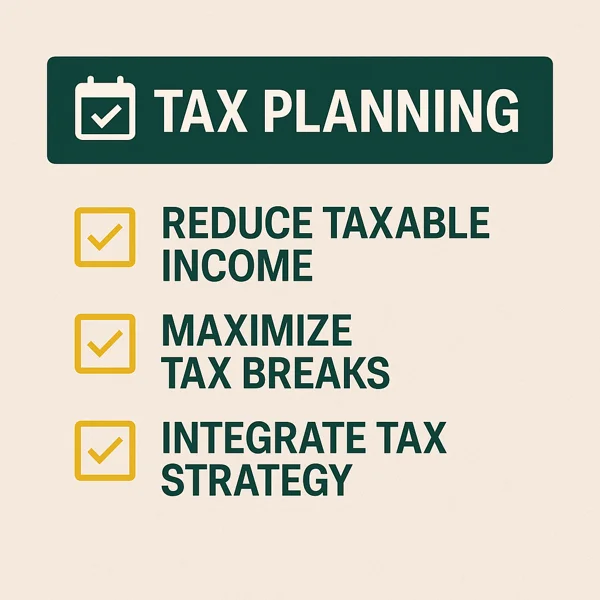
📜 Integrate Strategy, Minimize Taxes, Maximize Wealth
Taxes don’t have to be a once-a-year headache. With smart tax planning, you can turn taxes into a tool that supports your broader financial goals. Whether you’re saving for retirement, paying off debt, or investing in your future, every financial decision has a tax consequence. This guide shows you how to reduce your taxable income, leverage tax-advantaged accounts, and embed tax-smart thinking into everyday choices.
📊 Why Tax Planning Matters
Tax planning isn’t about cheating the system—it’s about making the system work for you. From choosing the right accounts to timing your income, a solid tax plan can:
- Increase your annual refund or reduce what you owe
- Maximize take-home pay and investment returns
- Free up cash for savings, giving, or debt reduction
💡 1. Understanding the Foundations of Tax Planning
Core Principles:
- Deferral: Push income into future years when your tax rate might be lower.
- Reduction: Lower your taxable income through deductions.
- Shifting: Move income to lower-taxed individuals or entities.
- Optimization: Coordinate timing, account type, and tax bracket to minimize impact.
“Tax planning is about using time, structure, and strategy to minimize your tax bill legally.”
🔹 2. Know Your Tax Bracket
Understanding your marginal tax rate helps you gauge the impact of each additional dollar earned.
| Tax Filing Status | Income Range (2025 est.) | Marginal Rate |
|---|---|---|
| Single | Up to $11,600 | 10% |
| $11,601 – $47,150 | 12% | |
| $47,151 – $100,525 | 22% | |
| Married Joint | Up to $23,200 | 10% |
| $23,201 – $94,300 | 12% | |
| $94,301 – $201,050 | 22% |
Tip: Knowing your bracket helps you make smart choices about deductions, conversions, and timing.
🛠 3. Reduce Taxable Income Strategically
Key Strategies:
- Max out pre-tax retirement contributions (401(k), Traditional IRA)
- Use employer benefits (FSA, HSA, commuter plans)
- Claim above-the-line deductions (student loan interest, self-employment tax)
- Bundle itemized deductions every other year to exceed the standard deduction
📌 Standard Deduction vs. Itemizing: Which One’s Better?
| Filing Status | 2025 Standard Deduction | Best for Itemizing If… |
| Single | $14,000 (est.) | Mortgage interest, high medical expenses, donations |
| Married Filing Joint | $28,000 (est.) | Dual incomes with deductions over $28k |
| Head of Household | $20,800 (est.) | High expenses + dependents |
Tip: Bundle donations and medical costs in a single year to exceed the threshold.
💲 4. Maximize Tax-Advantaged Accounts
| Account Type | Tax Treatment | Use Case |
| Traditional IRA | Pre-tax, tax-deferred growth | Lower taxable income now |
| Roth IRA | After-tax, tax-free growth | Ideal if you’re in a low bracket |
| HSA | Triple tax benefit | Health savings + long-term investing |
| 529 Plan | Tax-free for education | College or K-12 savings |
Pro Tip: HSA is the only account that offers tax-free contributions, growth, and withdrawals.
📌 Contribution Deadlines by Account Type
| Account Type | 2025 Contribution Deadline | Max Contribution Limit (2025) |
| Roth IRA | April 15, 2026 | $7,000 (age 50+: $8,000) |
| Traditional IRA | April 15, 2026 | $7,000 (age 50+: $8,000) |
| 401(k) | December 31, 2025 | $23,000 (age 50+: $30,500) |
| HSA | April 15, 2026 | $4,150 individual / $8,300 family (est.) |
| 529 Plan | December 31, 2025 (varies) | Varies by state (often $15,000+) |
🔄 5. Plan for Capital Gains and Losses
- Long-term gains (held >1 year) are taxed at 0%, 15%, or 20%
- Short-term gains are taxed as ordinary income
- Tax-loss harvesting lets you offset gains with losses
Example: Sell underperforming ETFs to offset a gain on a real estate sale.
📌 Tax-Loss Harvesting: When and How
| Situation | Action | Outcome |
| Sold asset at a gain | Sell a losing asset | Offset gain and reduce tax owed |
| No gains this year | Sell losers, carry losses forward | Up to $3,000/year against income |
| Rebuy similar asset immediately | Use a different but correlated ETF (e.g., VTI → SCHB) | Avoid wash sale rule |
📃 6. Use Credits, Not Just Deductions
Credits reduce your tax bill, not just your taxable income.
Popular Tax Credits:
- Child Tax Credit
- Earned Income Tax Credit (EITC)
- Saver’s Credit (for lower-income retirement savers)
- Education Credits (AOTC, LLC)
📌 Tax Credit vs. Tax Deduction: What’s the Difference?
| Feature | Tax Deduction | Tax Credit |
| Reduces… | Taxable income | Actual tax bill |
| Example | $2,000 student loan interest deduction | $2,000 American Opportunity Credit |
| Effective Value | Depends on your tax bracket | Full value applies directly |
| Who benefits more? | Higher-income earners | Lower- and middle-income earners |
🤵 7. Integrate Tax Strategy into Everyday Life
- Charitable Giving: Use donor-advised funds for flexibility and deductions.
- Filing Status: Married Filing Separately might be optimal in rare cases.
- Income Timing: Delay income or accelerate deductions in high-income years.
- Qualified Business Income Deduction: Self-employed individuals may qualify for 20% off eligible business income.
🧰 8. Special Considerations by Life Stage
| Life Stage | Common Tax Strategies |
| College Student | Education credits, Roth IRA contributions |
| Mid-Career | Max 401(k)/HSA, child tax credits |
| Self-Employed | SEP IRA, business deductions |
| Retirees | Roth conversions, RMD planning |
🧪 9. Scenario Examples
Scenario 1: Maria is a 38-year-old freelancer. She contributes to a SEP IRA, deducts her home office, and uses quarterly estimated payments.
Scenario 2: Joe and Lena are married with two kids. They max their 401(k)s, use a dependent care FSA, and qualify for the Child Tax Credit.
📅 10. Annual Tax Planning Checklist
Early Year (Q1-Q2):
- Review prior year return for missed opportunities
- Adjust withholding or quarterly payments
- Set contribution goals for retirement accounts
Mid-Year (Q2-Q3):
- Tax-loss harvesting if market is down
- Check FSA and HSA balances
- Review business deductions
Year-End (Q4):
- Finalize charitable donations
- Sell assets to manage capital gains
- Make IRA contributions (or plan to before April deadline)
🚀 11. FAQ
Q: Should I hire a tax advisor? A: If you have multiple income streams, a business, or investments—yes.
Q: Why do I always get a refund? A: You’re likely over-withholding. Consider adjusting W-4s.
Q: Can I invest and still lower my taxes? A: Absolutely. Use Roths, HSAs, and tax-efficient ETFs.
✅ Conclusion
Smart tax planning doesn’t just save money—it amplifies your wealth-building strategy. Every deduction, credit, and account choice can align your finances for long-term success.
Next Step: Review your last tax return, identify missed opportunities, and start planning for this year today.
📍 Up Next: Retirement Planning – Define Your Vision →
⬅️ Go Back: Investment Planning: Grow with Purpose and Confidence