
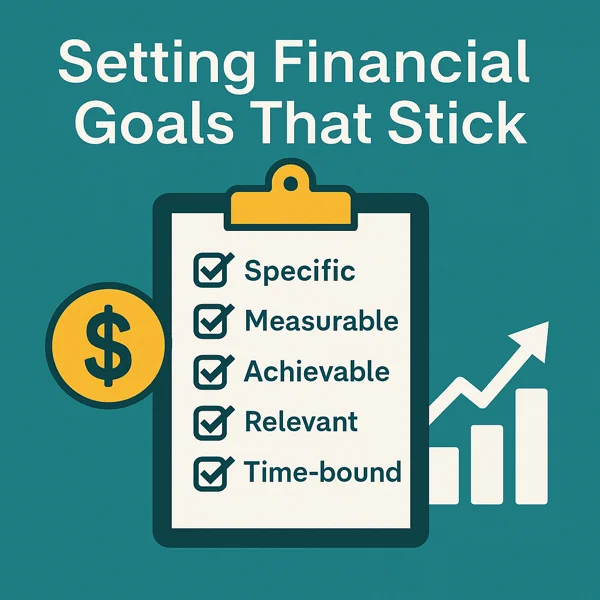
🎯 Use the SMART goal framework to turn dreams into clear, trackable priorities — short-term to long-term.
🔎 Introduction: Why Most Financial Goals Fail
We’ve all set vague goals like “save more,” “pay off debt,” or “start investing”—but without structure, most of these good intentions fall apart.
The reason? They’re not specific, trackable, or built into a larger plan.
If you want financial goals that actually stick, you need more than a wish—you need a framework. That’s where the SMART goal method comes in.
In this post, you’ll learn:
- How to write financial goals that are specific, realistic, and motivating
- How to prioritize goals across timeframes (short-, mid-, long-term)
- How to embed goals into your actual budget and behavior
This is Step 2 in your comprehensive financial plan: turning clarity into direction.
🧠 What Makes a Goal “Stick”?
A good financial goal isn’t just inspirational—it’s practical. It’s something you can see, track, and achieve.
✅ Sticky goals have:
- Clarity — you know exactly what success looks like
- Alignment — they reflect your values and life stage
- Systems — they’re tied to habits, automation, and planning
- Progress markers — you can track wins along the way
💬 “A financial goal without a system is just a hope. Structure creates momentum.” — Jason B. Ball, CFP®
🔍 The SMART Goal Framework for Personal Finance
The SMART framework helps you build goals that are:
| Letter | Meaning | Financial Example |
|---|---|---|
| S | Specific | “Save $6,000 for a Roth IRA” (not “save money”) |
| M | Measurable | “Pay off $5,000 in credit card debt” |
| A | Achievable | “Invest $200/month” (realistic based on income) |
| R | Relevant | “Build emergency fund” if job is unstable |
| T | Time-bound | “By December 31” or “in 6 months” |
This structure takes a fuzzy idea and transforms it into a clear, actionable plan.
📅 Short-Term, Mid-Term, and Long-Term Financial Goals
Not all goals belong in the same bucket. Categorizing them helps you balance urgency and importance.
✅ Short-Term (0–12 months):
- Build or top up your emergency fund
- Pay off credit cards or small debts
- Save for a vacation, holiday fund, or car repair
- Create a working household budget
⏳ Mid-Term (1–5 years):
- Save for a car, wedding, or home down payment
- Eliminate student loan debt
- Fund professional certifications or training
- Grow an investment account outside of retirement
🚀 Long-Term (5+ years):
- Save for retirement (Roth IRA, 401(k), SEP, Solo 401(k))
- Buy a home or vacation property
- Fund a child’s education
- Achieve full financial independence or early retirement
📊 Sample Goal Timeline Table:
| Timeframe | Goal Example | Why It Matters |
|---|---|---|
| Short-Term | Save $1,200 for emergency fund | Creates stability and peace of mind |
| Mid-Term | Pay off $10,000 student loan in 3 yrs | Frees up cash flow and improves credit |
| Long-Term | Invest $400/month for retirement | Builds long-term wealth and reduces future risk |
✍️ How to Write a SMART Financial Goal
Use this formula:
“I want to [action] [amount] for [purpose] by [date].”
🎯 Example 1:
“I will save $1,500 for a vacation by July 1 by setting aside $250/month.”
🎯 Example 2:
“I will pay off my $2,000 credit card balance by December using the avalanche method.”
📋 SMART Goal Writing Table:
| Category | Your SMART Goal |
|---|---|
| Emergency Fund | I will save $1,000 by October by saving $250/month. |
| Debt Payoff | I will pay off my $3,000 personal loan by April using snowball method. |
| Investment Goal | I will invest $200/month in a Roth IRA until I reach $6,000/year. |
Want a printable version? 👉 [Download the SMART Goal Worksheet]
🔄 Aligning Your Goals with Your Budget
Setting goals is one thing—funding them is another.
✅ Make it real by:
- Adding goal categories to your monthly budget
- Creating sinking funds for medium-term targets
- Automating savings and debt payments
- Reviewing progress monthly or quarterly
If your budget doesn’t reflect your goals, they’ll remain wishful thinking.
🧱 Connect Goals to Your Overall Financial Plan
SMART goals don’t stand alone—they feed directly into your comprehensive planning roadmap.
Each goal should map to a financial planning pillar:
| Planning Area | Goal Type Example |
|---|---|
| Emergency & Risk | Build 3–6 months of cash reserve |
| Debt Management | Pay off credit cards or student loans |
| Retirement Planning | Max out Roth IRA or 401(k) |
| Education Funding | Save $100/month in a 529 plan |
| Investing & Growth | Start taxable brokerage account |
By setting SMART goals by pillar, you bring your entire financial life into alignment.
🧠 Common Mistakes to Avoid
- ❌ Setting too many goals at once
- ❌ Skipping the “measurable” and “time-bound” pieces
- ❌ Making goals that aren’t relevant to your life
- ❌ Not writing the goals down
- ❌ Failing to review progress or pivot when needed
💬 “The best goals are flexible in strategy but fixed in purpose.”
👤 Example Scenario: Maya the Content Creator
Background:
Maya is a 28-year-old content creator who just transitioned from a side hustle to full-time self-employment. She earns about $5,000/month from YouTube ad revenue, brand partnerships, and digital product sales. With variable income and no employer benefits, she knows she needs a plan.
🧠 Maya’s Top 3 Financial Goals:
| Goal | Category | SMART Breakdown |
|---|---|---|
| Build Emergency Fund | Short-Term Saving | “I want to save $6,000 by March 31 to cover 3 months of expenses. I’ll set aside $500/month from each client payment.” |
| Pay Off Credit Card | Debt Elimination | “I’ll pay off my $2,400 balance by December 31 using the avalanche method and $300/month payments.” |
| Start SEP IRA | Retirement Investing | “I will contribute $200/month to a SEP IRA starting June 1 to reach $1,400 by year-end. I’ll increase this amount after my emergency fund is built.” |
💡 How She Stays On Track:
- Uses Tiller Money to automate a spreadsheet that tracks cash flow and goal progress
- Sets calendar reminders for a monthly money check-in
- Separates income into multiple savings buckets: taxes, goals, lifestyle
- Uses a physical whiteboard in her workspace with visual progress bars
📝 “Before I started writing my goals down, I was just reacting to money. Now I know exactly where every dollar goes—and that’s empowering.” — Maya
🔁 Monthly Review Snapshot:
| Goal | Progress | Status | Adjustments Needed? |
|---|---|---|---|
| Emergency Fund | $3,000/6,000 | On Track | No—fully automated |
| Credit Card Payoff | $1,800/2,400 | Nearly Completed | Increase final payment to finish early |
| SEP IRA Contributions | $600/1,400 | Slightly Behind | Delay increase until January cash flow boost |
This scenario brings the SMART process to life. Maya’s story is relatable for freelancers, creatives, or anyone with inconsistent income—and it highlights how even variable earners can create a stable, goal-driven plan.
🧾 SMART Financial Goal Tracker Template
Once you’ve written out your goals using the SMART framework, use this tracker to monitor your progress. It helps you stay accountable, adjust when needed, and celebrate milestones along the way.
| Goal Name | Category | Start Date | Target Date | Goal Amount | Progress | Status | Notes |
|---|---|---|---|---|---|---|---|
| Emergency Fund | Short-Term Saving | 04/01/2025 | 09/30/2025 | $1,500 | $750 | In Progress | Auto-transfers $250/month |
| Credit Card Payoff | Debt Elimination | 03/15/2025 | 12/31/2025 | $2,400 | $1,800 | On Track | Using snowball method |
| Roth IRA Contributions | Retirement Investing | 01/01/2025 | 12/31/2025 | $6,500 | $3,900 | In Progress | $500/month automated from paycheck |
| Home Down Payment | Mid-Term Goal | 01/01/2024 | 01/01/2027 | $30,000 | $10,500 | Needs Adjustment | Paused contributions temporarily |
💡 Tip: Use color codes or symbols in your own version to flag milestones, stalled goals, or budget conflicts.
Set a Goal Progress Review Routine
Even the best financial goals need check-ins. Without regular reflection, it’s easy to drift off course—or forget your goals altogether. A monthly review routine helps you stay intentional, make adjustments, and celebrate progress.
🔁 Why a Review Schedule Matters:
- Keeps goals visible and top-of-mind
- Allows for quick corrections before issues snowball
- Reinforces motivation by tracking wins
- Builds a planning habit that supports long-term success
✅ Monthly Goal Review Checklist
Take 30 minutes at the end of each month to sit down with your goal tracker and answer:
| Review Question | ✔️ |
|---|---|
| ☐ Did I make progress toward each of my financial goals? | |
| ☐ Do any deadlines, priorities, or amounts need adjusting? | |
| ☐ Were there any unexpected expenses or financial wins? | |
| ☐ Is my “why” for this goal still relevant and motivating? | |
| ☐ Can I automate any transfers or payments for next month? |
🧠 Pro Tip: Set a recurring calendar event titled “Money Check-In” on the last Sunday or last weekday of each month. Treat it like a non-negotiable appointment with your future self.
📌 Make It a Ritual, Not a Chore
- Light a candle. Put on music. Pour a cup of tea or coffee.
- Use your preferred tools: notebook, spreadsheet, budget app, or printed tracker.
- If you have a partner, consider doing this together as a shared financial touchpoint.
💬 “The review is where the real progress happens. It’s not just about setting goals—it’s about staying connected to them.” — Jason B. Ball, CFP®
🧠 Goal-Setting Reflection Questions
Before you finalize your goals, use these prompts to make sure they’re clear, realistic, and personally meaningful:
🎯 1. What exactly do you want to achieve?
- Is this tied to saving, investing, debt, lifestyle, or protection?
- How will you know when it’s “done”?
💰 2. How much will it cost or require financially?
- Estimate a total dollar amount.
- Break it down: What’s the monthly or weekly contribution?
⏰ 3. When do you want to reach it?
- Is this a short-, mid-, or long-term goal?
- What specific date or timeline makes sense?
💸 4. Can your current budget support it?
- What can you afford to set aside?
- Do you need to adjust spending elsewhere?
📊 5. How will you track your progress?
- Will you use a spreadsheet, app, or printable tracker?
- How often will you check in—monthly, quarterly?
❤️ 6. Why does this goal matter to you?
- What personal value or priority does it connect to?
- How will achieving this change your life?
✍️ Pro Tip: The clearer your “why,” the more motivated you’ll be when things get tough.
📥 Bonus Tools & Resources
- ✅ [SMART Goal Worksheet – Printable PDF]
- ✅ [Budgeting Template with Goal Tracker]
- ✅ [14-Step Planning Series Roadmap]
- ✅ [Emergency Fund Starter Guide – Next Post]
✅ Conclusion: Turn Vision Into Action
With the SMART goal method, you’re not just dreaming. You’re planning. You’re tracking. You’re building habits that lead to financial independence.
💬 “When your goals align with your values and cash flow, money becomes a tool—not a stressor.” — Jason B. Ball, CFP®
📍 Up Next: Building an Emergency Fund – Your Financial Safety →
⬅️ Go Back: Assessing Your Current Financial Situation
