
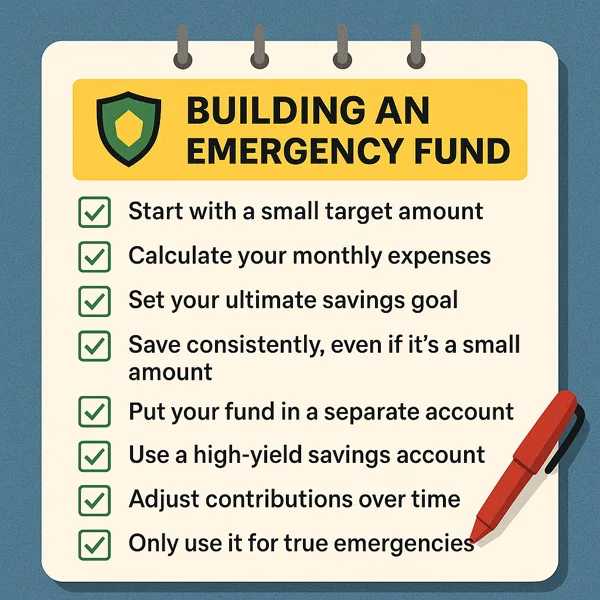
🏦 Your Financial Safety Net
A strong financial plan doesn’t start with investing or retirement planning. It starts with protection. And that begins with your emergency fund. Whether you’re a strong financial plan doesn’t start with investing or retirement planning. It starts with protection. And that begins with your emergency fund. Whether you’re a salaried employee, freelancer, or content creator with unpredictable income, having cash on hand can make the difference between a minor setback and a major financial crisis.
🔍 Why You Need an Emergency Fund
An emergency fund is your personal insurance policy against life’s inevitable surprises.
✅ Key Benefits:
- Cushions you against job loss, medical expenses, or car repairs
- Prevents reliance on credit cards or high-interest debt
- Gives you breathing room to make better financial decisions
- Reduces stress and builds confidence
“An emergency fund is the difference between a financial inconvenience and a full-blown crisis.” — Jason B. Ball, CFP®
🤔 How Much Do You Really Need?
📈 General Guidelines:
| Life Situation | Recommended Fund Size |
|---|---|
| Stable job, single | 3 months of essential expenses |
| Dual-income household | 3–6 months |
| Freelancer or creator | 6–12 months |
| Health issues or caretaking | 6–9 months + medical buffer |
💰 Milestone Approach:
- First $500 → First $1,000
- Then 1 month → 3 months → 6+ months
- Track progress visually (charts, bars, or savings buckets)
📊 Savings Goal Timeline
| Weekly Savings | Monthly Contribution | Time to Save $3,000 | Time to Save $6,000 |
| $25 | ~$100 | 30 months | 60 months |
| $50 | ~$200 | 15 months | 30 months |
| $100 | ~$400 | 7.5 months | 15 months |
| $250 | ~$1,000 | 3 months | 6 months |
✅ Use this table to set a savings pace that matches your income and lifestyle.
💸 Building Your Emergency Fund on Irregular Income
⚖️ Proven Tactics:
- Save a percentage, not a fixed amount (e.g., 10% of every deposit)
- Use windfalls (tax refunds, bonuses, seasonal highs)
- Automate with every paycheck or client payment
- Create mini-goals: $100/week, $500/month
- Use the 60/30/10 Rule:
- 60% to essentials
- 30% to lifestyle
- 10% to savings (including emergency fund)
Even $25/week adds up to $1,300 a year. Start where you are.
🧠 Psychology & Motivation – Make Saving Stick
🔑 Mental Strategies for Consistency:
- Name your emergency fund something meaningful (e.g., “Peace of Mind Account”)
- Tie each dollar saved to a real-life outcome: “This $100 = one less night of panic.”
- Create visual momentum: use bar charts, colored jars, or printable goal trackers
- Reward yourself for milestone wins (e.g., $1,000 saved = one self-care day)
- Revisit your “why” each month to stay focused
“Your emergency fund isn’t just a financial tool—it’s a mindset shift toward long-term resilience.”
🏦 Where to Keep Your Emergency Fund
Your emergency fund must be liquid, safe, and separate.
📃 Account Comparison Table:
| Account Type | Pros | Cons |
| High-Yield Savings | FDIC insured, earns interest | May require transfer delay |
| Online-Only Banks | Easy automation, higher APYs | No in-person banking |
| Credit Union Savings | Local, stable, often low fees | May offer lower interest |
| Money Market Account | Interest + check access | Minimum balance requirements |
| Cash Management Account | Flexible, often app-based | Not always FDIC insured |
❌ Avoid:
- Stocks or mutual funds (too volatile)
- Crypto or altcoins (high risk)
- Cash at home (keep only a small amount for disasters)
🚜 Example Scenarios
🔍 Sam the Freelance Videographer
- Income: $4,000–$8,000/month
- Goal: Build a $12,000 emergency fund
- Tactic: 15% of each payment → Auto-transferred to Ally Bank
- Tools: Spreadsheet + progress bar chart
🔍 Jess & Alex, Dual-Income Household
- Stable salary + seasonal income
- Goal: $9,000 (3-month fund)
- Tactic: Split paycheck deposit + use holiday bonus
- Tools: Capital One 360 savings buckets
🔄 Stay Consistent: Automate & Track
- Nicknamed accounts: e.g., “Rainy Day Fund”
- Automated transfers: weekly, biweekly, or per invoice
- Apps: YNAB, Qapital, Monarch Money, Ally Buckets
- Trackers: use a printable goal sheet or spreadsheet
❓ Emergency Fund FAQs
💬 Can I invest my emergency fund?
No—this money should be safe and stable. Stick to cash-equivalent accounts that don’t lose value.
💬 What qualifies as an “emergency”?
Ask: Is it urgent, unexpected, and necessary? If all three are true, it’s probably an emergency.
💬 What if I have debt?
Start with a $1,000 mini-fund to avoid further borrowing, then prioritize high-interest debt repayment.
💬 Should I pause contributions once I hit my goal?
You can—but consider reallocating that amount to long-term goals (e.g., IRA, HSA, investment account).
❌ Common Pitfalls to Avoid
- Dipping into your fund for non-emergencies (e.g., travel)
- Keeping it too accessible in checking
- Neglecting to replenish after use
- Over-saving and ignoring higher-return investments
📋 Monthly Emergency Fund Review Checklist
| ✅ Review Questions | Check |
| Did I contribute to my fund this month? | [ ] |
| Am I on track to hit my savings milestone? | [ ] |
| Were there any unexpected expenses? | [ ] |
| Did I automate next month’s savings transfer? | [ ] |
| Do I need to adjust my goal based on life changes? | [ ] |
🧾 Emergency Fund Starter Checklist
| Step | Task | Complete? |
| 1 | Calculate your essential monthly expenses | [ ] |
| 2 | Choose a target fund size (e.g., 3–6 months’ needs) | [ ] |
| 3 | Open a dedicated high-yield savings account | [ ] |
| 4 | Automate transfers weekly or biweekly | [ ] |
| 5 | Set savings milestones: $500, $1,000, $3,000, etc. | [ ] |
| 6 | Download a printable tracker or app to monitor | [ ] |
| 7 | Review and update progress monthly | [ ] |
| 8 | Replenish after any withdrawal | [ ] |
| 9 | Reassess your goal annually | [ ] |
📥 Bonus Downloads
- Emergency Fund Calculator Spreadsheet
- Freelancer’s Savings Playbook
✅ Final Takeaway: A Foundation That Frees You
A well-funded emergency reserve isn’t just about safety. It’s about freedom.
Freedom to leave a toxic job. To recover from a medical bill. To take a chance on yourself.
Emergency funds buy peace of mind. That’s a return no investment can match.
Start small. Start now. And build the financial resilience your future self will thank you for.
📍 Up Next: Managing Debt Effectively →
⬅️ Go Back: Setting Financial Goals That Stick
