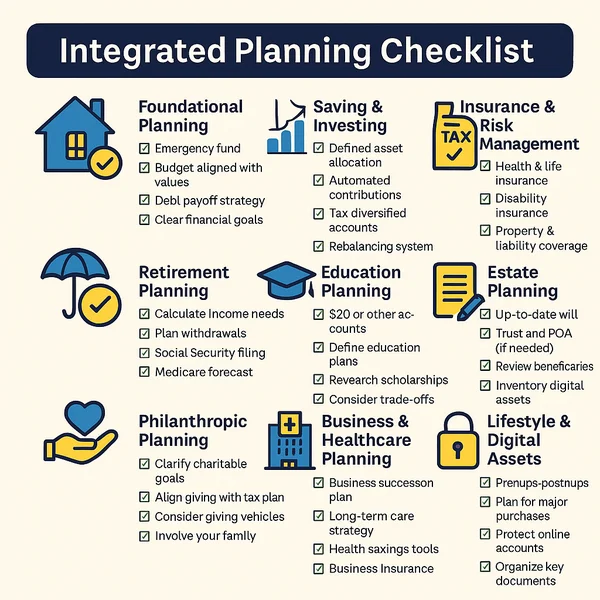
🧭 Bringing It All Together
Integrated planning isn’t just about checking off boxes—it’s about ensuring your entire financial life functions as a unified, strategic system. This post transforms our checklist into a living, breathing guide to managing your finances holistically. Whether you’re just getting started or fine-tuning an existing plan, here’s how to build, maintain, and adapt your financial strategy across all areas of life.
🏠 Foundational Planning
The groundwork for all your financial success begins here:
- Emergency fund: Save 3–9 months of essential living expenses in a high-yield savings account.
- Budget aligned with values: Make a spending plan that reflects what matters most to you—not just your bills.
- Debt payoff strategy: Use snowball (smallest to largest) or avalanche (highest to lowest interest rate) methods.
- Credit score monitored: Check regularly with tools like Credit Karma or your bank.
- Financial goals mapped: Identify and break down short-, medium-, and long-term goals.
📊 Saving & Investing
Maximize your wealth-building potential:
- Defined asset allocation: Match investment mix to time horizon and risk tolerance.
- Automated contributions: Pay yourself first with auto transfers to savings and investment accounts.
- Tax diversification: Use a mix of taxable, tax-deferred (401(k), Traditional IRA), and tax-free (Roth IRA) accounts.
- Investment Policy Statement (IPS): Document your strategy, rebalancing rules, and investment philosophy.
- Rebalancing system: Quarterly check-ins or threshold triggers (e.g., 5% drift).
🛡 Insurance & Risk Management
Protect what you’ve built:
- Health insurance: Annual open enrollment review for coverage and network updates.
- Life insurance: Ensure it covers income replacement, debts, and future obligations.
- Disability insurance: Especially important for self-employed or high-income earners.
- Property insurance: Sufficient home, auto, and renters coverage.
- Umbrella insurance: Consider if your net worth exceeds $500,000.
📑 Tax Planning
Make the tax code work for you:
- Retirement tax strategy: Coordinate Traditional vs. Roth contributions based on bracket and timing.
- Charitable giving: Use Donor-Advised Funds (DAFs), Qualified Charitable Distributions (QCDs), or itemized deductions.
- Quarterly estimated taxes: Avoid penalties if you’re self-employed or have investment income.
- Tax return review: Analyze prior year filings for missed deductions or carryovers.
👵 Retirement Planning
Secure your post-career life:
- Retirement income planning: Know your monthly income needs and inflation adjustments.
- Withdrawal strategy: Minimize taxes and sequence-of-return risk.
- Social Security planning: Time your benefits for longevity and spousal needs.
- RMDs: Track required distributions starting at age 73 (or 75 if born 1960+).
- Healthcare and Medicare: Plan for premiums, Medigap, and long-term care costs.
🎓 Education Planning
Plan for children’s or your own lifelong learning:
- 529 plans or alternatives: Consider UGMA/UTMA, custodial Roths, or taxable accounts.
- K–12, college, trade school: Estimate future costs using calculators like College Board.
- Scholarships and aid: Research FAFSA, CSS Profile, and merit-based opportunities.
- Parental trade-offs: Balance education funding with your own retirement savings.
🏡 Estate Planning
Ensure your legacy is honored and your wishes followed:
- Will and/or trust: Create a revocable living trust for privacy and probate avoidance.
- Durable power of attorney & healthcare directive: Cover legal, medical, and financial decisions.
- Beneficiary designations: Review annually for all accounts and insurance policies.
- Digital assets inventory: Document logins, cryptocurrency wallets, domain names, etc.
- Estate tax evaluation: Understand exposure at federal ($13.61M/person in 2025) and state levels.
💝 Philanthropic Planning
Give with intention and impact:
- Values-driven giving plan: Support causes aligned with your mission.
- Tax-smart giving: Use appreciated assets, DAFs, and QCDs for maximum benefit.
- Charitable trusts: Explore CRTs and CLTs for legacy planning.
- Family engagement: Teach children through family giving meetings.
🏢 Business & Healthcare Planning
For entrepreneurs and retirees alike:
- Succession plan: Define exit strategy, valuation, and transition roles.
- Long-term care plan: Consider hybrid life/LTC policies or stand-alone coverage.
- Health savings: Max out HSA contributions if eligible; spend FSA wisely.
- Self-employed planning: Cover liability, business insurance, and retirement options (e.g., Solo 401(k)).
🧠 Lifestyle & Digital Assets Planning
Plan for major life events and digital security:
- Prenups, postnups, estate documents: Protect both partners in blended or high-asset households.
- Major purchases: Save ahead for cars, homes, travel, or caregiving needs.
- Password managers and backups: Secure digital legacy and data continuity.
- Cloud backups of key files: Use encrypted storage for IDs, estate docs, and policies.
🔁 Regular Review & Adjustment
Agility is everything:
- Quarterly reviews: Budget, investments, debt, and savings updates.
- Annual reviews: Full strategic review of taxes, retirement, estate, insurance.
- Trackers and dashboards: Maintain visual tools to monitor progress.
- Accountability: Partner with a financial advisor or hold yourself to check-ins.
✅ Final Tip
Use a shared folder (cloud-based or physical binder) to organize your plan. Label documents clearly and set calendar reminders for quarterly and annual reviews.
A great plan isn’t written once—it’s lived, reviewed, and evolved over time.