
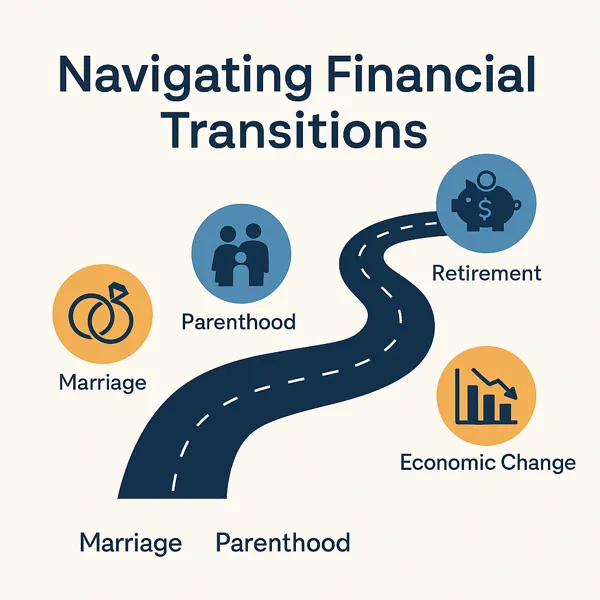
💡 Introduction — Why Financial Plans Must Evolve
Life rarely moves in a straight line—and neither does your money. Careers shift, families grow, health needs change, and the economy moves through cycles that directly affect your financial reality. A financial plan that once fit your life perfectly can quickly become outdated when circumstances evolve.
That’s why adaptability is one of the most important—yet most overlooked—skills in long-term financial planning. Adjusting your plan isn’t a sign that something went wrong. It’s a sign you’re paying attention. Regular reviews help ensure your budget, savings strategy, investment mix, and risk exposure reflect what’s happening right now in your life, not what made sense five years ago.
When people search for help during big life shifts, they often use phrases like “how to adjust your financial plan after a life change” or “what to do financially when life changes.” These are what we refer to as financial transitions—moments when your personal or economic environment changes enough that your financial strategy needs to evolve with it.
This guide will walk you through the most common transitions, how they affect your finances, and actionable steps you can take to stay grounded. You’ll also find real-world scenarios, practical checklists, and mindset strategies to help you navigate change with clarity and confidence.
🧭 Key Takeaways
- Financial planning is an ongoing process, not a one-time event. Expect to revisit and adjust your strategy whenever life, income, or economic conditions shift.
- Flexibility is your greatest financial advantage. Adaptive budgets, flexible savings targets, and periodic portfolio reviews help keep your plan aligned with your current reality.
- Major life events require immediate attention. Marriage, divorce, parenthood, career changes, caregiving, and retirement all reshape your financial priorities—and your plan should reflect that.
- Your emotions influence your decisions more than you think. Understanding the psychological side of transitions helps prevent panic-driven mistakes during high-stress periods.
- Consistent review is the key to long-term clarity. A semiannual or annual financial check-in strengthens your resilience and ensures your plan grows as your life evolves.
1. Signs It’s Time to Update Your Financial Plan
Your financial plan should evolve as your life, goals, and environment change. Yet most people wait until they feel overwhelmed before making adjustments. Recognizing early warning signs helps you stay proactive instead of reactive.
Key Indicators Your Plan Needs a Review
• Your goals have changed
Maybe you’re planning to buy a home sooner than expected, considering starting a business, or reprioritizing retirement. When your goals shift, your plan must shift with them.
• Your income has increased or decreased
Raises, bonuses, job changes, layoffs, or starting a side business all affect cash flow. An updated plan helps you avoid lifestyle creep—or financial strain.
• Your expenses aren’t matching your old budget
Childcare, medical bills, transportation changes, inflation, or caregiving demands can all push your current budget out of alignment.
• You’re feeling more financial stress than usual
Stress can be a signal that your plan no longer reflects your reality. Overspending, irregular cash flow, or uncertainty about priorities are classic signs.
• The economy has shifted
Inflation, interest rates, and tax laws all influence how your money should be allocated. A review ensures your strategy stays optimized for current conditions.
When to Review Immediately
- Marriage or divorce
- New child or adoption
- Major income change
- Major health event
- New mortgage or relocation
- Approaching retirement
- Significant market volatility
These moments reshape your financial landscape and require immediate updates to prevent long-term setbacks.
Tip: Set a recurring annual calendar reminder for your “Financial Review Day.” Treat it as seriously as tax season or open enrollment.
2. Rebalancing Your Budget and Cash Flow After a Life Change
Major life transitions—whether exciting, overwhelming, or unexpected—almost always reshape your financial landscape. Your old budget may no longer match your new priorities, and staying on autopilot can lead to overspending, missed savings opportunities, or unnecessary stress. Rebalancing your cash flow ensures your financial plan supports your new reality instead of working against it.
Below is a structured approach to recalibrating your budget in a way that is practical, repeatable, and grounded in sound financial planning principles.
Step 1: Start With a Fresh Cash Flow Audit
Before making changes, you need a clear picture of where your money is currently going.
Review Your Income
- Document all income sources (salary, bonuses, freelancing, benefits, support payments).
- If income is variable, calculate both your baseline and realistic average monthly income.
- Identify whether the change in your life event affects income stability or timing.
Update All Expenses
Break this into categories for accuracy:
- Fixed costs: rent/mortgage, insurance, childcare, transportation
- Variable essentials: groceries, utilities, fuel, healthcare
- Discretionary: entertainment, travel, subscriptions, memberships
- New expenses related to the life event: daycare, medical copays, therapy, union dues, commuting changes, education costs
Evaluate Savings Flow
- What % of income is currently being saved?
- Are previous goals still relevant?
- What needs to be paused, increased, or reallocated?
A properly updated budget is your foundation. It prevents guesswork and helps you prioritize intentionally, especially during times of transition.
Step 2: Reassess Needs vs. Wants (Strategically, Not Emotionally)
Life transitions often introduce new financial pressures—some temporary, some long-term. This is the moment to decide what’s essential and what can be dialed back.
Ask these questions:
- Does this expense still support my goals?
- Is this a want masquerading as a need?
- Can this be reduced or paused for 3–6 months?
- Does this purchase bring real value or just convenience?
Even modest adjustments—reducing subscriptions, pausing travel, limiting impulse purchases—can free up hundreds of dollars monthly, creating meaningful room for new obligations.
This step is less about deprivation and more about realignment.
Step 3: Adjust Your Savings Strategy to Match Your New Priorities
Savings should always reflect current goals—not the goals you had before your life shifted.
Depending on the transition, you may need to:
- Increase your emergency fund (especially after job changes, new expenses, or income volatility).
- Start new sinking funds for predictable upcoming costs (daycare, home repairs, tuition).
- Temporarily reduce retirement contributions to stabilize cash flow during a major transition.
- Increase retirement or tax-advantaged savings if income went up.
- Redirect savings toward a new life priority like maternity leave, caregiving costs, or relocation.
Key Principle
Your savings plan should always evolve with your life—not the other way around.
Step 4: Reallocate Debt Payments Intentionally
Debt strategies often need to change when your financial life changes.
If income falls or expenses rise:
- Shift from aggressive payoff to minimum payments temporarily.
- Consolidate or refinance to lower monthly obligations.
- Consider balance transfer promotions (only if you can repay during the promo window).
If income increases:
- Increase payments on high-interest debt first.
- Add “buffer payments” to speed up payoff without disrupting cash flow.
- Reevaluate debt priorities if your goals have changed.
If new debt has been added due to the life event:
- Integrate it into your broader payoff plan rather than treating it separately (common mistake).
You want your debt strategy to support your financial stability, not strain it during a period of transition.
Step 5: Prepare for New or Upcoming Costs Before They Hit
One of the best ways to protect your budget is to anticipate changes before they show up as financial emergencies.
Common examples of upcoming expenses during life transitions:
- Childcare or school-related costs
- Moving or relocation expenses
- Out-of-pocket medical costs
- Car repairs or vehicle replacement
- Home updates required by lifestyle changes
- Technology upgrades for a new job
- Support for aging parents
- Increased insurance premiums
How to plan ahead effectively:
- Create a sinking fund for each major upcoming cost.
- Add the estimated expense into a 6–12 month forecast.
- Build a small monthly buffer for unknowns.
- Set calendar reminders to review upcoming costs quarterly.
Planning ahead prevents short-term disruptions from turning into long-term financial strain.
Creator’s Insight– For freelancers, creators, or anyone with variable income, use the “Baseline + Bonus” system.
- Determine your minimum predictable income (the baseline) and build your living budget around it.
- Treat extra earnings as bonuses to fund savings, investments, or debt repayment.
This method stabilizes cash flow and removes emotional swings tied to inconsistent income.
3. Reviewing Investments and Risk Exposure During Transitions
Life changes often shift the level of financial risk you can comfortably—and wisely—take. Whether you’re starting a family, changing careers, navigating health changes, or approaching retirement, your investment strategy must be recalibrated to match your new goals, timeline, and cash flow realities.
This section will help you understand what to review, why it matters, and how to avoid costly mistakes that often happen during periods of uncertainty.
Step 1: Reevaluate Your Risk Tolerance and Capacity
Two things determine how much risk you can take:
- Risk tolerance — how comfortable you are with market volatility
- Risk capacity — how much risk your life situation financially allows you to take
Life transitions often affect both.
Examples of events that usually lower risk capacity:
- Job loss or career transition
- New childcare or caregiving responsibilities
- Major health changes
- Buying a home
- Approaching retirement
Events that may increase risk capacity:
- Significant income increase
- Reduced expenses or paid-off debts
- Dual-income stability
- Higher savings rate or large emergency fund
Your investment mix should reflect both comfort level and financial reality.
Step 2: Assess the Alignment Between Your Portfolio and Life Goals
After a major life change, revisit your time horizons:
- Short-term goals (0–3 years): stability > growth
- Medium-term goals (3–10 years): balanced mix
- Long-term goals (10+ years): more growth potential
Ask yourself:
- Have my long-term goals shifted?
- Do I need shorter-term liquidity?
- Has my investment timeline changed?
- Does my current mix still match my updated priorities?
If your goals or timelines changed, your asset allocation may need to as well.
Step 3: Rebalance Your Asset Allocation
Portfolio drift is normal—but transitions accelerate it.
Rebalancing involves:
- Selling assets that are overweight (too large a percentage of your portfolio)
- Buying assets that are underweight
- Realigning your mix toward stocks, bonds, and cash that match your new risk profile
When to consider rebalancing:
- After major market movement
- After your life changes significantly
- If any category drifts 5–10% from your target allocation
Rebalancing keeps your portfolio disciplined and prevents emotion-driven adjustments.
Step 4: Review Your Tax Strategy (Minimize Surprises)
Life transitions can create new tax implications:
- Changes in income can affect tax brackets
- Marriage or divorce changes filing status
- New dependents create new deductions
- Business ownership affects retirement plan options
- Caregiving or disability affects healthcare costs and credits
- Selling or buying a home changes capital gains exposure
Key areas to evaluate:
- Contribution limits (401(k), IRA, HSA)
- Tax-efficient investment placement
- Capital gains exposure
- Loss harvesting opportunities
- New or expiring credits/deductions
Reviewing tax strategy during transitions protects your long-term returns.
Step 5: Check Liquidity and Emergency Reserves
Your liquidity needs can change dramatically after a major life event.
Questions to ask:
- Do I need more cash on hand?
- Would a smaller emergency fund put my family at risk?
- Do I have enough liquid investments for short-term needs?
- Does my cash-to-investment balance need adjusting?
Liquidity cushions prevent you from selling investments at the wrong time or taking on unnecessary debt.
Step 6: Avoid the Most Common Mistakes (Especially During Stress)
Financial transitions increase emotional vulnerability. This is where many people make avoidable investment mistakes.
Avoid:
- Panic selling during volatility
- Increasing risk for “catch-up” returns
- Making emotional allocation decisions
- Ignoring tax consequences
- Over-contributing to long-term accounts when short-term needs are uncertain
- Neglecting to review insurance (life, disability, long-term care)
Instead:
- Pause, assess, plan
- Use data—not emotion—to guide decisions
- Make changes only after reviewing risk, goals, liquidity, and cash flow
A calm, structured approach helps keep your long-term plan intact.
Step 7: Consider Getting an Outside Review
During major life transitions, a second opinion can be invaluable.
A professional can help you:
- Reassess your risk profile
- Rebuild a goal-based asset allocation
- Evaluate your tax strategy
- Run retirement or cash flow projections
- Identify blind spots during stressful times
Even one session can prevent costly missteps.
Scenario Example
A dual-income couple expecting their first child reviews their finances and decides to:
- Reduce equity exposure in retirement accounts to limit volatility.
- Increase life and disability insurance to protect future income.
- Boost their emergency fund from 3 to 6 months’ expenses.
The shift prioritizes long-term security over short-term returns — a smart move during a major life transition.
4. Major Life Events That Require a Plan Update
Life transitions aren’t just emotional or logistical—they reshape your financial priorities, risk exposure, and long-term strategy. Any time a major life event occurs, your financial plan should be revisited to ensure it reflects your new reality. Below is a comprehensive breakdown of the most common transitions, how they affect your finances, and the key steps to take.
🔹 Marriage or Partnership
Merging two financial lives creates new opportunities—and new complexities.
Key Financial Impacts
- Combining household income and expenses
- Aligning financial goals and timelines
- Updating beneficiaries, insurance, and estate documents
- Establishing shared vs. individual accounts
- Adjusting tax strategy and filing status
Scenario
Two professionals with different spending habits merge finances. One has student loans; the other contributes heavily to retirement. Their old budgets and investment strategies no longer fit a shared future.
What to Do
- Create a unified household budget
- Discuss financial values, money habits, and long-term goals
- Review insurance and estate needs
- Decide how to manage individual vs. joint accounts
- Update tax withholdings and retirement contribution strategy
🔹 Divorce or Separation
Divorce is one of the most financially disruptive transitions. Your plan must be rebuilt from the ground up.
Key Financial Impacts
- Loss or redistribution of income
- Asset division (home, savings, retirement accounts)
- New or adjusted childcare/child support expenses
- Insurance and beneficiary changes
- Potential tax filing changes
Scenario
A parent transitioning from dual-income stability to single-income budgeting must adjust their cash flow, long-term savings, and investment risk. The old plan no longer applies.
What to Do
- Rebuild your budget based on single-income expenses
- Reevaluate insurance (life, disability, health)
- Update beneficiaries immediately
- Recalculate retirement projections
- Establish emergency and sinking funds for a single-income household
🔹 Starting or Changing Careers
Career transitions—whether voluntary or unexpected—directly impact financial stability and planning.
Key Financial Impacts
- Changes in salary and cash flow
- New benefits (or loss of employer benefits)
- Shifts in tax liability
- Variability and unpredictability in income
- Need for updated retirement contributions
Scenario
A teacher moves into a higher-paying administrative role with a different pension structure and new health benefits. Their retirement timeline and savings goals shift significantly.
What to Do
- Update your income forecast
- Adjust your budget to reflect new cash flow
- Compare old and new employer benefits
- Evaluate your investment mix and retirement plan
- Prepare for income gaps if transition is between jobs
🔹 Parenthood (Birth, Adoption, or Growing Family)
Parenthood introduces one of the largest long-term financial commitments.
Key Financial Impacts
- Childcare and medical expenses
- Adjusted work schedules or career paths
- Increased insurance needs
- Future education planning
- Lifestyle and home-related expenses
Scenario
A first-time parent faces new costs: prenatal care, maternity leave, childcare, and reduced work hours. The old budget no longer fits their household priorities.
What to Do
- Revise your budget for recurring childcare and medical costs
- Increase emergency fund size
- Review life and disability insurance
- Start or revisit a 529 plan
- Adjust long-term goals to reflect parenting responsibilities
🔹 Caring for Aging Parents
The “sandwich generation” often balances caring for children and aging parents simultaneously.
Key Financial Impacts
- Medical caregiving costs
- Reduced work hours or career changes
- Additional household expenses
- Estate and power-of-attorney considerations
- Long-term care planning
Scenario
An adult child takes on caregiving responsibilities for a parent with limited retirement savings. This impacts their own savings rate and stress level.
What to Do
- Build a caregiving budget
- Evaluate medical, long-term care, and supplemental insurance options
- Review POA, healthcare directives, and estate paperwork
- Reassess your own retirement timeline and savings contributions
- Consider state tax credits or benefits for caregivers
🔹 Buying a Home or Relocating
Housing changes are major financial pivots with ripple effects across your budget.
Key Financial Impacts
- Closing costs, moving expenses, repairs
- New property taxes, insurance, and utilities
- Cash flow shifts based on mortgage vs. rent differences
- Updated home-related sinking funds
- Potential tax impacts (mortgage interest, capital gains)
Scenario
A couple moves from renting to homeownership, doubling their housing costs and adding insurance, repairs, and property taxes. Their budget and emergency fund need immediate restructuring.
What to Do
- Rebuild your budget with updated housing obligations
- Create a home maintenance sinking fund
- Update insurance across all categories
- Recalculate savings contributions and lifestyle needs
- Factor in new commuting, utility, or community costs
🔹 Health Crisis or Disability
Unexpected health events can significantly alter both financial and emotional stability.
Key Financial Impacts
- Medical bills, prescriptions, therapy, rehab
- Reduced work hours or lost income
- Need for additional caregiving or support
- Insurance gaps or coverage limits
- Emergency fund strain
Scenario
An employee faces a months-long recovery after an accident and exhausts employer sick leave, requiring supplemental disability coverage. Their cash flow and long-term budget must be rebuilt.
What to Do
- Review health, disability, and supplemental insurance
- Document new medical and support costs
- Update your emergency fund plan
- Adjust financial goals and debt strategy
- Seek employer or government benefit programs
🔹 Retirement Transition (Full or Partial)
Retirement is not a single moment—it’s a multiyear transition that changes how you manage money.
Key Financial Impacts
- Shifting from saving to spending
- Social Security timing decisions
- Required Minimum Distribution (RMD) planning
- Healthcare and Medicare costs
- Adjusted investment risk exposure
Scenario
A retiree transitions from a salaried role to part-time consulting. Their investment withdrawal strategy and tax plan need to be redesigned.
What to Do
- Build a decumulation plan (withdrawals, order of operations)
- Review investment risk and asset allocation
- Evaluate Medicare, Medigap, or private insurance
- Coordinate RMDs with other retirement income
- Maintain liquidity for early-retirement expenses
🔹 Sudden Windfalls (Inheritance, Bonus, Settlement)
Windfalls fuel emotion—and emotion fuels poor decisions.
Key Financial Impacts
- Tax planning requirements
- Asset allocation challenges
- Pressure to help family or overspend
- Confusion over long-term priorities
Scenario
An adult inherits a lump sum after a parent’s passing. Without a plan, they risk overspending or misallocating the funds.
What to Do
- Pause major decisions for 30–90 days
- Build a “windfall plan” with short-, medium-, and long-term goals
- Reevaluate investment allocation
- Address tax liabilities
- Consider using a portion to build financial stability
5. The Emotional and Psychological Side of Financial Transitions
Financial transitions aren’t just about numbers—they are about identity, security, expectations, and the emotional weight of change. Even positive life events can create anxiety or uncertainty, and the way we feel during transitions often shapes the financial decisions we make.
Understanding the psychological side of financial change helps you stay grounded, make clearer choices, and avoid reaction-based mistakes that can derail long-term goals. This section provides practical mindset strategies to help you navigate transitions with clarity and confidence.
Why Emotions Matter More Than Most People Realize
During major life changes, your brain naturally shifts into “protection mode.” This can lead to:
- Decision fatigue
- Heightened stress responses
- Avoidance or procrastination
- Impulse spending or panic cutting
- Overconfidence or fear-driven conservatism
- Difficulty distinguishing urgent vs. important tasks
These emotional patterns are normal—but recognizing them helps you avoid letting them dictate your financial choices.
Mindset Strategies to Stay Grounded During Financial Change
1. Slow Down the Pace of Decisions
Fast decisions during stressful transitions often lead to mistakes.
Give yourself permission to pause.
Try this:
- Delay big financial decisions for 72 hours
- Break complex tasks into small, manageable steps
- Use written checklists instead of relying on memory
This protects you from making emotional, irreversible choices.
2. Reframe the Transition as a Temporary Period of Adjustment
Most financial stress isn’t caused by the transition itself—it’s caused by the fear that the change is permanent.
Remind yourself:
“This is a transition, not a destination.”
This mindset keeps short-term difficulties from overwhelming your long-term perspective.
3. Separate Facts From Feelings
Strong emotions can distort financial reality.
Example:
- Fear: “My income dropped; I’ll never catch up.”
- Fact: “My income changed. I need to adjust my budget for the next 6–12 months.”
Clarity comes from identifying:
- What is true
- What is temporary
- What you can control
4. Build Emotional Buffers Into Your Financial Plan
Just like you build financial buffers (emergency funds), you can build psychological buffers.
Examples include:
- A simplified spending plan
- Auto-transfers that reduce decision-making
- “Permission” categories for guilt-free spending
- Reassurance checkpoints (monthly review, quarterly adjustments)
These reduce mental load and help you stay consistent.
5. Use the “Values → Goals → Actions” Framework
During transitions, it’s easy to lose sight of why we’re making financial decisions.
This framework brings focus:
Values: What matters most to you
Goals: How those values translate into financial objectives
Actions: The specific steps that move you toward those goals
This model simplifies decision-making and reduces emotional clutter.
Common Emotional Traps to Avoid During Transitions
Understanding these pitfalls helps you protect both your finances and your peace of mind.
• Panic Spending or “Comfort Purchases”
When overwhelmed, some people spend to feel control or relief.
This can sabotage long-term stability.
• Avoidance of Financial Tasks
Ignoring bills, statements, or decisions only increases anxiety.
Use micro-tasks to stay engaged.
• Overcorrecting
Drastically slashing spending or selling investments out of fear can create new problems.
• Comparison With Others
Your financial transition is unique. Comparing your situation to others invites self-doubt, unrealistic expectations, and poor choices.
• All-or-Nothing Thinking
You don’t need to overhaul your entire plan at once.
Small, consistent adjustments create lasting stability.
How to Make Emotionally Intelligent Financial Decisions
Ask Three Questions Before Any Major Choice:
- Is this decision based on my goals or my emotions?
- Am I reacting to the short-term or planning for the long-term?
- Will I still feel confident about this choice in a week? A month? A year?
This simple framework prevents emotion-driven decisions that undermine your long-term strategy.
When to Seek Outside Support
Transitions often benefit from external perspective. Consider reaching out when you feel:
- Overwhelmed or stuck
- Unsure how to prioritize
- Emotionally drained
- Uncertain about balancing competing responsibilities
- Afraid of making a costly mistake
Support doesn’t always mean hiring a planner; it can be a trusted advisor, a financial coach, or a structured financial tool. The key is not navigating difficult transitions alone.
6. Building Flexibility Into Your Plan
Financial transitions can feel destabilizing, but flexibility transforms uncertainty into resilience. A flexible financial plan isn’t rigid or overengineered—it adapts as life evolves. Instead of reacting to change with stress or guesswork, you create systems that absorb shocks, preserve progress, and keep you aligned with your goals.
Below are practical ways to build flexibility into your budget, savings, investment strategy, and long-term planning so you can navigate life’s twists with confidence.
1. Adopt an Adaptive Budget (Not a Static One)
A flexible budget adjusts as your financial life shifts.
Core features of an adaptive budget include:
- Percentage-based savings: e.g., saving 15–20% of income regardless of income level
- Dynamic discretionary spending: allowing this category to shrink or expand based on life events
- Quarterly spending reviews: adjusting categories seasonally instead of locking yourself into a year-long plan
- Rolling 3-month projections: giving visibility into upcoming expenses
Why it matters:
Adaptive budgets prevent overwhelm during stressful periods and give you room to adjust without abandoning your plan.
2. Use the “Core and Variable” Framework
This method helps you stay financially steady even when income or expenses fluctuate.
Core Expenses:
Non-negotiable costs like housing, utilities, insurance, groceries, minimum debt payments.
Variable Expenses:
Discretionary categories that can flex up or down when needed: dining out, travel, entertainment, shopping.
How to use it:
Build your budget so core expenses fit within 50–60% of your take-home pay, leaving room for adjustments without sacrificing essentials.
3. Build Multi-Layered Emergency Funds
Not all emergencies are the same, so your savings shouldn’t be either.
Create three layers of buffers:
- Mini-buffer (1 month): for small disruptions like car repairs or medical bills
- Short-term fund (3 months): for temporary income changes
- Long-term fund (6–12 months): for major life transitions
Why it matters:
Layered funds let you manage emergencies without panic, debt, or tapping long-term investments.
4. Automate What You Can (and Leave Room to Adjust)
Automation is powerful—but only when used strategically.
Automate:
- Monthly savings transfers
- Investment contributions
- Bill payments
- Debt payoff plans
But keep flexible options:
- The ability to pause or modify transfers during tight months
- Quarterly review reminders
- Visibility into upcoming automated changes
Why it matters:
Automation increases consistency while preserving adaptability during transition periods.
5. Set Financial Goals in Ranges, Not Absolutes
Rigid goals can create unnecessary pressure during unpredictable times.
Use goal ranges like:
- “Save $8,000–$12,000 this year”
- “Invest 15–20% of my income”
- “Pay down $3,000–$4,500 of debt”
- “Build a $15,000–$20,000 emergency fund”
Why it matters:
Ranges create success markers at different levels and help prevent all-or-nothing thinking.
7. Annual Financial Review Checklist
Even when life feels stable, your financial plan needs regular maintenance. An annual (or semi-annual) review ensures your goals, budget, insurance, investments, and protections stay aligned with your current reality—not last year’s circumstances. Think of this as your financial “health check,” designed to catch problems early, identify opportunities, and strengthen long-term resilience.
Use the checklist below to guide your yearly review or to reset your financial plan after a major life transition.
1. Review Your Income, Expenses, and Cash Flow
Your cash flow is the backbone of your financial stability. Start with the basics.
Checklist
- Compare year-over-year income (raises, bonuses, side income, business revenue).
- Review fixed and variable expenses for increases or reductions.
- Identify lifestyle creep or overspending trends.
- Update your budget to reflect new priorities and life events.
- Confirm your emergency fund level is adequate for your current situation.
Goal: Ensure your spending and saving align with your present financial capacity.
2. Update Your Savings Strategy
Your savings needs evolve as your goals evolve.
Checklist
- Recalculate how much you need in your emergency fund.
- Adjust automatic transfers to match new goals or income.
- Evaluate progress toward sinking funds (travel, home repairs, tuition, childcare).
- Increase or decrease contributions as life circumstances change.
- Confirm whether any goals need to be paused, accelerated, or replaced.
Goal: Keep your savings aligned with your short-term and long-term needs.
3. Review Your Investments and Portfolio Allocation
Your portfolio should reflect your current goals, not the ones you had when you first started investing.
Checklist
- Reevaluate your risk tolerance and risk capacity.
- Check whether your portfolio has drifted (stocks vs. bonds vs. cash).
- Rebalance if allocations have shifted 5–10% from target.
- Review contributions to 401(k), IRA, HSA, or SEP/Solo 401(k).
- Confirm investment timelines still match your updated life stage.
- Evaluate fees and performance on old accounts or legacy investments.
Goal: Ensure your investment strategy supports your life goals with appropriate risk.
4. Evaluate Your Debt and Credit Health
Debt can support your goals—or slow them down. Review your overall debt picture annually.
Checklist
- Check balances and interest rates on all loans (mortgage, auto, student, credit cards).
- Identify high-interest debt to prioritize.
- Reevaluate payoff strategy (snowball, avalanche, hybrid).
- Assess whether refinancing, consolidation, or balance transfers make sense.
- Review your credit score and pull your credit reports for accuracy.
Goal: Strengthen financial resilience by reducing interest costs and improving credit health.
5. Review Insurance Coverage
Insurance needs change as your life evolves. Under-insurance is one of the biggest overlooked risks in financial planning.
Checklist
- Review health, dental, and vision coverage.
- Evaluate life insurance needs (especially after marriage, parenthood, or major income change).
- Check disability insurance coverage.
- Review auto, home, and renters policies for coverage gaps.
- Consider umbrella liability coverage as net worth increases.
- Update beneficiaries on all policies.
Goal: Protect your financial stability against unexpected events.
6. Assess Your Tax Strategy
Tax planning is one of the most effective ways to grow and protect wealth.
Checklist
- Review whether your tax withholding needs adjustment.
- Evaluate retirement contributions for tax efficiency.
- Confirm eligibility for credits or deductions you didn’t use before.
- Plan for major tax changes (RMDs, new dependents, business income, capital gains).
- Review HSA, FSA, or dependent care FSA use.
- Consider tax-loss harvesting opportunities.
Goal: Minimize tax exposure while aligning strategy with new income or life changes.
7. Update Your Estate and Legal Documents
Estate planning isn’t just for high-net-worth families. It’s about clarity and protection.
Checklist
- Update or create a will.
- Review your living trust (if applicable).
- Update power of attorney and healthcare directives.
- Confirm all beneficiary designations are current.
- Inventory digital assets: passwords, subscriptions, online accounts.
- Review guardianship plans if you have children.
Goal: Ensure your wishes and protections stay current and legally enforceable.
8. Strengthen Your Security and Digital Financial Hygiene
Financial security increasingly involves online and digital measures.
Checklist
- Change important passwords annually.
- Enable two-factor authentication on all financial accounts.
- Review credit monitoring and identity protection tools.
- Secure backup copies of financial documents.
- Check your device and browser security settings.
Goal: Protect your identity, accounts, and sensitive information.
9. Conduct a “Life Events” Review
Even small changes can have large financial consequences.
Checklist
- Marriage, divorce, or partnership changes
- New child or dependent
- New medical needs
- Job or income changes
- Home purchase, move, or downsizing
- Beginning or ending caregiving responsibilities
- Changes in long-term goals
- Any new risk exposure or responsibility
Goal: Identify transitions that require updates across your financial plan.
10. Set New Goals for the Year Ahead
Your annual review should end with a roadmap forward.
Checklist
- Define or refine short-term, medium-term, and long-term goals.
- Prioritize no more than 3 primary goals for the next 12 months.
- Align savings, investments, and budget to these goals.
- Schedule quarterly check-ins to stay on track.
Goal: Transform your review into clear, achievable financial progress.
8. Frequently Asked Questions About Financial Transitions
Financial transitions create uncertainty—and with uncertainty comes questions. Below are clear, practical answers to the issues people search for most when navigating life changes and trying to update their financial plan.
1. How often should I update my financial plan?
Most people should review their financial plan at least once a year, but update it immediately after any major life event such as:
- Job change or income change
- Marriage or divorce
- Birth or adoption
- Buying or selling a home
- Major health event
- Caring for aging parents
- Approaching retirement
If your income, expenses, goals, or risk level changes, your plan should change too.
2. What life events affect my finances the most?
The transitions that typically have the biggest financial impact include:
- Marriage or divorce
- Having a child
- Major medical events
- Job loss or career change
- Home purchase or relocation
- Becoming a caregiver
- Retirement or semi-retirement
- Receiving an inheritance or windfall
Each of these events requires updates to your budget, savings, insurance, and investments.
3. How do I adjust my budget after a major life change?
Start with a fresh cash-flow audit:
- Recalculate all income
- Update fixed and variable expenses
- Identify new recurring costs
- Adjust your savings priorities
- Build or reinforce emergency reserves
- Create or modify sinking funds
- Reevaluate discretionary spending
A life change often means your old budget no longer fits your new responsibilities.
4. Should I change my investment strategy during a transition?
Yes—if the transition changes your goals, timeline, or risk tolerance.
For example:
- A new baby may increase your need for liquidity.
- A job loss may reduce your risk capacity.
- Retirement may require shifting from growth to income.
However, avoid emotion-driven decisions. Make changes only after reviewing:
- Your new time horizons
- Cash-flow needs
- Risk tolerance
- Tax implications
5. What if my income becomes unpredictable or irregular?
If income fluctuates (career change, gig work, self-employment), build flexibility:
- Base your budget on your minimum guaranteed income
- Treat extra income as variable bonuses
- Increase emergency savings to 4–6 months
- Use sinking funds for predictable but infrequent expenses
- Automate essentials (core bills + savings %)
Stability comes from planning around your lowest predictable income—not your highest.
6. How do I handle financial transitions when emotions are high?
Use these strategies:
- Pause major financial decisions for 72 hours
- Break tasks into small steps
- Separate facts from feelings (“objective review”)
- Create temporary, simplified budgets
- Use a checklist to reduce decision fatigue
Emotional clarity can prevent costly financial mistakes.
7. Do I need to update insurance when life changes?
Yes—insurance should always match your current responsibilities.
Review or update life, disability, health, auto, home, and umbrella insurance after:
- Marriage or divorce
- Birth of a child
- Major income change
- Home purchase
- Health changes
- Caring for dependents
You may need more coverage—or different types of coverage—than before.
8. When should I update beneficiaries?
Update beneficiaries immediately after:
- Marriage
- Divorce
- Birth or adoption
- Death of a previously named beneficiary
You should also review all beneficiary designations during your annual financial review.
9. How do I know if I need professional help?
You may want outside guidance if you experience:
- Overwhelm or decision paralysis
- A major financial shift (divorce, inheritance, job loss)
- Confusion about investments or tax impacts
- Significant income changes
- Retirement transition planning
- Caring for aging parents
A professional can help clarify priorities, reduce risk, and avoid mistakes.
10. What’s the first step if my finances feel completely off-track after a transition?
Start small:
- Review your income and expenses
- Build a simple 30-day budget
- Update insurance and beneficiaries
- Reassess your goals
- Strengthen your emergency fund
- Make one positive financial adjustment at a time
Progress—not perfection—is the goal during transition periods.
9. Know When to Simplify
Sometimes flexibility comes from reducing complexity.
Simplify by:
- Consolidating accounts
- Streamlining investment portfolios
- Removing outdated goals
- Eliminating unused subscriptions
- Reducing decision points
Why it matters:
Less complexity means more clarity—and clearer decisions in moments of transition.
🏁 Conclusion — Your Financial Plan Should Evolve as You Do
Life is a series of transitions—some planned, some unexpected, all requiring thoughtful financial adjustments. A static financial plan can’t support a dynamic life. The real strength of long-term financial success comes from your ability to adapt, recalibrate, and make decisions that reflect where you are today, not where you were five years ago.
Whether you’re starting a new job, navigating parenthood, managing caregiving responsibilities, or preparing for retirement, every transition is an opportunity to realign your goals, sharpen your strategy, and rebuild financial confidence. Your plan should move with you, support you, and evolve alongside every new chapter.
As you apply the tools in this guide—budget reviews, investment check-ins, mindset strategies, and annual evaluations—you’ll build a plan that’s not just resilient but truly responsive to your life. Remember, progress during transitions isn’t about perfection. It’s about intentional, informed decisions that strengthen your financial stability and move you closer to long-term success.
