
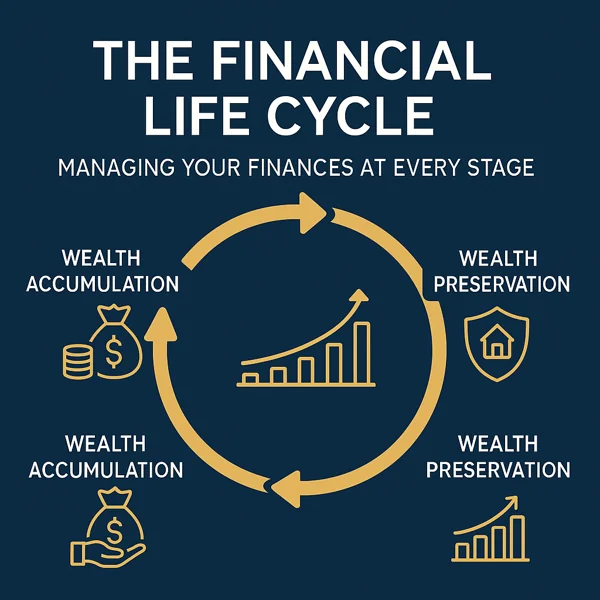
Introduction – Why Your Financial Life Cycle Matters More Than Ever
Financial planning is no longer a one-time task you check off a list—it’s a dynamic process that evolves as your life changes. In today’s economy, rising living costs, shifting career paths, and longer lifespans mean your financial strategy must adapt continuously. The decisions you make in your 20s look very different from the decisions you face in your 50s or your 70s, and managing those transitions well is the key to long-term financial stability.
Understanding the financial life cycle helps you anticipate these changes instead of reacting to them. It gives you a framework to organize your goals, prioritize your resources, and take action with confidence—no matter your age, income, or background.
🔑 5 Key Takeaways
- Your financial priorities evolve across four core stages—Accumulation, Building, Preservation, and Distribution—and each stage requires different strategies, tools, and protections.
- Age doesn’t determine your financial stage; your income stability, savings habits, debt load, responsibilities, and life events are far more accurate indicators of where you truly are.
- Major transitions—such as career changes, marriage, children, health events, business shifts, or preparing for retirement—often move you between stages and require updates to your financial plan.
- Success at every stage comes from focusing on the right actions, avoiding common mistakes, and adjusting your strategy as life changes—especially with taxes, risk management, and long-term planning.
- Revisiting your financial plan every year, or after major life events, keeps your goals aligned, reduces risk, and ensures you’re always moving toward financial stability, security, and lifelong wealth.
How Financial Priorities Evolve
Your financial priorities shift dramatically over time:
- In early adulthood, the focus is on building habits, establishing credit, and managing limited income.
- As your career and family responsibilities grow, your goals expand toward wealth building, risk management, and long-term investing.
- Approaching retirement, the emphasis shifts toward protecting your assets, reducing volatility, and preparing for income distribution.
- In retirement, the priority becomes efficient withdrawals, healthcare planning, and legacy considerations.
These transitions aren’t defined by age alone—they’re shaped by lifestyle, career milestones, and personal circumstances.
Why a Life-Cycle Framework Improves Long-Term Planning
A financial life-cycle model does more than categorize your financial goals. It:
- Creates clarity by defining what matters most at each stage
- Provides direction so you avoid common missteps like overinvesting too aggressively or saving too little in key years
- Ensures balance between short-term needs and long-term success
- Simplifies decision-making when financial trade-offs arise
- Builds continuity, so each stage supports the next rather than working against it
This framework helps you stay proactive—and resilient—even as the economy, your income, and your personal circumstances shift.
Overview of the Four Stages
The financial life cycle is typically divided into four stages:
- Wealth Accumulation – Building the foundation through habits, savings, and credit.
- Wealth Building – Growing assets, investing intentionally, and increasing financial stability.
- Wealth Preservation – Protecting what you’ve built by reducing risk and preparing for retirement.
- Wealth Distribution – Creating sustainable retirement income and planning your legacy.
Each stage requires different strategies, tools, and decisions. Understanding where you stand is the first step toward managing your financial future effectively.
What Makes This Guide Different
Most financial life-cycle guides stay high-level and theoretical. This one goes deeper.
You’ll find:
- Persona-driven examples to make the stages relatable
- Actionable, step-by-step strategies tailored to real-life scenarios
- Tables, metrics, and benchmarks you can use immediately
- Risk-based guidance grounded in modern financial planning practice
- Adaptations for unique circumstances, such as gig work, single-income households, or late-start savers
This approach is designed to give you not just information—but a practical roadmap you can apply today.
1. What Is the Financial Life Cycle?
A Modern Framework for Personal Finance**
Definition & Purpose
The financial life cycle is a planning framework that organizes your financial journey into stages based on common goals, opportunities, and challenges. Instead of viewing your finances as isolated decisions—saving here, investing there—the life-cycle model connects each decision to a broader long-term strategy.
Its purpose is simple:
Help you make the right financial moves at the right time, so your money works harder for you across your entire life.
The Four Core Stages Explained
1. Wealth Accumulation (Foundation Years)
You’re establishing financial habits, building credit, managing debt, and starting to save and invest. Income may be limited, but habits formed now have the highest long-term impact.
2. Wealth Building (Growth & Expansion)
Your career progresses, your income rises, and financial responsibilities increase. This is the stage where strategic investing, tax planning, and risk management matter most.
3. Wealth Preservation (Protection & Stability)
As retirement approaches, the goal shifts to protecting what you’ve built. Reducing investment risk, reviewing insurance, and preparing withdrawal strategies become essential.
4. Wealth Distribution (Retirement & Legacy)
Now the priority is sustainable income, healthcare planning, tax-efficient withdrawals, and passing wealth to the next generation with intention.
How Life Events Shift Your Stage
Your stage doesn’t always change based on age—it often changes based on circumstances:
- Marriage or divorce
- Buying a home
- Becoming self-employed
- Starting a family
- Career changes or promotions
- Receiving an inheritance
- Health challenges
- Market downturns
These events can accelerate, delay, or reshape your financial trajectory. A 45-year-old early-career professional may still be in Wealth Accumulation, while a high-income 30-year-old entrepreneur might move into Wealth Building earlier.
Common Misunderstandings About Wealth Stages
- “These stages are strictly age-based.”
False—life stages reflect financial circumstances, not birthdays. - “You only move forward, never backward.”
Many people move between stages multiple times due to job loss, divorce, health issues, or income changes. - “You must follow a strict order.”
You may overlap stages or manage elements of two stages concurrently. - “Retirement automatically means wealth distribution.”
Many retirees remain in wealth preservation for years if they delay withdrawals.
Financial Life Cycle Overview at a Glance
| Stage | Age Range (Typical) | Core Goals | Key Risks | Metrics to Monitor |
|---|---|---|---|---|
| Wealth Accumulation | Teens–30s | Build savings, credit, investing habits | Debt load, low income, lifestyle creep | Savings % of income, emergency fund, credit score |
| Wealth Building | 30s–50s | Grow net worth, invest strategically, manage risk | Overextension, market volatility, debt | Net worth growth, retirement contributions, debt ratio |
| Wealth Preservation | 50s–70s | Protect assets, reduce volatility, prepare retirement | Sequence risk, health expenses, inflation | Asset allocation, healthcare costs, retirement gap |
| Wealth Distribution | 70s+ | Sustainable withdrawals, tax efficiency, legacy | Longevity risk, RMD penalties, overspending | Withdrawal rate, tax efficiency, portfolio longevity |
2. How Age Overlaps with the Financial Life Cycle (Without Determining It)
Why age is a reference point—not a rule—in financial planning
Most people assume the financial life cycle follows strict age brackets. In reality, age is only a loose indicator. Your actual stage is determined by income stability, financial responsibilities, assets, debt load, risk tolerance, and long-term goals, not your birthday.
A 25-year-old earning six figures may already be in Wealth Building, while a 45-year-old paying down student loans might still be in Wealth Accumulation. Understanding this distinction prevents misalignment—and ensures your strategy matches your real financial needs.
Why Age Isn’t the Main Driver
Income Level Predicts More Than Age
A low-income 30-year-old can be in Stage 1.
A high-income 21-year-old can behave like Stage 2.
Responsibilities Shift You Forward or Backward
Marriage, kids, caregiving, buying a home, or divorce can rapidly change which stage you’re in.
Financial Experience Matters
Someone financially literate at 22 may advance faster than someone with late exposure to money management.
Life Events Can Delay or Accelerate Stages
- Job loss → return to Accumulation
- Business success → leap to Building
- Major inheritance → shift to Preservation or Distribution
Typical Age Overlaps (NOT rules)
These are general reference points—not rigid expectations:
- Teens–Early 30s: Wealth Accumulation
- Late 20s–50s: Wealth Building
- 50s–Early 70s: Wealth Preservation
- 70s+: Wealth Distribution
Your circumstances—not your age—determine where you truly belong.
Quick Diagnostic: Which Stage Are You Actually In?
Answer these six questions:
- Do you have more than 6 months of expenses saved?
- Is your debt manageable and decreasing?
- Are you contributing consistently to retirement?
- Is your income stable or growing?
- Are you planning for retirement or withdrawals?
- Do you have a clear estate or legacy plan?
Your answers reveal whether you’re building, preserving, or distributing wealth—regardless of age.
3. How to Transition Smoothly Between Stages
What to change, what to keep, and what to stop doing when your financial stage evolves
Most people struggle not with the stages themselves—but with the transitions between them. These natural shifts often go unrecognized, leading to mismatched strategies. For example, someone nearing retirement may still invest like they’re in their 30s, or an early-career worker might take on risks meant for someone much later in life.
Below is a practical framework for moving from one stage to the next with clarity and confidence.
Transition: Wealth Accumulation → Wealth Building
Key Indicators You’re Ready to Move On
- Emergency fund of 3–6 months
- Stable income
- Debt payments are under control
- You’re saving consistently for retirement
What Needs to Change
- Increase retirement contributions
- Begin diversifying investments
- Add insurance protections
- Shift focus from crisis management to long-term planning
What to Stop Doing
- Relying on credit to fill budget gaps
- Keeping too much in cash
- Ignoring tax planning
Transition: Wealth Building → Wealth Preservation
Key Indicators
- Retirement is within 10–15 years
- You’ve accumulated meaningful assets
- Debt is low or fully paid off
What Needs to Change
- Reduce volatility in investment portfolio
- Increase cash reserves
- Evaluate long-term care planning
- Begin forecasting retirement income needs
What to Stop Doing
- Making aggressive, speculative investments
- Concentrating assets in one sector or employer stock
- Putting off estate planning conversations
Transition: Wealth Preservation → Wealth Distribution
Key Indicators
- You’ve retired or are semi-retired
- Starting Social Security or pension benefits
- RMD age is approaching or already here
What Needs to Change
- Implement a withdrawal strategy
- Optimize taxes through careful order of withdrawals
- Evaluate healthcare coverage annually
- Reassess risk tolerance regularly
What to Stop Doing
- “Set it and forget it” investing
- Taking withdrawals without tax planning
- Keeping beneficiaries outdated
4. Stage 1 – Wealth Accumulation (Starting Out)
Building the foundation for long-term financial success
The Wealth Accumulation stage is where your financial habits, mindset, and early decisions create the foundation for everything that follows. Even small, consistent actions have an outsized impact during these years—thanks to time, compounding growth, and the structure you build now.
Who This Stage Applies To
This stage typically includes individuals who are:
- Entering the workforce
- Building credit for the first time
- Managing student loans or early debt
- Establishing their financial independence
- Working toward early savings and emergency funds
- Learning how to budget, invest, and manage income
Most people fall into this stage in their late teens through their 20s and early 30s, but age is not the determining factor—your financial situation and responsibilities are.
Core Financial Goals
During this stage, your focus should be on:
- Establishing financial habits that promote long-term success
- Building a meaningful emergency fund
- Managing and paying down high-interest debt
- Strengthening your credit score
- Starting retirement investing (401(k), IRA)
- Developing basic budgeting, cash-flow, and financial literacy skills
- Creating predictable savings patterns you can scale later
Strategies That Drive Progress in This Stage
1. Build a Simple, Realistic Budget
A clear spending plan helps reduce stress, avoid overspending, and identify what you can save each month.
2. Automate Savings & Bill Payments
Automation reduces missed payments, improves credit, and removes the pressure of “remembering to save.”
3. Establish a Starter Emergency Fund (Then Build to 3–6 Months)
Start with $500–$1,000, then gradually work toward the standard safety net.
4. Start Investing as Early as Possible
Even small retirement contributions ($50–$150 monthly) can multiply over decades.
5. Manage and Reduce High-Interest Debt
Strategic repayment—using methods like the Avalanche or Domino Strategy™—accelerates progress.
6. Build & Maintain a Strong Credit Score
Your credit score affects everything from rent approval to insurance rates.
Common Challenges in Wealth Accumulation
- Limited income or irregular paychecks
- Student loan burdens
- Lack of financial education
- Temptation toward lifestyle creep
- Difficulty saving consistently
- Overreliance on credit cards
Overcoming these challenges early increases your financial resilience dramatically.
Persona Examples
Avery – 23, Entry-Level Professional
Recently graduated, earning $48,000 a year, trying to balance student loans, rent, and building savings.
Jordan – 28, Gig Worker
Earning variable monthly income between $2,500–$4,500. Needs a system for budgeting and savings during slow months.
Mia – 31, New Entrepreneur
Running a small online coaching business. Balancing business expenses with personal financial habits.
Quick Tips for Wealth Accumulation
- Save 10%–20% of take-home pay if possible
- Track spending for 30 days to identify patterns
- Contribute enough to your 401(k) to get the full employer match
- Avoid financing lifestyle upgrades too early
- Set up automatic transfers the day you get paid
- Build credit with responsible use of one or two credit lines
Key Metrics for Wealth Accumulation
| Metric | Target or Benchmark | Why It Matters |
|---|---|---|
| Emergency Fund | $1,000 starter → 3–6 months saved | Protects against unexpected expenses |
| Savings Rate | 10%–20% of take-home pay | Establishes lifelong saving habits |
| Retirement Contributions | 5%–15% of income | Early investing boosts long-term growth |
| Debt-to-Income Ratio | Below 35% | Reduces financial stress and borrowing costs |
| Credit Score | 680+ (aim for 740+) | Determines cost of loans, housing access, and more |
5. Stage 2 – Wealth Building (Growing Income & Assets)
Turning financial habits into long-term, sustainable wealth
The Wealth Building stage is where progress accelerates. With increased income, stronger financial habits, and clearer goals, your focus shifts from establishing a foundation to scaling your financial growth. This is often the longest and most financially demanding stage of life.
Who This Stage Applies To
Individuals in this stage often:
- Have advancing careers or stable business income
- Are raising families or caring for dependents
- Own a home or are planning to purchase one
- Have growing retirement accounts
- Are working to reduce or eliminate major debts
- Have multiple competing financial goals
Age range: late 20s through 50s, though again, life circumstances matter more than age.
Core Financial Goals
- Accelerate retirement savings and investment growth
- Build and diversify long-term assets
- Protect income and dependents with proper insurance
- Strategically pay down mortgage or other large debts
- Optimize tax strategies
- Balance family, housing, and career financial decisions
- Build net worth year over year
Strategies for Effective Wealth Building
1. Increase Retirement Contributions
Aim for 15%–25% of income (combined between employee + employer contributions).
2. Build a Multi-Layered Investment Portfolio
Diversify across:
- Stocks
- Bonds
- Real estate
- Employer retirement plans
- Tax-advantaged accounts (HSA, 529, Roth IRA)
3. Manage Debt Strategically
Focus on eliminating high-interest debt and reducing long-term interest costs by refinancing or paying down principal.
4. Strengthen Insurance & Risk Planning
Protect your growing wealth with:
- Life insurance
- Disability insurance
- Umbrella liability policies
5. Develop a Forward-Looking Tax Strategy
Use tools like:
- Roth conversions
- Tax-loss harvesting
- HSA contributions
- Employer plan optimization
6. Begin Planning for Major Long-Term Goals
Including:
- College savings
- Home purchases
- Large career transitions
- Starting or scaling a business
Common Challenges in Wealth Building
- Competing financial responsibilities (kids, home repairs, aging parents)
- Income volatility for business owners
- Underestimating lifestyle costs
- Feeling “stuck” financially despite higher income
- Not optimizing investments appropriately
- Relying too heavily on employer stock or single assets
Many individuals in this stage feel financially overwhelmed even as earnings grow—largely due to competing demands.
Persona Examples
Elena & Marco – 40, Dual-Income Parents
Balancing mortgage payments, daycare costs, retirement contributions, and college savings.
Riley – 38, Self-Employed Content Creator
High variability in income; wants to grow investments while managing taxes efficiently.
Sophia – 45, Mid-Career Professional
Wants to maximize her 401(k), reduce debt, and prepare for a major job transition.
Quick Tips for Wealth Building
- Track net worth quarterly
- Avoid overconcentration in one asset or employer stock
- Increase contributions every time you get a raise
- Build a 6–12 month emergency fund, especially if self-employed
- Automate major savings goals
- Review insurance annually
Savings Targets & Investment Benchmarks
| Goal or Benchmark | Recommended Target | Why It Matters |
|---|---|---|
| Retirement Savings Rate | 15%–25% of income | Ensures long-term security |
| Net Worth Growth | 10%+ per year | Measures holistic financial progress |
| Emergency Fund (Enhanced) | 6–12 months of expenses | Protects against income or job disruptions |
| Debt-to-Income Ratio | Below 30% | Maintains borrowing flexibility |
| Retirement Account Balance | 1× annual salary by age 30, 3× by 40, 6× by 50 | Industry-standard benchmarks for retirement readiness |
6. Stage 3 – Wealth Preservation (Protecting What You’ve Built)
Safeguarding your assets and preparing for the transition into retirement
As you move into your 50s, 60s, or early 70s, your financial focus shifts from accumulation and growth toward stability, protection, and thoughtful planning. You’ve spent decades building wealth—now the goal is to ensure you don’t lose it to market volatility, inflation, unexpected health expenses, or poor withdrawal strategies.
This stage is crucial because decisions made here shape the quality and sustainability of your retirement years.
Who This Stage Applies To
Individuals who are:
- Approaching retirement within 5–15 years
- Reducing exposure to risk in their portfolios
- Preparing for income transitions
- Reviewing insurance and healthcare needs
- Seeking a more conservative financial strategy
Age range: 50s through early 70s, depending on circumstances.
Core Financial Goals
- Protect accumulated wealth
- Reduce portfolio volatility
- Strengthen insurance and risk protections
- Close retirement savings gaps
- Strategically eliminate or reduce major debts
- Prepare for Required Minimum Distributions (RMDs)
Key Strategies for Effective Wealth Preservation
1. Shift Toward a More Conservative Asset Allocation
Adjust stock/bond/cash mix to reduce volatility while maintaining long-term growth potential.
2. Conduct a Comprehensive Retirement Readiness Review
Evaluate:
- Projected expenses
- Estimated Social Security income
- Pension or annuity benefits
- Withdrawal needs
3. Strengthen Risk Management Tools
This may include:
- Long-term care planning
- Health insurance review
- Umbrella liability policies
- Disability insurance (if still working)
4. Evaluate Tax-Efficient Retirement Strategies
This includes Roth conversions, HSA maximization, and tax diversification planning.
5. Pay Down High-Impact Debt
Reducing or eliminating mortgages and high-rate debt lowers future income requirements.
Common Challenges in Wealth Preservation
- Market volatility during critical retirement years
- Healthcare costs increasing faster than inflation
- Fear of running out of money
- Emotional investing mistakes, such as over-conservatism or panic selling
- Underestimating long-term care needs
Persona Examples
Sam – 55, Preparing for Retirement in 10 Years
Wants to reduce market exposure and ensure retirement projections are accurate.
Dana – 62, Evaluating Employer Benefits
Sorting through pension options, healthcare decisions, and Social Security timing.
Harold – 67, Nearing RMD Age
Needs to prepare for changing tax obligations and develop an efficient withdrawal plan.
Quick Tips for Wealth Preservation
- Rebalance annually
- Run a retirement income projection every year
- Keep 2–3 years of expenses in cash or highly stable investments
- Evaluate Medicare and supplemental coverage options early
- Avoid concentration in a single stock or sector
- Review estate planning documents regularly
Asset Allocation Guidelines for Pre-Retirees
| Age Range | Stocks | Bonds | Cash / Short-Term | Notes |
|---|---|---|---|---|
| 50–55 | 60–70% | 25–35% | 5–10% | Growth still matters; reduce concentration risk |
| 56–60 | 50–60% | 30–40% | 10–15% | Begin shifting toward income stability |
| 61–65 | 40–55% | 35–50% | 10–20% | Prepare portfolio for withdrawals |
| 66–70 | 35–50% | 40–55% | 10–20% | Focus on reduced volatility and liquidity |
(Adjustments depend on income needs, health, risk tolerance, and retirement horizon.)
7. Stage 4 – Wealth Distribution (Retirement & Legacy Planning)
Creating sustainable income and preserving your legacy
In this stage, the priority shifts from protecting wealth to strategically using it. Retirement is not the end of financial planning—it’s a new phase that requires careful oversight of withdrawal strategies, tax efficiency, and long-term sustainability.
You’re no longer growing your assets with income from employment; instead, your portfolio becomes the engine that must support your lifestyle for decades.
Who This Stage Applies To
Individuals who are:
- Fully retired or semi-retired
- Drawing down retirement accounts
- Managing RMDs
- Planning for legacy or charitable giving
- Coordinating Social Security and pension income
Most people begin this stage in their late 60s to 70s, but the timing varies.
Core Financial Goals
- Create sustainable, reliable income
- Manage RMDs and minimize tax burdens
- Protect wealth against inflation and health expenses
- Reduce the risk of outliving assets
- Coordinate Social Security timing
- Create or implement an estate plan
Strategies for Effective Wealth Distribution
1. Use a Clear Withdrawal Strategy
Popular methods include:
- The Guardrails Strategy
- The Bucket Strategy
- Fixed Percentage Withdrawal
- Required Minimum Distribution–Based Withdrawal
Each offers different benefits for stability, flexibility, and longevity.
2. Optimize Social Security Benefits
Review strategies such as:
- Delaying benefits to increase lifetime income
- Coordinating spousal or survivor benefits
- Evaluating the best claiming age for your situation
3. Manage RMDs Tax-Efficiently
This may involve:
- Roth conversions before RMD age
- Qualified Charitable Distributions (QCDs)
- Balancing withdrawals across tax-deferred, taxable, and Roth accounts
4. Prepare for Healthcare Costs
This includes:
- Medicare planning
- Long-term care strategies
- Out-of-pocket expense forecasting
5. Create a Legacy Plan
Tools may include:
- Trusts
- Gifting strategies
- Beneficiary reviews
- Charitable giving plans
Common Challenges in Wealth Distribution
- Longevity risk (living longer than expected)
- Sequence-of-returns risk early in retirement
- Complex tax obligations around RMDs
- Psychological challenges with spending after a lifetime of saving
- Healthcare and caregiving costs
Persona Examples
Helen – 72, Recently Retired
Needs to balance Social Security, pension income, and RMDs without overspending.
Robert – 78, Focused on Legacy and Gifting
Wants to minimize estate taxes and support grandchildren’s education.
Linda – 70, Wants Predictable Income
Prefers a structured withdrawal method with minimal volatility.
Quick Tips for Wealth Distribution
- Keep 1–2 years of living expenses accessible
- Evaluate your withdrawal strategy annually
- Review tax-efficient withdrawal order (taxable → tax-deferred → Roth)
- Reassess longevity expectations and healthcare needs
- Consolidate accounts to simplify management
- Review beneficiaries at least once every two years
Retirement Withdrawal Strategies Compared
| Strategy | Pros | Cons | Best For |
|---|---|---|---|
| Bucket Strategy | Easy to understand; reduces panic; protects near-term income | Requires more maintenance | Retirees who want stability and mental ease |
| Guardrails Strategy | Flexible; adjusts for market changes | Requires ongoing monitoring | Retirees comfortable with some variability |
| Fixed Percentage Withdrawal | Simple; adjusts with portfolio size | Income can fluctuate year to year | Retirees with flexible spending needs |
| RMD-Based Withdrawal | Ensures IRS compliance; easy to follow | Not optimized for lifestyle or tax planning | Retirees who want minimal decision-making |
8. Common Challenges Across All Life Stages
Financial obstacles that show up repeatedly—and how to stay ahead of them
Regardless of where you fall in the financial life cycle, certain challenges tend to appear repeatedly. These obstacles can slow progress, create financial stress, or cause long-term setbacks if not addressed early. Recognizing these risks—and how they show up in each stage—helps you prepare proactively.
Lifestyle Creep
As income increases, spending often rises with it. This reduces savings capacity and delays long-term goals.
Why It Matters:
Lifestyle creep is one of the biggest barriers to long-term wealth accumulation—even among high earners.
How to Manage It:
- Increase savings every time you receive a raise
- Set clear spending boundaries
- Automate contributions so savings grows before spending does
Inflation Risk
Inflation reduces your purchasing power over time. Even low, steady inflation can erode savings and retirement income if not planned for properly.
Who It Affects Most:
- Accumulators with cash-heavy portfolios
- Pre-retirees who shift too conservatively too early
- Retirees with fixed-income strategies
How to Manage It:
- Maintain long-term equity exposure
- Invest in inflation-resistant assets (TIPS, real estate, dividend stocks)
- Adjust financial plans annually
Unexpected Expenses
Emergencies are part of financial life—car repairs, medical bills, job loss, family needs, and home disasters can strike at any point.
Who It Affects Most:
- Early-stage savers with small emergency funds
- Families with multiple dependents
- Retirees facing medical surprises
How to Manage It:
- Maintain 3–6 months of expenses (or 6–12 for self-employed)
- Keep a separate sinking fund for predictable but irregular expenses
- Use insurance appropriately, not as an afterthought
Market Volatility
All investors face uncertainty, but its effects vary depending on the life stage.
In Stage 1: Market volatility is a wealth-building opportunity.
In Stage 2: It’s a reminder to diversify and stay consistent.
In Stage 3: It becomes a substantial risk to retirement timing.
In Stage 4: It can directly impact withdrawal sustainability.
How to Manage It:
- Maintain an age-appropriate asset allocation
- Rebalance annually
- Avoid emotional trading decisions
- Use buffers like cash reserves or short-term bonds
Biggest Financial Risks by Stage
| Stage | Top Risks | Impact if Unmanaged | Preventative Strategies |
|---|---|---|---|
| Wealth Accumulation | High-interest debt, low savings rate, poor credit habits | Slower financial progress; reduced opportunities | Budgeting, responsible credit use, automation |
| Wealth Building | Overextension, lifestyle creep, market overexposure | Stagnant net worth, increased stress | Diversification, insurance, tax planning |
| Wealth Preservation | Sequence-of-returns risk, rising healthcare costs | Threatened retirement security | Defensive allocation, LTC planning, income forecasting |
| Wealth Distribution | Longevity risk, overspending, tax inefficiency | Running out of money; larger tax burdens | Withdrawal strategy planning, tax-efficient drawdowns |
9. How to Identify Your Current Stage in the Financial Life Cycle
A simple, practical way to determine where you are—and what to do next
You don’t need to match a specific age to determine your financial stage. Instead, evaluate your goals, financial obligations, income stability, and the level of complexity in your financial life. Your stage is determined by behavior and circumstances—not by your birthday.
Self-Assessment Checklist
You may be in Wealth Accumulation if you are:
- Building credit
- Managing student loans
- Saving for emergencies
- Improving basic financial habits
- Starting to invest
You may be in Wealth Building if you are:
- Increasing retirement contributions
- Growing net worth year over year
- Managing multiple financial responsibilities
- Buying a home or planning large long-term goals
- Optimizing tax strategies
You may be in Wealth Preservation if you are:
- Preparing for retirement within the next 5–15 years
- Reducing investment risk
- Optimizing healthcare planning
- Paying down or eliminating major debts
- Completing retirement income projections
You may be in Wealth Distribution if you are:
- Retired or semi-retired
- Managing withdrawals or RMDs
- Coordinating Social Security and pensions
- Planning charitable giving or legacy transfers
- Protecting assets for long-term sustainability
Stage-Transition Indicators
You are likely transitioning between stages if:
- Your income has significantly increased or decreased
- Your household has experienced a major life change (marriage, divorce, new child, caregiving responsibilities)
- You changed careers or became self-employed
- Your financial goals shifted dramatically
- You paid off or took on a major debt
- You’re approaching key retirement ages (59½, 62, 65, 67, 70½, 73)
Transitions are not rigid—many people move back and forth or overlap stages temporarily.
Red Flags That You’re Operating in the Wrong Stage
You may be acting “out of stage” if:
- You’re investing aggressively but don’t have an emergency fund
- You’re nearing retirement with no withdrawal strategy
- You’re retired but still overly exposed to market volatility
- You’re underinsured in midlife when risks are highest
- You’re delaying estate planning despite being in Wealth Distribution
- You have high-interest debt but are focused on investing first
Correcting these misalignments helps restore stability and reduces long-term risk.
Decision Triggers for Each Stage
| Decision Trigger | Likely Stage Shift | Example Scenario | Recommended Next Step |
|---|---|---|---|
| Major income increase | Accumulation → Building | New job with a $20k raise | Increase savings rate + review tax plan |
| Paying off major debt | Building → Preservation | Mortgage paid off at 58 | Reduce risk exposure + run retirement projection |
| Planning retirement within 10 years | Building → Preservation | Age 52 with $400k saved | Adjust allocation + evaluate LTC needs |
| Beginning withdrawals | Preservation → Distribution | Starting Social Security at 67 | Choose withdrawal strategy + review taxes |
| Inheritance or windfall | Any → Next stage ahead | $200k inheritance at 42 | Create investment plan + update risk profile |
10. Tools and Resources for Every Stage
Practical solutions to help you manage, grow, and protect your finances throughout the life cycle
Every stage of the financial life cycle benefits from the right tools—budgeting apps, investment platforms, insurance resources, tax software, and planning frameworks. The key is selecting tools that match your current goals and evolving with them as your financial life becomes more complex.
Below is a curated, stage-appropriate list of resources designed to enhance your financial planning at any level.
Budgeting & Cash-Flow Tools
Best for Wealth Accumulation:
- Mint or NerdWallet: Beginner-friendly expense tracking
- YNAB (You Need A Budget): Excellent for new savers building discipline
- Simple Google Sheets Budget: Ideal for low-income or variable-income earners
Best for Wealth Building:
- Tiller Money (Google Sheets integration): Ideal for families & professionals
- Monarch Money: Strong long-term net worth tracking
- PocketGuard: Helps manage lifestyle creep
Best for Preservation & Distribution:
- Quicken: Reliable for complex financial households
- Personal Capital (Empower): Tracks investments, retirement readiness, and cash flow
- Retirement Income Software: Helps project withdrawal sustainability
Investment & Retirement Tools
Beginner Platforms (Accumulation Stage):
- Fidelity or Vanguard Target-Date Funds
- Robo-advisors (Betterment, Wealthfront)
- 401(k) auto-enrollment + employer match tools
Mid-Career & Advanced Planning Tools (Building Stage):
- Vanguard / Fidelity brokerage accounts
- HSA providers (Fidelity HSA)
- 529 plan platforms through state programs
- Employer stock plan management software
Retirement & Distribution Tools (Preservation/Distribution):
- Social Security timing calculators
- RMD calculators (IRS-based tools)
- Tax-efficient withdrawal planners
- Portfolio rebalancing tools (M1 Finance, Empower)
Insurance & Risk Management Tools
For Accumulators:
- Credit monitoring services
- Renters insurance
- Disability insurance through employer plans
For Builders:
- Term life insurance calculators
- Umbrella policy estimators
- Small-business insurance tools
For Preservers and Distributors:
- Long-term care planning resources
- Medicare enrollment tools
- Estate and trust preparation platforms
Tax Planning Tools
- Federal/State withholding calculators
- Roth conversion calculators
- TurboTax or TaxSlayer for simpler tax needs
- CPA or enrolled agent for complex scenarios
- HSA contribution optimizers
Estate & Legacy Planning Tools
- Will and trust creation platforms (for simple estates)
- Online beneficiary checklists
- Digital legacy planners
- Professional estate attorneys for advanced planning
11. Adjusting the Life Cycle for Unique Circumstances
How to tailor your financial strategy when life doesn’t follow the traditional path
Not everyone follows the standard financial life cycle. For many households, career paths, family responsibilities, personal goals, or unexpected events require adjustments to the model. The key is to understand your stage—and adapt the strategies—to fit your reality.
Below are the most common scenarios where customization is essential.
Single-Income Households
Single-income families—whether by choice or circumstance—face increased vulnerability because all financial responsibilities rest on one earner.
Key Challenges:
- Limited savings buffer
- Higher reliance on credit during emergencies
- One income supporting major goals (housing, childcare, college savings)
Strategies:
- Build a 6–12 month emergency fund
- Prioritize affordable housing costs
- Increase insurance protections (life, disability)
- Focus on stable, long-term investment contributions
- Use sinking funds for predictable expenses
Where They Fit in the Financial Life Cycle:
They may remain in Wealth Accumulation longer, even into mid-career. Stability, not speed, is the priority.
Late-Start Savers
Some individuals begin saving seriously in their late 30s, 40s, or even 50s. This could be due to career transitions, family responsibilities, medical issues, or simply needing better guidance earlier in life.
Key Challenges:
- Compressed retirement timeline
- Limited compounding years
- Higher dependence on income stability
Strategies:
- Maximize catch-up contributions (401(k), IRA)
- Delay retirement to extend savings window
- Strengthen emergency savings to avoid future debt
- Reduce investment fees and optimize tax efficiency
- Consider part-time work in retirement to slow withdrawals
Where They Fit in the Financial Life Cycle:
They’re often a blend of Wealth Building and Wealth Preservation, requiring aggressive yet careful strategies.
Divorce or Loss of a Partner
These life events can shift someone backward into a prior stage or create sudden financial instability.
Key Challenges:
- Income reduction
- Asset division
- New financial responsibilities
- Emotional and financial decision fatigue
Strategies:
- Update beneficiaries and estate documents
- Rebuild emergency savings
- Create a new cash-flow plan
- Reassess retirement readiness
- Strengthen insurance protections
- Reevaluate investment risk tolerance
Where They Fit:
Often re-entering Wealth Accumulation or Building, depending on the severity of the financial reset.
Self-Employed & Gig Workers
These individuals face irregular income and must manage all financial responsibilities independently.
Key Challenges:
- Variable cash flow
- Lack of employer benefits
- Higher tax obligations
- Increased need for self-funded insurance
Strategies:
- Keep a larger emergency fund (6–12+ months)
- Use SEP IRAs, Solo 401(k)s, or SIMPLE IRAs for retirement
- Automate tax set-asides
- Diversify income streams
- Create a quarterly budget instead of monthly
Where They Fit:
They may shift between Accumulation and Building depending on income stability, but Preservation and Distribution must be planned more conservatively.
Recommended Strategies by Circumstance
| Unique Circumstance | Challenges | Primary Stage Alignment | Recommended Strategies |
|---|---|---|---|
| Single-Income Household | Higher vulnerability, limited savings | Accumulation → Building | Large EF, insurance, budget optimization |
| Late-Start Saver | Reduced time horizon | Building → Preservation | Catch-up contributions, delayed retirement |
| Divorce / Loss of Partner | Financial reset, emotional stress | Accumulation / Building | Rebuild EF, update estate plan, adjust investments |
| Self-Employed / Gig Worker | Variable income, no benefits | Accumulation ↔ Building | Large EF, SEP/Solo 401(k), tax automation |
12. Financial Life Cycle Mistakes to Avoid
The biggest pitfalls that can disrupt your financial journey at every stage
Every stage of the financial life cycle comes with predictable traps. Avoiding these mistakes helps you move through the stages smoothly and strengthens your long-term financial stability.
Mistakes in Wealth Accumulation
1. Delaying Savings Because Income Is Low
Even $25–$50 per paycheck compounds powerfully.
2. Overusing Credit Cards
High-interest debt creates long-term setbacks.
3. Waiting Too Long to Start Investing
Your greatest asset right now is time.
Mistakes in Wealth Building
1. Lifestyle Creep
Spending increases with income—saving does not.
2. Underinsuring Yourself or Your Family
Especially common in dual-income and gig-worker households.
3. Neglecting Tax Planning
Poor tax management results in thousands lost each year.
4. Overconcentration in Employer Stock
A dangerous single-point failure risk.
Mistakes in Wealth Preservation
1. Becoming Too Conservative Too Early
Overcorrecting risk can stunt long-term growth.
2. Underestimating Healthcare Costs
Medicare doesn’t cover everything.
3. Ignoring Required Minimum Distributions (RMDs)
Penalties can be significant.
4. Not Updating Estate Documents
Wills and beneficiaries become outdated quickly.
Mistakes in Wealth Distribution
1. Withdrawing Too Much, Too Soon
Can accelerate portfolio depletion.
2. Not Optimizing Withdrawal Order
Tax inefficiency can cost tens of thousands.
3. Failing to Plan for Longevity Risk
Many retirees underestimate how long they will live.
4. Not Coordinating Social Security With Other Income
Timing mistakes reduce lifetime benefits.
Cross-Stage Mistakes That Show Up Everywhere
- Not reviewing your financial plan annually
- Not tracking net worth
- Emotional investing (panic buying/selling)
- Keeping too much cash in low-yield accounts
- Poor recordkeeping and no financial organization system
Avoiding these mistakes strengthens your financial resilience and clarity at every stage of the journey.
13. Quick-Start Action Plans for Each Stage
Simple, practical steps you can take this month, this year, and long-term to stay financially aligned with your life stage
This section gives readers fast, actionable wins—something Google’s Helpful Content systems strongly reward. Each plan includes “This Month,” “This Year,” and “Long-Term” action lists to make the financial life cycle feel immediately usable.
Quick-Start Action Plan: Wealth Accumulation
Build stability, habits, and early momentum.
This Month
- Create a simple 50/30/20 or zero-based budget
- Set up automatic transfers to savings ($25–$100 per paycheck)
- Pull your credit report and credit score
- Pay at least one high-interest credit card below 30% utilization
This Year
- Build a starter emergency fund: $1,000 → 1 month → 3 months
- Contribute to your employer’s retirement plan (get the full match)
- Pay down high-interest debt using a clear method (Avalanche or Domino Strategy™)
- Open your first Roth IRA or taxable investment account
Long-Term (3–10 Years)
- Strengthen credit score to 720+
- Increase retirement savings to 10%–15% of income
- Build a diversified beginner portfolio
- Make your first major financial milestones: buying a car, moving out, saving for home
Quick-Start Action Plan: Wealth Building
Expand your assets, reduce risk, and optimize for long-term growth.
This Month
- Update your net worth statement
- Increase retirement contributions by 1–2%
- Review your insurance coverage (life, disability, home/auto)
- Audit your subscriptions and lifestyle creep areas
This Year
- Build a 6–12 month emergency fund
- Max out employer retirement accounts (or get closer each year)
- Start or continue college savings (529 plan)
- Rebalance your investment portfolio
- Pay down key debts (target highest-interest or highest-stress first)
Long-Term (10–20 Years)
- Hit key retirement benchmarks (2× salary by 35, 3× by 40, 6× by 50, etc.)
- Diversify beyond employer stock
- Build additional income streams (side business, rental property, etc.)
- Establish multigenerational planning foundations (trusts, insurance, wills)
Quick-Start Action Plan: Wealth Preservation
Protect what you’ve built and prepare for retirement.
This Month
- Run a retirement readiness projection
- Review investment risk levels and rebalance
- Start a healthcare cost estimate
- Gather all retirement accounts for consolidation
This Year
- Evaluate Medicare and supplemental plans
- Consider Roth conversions if tax-advantageous
- Review or update your estate plan
- Pay down or eliminate remaining major debts
- Project 10–20 years of retirement income and expenses
Long-Term (5–15 Years)
- Build a tax-efficient withdrawal strategy
- Prepare for long-term care costs
- Optimize Social Security claiming strategy
- Adjust portfolio allocations annually
Quick-Start Action Plan: Wealth Distribution
Create sustainable income, manage taxes, and preserve your legacy.
This Month
- Identify your withdrawal strategy (Guardrails, Bucket, Fixed %, or RMD-based)
- Review Social Security and pension income streams
- Update all beneficiaries
This Year
- Evaluate Required Minimum Distributions (RMDs)
- Increase healthcare and long-term care planning
- Assess tax efficiency of withdrawals
- Review portfolio longevity projections
Long-Term (5–20 Years)
- Maintain sustainable withdrawal rates (3–5%)
- Consider charitable gifting or QCDs
- Protect legacy goals through trusts and estate planning
- Reassess investment risk as health, lifestyle, and needs change
14. Frequently Asked Questions (FAQ)
A comprehensive resource addressing the most common concerns about the financial life cycle
This section improves topical completeness and directly aligns with “People Also Ask” queries—helping your post rank for long-tail search terms.
1. Is the financial life cycle really four stages?
Yes. While different models exist, the most practical and widely accepted version includes:
Wealth Accumulation, Wealth Building, Wealth Preservation, and Wealth Distribution.
These reflect natural patterns in how income, expenses, responsibilities, and risks change over time.
2. Can you be in multiple financial stages at once?
Absolutely. Life doesn’t always fit neatly into categories.
Example:
A 55-year-old maxing out 401(k)s (Building) may also be reducing investment risk (Preservation).
Overlap is normal.
3. Does age determine your financial stage?
No.
Age is loosely correlated, but your financial situation, goals, income stability, and responsibilities determine your actual stage.
A 30-year-old earning $200k may be in Stage 2.
A 45-year-old with debt and no savings may still be in Stage 1.
4. How do income changes affect your stage?
Significant increases or decreases in income can shift you into a new stage—forward or backward.
Raises, career jumps, or business success can accelerate progress.
Job loss or divorce can temporarily reset your stage.
5. What if I start saving late in life?
Late starters can still achieve strong outcomes by:
- Increasing savings rate
- Using catch-up contributions
- Delaying retirement
- Reducing expenses
- Optimizing investments and taxes
Many people begin serious planning in their 40s and 50s—and still succeed.
6. Do couples need to be in the same financial stage?
Not necessarily.
Partners often enter relationships at different points.
One may be in Accumulation while the other is in Building or Preservation.
The solution: Create a blended plan based on shared goals and individual needs.
7. How do I adjust if I suffer a financial setback?
This may temporarily move you back a stage—but it doesn’t erase your progress.
The focus becomes rebuilding stability:
- Strengthen emergency fund
- Reassess expenses
- Prioritize necessary protections
- Reenter the stage with durable habits
8. How do market downturns affect the stages?
Market declines affect people differently:
- Accumulators benefit (stocks “on sale”)
- Builders need diversification
- Preservers risk sequence-of-returns issues
- Distributors may need cash reserves for income stability
Adjusting allocations and reviewing strategy after downturns is key.
9. Do children or teenagers have a financial stage?
They have a pre-accumulation stage focused on:
- Basic money skills
- Earning small income
- Understanding saving/spending
- Building early financial literacy
This is foundational for long-term financial health.
10. How often should I revisit my stage?
At least once per year, and immediately after:
- Income changes
- Family or household changes
- Health events
- Job transitions
- Major financial milestones
Frequent reviews keep your plan aligned and protect long-term goals.
15. When & How to Revisit Your Financial Plan
Your financial plan should grow, evolve, and adapt as your life changes
A financial plan is not a one-time document. It’s a living roadmap—one that must adjust to changes in your income, lifestyle, family, health, and long-term goals. The most successful financial outcomes come from consistent monitoring and intentional adjustments, not from a “set it and forget it” approach.
Revisiting your plan regularly ensures that your strategies remain aligned with your current stage in the financial life cycle and prepared for the next one.
Annual Review Checklist
Use this list at least once per year—or more frequently if your financial life is complex:
Income & Cash Flow
- Did your income increase or decrease?
- Are your expenses stable, rising, or shrinking?
- Can you increase your savings rate?
Debt & Credit
- Are you making progress on high-interest debt?
- Have there been changes to your credit score?
- Do you need to refinance or consolidate?
Savings & Investments
- Did you meet your retirement contribution targets?
- Does your portfolio match your risk tolerance today—not two years ago?
- Do you need to rebalance?
Insurance & Risk Management
- Do your policies still match your life circumstances?
- Do you need more life, disability, or umbrella coverage?
- Are you relying too heavily on employer benefits?
Taxes
- Are you optimizing deductions and tax-advantaged accounts?
- Should you consider Roth conversions, HSAs, or changes to withholding?
Estate Planning
- Are beneficiaries up to date?
- Do your wills, trusts, or powers of attorney reflect your wishes?
Conducting this review annually keeps your financial strategy aligned with your goals, lowers long-term risk, and positions you for stage transitions.
Life Events That Require Immediate Adjustments
Some events require a financial plan review right away—not at your next annual check-in:
- New job, raise, or career transition
- Marriage, divorce, or new dependents
- Buying or selling a home
- Starting a business or becoming self-employed
- Major inheritance or windfall
- Health changes impacting income or expenses
- Approaching retirement age (55–65+)
- Receiving or nearing RMD obligations
These events can shift you into a new financial stage or require urgent updates to protect your long-term goals.
How to Get Professional Support
There are moments when professional guidance is invaluable:
- Transitioning from Wealth Building → Preservation
- Creating an income plan for retirement
- Managing tax-efficient withdrawal strategies
- Handling complex estate or trust planning
- Navigating divorce, inheritance, or business transitions
A CERTIFIED FINANCIAL PLANNER™ (CFP®) or fiduciary advisor can provide clarity when decisions feel overwhelming or have long-term consequences.
16. Final Thoughts – Embracing the Financial Life Cycle as a Lifelong Strategy
Your financial journey isn’t linear—and that’s a strength, not a weakness
Money doesn’t move in a straight line. Careers shift, families grow, emergencies arise, markets move, and your priorities evolve. The financial life cycle helps you navigate those changes with purpose—allowing you to adjust, adapt, and stay aligned with your long-term goals.
Each stage—Accumulation, Building, Preservation, and Distribution—comes with its own challenges, opportunities, and milestones. Mastering the transitions between them is where true financial stability is created.
You don’t need to be perfect. You don’t need to follow the stages at the exact same pace as everyone else. What matters is that you understand where you are, where you’re going, and what steps will carry you forward.
A Few Encouraging Principles to Remember
- Small steps compound into big results.
- You can start (or restart) at any age.
- Your plan can change as your life changes.
- Knowledge, consistency, and adaptation win over perfection.
- You are always one good financial decision away from improving your situation.
By embracing the financial life cycle as a flexible framework—not a rigid set of rules—you empower yourself to build wealth, protect your future, and create a meaningful legacy.
Your financial journey is a lifelong story. This framework helps you write it with clarity, intention, and confidence.
Continue Your Financial Education
Understanding how finances evolve throughout life is an important step toward building long-term financial stability. If you would like to explore these concepts further, the following guides and hubs provide additional insights to help you continue developing your financial knowledge.
Financial Education & Literacy Hub
Build a strong foundation in personal finance by exploring practical guides that explain essential money concepts such as budgeting, saving, managing credit, and planning for the future. These resources are designed to help readers develop the knowledge and confidence needed to make informed financial decisions.
→ Visit the Financial Education & Literacy Hub
The Financial Planning Roadmap
The Financial Planning Roadmap provides a structured framework that walks through the key stages of building a comprehensive financial plan. From evaluating your current financial situation to planning for retirement and long-term goals, this step-by-step guide helps connect the major pieces of personal finance into a clear strategy.
→ View the Financial Planning Roadmap
Explore the Finance Hub
The Finance Hub serves as the central navigation point for the major financial topics covered across Jason’s Fin Tips. It connects readers to in-depth guides covering areas such as:
- Budgeting and money management
- Credit and debt management
- Saving and investing
- Retirement planning
- Taxes and financial strategy
