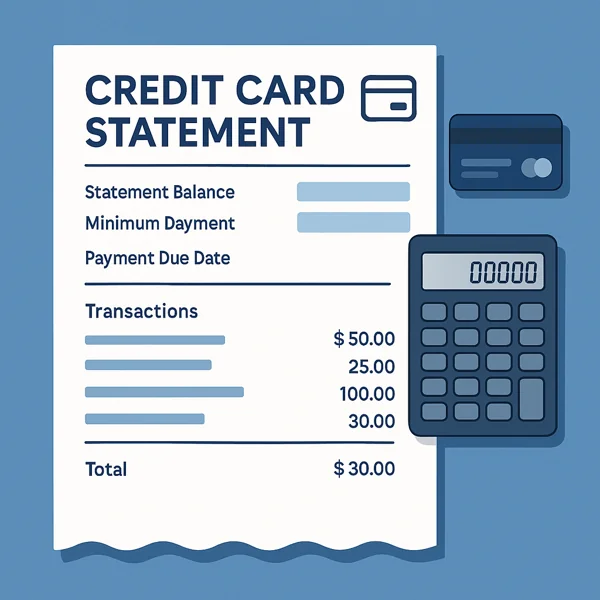
I. Introduction — Why Your Monthly Credit Card Statement Matters More Than You Think
Most people skim their credit card statement for one thing: the amount due. But behind that number is a detailed financial snapshot—your spending habits, interest charges, credit utilization, upcoming fees, and early warning signs of fraud. When you understand how to interpret every section, you gain the ability to prevent unnecessary charges, protect your credit score, and make more strategic financial decisions.
Reading your statement like a pro helps you:
- Spot billing errors before they escalate
- Catch unauthorized or fraudulent activity early
- Understand how interest is calculated
- Avoid minimum payment traps
- Optimize your credit utilization for a higher credit score
- Track your spending more accurately
- Identify hidden fees and rate changes
Mastering this monthly document isn’t just about staying organized—it’s a core credit management skill that strengthens your overall financial health.
Key Takeaways
- Your credit card statement is one of your most powerful financial tools. It reveals fees, interest charges, utilization levels, and spending patterns that directly impact your credit health.
- Statement balance—not current balance—is what credit bureaus typically see. Paying attention to your closing date helps you optimize your credit score.
- Minimum payments are designed to keep you in debt longer. Even small increases in monthly payments can save hundreds—or thousands—of dollars in interest.
- Interest compounds daily, not monthly. Understanding the average daily balance method helps you predict and reduce interest charges.
- Fraud often starts with small, easily overlooked test charges. Reviewing your statement each month is essential for early detection.
- APR categories matter. Purchases, balance transfers, cash advances, and penalty APRs are all calculated separately and can dramatically affect your bill.
- Unexpected fees and APR increases are red flags. They often signal late payments, credit limit reviews, or expiring promotional rates.
- Payment timing can raise your credit score. Paying before the closing date lowers utilization and improves reported balances.
- Subscriptions and auto-renewals are silent budget killers. Regular statement checks prevent unnecessary recurring charges.
- You have strong legal protections. The Fair Credit Billing Act (FCBA) ensures prompt dispute handling and limits your liability for fraud.
- A monthly audit routine strengthens your financial habits. Using a checklist or review template helps you identify errors, avoid interest, and stay proactive with your credit.
II. What Your Credit Card Statement Actually Includes
Every credit card issuer must provide a standardized set of disclosures and details under the CARD Act. These sections may vary in design or layout, but the content is largely the same. Understanding these components at a high level makes it easier to dig deeper in the next section.
Your statement typically includes:
- Statement Summary (balances, payments, credits)
- Payment Information (due date, minimum payment, late payment warnings)
- Billing Cycle Details (opening/closing dates, days in cycle)
- Transaction List (purchases, refunds, merchant codes)
- Interest Charges (per APR category)
- Fees and Adjustments
- Rewards Summary (if applicable)
- Balance Transfers or Promotional APR Information
Each of these sections tells a specific part of your financial story for the month. The next section breaks down each one so you can read it with full clarity.
III. Section-by-Section Breakdown — How to Decode Your Credit Card Statement
This is where the real insight happens. Below is a clear explanation of what each part of your statement means, how to interpret it, and what to look for each month to protect your finances.
A. Statement Summary
- Shows total balance, statement balance, and current balance
- Why statement balance matters: it’s what reports to credit bureaus
- How current balance can include pending transactions or payments
B. Payment Information
- Due date and cutoff time for on-time payment
- Minimum payment vs. full payment
- Minimum payment warning: how long repayment will take if you only pay the minimum
C. Billing Cycle & Closing Date
- How your cycle impacts interest and credit reporting
- Closing date = when your utilization is captured
- Timing purchases before/after the closing date for credit score optimization
D. Transactions & Merchant Category Codes (MCCs)
- How to identify unfamiliar charges
- Why merchant names may appear different from the store you visited
- MCCs and why they affect rewards, cashback, and disputes
E. Interest Charge Calculation
Breakdown includes:
- Purchase APR
- Cash advance APR
- Balance transfer APR
- Penalty APR
Explain:
- Average daily balance method
- Daily periodic rate
- Compounding effects
F. Fees Breakdown
- Late fees
- Cash advance fees
- Foreign transaction fees
- Returned payment fees
- How to identify unexpected charges
G. Rewards Summary
- Points earned vs. redeemed
- Cash back tracking
- What to verify for accuracy
H. Balance Transfers & Promotional APRs
- How promo APR periods work
- Fees associated with transfers
- Tracking the expiration of promotional rates
- Common pitfalls like losing the promo rate due to late payments
Statement Balance vs. Current Balance Comparison Table
| Feature | Statement Balance | Current Balance |
|---|---|---|
| What it includes | All posted transactions in the billing cycle | All posted + pending transactions |
| Impacts interest? | Yes — pay this to avoid interest | No — paying current balance early may reduce interest but isn’t required |
| Used for credit bureau reporting? | Yes | No |
| Changes after closing date? | No | Yes, updates with new activity |
Promotional APR & Balance Transfer Tracking Table
| Offer Type | APR | Start Date | End Date | Balance Transfer Fee | Notes |
|---|---|---|---|---|---|
| Promo Purchase APR | 0% | Jan 1 | Dec 31 | N/A | Must pay on time to keep offer |
| Balance Transfer | 0% | Jan 15 | Oct 15 | 3% | Paying late cancels promo |
IV. How to Identify Errors, Fraud, and Unauthorized Charges
A credit card statement is one of the most effective fraud-detection tools you have. Even small inconsistencies can signal billing mistakes, duplicate charges, or unauthorized activity. Reviewing each transaction carefully—even if you use alerts—is essential for protecting your financial health.
A. Common Billing Errors to Watch For
Mistakes happen more often than people realize. Look for:
- Duplicate charges from the same merchant
- Incorrect transaction amounts
- Returns or credits that never posted
- Monthly subscriptions you thought you canceled
- Charges on dates you didn’t use the card
If something looks unfamiliar, check:
- Your receipts and bank app
- Whether the merchant uses a parent-company name
- Whether someone else on your account made the purchase
B. How to Spot Fraud in Seconds
Unauthorized activity often shows up as:
- Small “test charges” (e.g., $1–$5)
- Purchases in unfamiliar states or countries
- Odd merchant names with no clear brand
- Late-night or rapid-fire charges
Fraud rarely appears as a large purchase first—criminals test the card quietly before using it aggressively.
C. How to Dispute Charges Correctly
If you find an issue:
- Contact the merchant first for billing disputes or errors.
- Contact your credit card issuer immediately for suspected fraud.
- Submit a dispute through your card app or website.
- Provide receipts, screenshots, or notes if needed.
- Track the response timeline (issuers must acknowledge disputes within 30 days under FCBA).
D. Your Rights Under the Fair Credit Billing Act (FCBA)
The FCBA protects you against:
- Unauthorized charges
- Billing errors
- Charges for goods or services not received
- Incorrect statement information
And limits your liability for fraudulent transactions to $50 (most issuers waive this entirely).
V. Understanding Minimum Payment Traps
Paying only the minimum may feel harmless—but it’s one of the biggest reasons people stay stuck in long-term credit card debt. Minimum payments are designed to keep your account current, not to help you pay off your balance efficiently.
A. How Minimum Payments Are Calculated
Issuers typically base the minimum on:
- 1%–2% of your balance plus interest
- A flat dollar amount, usually $25–$35
- Past-due amounts if you’re behind
This structure slows the payoff significantly because most of your payment goes toward interest—not the principal balance.
B. The True Cost of Paying the Minimum
Minimum payment warnings tell you how long repayment will take. Many consumers are surprised to learn:
- A balance of $5,000 at 20% APR may take 20–25 years to repay with minimums
- You could pay two to three times the original amount in interest
- Even a single late payment can trigger penalty APRs that make the problem worse
C. Example: Minimum Payment vs. Fixed Payment
Assume:
- Balance: $3,000
- APR: 19.99%
| Payment Type | Monthly Payment | Time to Pay Off | Total Interest |
|---|---|---|---|
| Minimum Only | ~$70 | ~17 years | ~$4,600 |
| Fixed $150 | $150 | 26 months | ~$520 |
| Fixed $250 | $250 | 14 months | ~$275 |
The difference is staggering—and worth illustrating to readers who underestimate these long-term costs.
D. Why Autopay Defaults Can Mislead You
Many consumers set autopay to “minimum due,” which:
- Keeps the account current
- Boosts issuer profits through interest
- Can mask overspending or rising debt
You can avoid long-term traps by switching autopay to:
- Statement balance (ideal)
- Fixed payment amount (if budgeting irregular income)
VI. How Credit Card Interest Really Works
Understanding how interest is calculated is one of the most powerful ways to reduce what you owe. Credit card interest isn’t simple—it compounds daily, uses a specific calculation method, and can be triggered even if you’ve paid off your card in previous months.
A. The Grace Period Explained
If you pay your statement balance in full by the due date:
- You typically avoid interest entirely
- Your grace period remains active
But you lose this grace period if:
- You carry any balance into the next month
- You pay late
- You revolve even a small portion of your balance
Once lost, interest applies to new purchases immediately until the grace period resets.
B. Daily Compounding & Average Daily Balance Method
Most cards use the Average Daily Balance (ADB) method:
- Add up your balance for every day of the billing cycle
- Divide by the number of days in the cycle
- Multiply by the Daily Periodic Rate (APR ÷ 365)
- Multiply by the number of days in the cycle
This means interest accumulates even when your balance fluctuates.
C. Different APR Buckets
Expect multiple APR categories, each calculated separately:
- Purchase APR
- Cash advance APR
- Balance transfer APR
- Penalty APR (for late payments)
Cash advances and penalty APRs start accruing interest immediately, with no grace period.
D. Example Interest Calculation
Assume:
- Balance averages $2,000
- APR is 20%
- Daily periodic rate (DPR) = 0.20 ÷ 365 = 0.0005479
- Billing cycle days = 30
Interest = 2,000 × 0.0005479 × 30
Interest ≈ $32.87
This aligns with what consumers see on their statements—and makes the math transparent.
Interest Calculation Example Table
| Item | Value |
|---|---|
| Average Daily Balance | $2,000 |
| APR | 20% |
| Daily Periodic Rate | 0.0005479 |
| Billing Cycle Days | 30 |
| Interest Charged | $32.87 |
E. Strategies to Avoid or Reduce Interest
- Pay the statement balance in full each month
- Make multiple payments throughout the cycle
- Pay before the closing date to reduce reported utilization
- Avoid cash advances entirely
- Transfer balances only with a clear payoff plan
The mechanics may be complex, but small changes in payment timing can dramatically reduce interest paid.
APR Categories and What They Mean
| APR Type | What It Applies To | Grace Period? | Typical Cost |
|---|---|---|---|
| Purchase APR | Everyday spending | Yes | Lowest APR |
| Cash Advance APR | ATM withdrawals, cash-like transactions | No | High APR + fees |
| Balance Transfer APR | Transferring balances from other cards | Sometimes (promo only) | Often 0% for 12–18 months |
| Penalty APR | Late payments or violations | No | Highest APR (up to 29.99%+) |
VII. How Your Credit Card Statement Affects Your Credit Score
Your monthly statement doesn’t just summarize your spending—it directly influences several major components of your credit score. Understanding how each part connects to your credit profile helps you optimize your score while avoiding preventable mistakes.
A. Credit Utilization Ratio (The Most Important Factor)
Your statement balance, not your current balance, is usually what credit card issuers report to the credit bureaus. That means:
- Even if you pay your balance in full every month…
- …your statement balance may still show up as debt.
This matters because credit utilization accounts for 30% of your FICO score.
Best practice:
Keep utilization below 30%, and under 10% for optimal score results.
B. Reporting Dates vs. Due Dates
Many people assume issuers report balances after the due date—but it’s usually on your closing date, before the due date arrives.
This means:
- Making a large purchase right before the closing date inflates utilization
- Paying early (before the closing date) can dramatically lower reported balances
- Payment timing influences your score even if you’re never late
C. How Statement Errors Can Hurt Your Score
Incorrect balances or missing payments on your statement can lead to inaccurate credit reporting, including:
- Inflated utilization
- Incorrect delinquency reporting
- Missing credit for past payments
- Errors that take months to resolve
D. Late Payments and Their Impact
A payment is considered late only if it misses the due date and grace period. Once it’s 30 days late:
- It can show up on your credit report
- Your score may drop by 60–110 points
- You may trigger a penalty APR
Tip: Use autopay for at least the minimum to avoid accidental late payments.
E. Credit Limit Changes
Your statement will show:
- Credit limit increases
- Credit limit decreases
- Soft-pull credit reviews
Limit reductions increase utilization instantly—even if your spending hasn’t changed.
VIII. Red Flags to Watch for Every Single Month
Monthly statement reviews are your first line of defense against fraud, hidden fees, and creeping debt. Spotting small warning signs early can save you money and protect your credit score.
A. Unexpected or Rising APRs
If your APR increases without your request:
- You may have triggered penalty APR
- Your issuer may have re-evaluated your credit
- A promotional rate may have expired
Unexpected rate changes should prompt a deeper review.
B. New or Unfamiliar Fees
Watch for:
- Cash advance fees
- Foreign transaction fees
- Paper statement fees
- “Membership” or program fees
- Returned payment fees
Many consumers overlook these small charges, but they add up.
C. Minimum Payment Rising Month-to-Month
A gradually increasing minimum payment often signals:
- Increasing debt
- More interest being added
- A promotional APR ending soon
- Purchases you may not recall
This is an early warning sign of a debt spiral.
D. Declining Credit Limit
A drop in your credit limit can:
- Increase your utilization
- Lower your credit score
- Signal issuer concerns about your credit risk
Review recent payments, balances, and reports to find the cause.
E. Strange or Vague Merchant Names
Many fraudulent charges start small and nondescript, such as:
- “SQ * Payment”
- “Online Services Purchase”
- $1–$3 trial or “test” charges
These should be reviewed immediately.
Statement Red Flags Checklist Table
| Red Flag | What It Means | Action Needed |
|---|---|---|
| Sudden APR increase | Possible penalty rate or expired promo | Review alert + call issuer |
| Unknown fees | Foreign fee, cash advance, or billing error | Contact issuer |
| Higher minimum payment | Rising utilization or interest charges | Review transactions |
| Strange merchant names | Possible fraud test charges | Verify + dispute if needed |
| Lowered credit limit | Issuer risk reassessment | Call issuer or reduce utilization |
IX. Advanced Strategies for Power Users
Once you understand the mechanics of your statement, you can use that knowledge strategically to save money, optimize your credit score, and maximize rewards.
A. Use the Sweep Method for Better Utilization
Pay down your balance before the closing date, not just before the due date.
Benefits include:
- Lower utilization reporting
- Higher credit score
- Lower interest if you revolve balances
- Cleaner statements and easier tracking
B. Time Large Purchases Around Your Statement Cycle
If you’re planning a major purchase, consider:
- Buying right after your closing date
- Avoiding big charges right before the closing date
This keeps utilization low for the next reporting period.
C. Align Billing Cycles With Your Income Flow
Creators, freelancers, and hourly workers benefit from aligning cycles around pay periods.
This makes:
- Cash flow easier
- Early payments more manageable
- Autopay schedules more predictable
D. Pay Multiple Times Per Month
Multiple payments throughout the cycle:
- Reduce average daily balance
- Reduce interest
- Keep utilization stable
- Prevent financial surprises
E. Use Balance Transfers Strategically
Balance transfers can help, but only when:
- You have a clear payoff plan
- You avoid new purchases on the old card
- You track promotional end dates
This strategy should be proactive—not reactive.
F. Request Credit Limit Increases at the Right Time
Request an increase when:
- Your income rises
- Your utilization is low
- You’ve had no late payments
- You’ve recently paid off a chunk of debt
Higher limits → lower utilization → better credit score.
X. Common Mistakes People Make With Credit Card Statements
Even financially savvy consumers overlook small—but costly—details on their monthly statements. Understanding these mistakes helps readers protect their money, avoid interest traps, and prevent damage to their credit reports.
A. Only Checking the Total Balance
Most people skip straight to the big number at the top.
But this misses:
- Rising minimum payments
- Hidden fees
- Transaction errors
- APR increases
- Promo APR expiration warnings
The total balance is only one piece of the full picture.
B. Confusing “Statement Balance” With “Current Balance”
This is one of the most common sources of confusion.
Your statement balance:
- Reflects charges only within the billing cycle
- Is what you must pay to avoid interest
- Is usually what gets reported to credit bureaus
Your current balance:
- Includes pending activity
- Can be lower or higher depending on recent payments
Not understanding the distinction can result in:
- Unexpected interest
- Higher utilization reporting
- Misinterpreting cash flow
C. Ignoring Interest Charges and APR Categories
If you revolve a balance, you may see:
- Purchase APR
- Cash advance APR
- Balance transfer APR
- Penalty APR
Each is calculated separately. Overlooking them can lead to costly surprises and ongoing debt.
D. Overlooking Subscriptions and Auto-Renewals
Subscription creep is a real threat to budgets.
Review each month for:
- New recurring charges
- Duplicate subscriptions
- Trials that became paid subscriptions
E. Not Checking for Small Fraudulent Charges
Fraud typically begins with “test charges,” such as $0.99 or $1.00. Small amounts are easy to miss but are an early indicator of stolen card information.
F. Skipping the Closing Date
Misunderstanding when the cycle ends leads to:
- Poor utilization timing
- Unexpected interest
- Incorrect expectations about rewards posting
G. Ignoring Alerts About Credit Limit Changes
A reduced credit limit increases utilization instantly—one of the fastest ways to see a score drop.
XI. When to Contact Your Credit Card Issuer
Knowing when to reach out to your issuer can save you money, correct mistakes quickly, and protect your account before issues escalate. Contacting support isn’t just for emergencies—many perks and protections activate only when you ask.
A. When You Notice Billing Errors or Suspicious Activity
Contact the issuer immediately if you find:
- Unauthorized charges
- Duplicate transactions
- Discrepancies between receipts and posted amounts
Issuers typically reverse fraudulent charges quickly and issue replacement cards.
B. When You’re Charged a Fee You Don’t Recognize
Fee-related calls often lead to:
- Late fee refunds (especially if you have a good history)
- Removal of foreign transaction mistakes
- Reversal of erroneous interest charges
Most issuers allow one-time courtesy waivers.
C. If Your APR Suddenly Increases
A sudden APR jump may indicate:
- A late payment
- A penalty APR activation
- Issuer-initiated credit review
Ask for:
- Why it increased
- Whether the increase is temporary
- Options to reduce it again
- Steps to restore your previous APR
D. To Request a Credit Limit Increase
This is one of the most effective ways to boost your credit score through lower utilization. Ideal timing:
- After a large payment
- After income increases
- With a clean payment history
E. To Clarify Promotional Rates or Balance Transfer Terms
Call if you’re unsure about:
- Promotional APR end dates
- Balance transfer fees
- How payments apply to different APR categories
This prevents expensive misunderstandings.
F. To Report Lost or Stolen Cards
Issuers immediately:
- Freeze the account
- Issue a new card
- Remove fraudulent charges
- Monitor for unusual activity
G. To Ask About Hardship Programs
If you’re struggling, many issuers offer:
- Temporary APR reductions
- Lower payment options
- Fee deferrals
- Short-term hardship relief
These programs are often underutilized because consumers don’t know they exist.
XII. Frequently Asked Questions (FAQ)
A practical FAQ helps readers resolve common credit statement questions quickly and reinforces long-term financial literacy.
1. Why Is My Minimum Payment Higher This Month?
Minimum payments rise when:
- Your balance increases
- Your interest charges grow
- You triggered a penalty APR
- You missed a payment
- New fees were applied
A rising minimum is an early red flag that deserves attention.
2. Why Did I Get Charged Interest Even After Paying My Balance?
Possible reasons:
- You lost your grace period
- Interest accrued from a previous cycle
- A cash advance triggered immediate interest
- You didn’t pay the full statement balance
Checking the interest calculation section provides clarity.
3. What’s the Difference Between Statement Balance and Current Balance?
- Statement balance = your balance on the closing date (used for credit reporting).
- Current balance = includes purchases/payments after the statement closed.
To avoid interest, always pay the statement balance.
4. When Do Credit Card Companies Report to the Credit Bureaus?
Most issuers report on the closing date, not the due date.
This means your score changes based on the balance shown on your statement—not what you owe today.
5. How Often Should I Review My Credit Card Statement?
At least once a month, but ideally:
- Review transactions weekly
- Enable transaction alerts
- Verify major purchases the same day
6. How Do I Know if a Fee Is Legitimate?
Check:
- Merchant type
- Cash advance activity
- International purchases
- Refunds not received
Unknown fees should always be questioned—and often can be reversed with a call.
7. Why Does My Statement Say I’ll Pay for Decades if I Only Pay the Minimum?
The minimum calculation includes:
- Interest
- A very small percentage of principal
This leads to extremely slow debt payoff—sometimes 20–25 years.
8. Should I Ever Carry a Balance to Help My Credit Score?
No.
Carrying a balance does not increase your credit score and leads to unnecessary interest. Utilization is based on statement balances—not revolving debt.
9. What Happens If I Disagree With a Transaction?
You can:
- Contact the merchant
- Submit a dispute through your issuer
- Provide copies of receipts
- Request temporary account credit while the dispute is investigated
The Fair Credit Billing Act protects your rights during disputes.
XIII. Credit Health Checklist — Review This Every Month
A credit card statement does more than summarize activity—it reveals early signs of financial stress, billing errors, or opportunities to strengthen your credit profile. This monthly checklist helps readers quickly audit their statement and stay ahead of potential issues.
A. Statement Accuracy & Fraud Review
- ☐ All transactions match receipts
- ☐ No duplicate charges
- ☐ No unfamiliar or suspicious merchants
- ☐ All refunds and credits posted correctly
- ☐ No small “test charges” (common in fraud attempts)
B. Balance & Payment Review
- ☐ Statement balance is correct and matches expected spending
- ☐ Minimum payment looks consistent
- ☐ No unexpected jump in interest charges
- ☐ Autopay settings correct (statement balance or fixed amount)
C. APR & Fee Review
- ☐ Purchase APR unchanged
- ☐ No new penalty APR
- ☐ No unexpected fees (late, foreign transaction, returned payment)
- ☐ Promotional APRs still active and not expiring this cycle
D. Credit Score Optimization
- ☐ Utilization under 30% (or under 10% for best scoring)
- ☐ Closing date noted for payment-timing strategy
- ☐ Credit limit unchanged
- ☐ Large purchases planned around the billing cycle
E. Rewards & Benefit Tracking
- ☐ Rewards earned match expected spending categories
- ☐ Bonus categories activated (if applicable)
- ☐ No missing points or cash back
- ☐ Credits (e.g., streaming, travel, dining) applied correctly
F. Account Security & Notifications
- ☐ Transaction alerts enabled
- ☐ Fraud alerts active
- ☐ Account password and 2FA secure
This checklist encourages routine financial hygiene—helping readers catch errors early and build long-term credit health.
XIV. Statement Audit Template (Simple, Practical, and Repeatable)
This template gives readers a structured framework to evaluate every part of their statement. You can later convert this into a downloadable PDF for added value.
| Review Area | What to Check | My Observations | Action Needed |
|---|---|---|---|
| Billing Cycle Dates | Start/end dates, cycle length | ||
| Statement Balance | Accurate? In line with spending? | ||
| Current Balance | Includes recent payments? | ||
| Payments & Credits | All payments posted? Any delays? | ||
| Transaction List | Legitimate, accurate, categorized correctly | ||
| Fees | Any unexpected fees or new charges? | ||
| Interest Charges | APR categories correct? Amount reasonable? | ||
| APR Review | Any increases? Any penalty APRs? | ||
| Rewards Summary | Points/cashback earned, missing rewards | ||
| Promotional Rates | Balance transfers, promo APR timelines | ||
| Credit Limit | Any changes? Utilization concerns? | ||
| Fraud Check | Unrecognized transactions, test charges |
This audit table positions your blog post as a practical, hands-on financial planning tool—perfect for your CFP®-level authority and your site’s audience.
XV. Conclusion — A Clear Statement Means a Stronger Financial Future
Your credit card statement isn’t just a record of purchases—it’s a roadmap for improving your financial health, avoiding hidden costs, and developing stronger credit habits over time. When you understand how your statement works, you gain control over:
- How much interest you pay
- How your credit score is calculated
- How to spot errors before they damage your finances
- Whether your spending aligns with your goals
- How issuers view your creditworthiness
With just a few minutes each month, reviewing your statement can protect your money, strengthen your credit profile, and prevent costly mistakes.
Next steps for readers:
- Read “Credit Clean-Up: Steps to a Better Credit Report” to improve overall credit health
- Explore “How to Track Monthly Expenses Easily” to tighten your budget
- Learn from “Decoding Your Bank Statements” to master all financial documents
A smarter financial future starts with understanding the details—line by line, statement by statement.