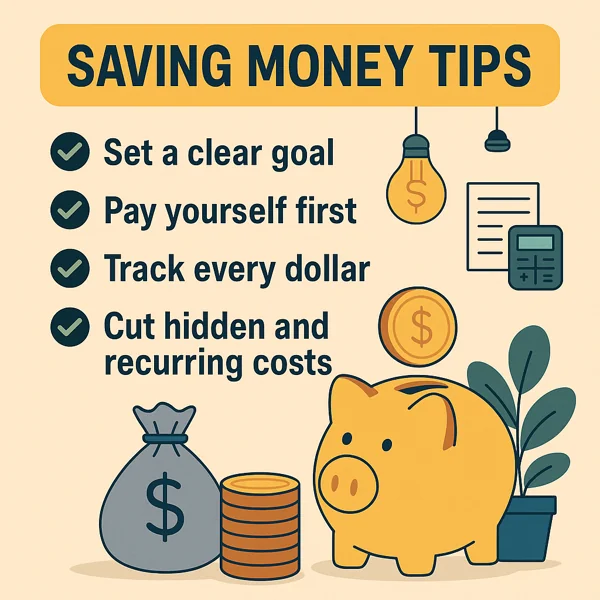
🧭 5 Key Takeaways
- Automate Before You Spend
Set up automatic transfers to savings the moment your paycheck hits. Treat saving like a fixed bill — it’s the easiest way to stay consistent and grow wealth without relying on willpower. - Audit Your Money Regularly
Review your budget and recurring expenses every quarter. Cancel or renegotiate unused subscriptions, insurance premiums, or memberships to keep more of what you earn. - Build an Emergency Fund for Peace of Mind
Aim for 3–6 months of living expenses in a high-yield savings account. This financial cushion protects you from debt and stress when unexpected events occur. - Guard Against Lifestyle Inflation
When your income rises, don’t let your spending follow. Funnel raises, tax refunds, and bonuses into your savings or investments instead — that’s how true wealth grows. - Leverage Technology and Tax Advantages
Use automation apps and tools like Acorns, Digit, or your bank’s direct deposit split to simplify saving. Boost returns through tax-advantaged accounts such as 401(k)s, IRAs, and HSAs to build financial security faster.
Introduction — Why Saving Money Is the Cornerstone of Financial Freedom
Do you ever feel like no matter how much you earn, there’s never enough left to save? You’re not alone. Many Americans face the same challenge — in fact, 44% of adults say they couldn’t cover a $1,000 emergency in cash, according to a 2024 Bankrate survey.
Saving money isn’t about restriction or cutting out every luxury. It’s about taking control of your future — ensuring that unexpected events don’t derail your life plans and that you can pursue opportunities with confidence. In this guide, we’ll walk through proven strategies to save smarter, avoid waste, and build lasting wealth.
I. Start with a Strong Foundation: Define Your Goals and Budget
A. Know What You’re Saving For
Before you can save effectively, you need clarity. Ask yourself: What am I saving for?
- Short-term goals: vacation fund, new car, or emergency savings.
- Long-term goals: retirement, college funding, or homeownership.
Use the SMART framework — Specific, Measurable, Achievable, Relevant, and Time-bound — to set goals you can actually reach.
Example: Instead of “I want to save more,” say “I’ll save $500 a month for my emergency fund by automating transfers on payday.”
B. Build a Realistic Budget
| Budget Method | How It Works | Ideal For | Potential Drawback |
|---|---|---|---|
| 50/30/20 Rule | Allocates 50% to needs, 30% to wants, 20% to savings and debt | Beginners who want balance and flexibility | Can overlook irregular expenses |
| Zero-Based Budget | Every dollar has a job — income minus expenses equals zero | Those seeking control and awareness | Requires frequent updates |
| Envelope System | Cash or digital “envelopes” for categories | Visual learners and those who overspend | Harder to manage online payments |
| Pay Yourself First | Automatically transfer savings before spending | Busy professionals or those with irregular income | May underfund other priorities if income fluctuates |
Tools like YNAB, Mint, or Monarch Money help automate this process and categorize expenses in real-time.
II. Pay Yourself First — Automate Your Savings
The best savers don’t rely on willpower — they rely on automation.
- Set up direct deposit splits so a percentage of your paycheck goes directly into savings.
- Use high-yield savings accounts with APYs above 4% to make your money work for you.
- Apps like Acorns or Chime automatically round up purchases and save the difference.
Automation turns good intentions into consistent results — and consistency builds wealth.
⚙️ Easy Ways to Automate Your Savings
| Automation Tool | How It Works | Typical Benefit |
|---|---|---|
| Direct Deposit Split | Send a fixed % of each paycheck to savings | Builds consistency effortlessly |
| High-Yield Savings Account (HYSA) | Automatically earns interest on idle funds | Earns 4–5× more than traditional banks |
| Acorns / Chime / Qapital Apps | Rounds up purchases or sets savings rules | Converts small habits into real savings |
| Employer Payroll Split | Divides paycheck between multiple accounts | Automates savings before spending temptation |
III. Track and Analyze Your Spending
You can’t fix what you can’t see. Tracking expenses exposes habits, impulse purchases, and areas for improvement.
- Review your last 60 days of spending.
- Categorize every expense: housing, food, transportation, entertainment, etc.
- Identify where small leaks add up — those $8 subscriptions or extra coffee runs.
Try using a simple spreadsheet or tools like Empower or PocketGuard. Schedule a monthly “money review date” to stay on track.
IV. Cut Hidden Costs Without Sacrifice
A. Identify Recurring Drains
- Cancel underused subscriptions (streaming, cloud storage, gym).
- Call service providers to negotiate lower rates on phone, internet, or insurance.
- Use Rocket Money or Billshark to handle negotiations automatically.
B. Optimize Daily Spending
- Groceries: Meal-plan, buy generic, and avoid shopping hungry.
- Energy bills: Install smart thermostats, switch off standby devices.
- Cashback and rewards: Use apps like Rakuten, Ibotta, and Honey to earn money back on regular purchases.
The goal isn’t deprivation — it’s optimization.
V. Lower Big Expenses First
The biggest savings opportunities usually come from the largest expenses.
A. Housing
- Refinance high-interest mortgages.
- Rent out a spare room or downsize if practical.
- Compare renters’ and homeowners’ insurance annually for better rates.
B. Transportation
- Consider buying reliable used cars instead of new (save thousands in depreciation).
- Shop for lower insurance premiums regularly.
- Use public transit or carpool when possible.
C. Food
- Batch cook and freeze meals for the week.
- Bring lunch from home — a $12 daily lunch habit costs nearly $3,000 a year.
- Treat dining out as an occasional experience, not a routine.
⚡ Small Changes, Big Annual Savings
(Insert near Section V — “Lower Big Expenses First”)
| Expense Adjustment | Monthly Savings | Annual Savings | Action Step |
|---|---|---|---|
| Cancel 2 unused subscriptions | $25 | $300 | Audit and cancel through app store or card statement |
| Cook dinner 3 nights/week instead of eating out | $60 | $720 | Meal prep on Sundays |
| Refinance car loan (lower APR by 2%) | $45 | $540 | Re-shop loan via credit union |
| Switch to a cheaper phone plan | $30 | $360 | Compare MVNO or prepaid carriers |
| Use energy-efficient bulbs & smart thermostat | $20 | $240 | Adjust thermostat by 2°F |
VI. Build an Emergency Fund
An emergency fund is your financial shock absorber — the key to avoiding credit card debt when life happens.
- Start with a small goal: $500.
- Build toward 3–6 months of living expenses.
- Keep it in a high-yield savings account separate from checking to avoid temptation.
When a car breaks down or medical bill arrives, you’ll have peace of mind instead of panic.
📈 Emergency Fund Goal Tracker
(Insert under Section VI — “Build an Emergency Fund”)
| Stage | Target | Purpose | Suggested Action |
|---|---|---|---|
| Step 1 | $500 | Starter buffer for small emergencies | Automate $25/week transfer |
| Step 2 | 1 month of expenses | Cover short-term income gaps | Use HYSA for liquidity |
| Step 3 | 3 months | Job loss or medical emergency | Review annually |
| Step 4 | 6 months | Full security reserve | Reinvest interest for compounding |
💰 Sample Monthly Budget Allocation
| Category | Recommended % of Income | Example on $4,000/Month |
|---|---|---|
| Housing & Utilities | 35% | $1,400 |
| Transportation | 10% | $400 |
| Food & Groceries | 10% | $400 |
| Insurance & Healthcare | 10% | $400 |
| Debt Payments | 10% | $400 |
| Savings & Investments | 20% | $800 |
| Entertainment & Misc. | 5% | $200 |
VII. Avoid Lifestyle Creep
As your income rises, your spending often rises with it — a silent wealth killer known as lifestyle inflation.
How to fight it:
- Keep your housing and car expenses steady as income grows.
- Direct raises or bonuses straight into savings or investments.
- Maintain the same lifestyle while increasing savings percentage yearly.
Example: A $5,000 annual raise saved and invested at 7% grows to $100,000 in 20 years — without any extra effort.
VIII. Use Technology to Your Advantage
Let modern tools do the heavy lifting.
- Acorns – Rounds up purchases and invests spare change.
- Digit (now Oportun) – Analyzes spending and moves small amounts into savings.
- Qapital – Lets you create savings “rules” (e.g., save $5 every time you skip takeout).
These micro-actions compound into real financial growth.
IX. Maximize Savings Through Smart Investing
Once you’ve built your emergency fund, move from saving to wealth building.
- 401(k) and IRA: Take advantage of tax-deferred or tax-free growth.
- HSA: The triple-tax advantage makes it the best account for health expenses.
- 529 Plan: Great for parents saving for education.
Even small contributions invested early can yield exponential returns thanks to compounding interest.
X. Make Saving Fun — Gamify the Process
Saving doesn’t have to be boring.
- Try a 52-week savings challenge: Start with $1 in week 1, $2 in week 2, and so on (you’ll save $1,378 in a year).
- Create a “no-spend” weekend or $5 challenge for motivation.
- Use visuals like progress bars or savings thermometers to track milestones.
When saving feels rewarding, it becomes a lifelong habit.
XI. Common Saving Mistakes to Avoid
- Saving while ignoring high-interest debt. Pay off credit cards first.
- Not accounting for inflation. Keep long-term funds in interest-bearing or investment accounts.
- Skipping emergency fund replenishment after use.
- Over-saving in cash while missing out on investment growth.
- Not revisiting goals — savings plans need annual reviews.
🧠 Common Saving Mistakes & Fixes
| Mistake | Why It Hurts You | How to Fix It |
|---|---|---|
| Saving while carrying high-interest debt | Interest wipes out savings gains | Pay down debt before increasing savings rate |
| Not automating savings | Inconsistent contributions | Set automatic transfers on payday |
| Keeping all cash in low-interest accounts | Loses value to inflation | Move excess to HYSA or low-risk investments |
| Ignoring emergency fund replenishment | Reduces future stability | Refill fund after use immediately |
| Upgrading lifestyle with every raise | Erases savings growth | Save half of every raise automatically |
Conclusion — Small Steps Create Big Change
Financial freedom doesn’t start with a windfall; it starts with one choice — saving intentionally. Each dollar saved today buys you freedom tomorrow: freedom to leave a stressful job, fund your child’s education, or retire without worry.
You don’t need to be perfect — you just need to be consistent. Start small, stay steady, and watch your savings compound into security, confidence, and opportunity.
“The habit of saving is itself an education; it fosters every virtue, teaches self-denial, cultivates order, and trains for thrift.” — T.T. Munger
💬 Call to Action
If you found this guide helpful, share it with a friend who’s trying to improve their finances.
Then, explore related posts:
- How to Track Monthly Expenses Easily
- A Guide to Budgeting and Forecasting Techniques
- Smart Money Habits for Kids
Back to Savings Strategies & Techniques