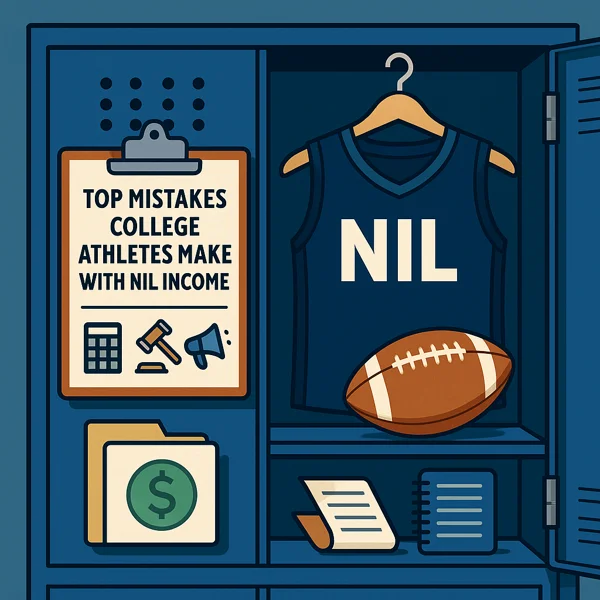
5 Key Takeaways for College Athletes Managing NIL Income
- Plan now for life after sports. Use NIL to fund education, investments, and skills that last beyond your playing career.
- Treat NIL income like a business. Open a separate account, track expenses, and set aside money for taxes — you’re operating as an entrepreneur now.
- Save before you spend. Build an emergency fund, automate savings, and avoid lifestyle creep driven by social media pressure.
- Never sign anything without expert review. Have every NIL contract reviewed by a qualified attorney or financial professional to protect your rights and future income.
- Build a long-term brand, not just short-term deals. Stay authentic, consistent, and professional on social media — sponsors value reliability over flash.
I. Introduction: NIL Success or Stress? The Line Is Thinner Than You Think
Since 2021, the NCAA’s new Name, Image, and Likeness (NIL) policy has transformed college sports. Student-athletes now earn money from sponsorships, endorsements, camps, and content creation — with some pulling in six or even seven figures.
But opportunity comes with complexity. Even the most talented, well-intentioned athletes can find themselves in financial trouble, break NCAA rules, or damage their reputation before graduation.
This guide breaks down the top NIL mistakes college athletes make — and how to avoid them. By treating NIL income like a real business and planning ahead, you can protect your eligibility, finances, and long-term future.
II. Understanding the NIL Landscape
NIL income includes more than just sponsorships. It can come from:
- Brand endorsements and paid social posts
- Content creation on platforms like YouTube or TikTok
- Personal merchandise or apparel lines
- Coaching clinics or camps
- Appearances, signings, and events
Compliance Basics
Athletes must follow NCAA, conference, and school-specific rules. Each institution has disclosure requirements, and every deal must comply with both state NIL laws and school policies.
Bottom line: NIL income isn’t just “extra cash.” It’s self-employment income — meaning you’re running a small business with tax, legal, and branding responsibilities.
III. Financial Mistake #1: Ignoring Taxes
Why It Matters
NIL income is taxable. The IRS classifies it as self-employment income, and most athletes receive a Form 1099-NEC instead of a W-2.
Common Mistakes
- Not setting aside money for quarterly tax payments
- Failing to track deductible expenses (travel, gear, software, etc.)
- Mixing personal and business funds in one account
How to Avoid It
- Open a separate business bank account for NIL income
- Track expenses with budgeting apps or spreadsheets
- Consult a tax professional or CFP® who understands NIL-specific rules
💡 Tip: Save roughly 25–30% of your NIL income for taxes — especially if you live in a state with income tax.
IV. Financial Mistake #2: Spending Instead of Saving
Sudden income can lead to lifestyle creep — buying luxury items to keep up appearances on social media. But NIL earnings can fluctuate dramatically.
How to Avoid It
- Follow the 50/30/20 Rule:
- 50% needs
- 30% wants
- 20% savings or debt repayment
- Automate transfers into a high-yield savings account
- Create short-term goals (e.g., car savings) and long-term goals (e.g., Roth IRA or business fund)
🎯 Pay yourself first — treat savings as a non-negotiable expense.
V. Legal Mistake #3: Signing Bad Contracts
Some brands exploit young athletes through unfair or restrictive agreements.
Common Contract Traps
- Lifetime exclusivity or perpetual image rights
- Unclear payment terms or “free product” exchanges
- Hidden clauses giving away future earnings potential
How to Avoid It
- Have an attorney review every contract before signing
- Understand your school’s NIL disclosure process
- Keep copies of all contracts and correspondence
🧾 If a deal sounds too good to be true — it probably is.
VI. Legal Mistake #4: Violating NCAA or School Rules
Violations can lead to suspension, loss of eligibility, or revoked scholarships.
Common Violations
- Promoting restricted products (alcohol, gambling, tobacco)
- Failing to report NIL income to compliance offices
- Participating in “pay-for-play” or recruitment-based deals
How to Avoid It
- Report all NIL activities to your compliance department early
- Know your state’s NIL laws and school’s restrictions
- Avoid deals connected to recruitment or athletic performance bonuses
⚖️ Eligibility is priceless — don’t risk it for a quick deal.
VII. Branding Mistake #5: Poor Social Media Management
Your digital footprint can make or break your NIL career. Unfiltered posts, inconsistent branding, or controversial comments can destroy sponsor interest overnight.
How to Avoid It
- Keep content positive, authentic, and brand-safe
- Separate personal and professional accounts if necessary
- Engage consistently with followers — professionalism pays off
📸 Remember: sponsors buy your image as much as your performance.
VIII. Branding Mistake #6: Ignoring Long-Term Brand Value
Many athletes chase short-term sponsorships instead of thinking strategically. The real value of NIL is in building a personal brand that lasts beyond sports.
How to Avoid It
- Build partnerships that align with your values and goals
- Focus on authenticity and community engagement
- Use NIL to develop entrepreneurial and media skills
- Plan your content calendar to support your long-term career
🏗️ Think of yourself as a brand, not just a player.
IX. Management Mistake #7: Going It Alone
Many athletes try to handle finances, contracts, and branding solo — often leading to mistakes.
How to Avoid It
- Build a trusted team: accountant, financial planner, and sports attorney
- Vet advisors with experience in sports or entertainment
- Review all professional agreements for fiduciary duty
🧠 The best athletes delegate — but stay informed.
X. Ethical Mistake #8: Undervaluing Education and Eligibility
Academic performance and compliance aren’t just obligations — they’re your safety net. A strong educational foundation lasts far beyond any NIL deal.
How to Avoid It
- Maintain open communication with academic and compliance advisors
- Use time management tools to balance NIL work and studies
- Protect your GPA and reputation — both matter to future employers
🎓 NIL is temporary. Education is forever.
XI. Bonus Mistake #9: Failing to Plan for Life After Sports
When the spotlight fades, what’s next? Many college athletes focus so heavily on short-term NIL opportunities that they overlook what comes after the final whistle. Whether your athletic career ends after college or extends into the pros, your NIL income window is temporary — and it’s what you build with it that creates lasting success.
The Reality Check
According to the NCAA, fewer than 2% of college athletes go on to play professionally. That means for 98% of student-athletes, NIL income is the peak of their sports-related earnings. Without a long-term plan, even high NIL earners can end up with little to show for their hard work.
NIL income should be seen as a launchpad — not a finish line. The habits, savings, and relationships you build during your NIL years can position you for financial independence, business ownership, or a career transition later.
How to Avoid It – Building Your Post-Sports Future
1. Turn NIL Income into Real Assets
Use today’s income to build long-term value:
- Save early and often: Prioritize building an emergency fund before increasing lifestyle spending.
- Invest intelligently: Even small, consistent contributions to a Roth IRA can grow substantially over time, and a SEP IRA may be available if you structure your NIL work as self-employment.
- Buy appreciating, not depreciating, assets: Focus on education, certifications, or business equipment that supports your future goals — not luxury items that lose value.
💰 Tip: Treat every NIL check like a business owner’s paycheck — a tool for building your future income streams.
2. Learn to Leverage NIL Experience Professionally
Your NIL journey builds skills beyond sports:
- Negotiation & Branding: These are highly marketable in marketing, business, or entrepreneurship.
- Financial Literacy: Managing contracts, taxes, and savings prepares you for real-world financial decisions.
- Public Image & Media Presence: Sponsors, media outlets, and even employers value individuals who can represent brands professionally.
Translate your NIL experience into your resume, LinkedIn profile, or entrepreneurial pitch. Employers and investors look for initiative — and NIL proves you already have it.
3. Build a Professional Network
Your network is one of your most valuable post-college assets. Start now by:
- Connecting with alumni who transitioned from sports into business or leadership roles
- Attending NIL, business, or financial literacy workshops offered by your university or sponsors
- Seeking mentors — coaches, financial planners, or entrepreneurs who can help you navigate the next phase
🤝 Your NIL deals might end, but your relationships can open new doors for decades.
4. Explore Entrepreneurship and Career Options
Many athletes successfully transition their NIL exposure into long-term business ventures:
- Launch a personal brand or product line (fitness, nutrition, or apparel)
- Create an online course or coaching program
- Build a YouTube or podcast platform for ongoing income
- Transition into sports media, business, or public speaking
🚀 Think like a founder: your NIL brand is your first startup.
5. Plan for Financial Independence
Start with small, sustainable steps:
- Set measurable financial goals: “Save $10,000 by graduation” or “Invest 15% of NIL income monthly.”
- Work with a CFP® to create a personalized plan for debt, insurance, and investing.
- Prepare for variable income by budgeting quarterly instead of monthly — NIL earnings often fluctuate.
📈 Long-term success doesn’t happen by accident — it’s built through consistent, intentional action.
Transition Mindset – From Athlete to Entrepreneur
When NIL income ends, your financial habits and brand foundation remain. Every contract, every sponsorship, every connection is practice for building the next stage of your career.
Ask yourself:
- How will I use my NIL experience to create lasting value?
- What assets am I building that will still generate income after graduation?
- Who am I becoming beyond the athlete identity?
The athletes who win long-term are the ones who treat NIL not as a finish line, but as the first inning of their financial future.
🏆 Your NIL experience is your training ground for life after sports — invest in yourself now to stay ahead of the game.
XII. Scenario Lessons from NIL Trailblazers
| Athlete | Success or Setback | Lesson |
|---|---|---|
| Haley & Hanna Cavinder (Miami Basketball) | Built a media empire with long-term brand partnerships and diversified platforms. | They treated NIL as a business — not a side hustle — and invested in professional management and content strategy. |
| Unnamed Athlete (2023 Suspension) | Lost eligibility for failing to disclose NIL agreements to compliance officials. | Even high earners can lose everything without transparency and compliance. |
| CJ Stroud (Ohio State) | Balanced academics and NIL success while securing major sponsorships and maintaining a strong personal image. | Professionalism, education, and communication create opportunities far beyond college. |
| Gymnast Olivia Dunne (LSU) | Leveraged social media influence to build one of the most lucrative NIL brands in the nation. | Authenticity, audience connection, and consistent branding outperform flashy short-term deals. |
| Bo Nix (Oregon) | Used NIL to fund charitable initiatives and community engagement. | Purpose-driven branding strengthens long-term reputation and trust with audiences. |
Conclusion – NIL Success Comes from Strategy, Not Luck
Earning NIL income can be a life-changing opportunity — but only if you manage it wisely.
Avoiding the eight (plus one bonus) mistakes outlined here will protect your money, eligibility, and personal brand.
Takeaways
- Treat NIL income as a legitimate business.
- Separate finances, track taxes, and plan ahead.
- Protect yourself legally — never sign blind.
- Build a long-term personal brand, not short-term hype.
- Stay compliant, stay educated, and think beyond the game.
👉 Explore our Financial Planning for College Athletes Series to learn how to budget, invest, and protect your NIL income for long-term success.
Back to Introduction to NIL and Financial Basics
Back to Financial Planning for College Athletes in the NIL Era