Key Takeaways
- 💡 Start Early: Children begin forming money habits by age seven, so early exposure to saving and spending concepts builds lasting awareness.
- 💰 Use Real-Life Experiences: Everyday activities — grocery shopping, allowance, or planning a family trip — make the best financial lessons.
- 📊 Grow With Their Age: Move from simple money games to budgeting, credit, and investing lessons as their understanding deepens.
- 💖 Teach Responsibility and Generosity: Balance earning and saving with giving, gratitude, and empathy.
- 🧠 Model Confidence and Openness: The most powerful lessons come from parents who talk openly about money, model healthy behaviors, and make learning fun.
Introduction – Building a Foundation for Financial Confidence
Money is part of daily life — from buying groceries to paying bills — yet talking about it with kids can feel uncomfortable for many parents. While schools often focus on math and reading, financial literacy isn’t always part of the curriculum. That’s why it’s up to parents to fill in the gap.
The good news? You don’t need to be a financial expert to teach your children about money. What matters most is starting early and using real-life experiences to help them understand how money works. Studies show that many lifelong money habits begin forming as early as age seven, meaning the lessons you teach today can shape their financial behavior for decades to come.
In this guide, we’ll break down age-appropriate money lessons — from teaching toddlers what money is to helping teens understand saving, credit, and investing. Each stage includes practical examples, activities, and conversation tips you can use to make money lessons part of everyday life.
Whether your child is learning to count coins or managing their first paycheck, this guide will help you nurture a confident, financially savvy mindset that grows with them.
💡 Why Teaching Kids About Money Is Important
Financial literacy isn’t just about dollars and cents — it’s about building confidence, decision-making skills, and lifelong independence. When children learn how money works early, they develop habits that shape how they save, spend, and think about value throughout adulthood.
1. Money Habits Form Early
Research from the University of Cambridge shows that a child’s money habits are largely set by age seven. By this age, children already begin to understand earning, saving, and spending behaviors from observing parents and caregivers. Teaching financial concepts early helps ensure those habits are intentional and positive, not accidental.
2. Financial Literacy Builds Responsibility
Understanding that money is earned — not just given — teaches children the value of work and effort. They begin to connect actions with outcomes, whether it’s earning a small allowance for chores or saving toward a goal. This sense of accountability carries into adulthood, influencing how they approach jobs, bills, and long-term planning.
3. Prepares Kids for Real-World Decisions
From choosing how to spend birthday money to understanding the basics of credit, each lesson builds practical decision-making skills. Children who grow up discussing money are more likely to budget effectively, avoid debt traps, and make informed financial choices later in life.
4. Encourages Healthy Attitudes Toward Money
Open conversations about money help remove the taboo surrounding finances. When kids see money as a tool — not a source of stress or secrecy — they’re better able to develop a healthy relationship with saving, giving, and spending.
5. Strengthens Family Values
Teaching money management is also an opportunity to reinforce your family’s values. Whether it’s generosity, hard work, or living within your means, how you handle money teaches just as much as what you say about it. Kids who grow up seeing responsible financial behavior are more likely to model those same behaviors.
Key Takeaway
Financial education is not a one-time lesson — it’s a lifelong skill. By starting young, you give your children the tools to make confident choices, weather financial challenges, and build the foundation for lasting security.
Would you like me to add a short sidebar callout (for Gutenberg formatting) summarizing statistics or insights — for example:
“💬 Did you know? Only 23 states require personal finance education in high school. The earlier kids learn, the greater their long-term financial confidence.”
💖 Teaching Giving and Generosity (All Ages)
Money lessons aren’t just about saving and spending — they’re also about values. Teaching children generosity and social responsibility helps them understand that money is a tool for doing good, not just for personal gain. When kids learn to give thoughtfully, they develop empathy, gratitude, and a healthier emotional relationship with money.
🌱 Why It Matters
Children who grow up understanding the joy of giving are more likely to manage money responsibly as adults. They see financial success not just as a means of personal comfort, but as a way to create positive impact — for their family, community, and causes they care about.
💡 How to Teach Generosity
- Set a “Giving Goal”: Encourage kids to save a portion (even 5–10%) of their allowance or earnings for donations.
- Let Them Choose: Allow children to select causes that matter to them — animal shelters, food banks, or school drives.
- Make Giving Tangible: Deliver donations together, volunteer at events, or create “kindness jars” to collect for others.
- Highlight Non-Monetary Giving: Time, effort, and creativity can be just as valuable as money — especially for younger children.
Example Conversation:
“You earned $10 this week — would you like to give $1 to help the animal shelter buy food for pets? Every small gift makes a difference.”
🧾 Key Lesson
Giving teaches kids that wealth is about more than accumulation — it’s about impact. When generosity becomes a habit, financial decisions become more thoughtful, ethical, and balanced.
🧠 Money and Mindset – Building Healthy Financial Attitudes
A child’s relationship with money often reflects what they observe at home. How you talk about spending, saving, or financial stress shapes their emotional framework for life. Developing a positive money mindset helps kids view finances not as a source of anxiety, but as a tool for independence and opportunity.
🧩 Why Mindset Matters
Kids who associate money with fear, guilt, or secrecy may grow into adults who avoid financial planning or overspend for emotional comfort. Conversely, children who see money handled calmly and intentionally tend to make more rational and confident financial decisions.
💬 How to Cultivate a Positive Money Mindset
- Model Confidence and Calm: Avoid saying “we’re broke” or “money is stressful.” Instead, explain, “We’re budgeting this month so we can reach our savings goal.”
- Celebrate Wins: Praise responsible behavior, such as saving for a goal or making a thoughtful purchase.
- Normalize Mistakes: Share small financial errors and how you corrected them — it teaches resilience and problem-solving.
- Encourage Gratitude: Ask, “What are you thankful we can buy or save for this week?” to reinforce perspective and appreciation.
- Reinforce Growth: Frame money learning as a skill that improves with practice, not as something kids are “good” or “bad” at.
💡 Parent Insight
Children mirror your emotional cues. If they see you set goals, stay patient during financial challenges, and talk openly about money, they’ll internalize those same healthy behaviors.
Key Lesson
A positive money mindset fosters confidence, emotional intelligence, and lifelong stability. When kids believe they can manage money well, they’re far more likely to actually do it.
1. Teaching Basic Money Concepts (Ages 3–5)
At this stage, kids are naturally curious, observant, and eager to imitate what adults do — which makes it the perfect time to start introducing simple financial ideas through play and conversation. While they may not yet grasp complex ideas like budgeting or banking, they can begin to understand what money is, how it’s earned, and why saving matters.
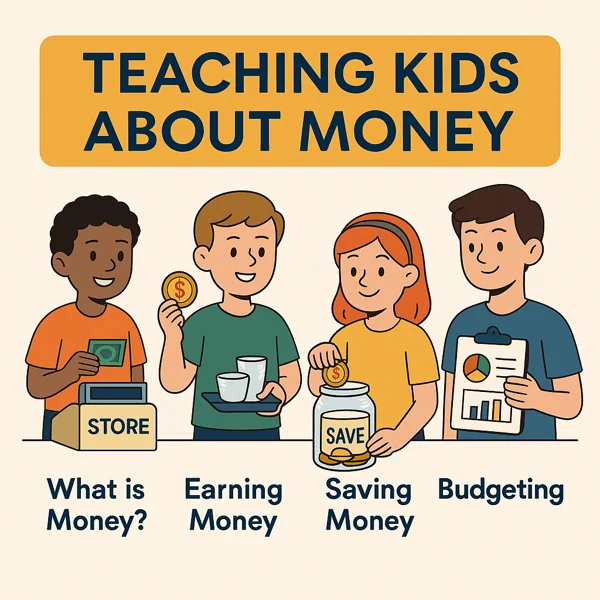
🪙 What Is Money?
Start with the basics:
Money is what people use to buy things. It comes in different forms — coins, paper bills, and even digital payments (like when you tap your card or phone). Use real-life examples so children can connect the concept to everyday experiences.
Fun Learning Ideas:
- Play “pretend store” or “restaurant” where your child can act as the cashier or customer using play money.
- Sort coins by size, color, or value to help them recognize differences.
- Let them hand the cashier cash at the store — it helps them see money as something exchanged for goods.
Key Lesson: Money is a tool people use to buy things they need or want.
💼 Earning Money
At this age, it’s important for kids to understand that money is earned through work. This builds the foundation for understanding effort, value, and reward later in life.
How to Teach:
- Offer small rewards or coins for simple chores like picking up toys, feeding the pet, or helping set the table.
- Explain, “When we work, we earn money to buy the things we need.”
Key Lesson: Money is earned, not just given — it’s the result of effort and responsibility.
🏦 The Savings Jar
Introduce the concept of saving with something visual — like a clear jar or a see-through piggy bank. Kids love watching their money grow, and this visual reinforcement helps them understand patience and goal-setting.
How to Teach:
- Label a jar “My Savings Jar.”
- Encourage them to put in coins or small bills they receive from chores, birthdays, or relatives.
- When it fills up, talk about what they might want to buy — or how saving more can help them reach a bigger goal.
Key Lesson: Saving helps money grow over time and teaches patience and planning.
📊 Quick Reference Table for Ages 3–5
| Concept | Activity Example | Key Lesson |
|---|---|---|
| What is Money? | Play pretend store or restaurant | Money is used to buy things. |
| Earning Money | Reward for simple chores | Money is earned through effort. |
| Saving Money | Use a clear jar to save coins | Saving helps money grow over time. |
🎲 Additional Fun Activities
- 📖 Read storybooks like “Bunny Money” by Rosemary Wells or “Curious George Saves His Pennies” to introduce money concepts in a fun way.
- 🎵 Sing counting or saving songs — many children’s music playlists and YouTube Kids videos reinforce financial lessons through rhythm and rhyme.
- 🧩 Incorporate real-world play — let them “pay” at a pretend grocery store or help plan a family “shopping trip” with a toy budget.
Parent Tip
At this age, it’s less about numbers and more about values and observation. Children learn best by watching you — so model good habits like saving change, discussing prices, or saying, “We’re saving up for that.”
2. Earning, Spending, and Saving (Ages 6-10)
As children get a little older, they can start to understand more about how money works in everyday life. Now’s the perfect time to dive deeper into concepts like earning, spending, and saving.
Allowance and Chores
- Assign small tasks around the house—like making their bed or feeding the pet—and pay them a set allowance.
Teaching Wants vs. Needs
- Explain that things like food and clothing are needs, while toys and treats are wants.
- Help them prioritize their spending.
Developing the Habit of Saving
- Set up a system where they divide their money into categories: spending, saving, and giving.
- Use three jars labeled for each category to make it visual and fun.
Checklist for Ages 6-10:
Additional Tips:
- Encourage children to save for a small goal, like a toy, to understand delayed gratification.
- Involve them in shopping by giving them a small budget for a family grocery trip.
3. Budgeting and Financial Goals (Ages 10–13)
By the time kids reach their pre-teen years, they’re becoming more independent — managing allowance money, making small purchases, and developing opinions about how to spend. This is the perfect stage to introduce budgeting, goal-setting, and value-based decision-making.
At this age, children begin to understand that money is finite — and that how they choose to spend or save it has consequences. Helping them learn to plan their money builds the foundation for smart financial management later in life.
📘 The Basics of Budgeting
Teach your child to think of budgeting as a spending plan, not a restriction. The goal is to understand where their money goes and how to make thoughtful choices.
How to Teach:
- Help them divide their money into three simple categories — Saving, Spending, and Giving.
- Use jars, envelopes, or digital apps to separate funds visually or virtually.
- Explain that every dollar has a purpose — saving for goals, spending on needs or fun, and giving to help others.
Key Lesson: Budgeting helps kids plan ahead and make informed financial decisions instead of spending impulsively.
🎯 Setting Financial Goals
Once they understand how to allocate money, introduce the concept of financial goals — things they want to achieve by saving and planning.
How to Teach:
- Encourage them to pick a specific goal, such as saving for a bike, tablet, or class trip.
- Set a timeline for reaching that goal and track progress weekly or monthly.
- Use a goal chart or savings tracker app so they can visualize how their effort adds up.
- Celebrate milestones — when they reach halfway, acknowledge their discipline and persistence.
Key Lesson: Setting goals teaches patience, planning, and the satisfaction of earning what you want.
🛒 Understanding the Cost of Things
Children at this age begin to recognize price differences and start forming opinions about value and quality. This is an ideal opportunity to discuss cost versus value and smart shopping.
How to Teach:
- Take them shopping and compare prices between brands or stores.
- Ask, “Is this worth the price?” or “Could we find a better deal?” to spark critical thinking.
- Introduce the idea that sales, discounts, and quality can all affect long-term value.
Key Lesson: Learning to compare costs builds financial awareness and teaches kids to spend wisely.
📊 Sample Budgeting Table for Ages 10–13
| Weekly Allowance | Saving (50%) | Spending (30%) | Giving (20%) |
|---|---|---|---|
| $10 | $5 | $3 | $2 |
| $20 | $10 | $6 | $4 |
| $30 | $15 | $9 | $6 |
Tip: Encourage them to adjust their percentages as they grow — perhaps increasing saving when working toward a bigger goal.
💡 Interactive Learning Ideas
- Plan a Simple Budget: Have your child create a budget for a birthday party, school fair, or family night, assigning costs for food, games, and gifts.
- Try Family Finance Apps: Use kid-friendly apps like Greenlight, FamZoo, or BusyKid to make money management interactive and hands-on.
- Track Real Expenses: Encourage them to keep a small notebook or digital tracker of weekly spending to see where their money actually goes.
Parent Tip
Encourage autonomy but stay involved. Ask open-ended questions like, “What are you saving for this month?” or “What’s your plan if you run out of spending money?” This helps children connect their choices to outcomes — a vital skill for future financial independence.
4. Teaching the Power of Compound Interest (Ages 13–15)
By their early teens, kids are ready to grasp more advanced money concepts — especially how saving and investing can make their money grow over time. This is the perfect age to introduce the concept of compound interest, often called the “eighth wonder of the world.”
Understanding compound interest helps teens see that time is their greatest financial advantage — and that even small, consistent savings can turn into something big with patience and discipline.
💰 Savings Accounts and How Interest Works
Open a savings account for your teen (or involve them in managing one they already have). Show them how banks pay interest for keeping money deposited — a simple yet powerful example of passive income.
How to Teach:
- Explain that simple interest pays only on the original amount saved, while compound interest pays on both the original amount and the accumulated interest.
- Log into their account together and show them how interest is added each month or quarter.
- Encourage them to set up automatic transfers from allowance or part-time job income to their savings account.
Key Lesson: The earlier they start saving, the more time their money has to grow — and the less effort it takes later.
🕰️ Delayed Gratification in Action
Teens are naturally focused on the present, so this is an ideal time to teach the importance of delayed gratification — waiting now for a bigger payoff later. Compound interest makes this concept tangible.
Use examples like:
- “If you save $100 now and earn 5% interest, next year you’ll have $105. But if you leave it alone, it keeps earning interest on that $105 — so you’re earning money on your money.”
- Compare two savers: one who starts at 15 and one who waits until 25. Show how the early saver ends up with far more, even if they contribute less overall.
Key Lesson: Saving early and staying consistent leads to exponential growth — patience pays off.
📈 Compound Interest Example
| Year | Starting Balance | Interest Earned (5%) | Ending Balance |
|---|---|---|---|
| 1 | $100.00 | $5.00 | $105.00 |
| 2 | $105.00 | $5.25 | $110.25 |
| 3 | $110.25 | $5.51 | $115.76 |
| 4 | $115.76 | $5.79 | $121.55 |
| 5 | $121.55 | $6.08 | $127.63 |
After just five years, that $100 has grown to more than $127 — without adding another penny. Now imagine saving $10 a month for five years — the results compound even faster.
Key Lesson: Compound interest rewards consistency and time — the sooner you start, the greater the impact.
🧮 Practical Activities
- Use an Online Calculator: Try a compound interest calculator (like the one at Investor.gov) to experiment with different savings rates, timeframes, and interest percentages.
- Simulate Growth: Have your teen track hypothetical savings over six months using a spreadsheet or app.
- Explore Real Accounts: Review options for youth savings accounts or custodial investment accounts and compare interest rates together.
- Play the “Doubling Game”: Ask, “Would you rather have $1 million today or a penny that doubles every day for 30 days?” (Spoiler: the penny grows to over $5 million!)
Parent Tip
This is the stage where kids begin to understand why saving matters. Reinforce the message that time is a powerful ally — not just in money, but in achieving any goal. The discipline they learn through saving and compounding can apply to everything from studying for exams to planning their future career.
5. Credit, Debt, and Borrowing (Ages 15–18)
As teens approach adulthood, money lessons become more real — credit cards, car loans, and student loans are right around the corner. Teaching them about credit, debt, and borrowing now can prevent costly mistakes later and set them up for a lifetime of responsible financial decision-making.
At this age, your teen can understand that borrowing money is not “free money.” Every dollar borrowed comes with interest and responsibility — and good habits now will help them build strong credit early on.
💳 How Credit Works
Start by explaining that credit means borrowing money with the promise to pay it back later, often with interest added. Credit cards, student loans, and car loans all work on this principle.
How to Teach:
- Show them a real credit card statement (yours or a sample) and highlight the interest rate (APR), minimum payment, and total amount due.
- Explain that paying only the minimum balance means interest keeps growing, and it can take years to pay off even small amounts.
- Run a simulation: Borrow $100 “from you” and charge 10% interest. If they don’t repay in full, show how the balance increases monthly.
Key Lesson: Credit is borrowed money — it’s convenient, but it must be used wisely and paid back on time.
⚠️ The Dangers of Debt
Debt can be useful when managed carefully (like student loans or a car loan), but it becomes dangerous when spending exceeds the ability to repay. Teens need to understand that interest is the price of impatience — the cost of buying now and paying later.
How to Teach:
- Compare high-interest credit cards (20–25%) to low-interest options like federal student loans (around 5–6%).
- Use real-world examples: “If you charge $1,000 on a card with 20% interest and only pay $25 a month, it could take over five years to pay off — and cost more than $500 in interest.”
- Talk openly about how debt stress can affect mental health, relationships, and long-term financial freedom.
Key Lesson: Debt can build opportunities — or become a trap. The difference lies in how it’s managed.
🌟 Building Good Credit
Introduce the concept of a credit score and why it matters — it affects their ability to rent an apartment, buy a car, or even get a job in some industries.
How to Teach:
- Explain the factors that influence credit scores:
- Payment history (35%) – Paying bills on time
- Credit utilization (30%) – Keeping balances below 30% of available credit
- Length of credit history (15%) – Starting early helps build a solid track record
- New credit inquiries (10%) – Too many applications can lower scores
- Credit mix (10%) – A variety of accounts (loans, cards) can help
- Encourage responsible use of credit cards — small purchases paid off monthly.
- Consider opening a secured credit card or adding them as an authorized user on your account to build history safely.
Key Lesson: Good credit opens doors — but only when built with responsibility and consistency.
✅ Checklist for Ages 15–18
| Topic | Goal | Activity Example |
|---|---|---|
| Understanding Credit | Know how credit cards and loans work | Review a real statement together |
| Avoiding Debt Traps | Recognize the cost of interest | Simulate a “minimum payment” scenario |
| Building Credit | Learn how credit scores are formed | Create a mock credit report |
| Responsible Borrowing | Plan repayment before borrowing | Practice tracking “loan” payoffs at home |
| Smart Spending | Use credit strategically | Make one small purchase and pay it off |
💬 Real-Life Examples & Exercises
- Mock Credit System: Set up a “family credit experiment.” Give them a $100 limit they can “borrow” for a month at 10% interest. Let them see how fast the amount grows if they don’t repay on time.
- Success Stories: Share examples of young adults who used credit wisely — perhaps a college student who built good credit through small purchases and timely payments.
- Credit-Building Apps: Explore educational tools like Zogo, Step, or Cleo to reinforce lessons interactively.
Parent Tip
Teens learn more from your transparency than from lectures. Discuss your own experiences — both wins and mistakes — with credit. This not only humanizes money lessons but helps them see credit as a tool for independence, not a shortcut to luxury.
6. Introduction to Investing (Ages 16–18)
As your teen approaches adulthood, they’re ready to move beyond saving and understand how to make their money work for them. This is the perfect stage to introduce investing — the process of using money to build wealth over time.
At this age, the key is to demystify the stock market, explain risk and reward in simple terms, and emphasize that time is the most valuable asset any investor has.
📊 What Is Investing?
Start by explaining that investing means buying assets — like stocks, bonds, or mutual funds — with the goal of helping money grow over time. Unlike saving, which keeps money safe but slow-growing, investing involves risk but offers higher long-term potential returns.
How to Teach:
- Use relatable comparisons: “Saving is like parking your car — it stays put. Investing is like driving it somewhere — there’s more movement, but you have to steer carefully.”
- Introduce key types of investments:
- Stocks: Ownership in a company. If the company grows, so does the value of your investment.
- Bonds: Loans to companies or governments that pay back interest over time.
- Mutual Funds & ETFs: Collections of investments managed together to spread out risk.
Key Lesson: Investing helps your money grow faster than saving alone, but every investment comes with some level of risk.
🧩 The Importance of Diversification
One of the most important investing lessons is diversification — not putting all your eggs in one basket.
How to Teach:
- Explain that diversification means spreading money across different types of investments (stocks, bonds, cash, or even industries).
- Use an analogy: “If you invest in only one company and it struggles, your whole investment suffers. But if you own 20 companies through a mutual fund, one bad year won’t ruin your portfolio.”
- Show examples of diversified vs. concentrated portfolios using pie charts or online simulators.
Key Lesson: Diversification helps reduce risk and smooth out investment returns over time.
🕰️ Long-Term Investing and Starting Early
Introduce your teen to the concept of compounding returns in investing — similar to compound interest in savings, but with higher growth potential. Starting early allows investments to compound over decades, turning small contributions into significant wealth.
How to Teach:
- Explain how investing even modest amounts regularly can lead to major growth.
- Show how Roth IRAs and custodial brokerage accounts can help teens begin investing safely.
- Reinforce that patience, consistency, and emotional control are more valuable than chasing “hot stocks.”
Key Lesson: The earlier you start investing, the more time your money has to grow — and the less you need to contribute later.
📈 Investment Growth Example
| Year | Initial Investment | Annual Contribution | Growth Rate (8%) | Total Value |
|---|---|---|---|---|
| 1 | $1,000 | $500 | $120 | $1,620 |
| 10 | $1,000 | $5,000 | $4,690 | $10,690 |
| 20 | $1,000 | $10,000 | $22,890 | $33,890 |
| 30 | $1,000 | $15,000 | $56,880 | $72,880 |
Insight: By investing early, teens can experience firsthand how compounding accelerates growth — the longer the money stays invested, the faster it multiplies.
💡 Practical Learning Activities
- Simulate the Stock Market: Use teen-friendly apps like HowTheMarketWorks, MarketWatch Virtual Stock Exchange, or The Stock Market Game to explore risk-free investing.
- Explore Fractional Investing: Many brokerage platforms allow small investments (as little as $1) into well-known companies — a great way to make investing relatable.
- Introduce Dollar-Cost Averaging: Teach that investing the same amount regularly (e.g., $25/month) helps smooth out market ups and downs over time.
- Track a Portfolio Together: Have your teen “follow” a few companies or ETFs for six months to see how values change and discuss why.
Parent Tip
Focus less on predicting the market and more on building habits. Help your teen understand that investing is about consistency, not luck. Starting early with small, steady investments — even in index funds — can set them up for lifelong financial independence.
7. Exploring Entrepreneurship (Ages 10–18)
Introducing kids to entrepreneurship is one of the most powerful ways to teach real-world money management, problem-solving, and creativity. Whether it’s a lemonade stand, pet-sitting gig, or an online shop, running a small business gives children and teens hands-on experience with earning, saving, spending, and planning for growth.
Entrepreneurship isn’t just about making money — it’s about learning responsibility, innovation, and confidence in turning ideas into action.
🚀 Starting a Small Business
Children as young as 10 can begin exploring small-scale business ideas that match their interests and community needs. These projects help kids understand that income is earned through effort, creativity, and customer value.
How to Teach:
- Brainstorm together: What problems can they solve or what products could they create?
- Younger kids (10–13): Lemonade stands, dog walking, plant sales, car washing, or handmade crafts.
- Older teens (14–18): Tutoring, lawn care, digital art commissions, or selling items online.
- Teach them to keep a simple income and expense log:
- Income = total sales
- Expenses = supplies, materials, advertising
- Profit = what’s left after expenses
- Introduce the idea of reinvesting profits — saving part of earnings to grow their business.
Key Lesson: Entrepreneurship teaches that money is earned through initiative and effort — and that smart reinvestment can multiply opportunities.
📣 Lessons in Marketing
Every great business starts with customers — and marketing is how entrepreneurs connect with them. Even a simple business can teach powerful lessons about communication, creativity, and customer relationships.
How to Teach:
- Help your child create flyers, posters, or digital ads using free tools like Canva.
- Discuss the importance of presentation, pricing, and value — what makes people want to buy?
- For teens, show how social media platforms like Instagram, Facebook, or TikTok can help promote small ventures responsibly.
- Talk about customer service — being polite, reliable, and honest builds trust and repeat customers.
Key Lesson: Great businesses aren’t just about selling — they’re about solving problems and treating people well.
💡 Advanced Opportunities for Teens
Older teens ready to take their ventures online can explore platforms and opportunities that expand their entrepreneurial horizons.
Ideas to Explore:
- Etsy or Shopify: Create an online store for handmade crafts, art prints, or digital designs.
- Print-on-Demand (e.g., Printful, Redbubble): Sell custom designs on T-shirts, mugs, or phone cases with no inventory required.
- Freelancing platforms: Teens with writing, design, or coding skills can explore safe, parent-supervised options to build experience.
- Entrepreneurship programs: Encourage participation in Junior Achievement, DECA, BizKid$, or local small business workshops.
Key Lesson: Modern entrepreneurship empowers teens to turn their passions into income — and teaches long-term skills like innovation, accountability, and perseverance.
🧾 Sample Mini-Business Budget
| Item | Cost | Purpose | Notes |
|---|---|---|---|
| Lemonade mix | $5 | Inventory | Enough for 50 servings |
| Poster board & markers | $3 | Marketing | Homemade advertising |
| Paper cups | $4 | Supplies | Recyclable option |
| Total Startup Cost | $12 | Break-even after ~25 cups sold at $0.50 |
Discussion Prompt: Ask your child, “How can we increase profits — by lowering costs, improving marketing, or selling more?” This sparks critical thinking and real-world financial problem-solving.
🌱 Parent Tip
Let kids make small mistakes — they’re powerful teachers. If a business idea doesn’t work out, help them reflect on what went wrong and how to improve next time. The goal isn’t perfection — it’s learning resilience, creativity, and financial responsibility.
Key Takeaway
Entrepreneurship bridges financial literacy and independence. When kids and teens take ownership of an idea — earning, budgeting, and reinvesting — they gain real-world skills that last far beyond childhood. You’re not just teaching business—you’re cultivating confidence, adaptability, and lifelong money wisdom.
Conclusion – Building Lifelong Financial Confidence
Teaching kids about money isn’t a one-time lesson — it’s a lifelong conversation that grows alongside them. Each stage, from counting coins to managing credit, lays another brick in the foundation of financial confidence. When you start early and consistently reinforce key principles — earning, saving, budgeting, investing, and giving — you’re helping your child develop the mindset and habits that lead to lifelong financial well-being.
The goal isn’t just to raise kids who know how to balance a checkbook or save for a goal — it’s to raise adults who understand the value of money, think critically about financial decisions, and feel empowered to shape their own futures. Every real-life experience — grocery shopping, earning an allowance, setting up a savings jar, or exploring entrepreneurship — becomes a teaching moment.
Make it fun. Use stories, games, challenges, and real-world examples to turn financial learning into something your kids look forward to. Keep money discussions open, honest, and judgment-free, so they feel comfortable asking questions and sharing their own ideas.
The greatest gift you can give your child isn’t money itself — it’s the knowledge and confidence to manage it wisely.
💬 Join the Conversation
What money lessons are you teaching your kids right now? Have they started saving, budgeting, or launching a small business?
Share your experiences, ideas, or family money traditions in the comments below — your insights might inspire another parent to start the journey toward financial literacy today.
Back to Basics of Personal Finance