🏁 Introduction
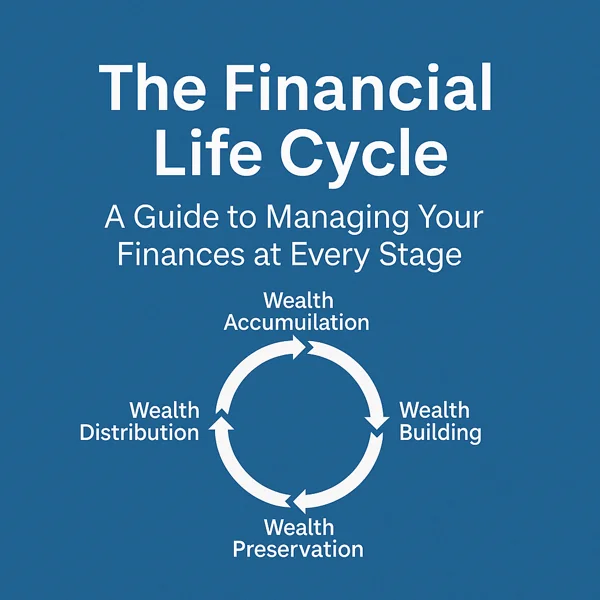
Wealth isn’t built overnight — it’s a lifelong process that evolves with your goals, responsibilities, and circumstances. From opening your first bank account to passing on your legacy, your financial journey moves through distinct stages, each requiring new strategies and priorities.
The financial life cycle provides a framework for navigating these transitions intentionally. By understanding where you are — and preparing for what comes next — you can make smarter choices, avoid common pitfalls, and achieve long-term financial independence.
This guide breaks the process into six actionable stages — each with its own checklist of key steps to take, decisions to make, and milestones to reach. Whether you’re a college student, a growing family, or approaching retirement, you’ll find clear guidance to strengthen your financial foundation and plan your next move with confidence.
🔑 Key Takeaways
- Financial planning evolves through distinct stages.
Your financial priorities change with life events — from building credit in your 20s to managing income withdrawals in retirement. - Start early to maximize time and compounding.
The earlier you begin saving and investing, the more exponential your growth becomes. Consistency beats timing every time. - Adapt your strategy at each phase of life.
As your career, family, and goals evolve, your budgeting, insurance, and investment strategies should evolve too. - Protect as you grow — insurance and estate planning matter.
Building wealth is only half the journey. Preserving it through risk management and estate planning ensures long-term stability. - Regular reviews keep your plan on track.
Annual financial checkups — adjusting for inflation, taxes, and new priorities — help keep your goals aligned with reality.
🧠 Why Understanding the Financial Life Cycle Matters
Most people manage their money reactively — responding to bills, opportunities, or crises as they arise. But real financial success comes from thinking proactively, anticipating what’s next, and preparing for it before it happens. That’s exactly what the financial life cycle helps you do.
Each stage represents a unique mix of opportunities, challenges, and decisions.
Understanding where you are — and what comes next — allows you to:
- Prioritize goals with clarity.
Instead of spreading yourself thin, you can focus on the milestones that matter most for your current phase of life — whether that’s paying off student debt, saving for a home, or building retirement security. - Avoid costly financial mistakes.
Many financial missteps — like underinsuring, investing too aggressively near retirement, or neglecting estate planning — happen because people apply the wrong strategy to the wrong stage. - Optimize decisions for timing and impact.
A dollar saved or invested in your 20s can grow exponentially more than one added in your 40s. Recognizing the compounding effect of timing helps you make smarter moves earlier. - Balance short-term comfort with long-term success.
Understanding the life cycle encourages sustainable habits — spending responsibly today while ensuring your future goals stay within reach. - Build resilience through transitions.
Major life events — career shifts, family changes, or health issues — are easier to navigate when you already know how they fit into your broader financial picture.
Ultimately, understanding these stages transforms financial planning from a list of disconnected tasks into a cohesive lifelong strategy — one that adapts as your needs, responsibilities, and opportunities evolve.
🗺️ Overview: The Six Stages of Financial Growth
| Stage | Age Range | Core Focus | Key Goal |
|---|---|---|---|
| Stage 0: Financial Foundations | Teens–20s | Learning money basics, managing debt, building credit | Establish financial literacy and independence |
| Stage 1: Wealth Accumulation | 20s–40s | Budgeting, saving, investing early | Build the foundation for long-term wealth |
| Stage 2: Family & Career Growth | 30s–50s | Managing dual incomes, homeownership, insurance | Balance family priorities and financial security |
| Stage 3: Wealth Expansion | 40s–60s | Advanced investing, tax optimization | Maximize returns and prepare for retirement |
| Stage 4: Wealth Preservation | 50s–70s | Risk reduction, healthcare, estate updates | Protect assets and ensure stability |
| Stage 5: Wealth Distribution & Legacy | 70s+ | Sustainable withdrawals, charitable giving, legacy planning | Make your wealth work for you and future generations |
🎓 Stage 1: Financial Foundations (Teens–20s)
Goal: Learn the basics of money management and develop habits that support financial independence.
Your first financial choices set the tone for decades to come. This is the time to build literacy, understand debt, and establish a credit and savings foundation that supports future goals.
Checklist
- ☐ Open a checking and savings account
- ☐ Learn to budget (use free apps or a spreadsheet)
- ☐ Build credit with a secured card or small student loan
- ☐ Avoid high-interest debt (especially revolving credit)
- ☐ Start an emergency fund ($500–$1,000 minimum)
- ☐ Learn the basics of investing — even small contributions count
- ☐ Understand student loans and repayment options
- ☐ Take a personal finance course or follow reputable blogs
💡 Pro Tip: Your greatest financial advantage at this stage is time. The earlier you start saving and investing, the more powerful compounding becomes.
🧩 Stage 2: Wealth Accumulation (20s–40s)
Goal: Build a strong financial foundation by saving, reducing debt, and starting to invest consistently.
The accumulation stage is all about momentum — turning income into progress. Every habit formed now, from budgeting to automating savings, will compound for decades.
Checklist
- ☐ Build a 3–6 month emergency fund
- ☐ Track income and expenses with a budget
- ☐ Contribute to a 401(k) or Roth IRA (start with employer match)
- ☐ Pay off high-interest debt (credit cards, personal loans)
- ☐ Automate savings and recurring bills
- ☐ Invest in career skills and certifications
- ☐ Start building credit responsibly
- ☐ Review basic insurance coverage (health, renters, auto)
📘 Example:
“Maria, 28, automates $150 per paycheck into savings. After 10 years, she’ll have over $39,000 — before even factoring in investment growth.”
💡 Pro Tip: Focus on consistency, not perfection. Regular contributions matter more than timing the market.
👨👩👧 Stage 3: Family & Career Growth (30s–50s)
Goal: Balance family priorities with financial stability and growth.
This stage brings new responsibilities — a home, children, career transitions, or business ownership. Planning ahead helps you build security while managing competing financial goals.
Checklist
- ☐ Increase savings rate to 15–20% of income
- ☐ Purchase adequate life and disability insurance
- ☐ Buy or refinance a home strategically
- ☐ Open and fund a 529 college savings plan
- ☐ Review employee benefits annually (HSA, FSA, ESPP)
- ☐ Update wills and beneficiary designations
- ☐ Build sinking funds for large planned expenses
- ☐ Create a joint financial plan with your partner
- ☐ Begin tax planning to minimize annual liabilities
💬 Pro Tip: Automate savings and discuss money openly as a couple — transparency and teamwork strengthen both your finances and your family.
🚀 Stage 4: Wealth Expansion (40s–60s)
Goal: Optimize assets and income during peak earning years while preparing for retirement.
This is your financial “power decade.” Use rising income and career stability to invest strategically, reduce taxes, and accelerate progress toward independence.
Checklist
- ☐ Max out retirement contributions (401(k), IRA, HSA)
- ☐ Diversify investments across stocks, bonds, and real estate
- ☐ Rebalance portfolio annually
- ☐ Explore tax-efficient strategies (Roth conversions, municipal bonds)
- ☐ Consider business ownership or passive income streams
- ☐ Evaluate long-term care insurance options (mid-to-late 50s)
- ☐ Fund college tuition and maintain retirement progress
- ☐ Schedule a mid-career review with a CFP® professional
📈 Example:
“At age 45, increasing savings by just 5% of income can add hundreds of thousands of dollars to your retirement balance over 20 years.”
💡 Pro Tip: The focus now is optimization — your money should be working as hard as you are.
🛡️ Stage 5: Wealth Preservation (50s–70s)
Goal: Protect your assets, manage healthcare costs, and prepare for a confident retirement.
As you approach or enter retirement, priorities shift from growth to security. Preserving what you’ve built becomes the foundation for peace of mind.
Checklist
- ☐ Rebalance your portfolio for lower volatility
- ☐ Pay off remaining debts, especially your mortgage
- ☐ Make catch-up contributions to retirement plans
- ☐ Estimate healthcare and long-term care expenses
- ☐ Review and update estate documents (will, trust, POA)
- ☐ Consolidate accounts for easier management
- ☐ Test-run retirement budgets with partial withdrawals
💡 Pro Tip: Focus on income reliability and simplicity. A well-structured withdrawal plan and reduced risk exposure can make retirement far less stressful.
🧾 Stage 6: Wealth Distribution & Legacy (70s and Beyond)
Goal: Transition from accumulation to sustainability — ensuring your wealth supports you and your legacy.
This final stage is about purpose: using your lifetime of savings to create stability for yourself and opportunities for others.
Checklist
- ☐ Establish a sustainable withdrawal plan (e.g., 4% rule)
- ☐ Take required minimum distributions (RMDs) on time
- ☐ Plan charitable giving or family gifting
- ☐ Use trusts or advanced estate tools for tax efficiency
- ☐ Review and update healthcare directives and power of attorney
- ☐ Discuss legacy intentions with heirs or advisors
- ☐ Reassess investment risk and income sustainability annually
🏛️ Example:
“John, 72, restructured his portfolio into dividend ETFs and municipal bonds to generate steady income and reduce taxes.”
💡 Pro Tip: A clear legacy plan prevents confusion, reduces taxes, and ensures your wealth has the impact you intend.
⚖️ Universal Best Practices for Every Stage
Certain principles apply no matter where you are in your financial journey. These timeless habits strengthen your plan and improve outcomes in every decade.
- ☐ Review your financial plan annually
- ☐ Adjust for life events (marriage, divorce, job loss, inheritance)
- ☐ Maintain an emergency fund at all times
- ☐ Keep tax and investment knowledge up to date
- ☐ Use automation to stay consistent
- ☐ Partner with a CFP® or fiduciary advisor when complexity increases
💡 Reminder: Financial planning isn’t about perfection — it’s about progress and alignment with your goals.
💰 Wealth Benchmarks by Stage
Understanding how your financial progress compares to general benchmarks can provide valuable perspective — not as a measure of worth, but as a tool for progress tracking.
Everyone’s journey is unique, and factors like income, cost of living, and life choices all play a role. These figures simply help you evaluate whether your current savings rate and net worth are keeping pace with your long-term goals.
| Stage | Typical Net Worth Range* | Savings Rate Target | Retirement Progress Check |
|---|---|---|---|
| Financial Foundations | <$50,000 | 5–10% | Start saving and focus on consistent habits |
| Wealth Accumulation | $50K–$250K | 10–15% | Aim for roughly 1× your annual salary by age 30 |
| Family & Career Growth | $250K–$750K | 15–20% | Target 2–4× your salary by age 40 |
| Wealth Expansion | $750K–$2M | 20%+ | Strive for 6–8× your salary by age 50 |
| Wealth Preservation | $1M–$3M+ | Maintain contributions | Achieve 10–12× your salary by retirement |
| Legacy & Distribution | $1M–$5M+ | Drawdown phase | Focus on sustainability, income longevity, and giving |
*Estimates based on Federal Reserve Survey of Consumer Finances (SCF) and Fidelity 2025 retirement benchmarks.
Values are generalized and will vary depending on income, geography, and investment returns.
📊 Why These Benchmarks Matter
- They reveal patterns, not perfection.
Comparing progress by life stage helps you identify gaps or areas needing more attention — without judgment. - They guide decision-making.
If your savings or net worth fall short of your target range, small adjustments to savings rate or spending can help you catch up over time. - They reinforce the power of consistency.
The households that consistently save and invest — even modest amounts — tend to align most closely with these benchmarks over decades.
💡 Pro Tip: Revisit your net worth annually. Tracking progress is one of the simplest and most motivating ways to stay engaged with your financial goals.
⚠️ Common Mistakes at Each Stage of the Financial Life Cycle
Even the best intentions can go off track when financial strategies don’t match the stage of life you’re in. Recognizing these common pitfalls helps you plan proactively, avoid unnecessary stress, and stay on course toward your long-term goals.
Stage 1: Financial Foundations (Teens–20s)
Mistake: Relying on credit cards to fund lifestyle expenses.
Why It’s a Problem: Early debt can damage your credit and delay savings habits.
Fix It: Use a secured credit card or low-limit starter card and pay the balance in full each month. Focus on budgeting and saving first.
Stage 2: Wealth Accumulation (20s–40s)
Mistake: Delaying retirement contributions until “later.”
Why It’s a Problem: Waiting even a few years can cost hundreds of thousands in lost compounding growth.
Fix It: Start with small, automatic contributions to a 401(k) or Roth IRA — even $50 a month creates momentum.
Mistake: Ignoring emergency savings while focusing only on debt.
Fix It: Balance both. A $1,000 starter fund prevents you from using credit for every unexpected expense.
Stage 3: Family & Career Growth (30s–50s)
Mistake: Underinsuring or relying solely on employer coverage.
Why It’s a Problem: Job changes or layoffs can leave families unprotected.
Fix It: Supplement employer plans with affordable term life and disability coverage. Review annually.
Mistake: Overspending on housing or lifestyle upgrades.
Fix It: Keep your total debt-to-income ratio under 36%. Lifestyle inflation is the silent killer of long-term savings.
Stage 4: Wealth Expansion (40s–60s)
Mistake: Neglecting tax strategy during peak earning years.
Why It’s a Problem: Higher income often pushes you into higher tax brackets, reducing your net savings.
Fix It: Maximize pre-tax accounts (401(k), HSA) and explore Roth conversions or charitable deductions to manage taxable income.
Mistake: Not rebalancing investments as the market shifts.
Fix It: Review your portfolio annually to realign with your risk tolerance and long-term goals.
Stage 5: Wealth Preservation (50s–70s)
Mistake: Staying too aggressive with investments near retirement.
Why It’s a Problem: A major market downturn can significantly reduce income potential just before you need it.
Fix It: Gradually shift toward lower-risk, income-focused assets such as bonds, dividend funds, or balanced portfolios.
Mistake: Failing to plan for healthcare and long-term care costs.
Fix It: Explore LTC insurance options in your 50s and estimate healthcare expenses using realistic inflation-adjusted projections.
Stage 6: Wealth Distribution & Legacy (70s and Beyond)
Mistake: Forgetting required minimum distributions (RMDs).
Why It’s a Problem: Missing an RMD triggers a 25% IRS penalty on the amount not withdrawn.
Fix It: Automate withdrawals through your custodian or advisor to stay compliant.
Mistake: Not communicating your legacy or estate plans.
Fix It: Hold family conversations, update legal documents, and share your intentions clearly to avoid future disputes or confusion.
💡 Pro Tip: Reviewing this list annually helps you identify red flags early and adjust your plan before small issues become costly mistakes.
🚫 Common Mistakes by Stage
| Stage | Common Mistake | How to Avoid |
|---|---|---|
| Foundations | Ignoring credit or overspending | Track spending and set alerts |
| Accumulation | Delaying investing | Automate small recurring contributions |
| Family & Career | Underinsuring income | Maintain term life and disability coverage |
| Expansion | Neglecting tax strategy | Use Roth and pre-tax diversification |
| Preservation | Staying too aggressive | Gradually reduce portfolio risk |
| Distribution | Missing RMD deadlines | Automate withdrawals through custodian |
🔄 When Financial Stages Overlap
Life rarely unfolds in perfect order — and neither does your financial journey. While the financial life cycle is a useful roadmap, it’s important to remember that these stages often overlap. You may find yourself saving for retirement while paying off student loans, funding college for your children while supporting aging parents, or starting a business while planning for long-term care.
Why Overlap Happens
- Life is nonlinear. Careers, relationships, health, and the economy all influence how — and when — you reach each milestone.
- Financial growth is cumulative. Decisions in one stage carry forward. For example, the habits you form in your 20s impact your wealth-building potential in your 40s.
- External factors evolve. Inflation, job markets, housing costs, and tax laws shift over time, requiring flexible strategies that adapt to changing realities.
How to Manage Overlapping Priorities
- Clarify your core goals.
Identify which objectives are most time-sensitive (e.g., debt payoff, emergency savings, retirement contributions). Address those first. - Use the 70/20/10 rule.
Allocate roughly 70% of income to essentials, 20% to future goals, and 10% to personal enjoyment — adjusting the ratios as life changes. - Automate what you can.
Overlapping priorities are easier to manage when savings, investments, and bills are automated. This reduces decision fatigue and ensures consistency. - Revisit your plan annually.
Adjust goals as circumstances evolve — like a growing family, a new business venture, or a shift in health or income. - Seek professional guidance during transition years.
When multiple goals collide (such as college funding and retirement planning), a CFP® or fiduciary advisor can help you balance trade-offs efficiently.
Takeaway
The stages of wealth are not a straight path — they’re more like phases that blend, repeat, and evolve as your life unfolds. The goal isn’t to complete one stage perfectly before starting another, but to stay intentional and ensure every decision supports your long-term financial vision.
🧭 Conclusion – Your Financial Journey Is Ongoing
Your financial life is dynamic — and so should your plan be. Each stage presents new opportunities, risks, and responsibilities, but also new ways to create stability and freedom. The key is staying proactive, reviewing regularly, and taking the next right step — wherever you are today.
No matter your age or stage, financial progress is within reach. Start where you are, follow the checklist, and keep building toward the future you envision.
Back to
- Financial Planning for Different Life Stages
- The Financial Planning Roadmap
- Financial Education & Literacy Hub