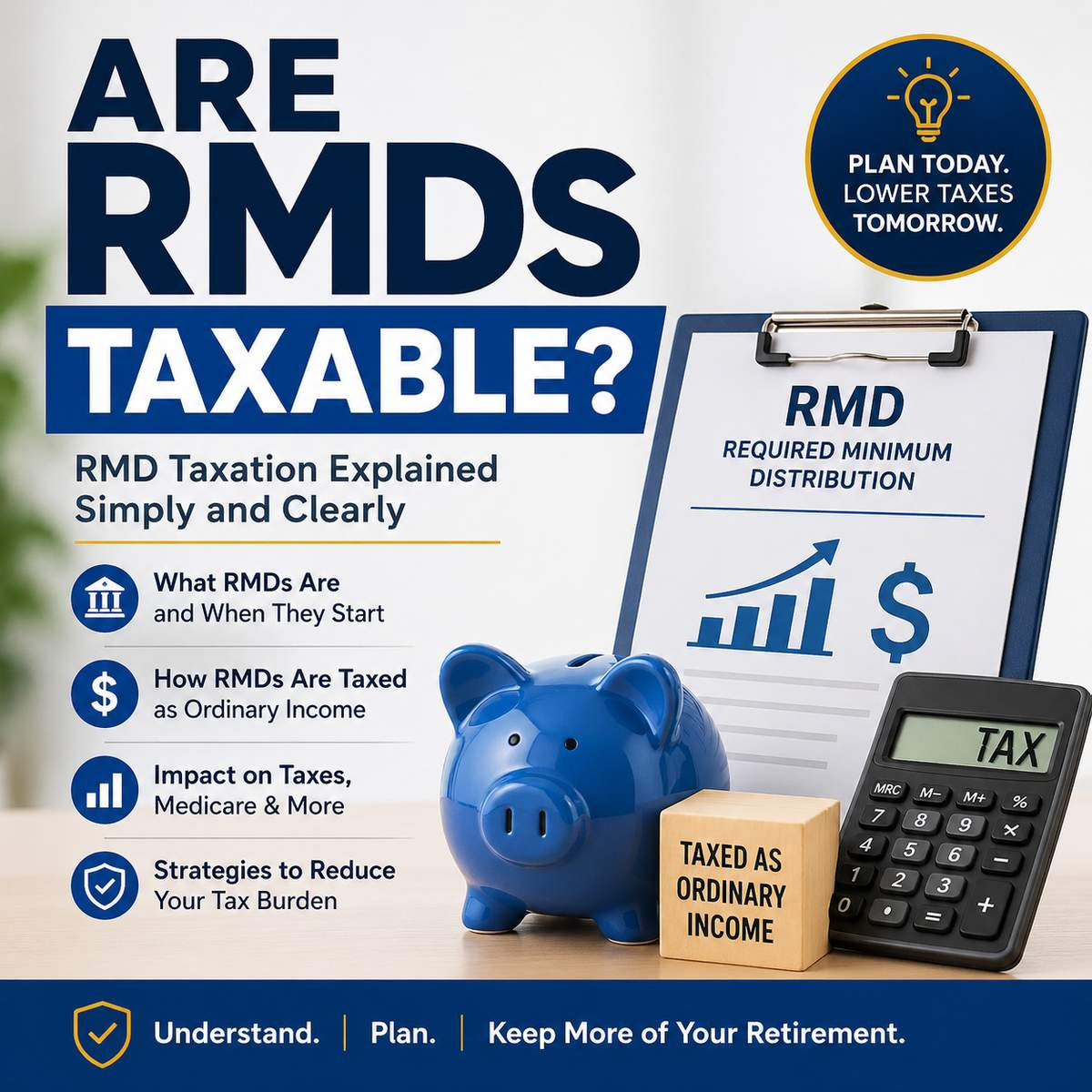
💡Quick Take -What Are RMD Taxes?
Required Minimum Distribution (RMD) taxes refer to the income taxes you pay on mandatory withdrawals from tax-deferred retirement accounts such as Traditional IRAs, 401(k)s, and 403(b)s.
- RMDs are taxed as ordinary income
- They are not subject to early withdrawal penalties
- They increase your total taxable income for the year
- They can impact:
- Your tax bracket
- Medicare premiums (IRMAA)
- The taxation of Social Security benefits
👉 Simple rule: If your retirement contributions were tax-deferred, your RMD withdrawals will be taxed when you take them.
👉 Bottom line: RMDs are not just withdrawals—they are taxable income events that must be managed strategically in retirement.
📊 Are RMDs Taxable?
| Question | Answer |
|---|---|
| Are RMDs taxable? | ✅ Yes, as ordinary income |
| Do federal taxes apply? | ✅ Yes |
| Do state taxes apply? | ⚠️ Depends on your state |
| Are RMDs subject to early withdrawal penalties? | ❌ No |
| Can RMDs increase your tax bracket? | ✅ Yes |
| Do RMDs affect Medicare premiums (IRMAA)? | ✅ Yes |
| Are Roth IRA RMDs taxable? | ❌ No (no RMDs during owner’s lifetime) |
👉 Key takeaway: RMDs are treated like paycheck income in retirement—they are added to your total income and taxed accordingly.
Introduction
Retirement is the moment your financial life shifts from saving to spending — and with that transition comes one of the IRS’s strictest rules: Required Minimum Distributions (RMDs). These mandatory withdrawals ensure the government eventually collects taxes on money that has grown tax-deferred inside Traditional IRAs, 401(k)s, 403(b)s, and similar accounts.
Beginning in 2025, retirees generally must start taking RMDs at age 73. Those born in 1960 or later will begin at age 75, reflecting the latest updates from the SECURE 2.0 Act. Failing to follow these rules has consequences: withdrawing too late or not enough can trigger steep IRS penalties, while withdrawing without a plan can raise your tax bill, affect Medicare premiums, and disrupt long-term retirement strategies.
This guide explains how RMD taxation works, why these rules matter, and the practical steps you can take to avoid unnecessary taxes. You’ll learn:
- How RMDs are calculated and when they begin
- The tax rules that apply to RMD withdrawals
- The most common — and costly — mistakes retirees make
- Proven strategies to reduce your lifetime tax burden
- Tools, checklists, and planning steps to stay compliant
Whether you’re preparing for your first RMD or managing distributions across multiple retirement accounts, understanding these rules puts you in control. With thoughtful planning, RMDs become more than a tax obligation — they can be a strategic tool for shaping your retirement income, protecting benefits, and preserving your financial legacy.
🎯 Who Needs to Understand RMD Taxation?
Understanding how RMDs are taxed is essential if you fall into any of the following categories:
- Retirees age 70+ with Traditional IRAs, 401(k)s, or similar accounts
- Pre-retirees planning future withdrawal strategies
- Individuals with large tax-deferred retirement balances
- Investors considering Roth conversion strategies
- Retirees concerned about Medicare premium increases (IRMAA)
- Beneficiaries managing inherited retirement accounts
👉 If you have tax-deferred retirement savings, RMD taxation will eventually affect your financial plan—whether you’re ready or not.
5 Key Takeaways
1. RMDs Are Taxed as Ordinary Income
RMD withdrawals count as taxable ordinary income for federal income tax purposes and, in many states, for state tax as well. Because they increase your adjusted gross income (AGI), RMDs can unintentionally push retirees into higher tax brackets if taken without a coordinated withdrawal strategy.
2. Roth IRAs Have No RMDs
Roth IRAs are exempt from RMDs during the account owner’s lifetime. This allows Roth assets to grow tax-free indefinitely, creating valuable flexibility for retirement planning, longevity risk, and estate transfers.
3. Missing an RMD Leads to Significant Penalties
If you miss your RMD deadline — December 31 for most retirees or April 1 for your first RMD year — the IRS may assess an excise tax of 25% on the amount not withdrawn. This can be reduced to 10% if corrected promptly and reported using Form 5329.
4. Strategic Planning Can Reduce Long-Term Tax Costs
You can significantly reduce RMD-related taxes by using coordinated strategies such as:
- Qualified Charitable Distributions (QCDs): Send up to $100,000 per year directly to charity and exclude that amount from taxable income.
- Roth conversions: Convert pre-tax funds in lower-income years to cut future RMDs.
- Tax-efficient withdrawal sequencing: Balance taxable, tax-deferred, and tax-free income streams to smooth your lifetime tax burden.
Smart planning can turn RMDs from a compliance requirement into a long-term tax optimization opportunity.
5. RMDs Can Increase Medicare Premiums (IRMAA)
Because RMDs raise your modified adjusted gross income (MAGI), they can push you into higher Medicare Part B and Part D premium tiers under the IRMAA rules. Coordinating RMDs with Social Security, Roth income, and other cash-flow sources can help you manage or avoid these higher premiums.
💡 Bottom line: The sooner you understand how RMD taxation works, the more control you have over your retirement income, taxes, and financial legacy.
Why RMDs Matter
Many retirees underestimate the impact that Required Minimum Distributions (RMDs) can have on their long-term financial plan. Yet, RMDs play a crucial role in how much you keep after taxes, how long your portfolio lasts, and how efficiently you pass wealth to heirs.
1. Avoiding Costly Penalties
The IRS imposes some of the steepest penalties in the tax code for missed RMDs—25% of the amount not withdrawn, reduced to 10% if corrected promptly. Failing to understand the rules or deadlines can lead to thousands of dollars in unnecessary penalties. Knowing when and how much to withdraw ensures compliance and protects your hard-earned savings.
2. Managing Taxable Income
RMDs count as ordinary income, which means they can push retirees into higher federal and state tax brackets. This added income can also trigger Medicare IRMAA surcharges, reducing your net retirement income. Understanding how RMDs interact with your overall income picture allows for smarter timing, better withdrawal coordination, and potentially lower tax bills.
3. Enhancing Portfolio Longevity
A well-planned RMD strategy can help your retirement savings last longer. By coordinating withdrawals across different account types—such as taxable, tax-deferred, and Roth—you can preserve tax-advantaged growth while meeting your annual requirements. This proactive approach supports sustainable cash flow and protects against premature asset depletion.
4. Supporting Charitable and Legacy Goals
If you’re charitably inclined, Qualified Charitable Distributions (QCDs) let you satisfy part or all of your RMD without increasing your taxable income. Understanding how RMDs and QCDs work together creates opportunities to reduce taxes and make a meaningful impact through giving—all while meeting IRS rules.
5. Preparing for Legislative Changes
Tax laws surrounding RMDs have evolved multiple times in recent years—most notably through the SECURE Act and SECURE 2.0 Act. Staying informed about updates, such as changes to starting ages or penalty reductions, ensures your plan remains compliant and optimized under the current tax code.
💡 Key Insight
RMDs are more than just a legal requirement—they’re a strategic component of your retirement income plan. Understanding them helps you minimize taxes, avoid penalties, and align withdrawals with your broader financial goals.
🧠 How RMD Taxes Work (Step-by-Step)
Understanding how RMDs are taxed becomes much easier when you break the process into clear steps:
- Calculate your RMD
Your required withdrawal is determined using IRS life expectancy tables and your account balance. - Withdraw the required amount
You must take at least the minimum amount each year once RMDs begin. - Add the withdrawal to your income
The RMD amount is included in your total taxable income for the year. - Apply your income tax rate
The RMD is taxed at your current ordinary income tax rate, not a special rate. - Assess the ripple effects
The additional income may:- Push you into a higher tax bracket
- Increase Medicare premiums (IRMAA)
- Cause more of your Social Security benefits to become taxable
👉 Key insight: RMDs stack on top of your other income—there’s no separate “RMD tax rate.”
What Are Required Minimum Distributions (RMDs)?
Definition of RMDs
Required Minimum Distributions (RMDs) are the mandatory withdrawals the IRS requires from certain tax-deferred retirement accounts once you reach a specific age. Because these accounts were funded with pre-tax dollars, the government eventually wants to collect income tax on the money withdrawn.
In short, RMDs are how the IRS ensures that retirees pay taxes on deferred earnings. Failing to take them on time can result in steep penalties, making it critical to understand how and when they apply.
Applicable Accounts
RMDs apply to most tax-deferred retirement savings plans, including:
- Traditional IRAs
- 401(k) and 403(b) plans (excluding Roth 401(k) and Roth 403(b) balances beginning in 2024)
- SEP IRAs
- SIMPLE IRAs
- Inherited IRAs (both Traditional and Roth)
Beginning in 2024, Roth 401(k) and Roth 403(b) accounts are no longer subject to RMDs while the owner is alive, aligning them with Roth IRAs.
Roth IRAs — A Key Exception
Roth IRAs remain fully exempt from RMDs during the account owner’s lifetime because contributions are made with after-tax dollars, and qualified withdrawals are tax-free.
This exemption allows funds to continue compounding tax-free, providing a powerful advantage in long-term retirement and estate planning. Many retirees strategically leave Roth accounts untouched to reduce taxable income and preserve flexibility later in retirement.
Age Requirements and Key Rules (2025 & SECURE 2.0)
The SECURE 2.0 Act updated RMD ages to reflect longer life expectancies:
| Birth Year | RMD Start Age | First RMD Deadline |
|---|---|---|
| 1951–1959 | Age 73 | April 1 of the year after turning 73 |
| 1960 or later | Age 75 | April 1 of the year after turning 75 |
Your first RMD must be taken by April 1 of the year following the year you reach your RMD age, and each subsequent year’s RMD must be withdrawn by December 31.
Failing to meet these deadlines can trigger a 25% excise tax on the amount not withdrawn—reduced to 10% if corrected in a timely manner.
Example RMD Scenarios and Tax Implications
| Scenario | Social Security Income | Pension Income | RMD Amount | Total Taxable Income | Tax Bracket (Single) | Tax Bracket (Married) |
|---|---|---|---|---|---|---|
| Low Income | $20,000 | $10,000 | $15,000 | $45,000 | 12% | 12% |
| Moderate Income | $30,000 | $20,000 | $25,000 | $75,000 | 22% | 12% |
| High Income | $40,000 | $30,000 | $50,000 | $120,000 | 24% | 22% |
These examples show how RMDs combine with other income sources to determine your taxable income. Even modest withdrawals can push retirees into higher federal or state tax brackets, affecting everything from net take-home income to Medicare IRMAA premiums.
💡 Quick Takeaway
RMDs aren’t just a tax obligation — they’re a strategic trigger point in your retirement income plan. Proper timing and coordination with other income sources can help reduce tax exposure, protect benefits, and extend portfolio longevity.
How Are RMDs Taxed?
Understanding how Required Minimum Distributions (RMDs) are taxed is essential for managing retirement income efficiently and avoiding surprises at tax time. Because RMDs come from tax-deferred accounts, every dollar withdrawn is treated as taxable income in the year it’s received.
Ordinary Income Classification
RMDs are taxed as ordinary income, not at the lower long-term capital gains rates. That means the money you withdraw from your Traditional IRA, 401(k), or other tax-deferred account is added to your other income sources—such as Social Security benefits, pensions, and part-time work—and taxed according to your marginal federal income tax bracket.
Example:
If your federal income tax bracket is 22%, each dollar withdrawn through your RMD will generally be taxed at that rate (unless portions of your income fall into lower brackets).
💡 Tip: Even though RMDs are taxable, you can choose which accounts to draw from first and when during the year to withdraw, which may help you optimize timing and reduce tax impact.
📊 RMD Tax Treatment by Account Type
Understanding how different accounts are taxed helps you plan withdrawals more efficiently.
| Account Type | RMD Required? | Tax Treatment |
|---|---|---|
| Traditional IRA | Yes | Taxed as ordinary income |
| 401(k) / 403(b) | Yes | Taxed as ordinary income |
| Roth IRA | No (owner) | Tax-free withdrawals |
| Roth 401(k) | Yes (before rollover) | Tax-free if qualified |
| Inherited IRA | Yes | Depends on beneficiary rules |
How RMDs Affect Tax Brackets (Bracket Creep)
The tax rate applied to your RMD depends on your total taxable income and filing status. Because RMDs add to your adjusted gross income (AGI), they can push you into a higher tax bracket or increase taxation on other income streams—especially Social Security benefits or Medicare premiums.
Example Scenario
| Income Source | Amount |
|---|---|
| Social Security | $30,000 |
| Pension | $20,000 |
| RMD | $15,000 |
| Total Taxable Income | $65,000 |
For a single filer, this total would place them near the top of the 22% tax bracket for 2025, whereas a married couple filing jointly would remain closer to the 12% bracket. This demonstrates how RMDs can subtly but significantly shift your tax exposure depending on your situation.
Planning Tip:
Use an online RMD calculator or consult a CERTIFIED FINANCIAL PLANNER™ professional to project future RMD amounts and estimate your taxable income in advance.
State Income Tax Considerations
In addition to federal taxation, some states tax RMDs as ordinary income, while others exempt all retirement income or have no state income tax.
- States with no income tax: Florida, Texas, Nevada, Washington, and others.
- States with partial or full exemptions: Pennsylvania, Illinois, and Mississippi often exclude retirement income.
Understanding your state’s rules can help you plan where to live in retirement—or how to structure withdrawals to minimize overall tax liability.
RMD Calculation Factors
The IRS determines your annual RMD based on a formula that reflects your account balance, age, and life expectancy factor.
| Factor | Explanation |
|---|---|
| Account Balance | Based on the total value of your tax-deferred retirement accounts as of December 31 of the previous year. |
| Life Expectancy Factor | Derived from the IRS’s Uniform Lifetime Table (or the Single Life Table for certain beneficiaries). |
| Age | Determines the divisor used in calculating the RMD—the older you are, the higher the percentage required to withdraw. |
| Account Type | Different accounts (e.g., IRA vs. 401(k)) may have unique aggregation rules; for instance, IRA RMDs can be combined, but 401(k)s must be withdrawn individually. |
💡 Key Insight: Even though the formula is standardized, your personal RMD amount can vary significantly depending on market performance and total retirement balances.
RMD Deadlines and Required Actions
Missing an RMD can result in steep IRS penalties. Here’s a quick reference guide to help you stay compliant:
| Age/Year | Action Required | Deadline | Notes |
|---|---|---|---|
| 73 (or 75 if applicable) | Take your first RMD | April 1 of the year after you reach your RMD age | Taking it the same year as your second RMD can cause double taxation in one year. |
| Subsequent Years | Take your annual RMD | December 31 each year | Ensure the full amount is withdrawn to avoid penalties. |
| Missed RMD | Withdraw and file Form 5329 | As soon as possible | The 25% penalty can be reduced to 10% or waived if corrected promptly and justified in writing. |
⚖️ Tax Planning Insight
Because RMDs are fully taxable, coordinating them with other income sources—such as Roth conversions, charitable giving, or delayed Social Security—can substantially improve after-tax results. A well-planned strategy can lower future RMD amounts, reduce IRMAA surcharges, and preserve tax efficiency across retirement years.
Example Tax Scenario
To see how RMDs influence taxes in real life, let’s walk through a simple example using 2025 tax brackets.
Scenario: Meet Linda, Age 74
- Filing status: Single
- Taxable retirement accounts:
- Traditional IRA valued at $520,000 on December 31
- Life expectancy factor: 25.5 (Uniform Lifetime Table)
- Other income:
- Social Security benefits: $24,000
- Pension income: $18,000
Step 1: Calculate Linda’s RMD
Formula:
Prior year-end balance ÷ Life expectancy factor
$520,000 ÷ 25.5 ≈ $20,392 (Linda’s RMD for 2025)
Step 2: Determine Her Taxable Income With the RMD
Without RMD:
- Social Security (taxable portion): approx. $20,400
- Pension: $18,000
With RMD added:
- RMD: $20,392
Total estimated taxable income:
$20,400 + $18,000 + $20,392 = $58,792
Step 3: How the RMD Changes Her Taxes
Before the RMD, Linda would fall comfortably inside her tax bracket.
With the RMD:
- She remains in the same marginal bracket but is now close to the next threshold.
- Her AGI increases, which can cause “tax ripple effects,” including:
- A higher taxable portion of Social Security
- Possible IRMAA increases if MAGI crosses key thresholds
- Reduced eligibility for certain deductions or credits
Tax Impact
Assuming a 22% marginal rate, the tax on the RMD alone is:
$20,392 × 0.22 ≈ $4,486 in federal tax
(State tax may apply depending on location.)
And because her AGI is now higher, a larger share of Social Security is taxed — creating an additional couple hundred dollars in tax she wouldn’t have owed otherwise.
🧮 Example: How an RMD Is Taxed in Real Life
Let’s look at a simple example:
- Retirement account balance: $500,000
- Age: 73
- IRS life expectancy factor: 26.5
RMD Calculation:
$500,000 ÷ 26.5 = $18,867
If you are in the 22% federal tax bracket, your estimated tax impact:
- $18,867 × 22% ≈ $4,150 in federal taxes
👉 This does not include:
- State taxes (if applicable)
- Medicare premium increases (IRMAA)
- Impact on Social Security taxation
💡 Insight: Even a “moderate” RMD can create a
Meet Linda, Age 74
- Filing status: Single
- Taxable retirement accounts:
- Traditional IRA valued at $520,000 on December 31
- Life expectancy factor: 25.5 (Uniform Lifetime Table)
- Other income:
- Social Security benefits: $24,000
- Pension income: $18,000
Step 1: Calculate Linda’s RMD
Formula:
Prior year-end balance ÷ Life expectancy factor
$520,000 ÷ 25.5 ≈ $20,392 (Linda’s RMD for 2025)
Step 2: Determine Her Taxable Income With the RMD
Without RMD:
- Social Security (taxable portion): approx. $20,400
- Pension: $18,000
With RMD added:
- RMD: $20,392
Total estimated taxable income:
$20,400 + $18,000 + $20,392 = $58,792
Step 3: How the RMD Changes Her Taxes
Before the RMD, Linda would fall comfortably inside her tax bracket.
With the RMD:
- She remains in the same marginal bracket but is now close to the next threshold.
- Her AGI increases, which can cause “tax ripple effects,” including:
- A higher taxable portion of Social Security
- Possible IRMAA increases if MAGI crosses key thresholds
- Reduced eligibility for certain deductions or credits
Tax Impact
Assuming a 22% marginal rate, the tax on the RMD alone is:
$20,392 × 0.22 ≈ $4,486 in federal tax
(State tax may apply depending on location.)
And because her AGI is now higher, a larger share of Social Security is taxed — creating an additional couple hundred dollars in tax she wouldn’t have owed otherwise.
⚖️ Tax Planning Insight
This example highlights a crucial reality: RMDs don’t just add income — they can cascade into multiple layers of taxation.
Key lessons:
1. Timing Matters
Taking RMDs earlier in the year (or spreading them quarterly) can help manage cash flow and avoid last-minute, high-income spikes.
2. Multi-Year Planning Reduces Lifetime Taxes
Roth conversions, done between ages 60–72 (before RMDs begin), can meaningfully shrink future RMD amounts — and the taxes that come with them.
3. Watch Your IRMAA Thresholds
A single dollar over a Medicare bracket can trigger hundreds or thousands in higher premiums. Coordinating RMDs with Social Security and other income sources is essential.
4. QCDs Can Eliminate Some or All of Your RMD Tax
If Linda were charitably inclined, directing part of her RMD up to $100,000/year via a Qualified Charitable Distribution would:
- Reduce her taxable income
- Lower AGI
- Minimize IRMAA risks
- Still satisfy the RMD requirement
5. RMDs Should Never Be Managed in Isolation
They influence:
- Tax brackets
- Social Security taxation
- Medicare costs
- Portfolio longevity
- Estate strategy
Coordinating all income sources — tax-deferred, Roth, taxable, and guaranteed income streams — leads to far better outcomes.
How RMDs Are Calculated
Required Minimum Distributions are not arbitrary — they’re based on a formula set by the IRS to ensure tax-deferred money is eventually taxed. Understanding how RMDs are calculated helps you estimate your tax bill, plan withdrawals strategically, and avoid costly mistakes.
At the core of every RMD calculation is a simple formula:
RMD = Prior December 31 Account Balance ÷ IRS Life Expectancy Factor
Let’s break down the components.
meaningful tax obligation if not planned for in advance.
IRS Life Expectancy Tables
The IRS provides three different life expectancy tables, but most retirees use the Uniform Lifetime Table, which applies to:
- Traditional IRAs
- SEP and SIMPLE IRAs
- Employer plans (401(k), 403(b)) once separated from service
Other tables apply in specific cases:
- Joint Life and Last Survivor Table: Used when the spouse beneficiary is more than 10 years younger.
- Single Life Table: Used for inherited IRAs (beneficiaries).
Life expectancy factors decrease each year as you age. A smaller divisor means larger required withdrawals over time.
Example:
At age 73, the Uniform Lifetime Table factor is 26.5, meaning you divide your account balance by 26.5 to determine your RMD.
Account Balance and Timing
Your RMD is always based on the value of your tax-deferred account(s) as of December 31 of the prior year.
Examples:
- Your 2025 RMD uses your December 31, 2024 account balance.
- Market swings after January 1 do not affect your current-year RMD.
This timing is important because:
- Large year-end market gains increase your next RMD.
- Year-end withdrawals (before December 31) can lower the next year’s required distribution.
Multiple Accounts and Aggregation Rules
The IRS has distinct rules about how RMDs are calculated — and whether you can combine withdrawals — depending on the type of account.
Traditional IRAs, SEP IRAs, SIMPLE IRAs
- You must calculate each account’s RMD separately,
- But you can take the total RMD from any one (or combination) of your IRA accounts.
401(k)s and Employer Plans
- RMDs must be calculated and withdrawn separately for each plan.
- You cannot aggregate RMDs across multiple 401(k)s.
403(b) Plans
- Similar to IRAs: RMDs are calculated separately but can be aggregated across 403(b) accounts.
Misunderstanding these rules can lead to accidental under-withdrawals and IRS penalties.
First-Year RMD Options
Your first RMD year has a special timing rule:
- You can take your first RMD by December 31 of the year you turn 73 (or 75 if born in 1960 or later),
OR - You can delay it until April 1 of the following year.
This delay gives retirees more flexibility — but it comes with a risk:
If you delay your first RMD, you must take two RMDs in the same year.
Two distributions in one year can:
- Increase taxable income
- Push you into a higher tax bracket
- Trigger Medicare IRMAA surcharges
- Raise the taxable portion of Social Security
For many retirees, taking the first RMD in the same year you become eligible avoids these stacking effects.
RMD Deadlines and Required Actions
To avoid penalties, retirees must follow strict deadlines:
Standard Deadline
- December 31 each year
(Applies to all years after your first RMD.)
First-Year Deadline
- April 1 of the following year (optional delay)
- December 31 if choosing not to delay
Steps You Must Take
- Calculate each account’s RMD using prior year-end balances.
- Verify whether accounts can be aggregated (IRAs and 403(b)s) or must be taken separately (401(k)s).
- Withdraw the correct total amount by the deadline.
- Keep records of distributions for tax filing and future planning.
The IRS will not remind you — it is your responsibility to ensure RMDs are satisfied each year.
Takeaway
RMDs follow a straightforward formula, but the rules behind it are complex. The correct life expectancy table, prior-year account values, and account-specific aggregation rules all determine how much you must withdraw — and when. Understanding these mechanics not only prevents penalties but also opens the door to smarter, more tax-efficient retirement income planning.
Key Factors That Affect Your RMD Tax Burden
Required Minimum Distributions don’t exist in a vacuum. While the IRS determines the dollar amount you must withdraw, the tax cost of that withdrawal depends on your entire financial landscape. Multiple factors — from income sources to Medicare rules — shape how much tax you ultimately pay. Understanding these dynamics can help you take smarter, more intentional action each year.
1. Total Income and “Stacking” Effects
Your RMD gets added on top of all other taxable income, including:
- Pension income
- Wages (if still working)
- Interest and dividends
- Capital gains
- Annuity payouts
- The taxable portion of Social Security
This “stacking” of income can produce several ripple effects:
How Stacking Impacts Taxes
- Higher marginal brackets: RMDs may push your income into the next tax tier.
- Phaseouts: Higher AGI can reduce deductions or credits.
- Net Investment Income Tax (NIIT):
- Kicks in when MAGI exceeds $200,000 (single) or $250,000 (MFJ).
- Taxable Social Security increases: Higher provisional income raises the taxable share of benefits.
Strategic Insight:
Coordinating RMDs with other income sources — or strategically preparing before RMD age through Roth conversions — helps smooth taxable income and prevent year-to-year tax spikes.
2. Marital Status and Filing Choices
Your filing status determines how much income each tax bracket can absorb before moving into a higher marginal rate.
How Filing Status Affects RMD Taxation
| Filing Status | Impact on RMD Taxation |
|---|---|
| Single | Narrow brackets mean RMDs may trigger higher tax rates sooner. |
| Married Filing Jointly | Wider brackets offer more flexibility for managing income. |
| Married Filing Separately | Often results in higher rates and more limitations; generally unfavorable for retirement taxation. |
Example:
A $20,000 RMD may be taxed at 12% for a married couple, but at 22% for a single filer with similar income levels.
3. Interaction With Social Security
RMDs directly influence the taxable portion of your Social Security benefits.
How It Works
Social Security taxation is based on provisional income, calculated as:
Provisional Income =
AGI (including RMDs)
- Nontaxable interest
- 50% of Social Security benefits
As provisional income rises, more of your Social Security becomes taxable:
- Up to 50% becomes taxable when provisional income exceeds:
- $25,000 (single)
- $32,000 (MFJ)
- Up to 85% becomes taxable when income exceeds:
- $34,000 (single)
- $44,000 (MFJ)
Why This Matters:
Your RMD may not only increase AGI — it can also cause more of your Social Security check to be taxed, raising your total tax liability.
4. IRMAA and Medicare Premium Impacts
Medicare uses your MAGI from two years prior to determine whether you owe IRMAA (Income-Related Monthly Adjustment Amount) surcharges.
Why RMDs Trigger IRMAA
Because RMDs boost MAGI, even a small increase can push you over a threshold, creating significant cost increases:
- Part B premiums can rise by hundreds or thousands per year.
- Part D premiums also increase in higher IRMAA tiers.
- IRMAA brackets are cliffs — even $1 over leads to a full surcharge.
Example:
A retiree with MAGI of $102,001 (single) pays the higher IRMAA tier, even though they exceed the threshold by only $1.
Planning Insight
Managing RMD timing, Roth conversions, QCDs, and withdrawal sequencing can help you stay under key IRMAA thresholds.
5. Penalties for Missed RMDs (and How to Correct Them)
Missing an RMD — or withdrawing too little — is one of the most expensive retirement mistakes.
Penalty Structure
- 25% excise tax on the amount not withdrawn
- Reduced to 10% if corrected promptly and reported correctly
How to Fix the Error
| Situation | Penalty | Required Action |
|---|---|---|
| Missed or incomplete RMD | 25% | Take the missed amount, file Form 5329, and request a waiver. |
| Prompt correction | 10% | Withdraw immediately and include Form 5329 with your return. |
| Late correction | Full 25% may apply | Document reasonable cause and seek professional guidance. |
IRS Note:
The IRS often waives penalties if the error was unintentional and corrected quickly with proper documentation.
🧭 Takeaway
Your RMD tax burden reflects more than just the size of your retirement account. It’s shaped by income stacking, Social Security interactions, IRMAA thresholds, marital filing status, and potential penalties. With proactive planning — and careful coordination of all income sources — retirees can significantly reduce tax drag, protect Medicare costs, and ensure long-term financial stability.
⚠️ Common RMD Mistakes to Avoid
Even with the best planning, Required Minimum Distributions (RMDs) can trigger unexpected tax consequences if not managed carefully. The following pitfalls are among the most common — and costly — mistakes retirees make when handling RMDs.
1. Failing to Take RMDs on Time
Missing an RMD deadline is one of the most expensive errors in retirement income management.
If you fail to withdraw your full RMD by December 31 (or by April 1 of the following year for your very first RMD), the IRS imposes a 25% excise tax on the amount not withdrawn.
Under the SECURE 2.0 Act, this penalty may be reduced to 10% if you correct the oversight promptly and file Form 5329 with your tax return. To qualify for penalty relief, you must:
- Withdraw the missed RMD as soon as possible.
- File Form 5329 explaining the cause of the mistake.
- Demonstrate reasonable error and show that you’ve taken steps to prevent future issues.
💡 Example:
If you were required to take a $20,000 RMD but only withdrew $10,000, the penalty on the missing $10,000 would be $2,500 (25%). If you correct it immediately and provide proper documentation, that penalty can be reduced to $1,000 or even waived entirely at the IRS’s discretion.
Prevention Tip:
Set up automatic RMD withdrawals through your custodian or advisor to ensure compliance each year and reduce the risk of missing deadlines.
2. Pushing Yourself Into a Higher Tax Bracket
RMDs count as ordinary income, which means they can push you into a higher tax bracket when combined with other income sources like Social Security, pensions, or part-time work.
This not only increases the taxes owed on your RMD itself, but also:
- Triggers higher taxation on Social Security benefits (up to 85% taxable).
- Reduces eligibility for key tax credits and deductions.
- Increases your Adjusted Gross Income (AGI) — which can affect Medicare premiums and the 3.8% Net Investment Income Tax (NIIT).
💡 Example:
A retiree with $40,000 in combined income adds a $30,000 RMD. This raises taxable income to $70,000, potentially shifting them from the 12% to the 22% federal tax bracket — adding several thousand dollars in unexpected taxes.
Prevention Tip:
Consider strategies such as Roth conversions before RMD age, Qualified Charitable Distributions (QCDs), or spreading withdrawals across multiple years to manage your tax bracket more effectively.
3. Increasing Medicare Premiums (IRMAA Impact)
RMDs can also lead to higher Medicare Part B and Part D premiums through the Income-Related Monthly Adjustment Amount (IRMAA). These surcharges are based on your Modified Adjusted Gross Income (MAGI) from two years prior — meaning your 2025 income affects your 2027 premiums.
| Filing Status | 2025 IRMAA Thresholds | Potential Impact |
|---|---|---|
| Single | $103,000 | Premiums may increase by $69.90–$419.30/month |
| Married Filing Jointly | $206,000 | Combined surcharges can exceed $800/month for high earners |
Prevention Tip:
If your income fluctuates — for example, after a one-time RMD spike — you can file Form SSA-44 to request a Medicare IRMAA reduction due to a “life-changing event” such as retirement, income loss, or death of a spouse.
4. Ignoring the Tax Ripple Effect
RMDs don’t just affect your tax bill for one year — they can influence multiple parts of your financial life, including:
- Taxation of Social Security benefits
- Loss of deductions or credits
- Capital gains harvesting opportunities
- Estate tax exposure
Prevention Tip:
Work with a CFP® professional or tax planner to model your multi-year tax picture. This allows you to coordinate RMDs with other income streams and ensure your withdrawal strategy aligns with long-term goals.
⚠️ Key Takeaway
RMD missteps can erode your retirement savings faster than you expect. Proactive planning — through early withdrawal coordination, automatic compliance systems, and periodic tax reviews — helps keep your tax burden low, your Medicare premiums stable, and your retirement strategy on track.
⚠️ Common RMD Mistakes to Avoid
Even financially prepared retirees can make costly RMD mistakes. Here are some of the most common:
- Missing the RMD deadline (December 31, or April 1 for first year)
- Under-withdrawing and triggering IRS penalties
- Taking withdrawals without tax planning
- Ignoring how RMDs affect Medicare premiums (IRMAA)
- Failing to coordinate RMDs with Social Security income
- Overlooking opportunities for Qualified Charitable Distributions (QCDs)
👉 Avoiding these mistakes can save thousands in unnecessary taxes and penalties.
Strategies to Reduce RMD Taxes
Understanding and managing Required Minimum Distributions (RMDs) strategically can significantly reduce your lifetime tax liability. The right approach depends on your income level, charitable goals, and retirement timeline — but the strategies below can help make RMDs work for you instead of against you.
1. Qualified Charitable Distributions (QCDs)
What Is a QCD?
A Qualified Charitable Distribution allows IRA owners aged 70½ or older to transfer up to $105,000 (2025 limit) per year directly from an IRA to one or more qualified 501(c)(3) charities.
A QCD can satisfy part or all of your RMD for the year, and the transferred amount is excluded from taxable income — offering one of the most powerful tools to reduce RMD-related taxes.
Benefits of QCDs:
- ✅ Reduces taxable income, which may lower your federal tax bracket
- ✅ Avoids increasing Adjusted Gross Income (AGI), preserving eligibility for deductions and credits
- ✅ Helps reduce Medicare IRMAA surcharges by keeping MAGI lower
- ✅ Supports meaningful charitable causes
Example:
If your RMD is $30,000, directing $10,000 as a QCD means you only report $20,000 as taxable income — while still meeting your full RMD requirement.
💡 Tip: QCDs can’t be made from employer plans like 401(k)s — funds must first be rolled into an IRA.
2. Roth Conversions
What Is a Roth Conversion?
A Roth conversion involves transferring money from a Traditional IRA or 401(k) into a Roth IRA, paying taxes on the converted amount now to enjoy tax-free growth and withdrawals later.
Once in a Roth IRA, those funds are exempt from future RMDs, giving you greater flexibility in retirement and estate planning.
Benefits of Roth Conversions:
- ✅ Reduces or eliminates future RMD obligations
- ✅ Allows tax-free withdrawals in retirement (subject to rules)
- ✅ Provides heirs with tax-free inherited assets
- ✅ Helps manage long-term bracket creep by paying taxes while in a lower bracket today
Partial Roth Conversions:
Many retirees choose multi-year conversions — spreading conversions across several years to stay within a targeted tax bracket. This smooths out tax liability and prevents triggering IRMAA or NIIT thresholds.
💡 Tip: The ideal time for Roth conversions is often the gap years between retirement and RMD age (73 or 75) — when earned income is low and tax rates are favorable.
3. Tax-Efficient Withdrawal Strategies
Coordinated Withdrawals:
Withdraw from accounts in a strategic sequence:
- Taxable accounts first (e.g., brokerage) to allow retirement accounts to keep growing.
- Tax-deferred accounts next (Traditional IRA/401(k)) once RMDs begin.
- Roth accounts last — preserving tax-free growth for as long as possible.
Withdraw Early (Before RMD Age):
Consider voluntary withdrawals in your 60s to spread taxable income over multiple years. This can reduce the size of future RMDs and help avoid sharp tax increases later.
Benefits:
- Reduces future required withdrawals
- Keeps long-term tax exposure more predictable
- Provides steady, manageable income
💡 Example: A retiree withdrawing $20,000 per year between ages 65–72 could lower their RMDs at 73 by tens of thousands of dollars — and stay in a lower tax bracket over time.
4. Timing Your RMDs Throughout the Year
While the IRS only requires that RMDs be completed by December 31, how and when you take them can affect your overall tax experience.
Options:
- Lump-sum withdrawal at year-end (simpler, but could spike income)
- Quarterly or monthly withdrawals for smoother cash flow and tax management
Considerations:
- Smaller periodic withdrawals can help manage estimated tax payments.
- Timing affects cash flow and market exposure — withdrawing during a market dip may realize losses unnecessarily.
- Multiple withdrawals increase administrative complexity, especially across multiple accounts.
Best Practice:
Automate distributions but review annually with a tax professional to ensure timing aligns with income goals and market conditions.
5. Coordinated Income and Tax Planning
Integrate RMDs into your broader tax and retirement plan. Coordination is key:
- Use tax software or professional planning tools to model your multi-year income picture.
- Coordinate with Social Security timing, capital gains harvesting, and charitable gifting strategies.
- Keep an eye on tax bracket thresholds, IRMAA tiers, and future estate goals.
💡 Example: Pairing small Roth conversions with QCDs can offset taxable income while reducing both future RMDs and Medicare premium exposure.
🧭 Summary: A Strategic Approach to RMDs
By combining Qualified Charitable Distributions, Roth conversions, and tax-efficient withdrawal sequencing, retirees can dramatically reduce the tax drag of RMDs. The optimal approach depends on your individual financial picture, but proactive planning can:
- Lower lifetime taxes
- Protect Social Security and Medicare benefits
- Support charitable giving
- Extend portfolio longevity
Work with a CERTIFIED FINANCIAL PLANNER™ professional or tax advisor to design an RMD strategy aligned with your personal goals and tax outlook.
🧠 Strategic Insight: RMDs and Tax Timing Risk
One of the most overlooked aspects of RMDs is tax timing risk.
RMDs force taxable income later in retirement—often at the same time as:
- Social Security benefits
- Pension income
- Investment withdrawals
This creates a “stacking effect” that can:
- Push you into higher tax brackets
- Increase Medicare premiums (IRMAA)
- Reduce tax efficiency over your lifetime
👉 Strategic planning insight:
Many retirees benefit from proactive tax strategies before RMD age, such as:
- Roth conversions during lower-income years
- Strategic withdrawals before age 73
- Managing income thresholds annually
💡 The goal is simple:
Control when you pay taxes—not just how much.
Common Questions About RMD Taxation (FAQ)
Understanding the finer details of RMD taxation can help you make smarter financial decisions and avoid unnecessary penalties. Below are answers to some of the most frequently asked questions about how RMDs are treated for tax purposes.
Are RMDs taxed differently for married couples?
No — RMDs are always taxed as ordinary income, regardless of marital status.
However, your filing status does affect how much you pay in taxes.
- Married couples filing jointly benefit from wider tax brackets, meaning they can generally withdraw more before moving into a higher tax rate.
- Single filers reach higher brackets sooner, so RMDs may create a steeper tax impact.
💡 Tip: Couples can coordinate withdrawals across their accounts to balance taxable income and keep overall taxes lower.
Can I reinvest my RMDs after withdrawal?
Yes — you can reinvest RMD funds, but not into another tax-deferred account such as an IRA or 401(k). Once withdrawn, the money is considered taxable income for that year.
You can, however, reinvest your RMD in:
- Taxable brokerage accounts (stocks, ETFs, bonds, mutual funds)
- High-yield savings or money market accounts
- Municipal bonds or other investments suited to your tax situation
💡 Example: If you take a $15,000 RMD and don’t need the cash, you can invest that amount in a taxable portfolio to continue compounding growth—just note that future gains may trigger capital-gains taxes.
How are inherited IRAs treated for taxation?
Inherited IRAs have special RMD rules that depend on the beneficiary type. All RMDs from inherited IRAs are taxed as ordinary income, regardless of when they are taken.
Under the 10-Year Rule (SECURE Act & SECURE 2.0):
- Non-spouse beneficiaries must generally withdraw the entire account balance within 10 years of the original owner’s death.
- Annual RMDs may still apply if the decedent had already begun RMDs before death (pending ongoing IRS guidance).
Exceptions – Eligible Designated Beneficiaries (EDBs):
Certain beneficiaries qualify for extended payout timelines, including:
- Surviving spouses
- Minor children of the account owner (until age 21)
- Individuals with disabilities or chronic illnesses
- Beneficiaries not more than 10 years younger than the account owner
These individuals may continue to use their own life expectancy to determine withdrawals, allowing greater flexibility and reduced annual tax exposure.
💡 Planning Tip: If you inherit an IRA, coordinate withdrawals with a tax professional to spread income efficiently over the 10-year period and avoid unplanned tax spikes.
Can RMDs affect my Social Security or Medicare costs?
Yes. RMDs increase your adjusted gross income (AGI), which can:
- Make up to 85% of your Social Security benefits taxable, and
- Trigger higher Medicare Part B and D premiums through IRMAA surcharges.
Strategic planning — such as Qualified Charitable Distributions (QCDs) or Roth conversions before RMD age — can help mitigate these impacts.
💡 Key Takeaway
RMDs are a predictable but powerful tax lever. Knowing how they interact with your income, filing status, and estate plan can help you control your taxable income, avoid penalties, and protect your broader retirement strategy.
🧩 How RMDs Fit into Your Overall Retirement Plan
RMDs aren’t just a tax event — they’re a cornerstone of retirement income planning. Understanding how they interact with your broader financial picture can help you align withdrawals with your goals, manage longevity risk, and preserve wealth for future generations.
Integrating RMDs with Social Security and Pensions
Coordinating your RMD timing with Social Security and pension income allows you to balance cash flow and taxes. For example, deferring Social Security until age 70 can increase benefits by roughly 8% per year, while using RMD income earlier can bridge the gap and smooth taxable income over time.
RMDs and Sustainable Withdrawal Rates
For many retirees, the RMD percentage acts as a natural spending guideline. Because the IRS divisor decreases each year, RMDs rise gradually as life expectancy shortens — aligning with the concept of drawing slightly more income later in life. However, if market volatility reduces account balances, taking only the required amount helps protect portfolio longevity.
Coordinating Across Account Types
Balancing withdrawals among taxable, tax-deferred, and tax-free accounts creates flexibility. Using RMDs to cover living expenses while preserving Roth assets for later years or heirs can reduce long-term taxes and sustain wealth across generations.
💡 Key Insight: A coordinated withdrawal plan that blends RMDs, pensions, and Social Security produces smoother after-tax income and helps you avoid unnecessary bracket jumps or Medicare premium surcharges.
👥 Example RMD Scenarios
Practical examples bring RMD planning to life. Below are sample scenarios illustrating how retirees can apply different strategies to minimize taxes and enhance flexibility.
| Retiree Profile | Income Sources | RMD Amount | Tax Challenge | Strategy Applied | Outcome |
|---|---|---|---|---|---|
| Mary, 73 – Retired teacher | Pension $25,000 + IRA $300,000 | $11,000 | Pushed into 22% tax bracket | Made $11,000 Qualified Charitable Distribution | Avoided tax on RMD and supported charity |
| Robert, 68 – Still working | Salary $80,000 + IRA $500,000 | $0 (no RMD yet) | Future large RMDs expected | Performs partial Roth conversions pre-73 | Reduces future RMDs, creates tax-free income later |
| Linda & George, 75 – Married retirees | Social Security + 401(k)s | $35,000 each | IRMAA premium increase | Coordinate withdrawals & QCDs | Keep MAGI below IRMAA threshold |
| Carlos, 80 – Widowed | IRA $400,000 | $22,000 | Portfolio shrinkage | Takes RMD early in year to avoid market dip | Maintains income stability and compliance |
💡 Lesson: Personalized RMD management can save thousands in taxes over time — but success depends on timing, coordination, and annual review.
📈 RMDs and Inflation — Protecting Your Real Income
Inflation affects every retiree differently, but its impact on RMDs is subtle and often overlooked.
Inflation’s Hidden Effect
Because RMDs are based on nominal account balances, not purchasing power, inflation can erode the real value of your withdrawals even as dollar amounts rise. A $20,000 RMD today may buy significantly less in ten years if inflation averages 3%.
Strategies to Preserve Real Income
- Reinvest Excess Withdrawals: If you don’t need all RMD funds immediately, reinvest in short-term TIPS, CD ladders, or balanced funds to hedge inflation.
- Diversify for Growth: Maintain some equity exposure to offset long-term inflation risk.
- Review Spending Annually: Adjust your withdrawal strategy each year based on inflation trends and portfolio performance.
- Coordinate with Social Security: Because Social Security is inflation-adjusted, timing benefits alongside RMD income can maintain overall purchasing power.
💡 Key Insight: RMDs ensure tax collection, not income adequacy — it’s up to you to preserve real spending power through smart reinvestment and balanced asset allocation.
⚖️ SECURE 2.0 Updates & Future Legislative Outlook
RMD rules have evolved significantly under the SECURE Act (2019) and SECURE 2.0 Act (2022). Staying informed ensures compliance and allows you to adjust proactively.
| Provision | Change | Effective Year | Why It Matters |
|---|---|---|---|
| RMD Starting Age | Raised to 73 (and 75 for those born 1960 or later) | 2023–2033 | Delays required withdrawals and allows longer tax-deferred growth. |
| Reduced Penalty | Lowered from 50% to 25%, and 10% if corrected promptly | 2023 | Encourages compliance and offers relief for honest mistakes. |
| Roth 401(k) Exemption | Roth 401(k)s no longer subject to RMDs during owner’s lifetime | 2024 | Aligns employer Roth plans with Roth IRAs for greater flexibility. |
| QCD Limit Indexed to Inflation | Raised to $105,000 (2025) and adjusts annually | 2024+ | Expands charitable giving opportunities that reduce taxable income. |
Looking Ahead
Future legislation may further simplify RMD rules, possibly harmonizing inherited IRA treatment and expanding Roth opportunities. Keep monitoring IRS updates and Congressional proposals each year to adjust your plan accordingly.
Tools and Resources for Managing RMD Taxes
Effective RMD management isn’t just about compliance — it’s about strategy. The right tools and professional guidance can help you calculate accurate withdrawals, minimize taxes, and stay ahead of regulatory changes.
🔢 RMD Calculators
Use reputable online RMD calculators to estimate your required withdrawals each year. Many are provided free by trusted financial institutions and government agencies.
Recommended Tools:
- IRS RMD Worksheet – Available directly from the IRS website
- Fidelity, Schwab, and Vanguard RMD Calculators – Estimate your annual withdrawal based on current life expectancy tables
- AARP RMD Calculator – User-friendly and ideal for quick, approximate calculations
💡 Tip: Always recheck your numbers at the start of each year — your RMD is recalculated annually based on your December 31 account balance and the latest IRS tables.
📘 IRS Resources
The IRS Publication 590-B (Distributions from Individual Retirement Arrangements) remains the definitive resource on RMD rules, calculation tables, and exceptions.
Other helpful IRS references include:
- Form 5329 – Used to report missed RMDs or request a penalty waiver
- IRS Uniform Lifetime Table – For determining life expectancy factors
- IRS FAQs on RMDs – Updated periodically to reflect new legislation
💡 Planning Tip: Bookmark the IRS Retirement Topics – Required Minimum Distributions (RMDs) page for annual updates following SECURE 2.0 adjustments.
👨💼 Financial and Tax Advisors
👨💼 Financial and Tax Advisors
Working with a qualified financial or tax professional can help you make more informed decisions about Required Minimum Distributions (RMDs) and their long-term impact on your financial plan.
Professionals such as a CERTIFIED FINANCIAL PLANNER™ (CFP®), Personal Financial Specialist (PFS), or Chartered Financial Consultant® (ChFC®) can assist with:
- Integrating RMDs into your broader retirement income strategy
- Evaluating opportunities for Roth conversions and Qualified Charitable Distributions (QCDs)
- Modeling multi-year tax projections to help manage future tax brackets
- Coordinating RMD decisions with estate planning and charitable giving goals
- Monitoring changes in tax law, including updates under legislation such as the SECURE 2.0 Act
Because RMD rules, tax thresholds, and planning strategies evolve over time, professional guidance can help ensure your approach remains compliant, efficient, and aligned with your long-term financial objectives.
🧭 Conclusion
Required Minimum Distributions (RMDs) are a pivotal element of retirement income planning. While they represent a legal requirement, they also offer opportunities to optimize your tax situation and strengthen your long-term financial stability.
By understanding how RMDs are taxed — and using strategies such as Qualified Charitable Distributions, Roth conversions, and tax-efficient withdrawals — you can minimize unnecessary taxes, preserve your wealth, and support your financial and legacy goals with confidence.
Successful RMD management isn’t just about meeting deadlines — it’s about aligning each withdrawal with your retirement income plan, tax outlook, and charitable intent.
🚀 Next Steps
If you’re approaching RMD age (73 or 75 under SECURE 2.0), take action now to ensure your plan is tax-efficient and penalty-free:
- Review all retirement account balances as of December 31 each year.
- Use an RMD calculator or consult your custodian for accurate annual withdrawal amounts.
- Establish a distribution schedule — monthly, quarterly, or annually — to avoid year-end rushes.
- Consider partial Roth conversions before your first RMD year to reduce future required withdrawals.
- Explore QCDs if you’re charitably inclined and want to reduce taxable income.
- Work with a CFP® professional or tax expert to coordinate your RMDs with Social Security, Medicare, and other income streams.
💬 Final Thought – The key to RMD success lies in proactive, informed planning. Treat RMDs not as a burden, but as a strategic opportunity to fine-tune your tax efficiency and preserve your legacy.de.
🔗 Continue Exploring On Financial Journey
Building a tax-efficient retirement strategy is just one part of a broader financial plan. Continue strengthening your knowledge with these related resources designed to help you connect retirement, taxes, and long-term wealth building.
🔙 Back to Retirement Tax Planning and Optimization
Return to the main section to explore additional strategies for managing taxes in retirement.
👉 Explore Retirement Tax Planning
🧭 Tax Planning & Optimization Hub
Access a complete library of tax strategies, planning concepts, and long-term optimization techniques.
👉 Visit the Tax Planning Hub
🧭 The Financial Planning Roadmap
A comprehensive framework to help you build financial stability and long-term success in clear, logical stages.
👉 View the Roadmap
💰 Jason’s Fin Tips Budgeting Frameworks
Learn how to select and implement a budgeting system that aligns with your income, goals, and lifestyle.
👉 Explore Budgeting Frameworks
📊 The Ultimate Tax Planning Roadmap
Understand how taxes influence every stage of your financial life—and how to proactively reduce your long-term tax burden.
👉 Learn How to Reduce Taxes and Build Wealth
🧩 How to Create a Financial Plan
A practical, step-by-step guide to organizing your goals, priorities, and long-term financial strategy.
👉 Start Building Your Financial Plan
🛡️ Life Insurance Planning Hub
Explore key risk management strategies and learn how insurance fits into a comprehensive financial plan.
👉 Explore Insurance Strategy