
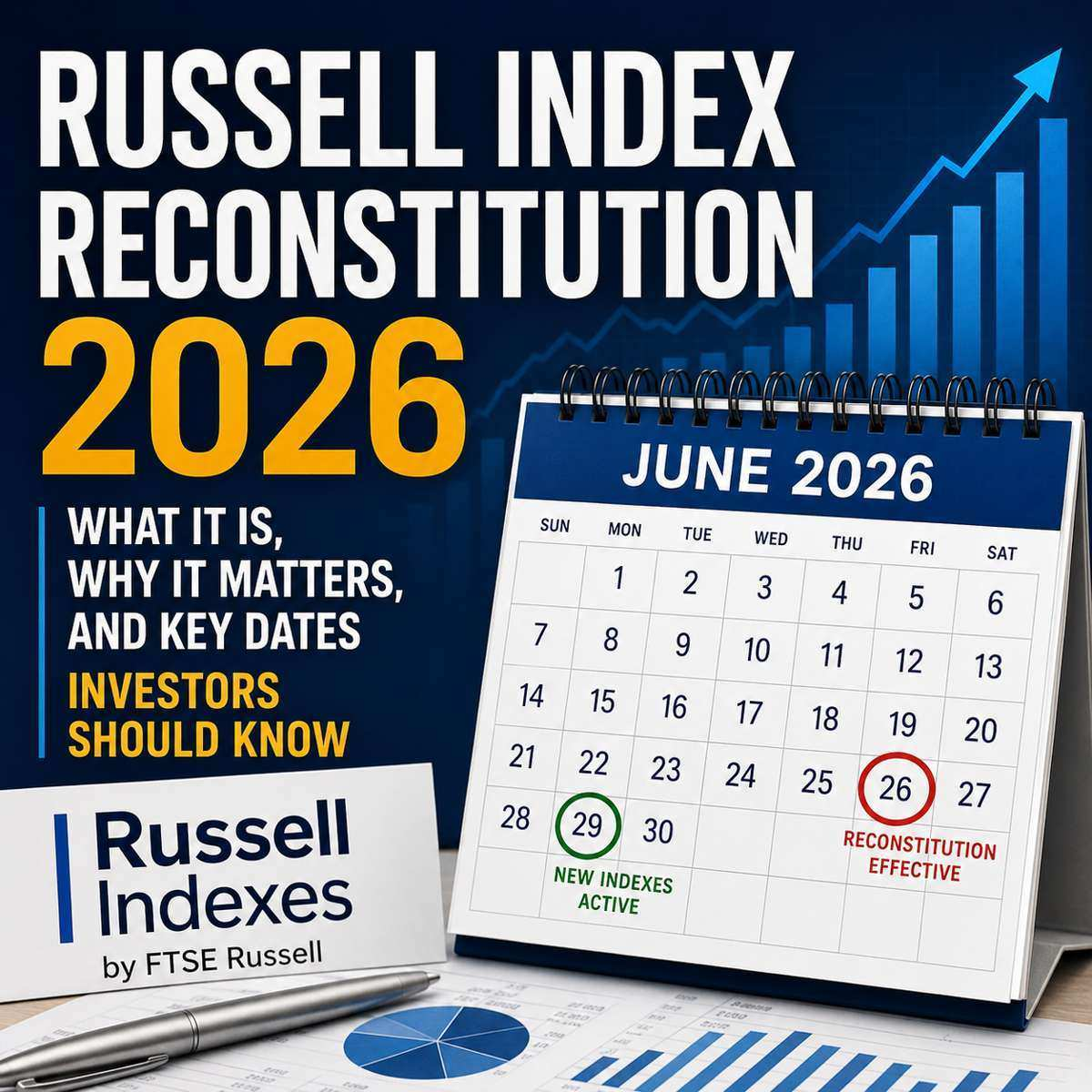
Russell Index Reconstitution
Every June, one of the largest events in the U.S. stock market takes place, yet many individual investors have never heard of it.
The Russell Index Reconstitution affects thousands of publicly traded companies and influences trillions of dollars managed by mutual funds, exchange-traded funds (ETFs), pension funds, and institutional investors. For a brief period each year, billions of dollars may flow into or out of specific stocks simply because their index membership or weighting changes.
If you’ve ever wondered why a stock suddenly experiences unusually high trading volume or a sharp move without any major company news, Russell Reconstitution may be part of the explanation.
In this guide, we’ll explain what Russell Reconstitution is, review the important 2026 dates, and discuss why investors should pay attention to this annual market event.
A Major Change: Russell Is Returning to Semi-Annual Reconstitution
For many years, Russell indexes underwent a comprehensive reconstitution once each year, typically in June.
Beginning in 2026, FTSE Russell is returning to a semi-annual reconstitution model. In addition to the traditional June reconstitution, a second reconstitution will occur in December.
The goal is to help Russell indexes more accurately reflect changes occurring throughout the market.
In recent years, the pace of change in the equity markets has accelerated due to:
- Initial public offerings (IPOs)
- Rapidly growing companies
- Corporate mergers and acquisitions
- Significant shifts in market capitalization
- Changes in sector leadership
Under an annual system, companies that experienced substantial growth or decline could remain in an index classification that no longer accurately reflected their size for many months.
By updating index membership twice per year, FTSE Russell aims to improve index accuracy and reduce the lag between market changes and index representation.
What This Means for Investors
The move to semi-annual reconstitution may create additional periods of index-related trading activity each year.
Instead of one major reconstitution event, investors will now have:
| Reconstitution Period | Typical Timing |
|---|---|
| Mid-Year Reconstitution | June |
| Year-End Reconstitution | December |
As a result, investors may see:
- More frequent index membership updates
- Additional buying and selling by index funds
- Increased attention on market capitalization changes
- More opportunities for companies to move between indexes
For long-term investors, the change is unlikely to alter an investment strategy. However, understanding the new schedule can help explain unusual trading activity that may occur not only in June but also near year-end.
Why the Change Matters
The return to semi-annual reconstitution reflects the growing importance of passive investing and the increasing speed at which companies can rise or fall in market value.
As trillions of dollars continue to track benchmark indexes, maintaining accurate index composition has become increasingly important for fund managers, institutional investors, and the millions of individuals who invest through index funds and ETFs.
For investors, it means Russell Reconstitution is no longer just a June event. Beginning in 2026, December will become another important period to watch on the market calendar.
Russell Reconstitution 2026 Key Dates
| Date | Event | Why It Matters |
|---|---|---|
| April 30, 2026 | Rank Day | Determines company rankings by market capitalization |
| May 22, 2026 | First Preliminary List | Investors get first look at additions and deletions |
| May 29, 2026 | Updated Preliminary List | Additional index updates released |
| June 5, 2026 | Updated Preliminary List | Further refinements announced |
| June 12, 2026 | Updated Preliminary List | Market participants adjust expectations |
| June 18, 2026 | Final Preliminary List | Near-final membership changes announced |
| June 26, 2026 | Mid-Year Reconstitution Effective | Major trading activity and closing auction volume |
| June 29, 2026 | New Mid-Year Indexes Active | Updated indexes take effect |
| December 11, 2026 | Year-End Reconstitution Effective | Second major index update of the year |
| December 14, 2026 | New Year-End Indexes Active | December index changes take effect |
Note: Beginning in 2026, FTSE Russell is returning to a semi-annual reconstitution schedule. Investors should expect major index updates in both June and December.
What Is Russell Reconstitution?
Russell Reconstitution is the process used to update the Russell family of stock market indexes so they continue to accurately represent the U.S. equity market.
The indexes are maintained by FTSE Russell and serve as benchmarks for many investment funds and portfolio managers.
Some of the most widely followed Russell indexes include:
- Russell 1000 Index (large-cap U.S. companies)
- Russell 2000 Index (small-cap U.S. companies)
- Russell 3000 Index (broad U.S. market benchmark)
- Russell Growth Indexes
- Russell Value Indexes
These indexes are not static. Companies grow, shrink, merge, go private, or conduct initial public offerings (IPOs). Over time, changes in market capitalization can cause a company to move between indexes or receive a larger or smaller weighting.
The reconstitution process updates index membership to reflect these changes.
For example, a rapidly growing small-cap company may become large enough to move from the Russell 2000 into the Russell 1000. Conversely, a company experiencing significant declines may move down in size classification or be removed altogether.
While these changes may seem minor, they can have a meaningful impact because so many investment products track Russell indexes.
Table 2: Major Russell Indexes Explained
| Index | Focus | Approximate Companies |
|---|---|---|
| Russell 1000 | Large-cap U.S. stocks | 1,000 |
| Russell 2000 | Small-cap U.S. stocks | 2,000 |
| Russell 3000 | Broad U.S. stock market | 3,000 |
| Russell Growth | Growth-oriented stocks | Varies |
| Russell Value | Value-oriented stocks | Varies |
Understanding the differences between these indexes helps investors better interpret reconstitution announcements and understand why certain stocks may experience increased trading activity. A company moving between Russell indexes can trigger buying or selling by funds that track those benchmarks, even if the company’s underlying business has not changed.
Why Russell Reconstitution Matters
To understand why investors pay attention to Russell Reconstitution, it helps to understand how index funds operate.
An index fund is designed to replicate the performance of a specific benchmark. If a company is added to an index, funds tracking that index generally need to purchase shares. If a company is removed, those same funds may need to sell shares.
This process creates real buying and selling activity that is not necessarily related to a company’s earnings, products, management team, or long-term prospects.
Instead, the trading occurs because fund managers are required to match the composition of the benchmark they track.
As a result, Russell Reconstitution can lead to:
- Significant increases in trading volume
- Short-term stock price volatility
- Temporary supply and demand imbalances
- Changes in institutional ownership
- Increased attention from analysts and investors
For most long-term investors, these effects are temporary. However, understanding the process can help explain unusual market behavior that may otherwise seem disconnected from company fundamentals.
How Much Money Tracks Russell Indexes?
One reason Russell Reconstitution attracts so much attention is the sheer amount of money linked to these benchmarks.
According to FTSE Russell, trillions of dollars in assets are benchmarked against Russell indexes. Many institutional investors use Russell indexes as performance benchmarks, while numerous mutual funds and ETFs directly track them.
When a benchmark influences trillions of dollars in assets, even relatively small changes can result in substantial trading activity.
This is why Wall Street firms, hedge funds, quantitative traders, and portfolio managers closely monitor reconstitution announcements throughout the spring.
The largest trading activity often occurs during the final stages of the reconstitution process when funds begin adjusting their holdings to reflect the upcoming index changes.
Russell Reconstitution 2026 Key Dates
While Russell Reconstitution is a months-long process, several dates are particularly important for investors.
April 30, 2026: Rank Day
Rank Day serves as the foundation for the reconstitution process.
On this date, companies are ranked based on their market capitalization. These rankings help determine which stocks qualify for various Russell indexes and how much weight they will receive.
In many ways, Rank Day acts as the snapshot that drives the rest of the reconstitution process.
May 22, 2026: First Preliminary Membership List
FTSE Russell releases the first preliminary list of index additions and deletions.
This is often the first opportunity for investors to identify companies that may experience increased buying or selling pressure due to index changes.
The release of preliminary lists frequently attracts attention from institutional investors, quantitative traders, and hedge funds seeking to position themselves ahead of the final reconstitution.
Additional Preliminary Updates
Updated preliminary membership lists are scheduled for:
- May 29, 2026
- June 5, 2026
- June 12, 2026
- June 18, 2026
Each update provides additional clarity regarding the likely composition of the indexes and allows market participants to refine their expectations before the final reconstitution takes effect.
June 26, 2026: Mid-Year Reconstitution
After the market closes on June 26, the newly reconstituted Russell indexes become effective.
To align their portfolios with the updated index membership and weightings, many index funds and institutional investors execute trades during the closing auction.
As a result, reconstitution day is often one of the highest-volume trading days of the year.
Investors may see:
- Unusually large trading volumes
- Sharp price swings near the close
- Significant buying and selling pressure in specific stocks
- Increased volatility in companies undergoing index changes
It is important to remember that these price movements are often driven by index-related trading activity rather than changes in a company’s underlying business performance.
June 29, 2026: Mid-Year Indexes Go Live
On the first trading day following the June reconstitution, the updated Russell indexes officially become the benchmarks used by index-tracking funds.
At this point, most of the required rebalancing has already occurred, although some additional adjustments may continue in the following days.
December 11, 2026: Year-End Reconstitution
For the first time in several years, investors will also experience a second major Russell reconstitution event during December.
Like the June event, index funds and institutional investors may need to buy and sell shares to align with the updated index composition.
While the December reconstitution may receive less media attention than the June event, it can still create meaningful trading activity in affected stocks.
December 14, 2026: Year-End Indexes Go Live
The updated year-end Russell indexes become effective at the market open following the December reconstitution.
Together, the June and December events now form the foundation of Russell’s semi-annual index maintenance process.
For investors, this means that unusual trading volume and index-related volatility are no longer confined to late June. Beginning in 2026, December becomes another important period to monitor for potential index-driven market activity.
When Does the Buying and Selling Actually Begin?
One of the most common misconceptions about Russell Reconstitution is that all buying and selling occurs on reconstitution day.
In reality, the process often begins weeks earlier.
Phase 1: Market Participants Analyze Preliminary Lists
Once preliminary membership lists are released, investors begin estimating which companies may see increased demand and which may face selling pressure.
Institutional investors, hedge funds, and quantitative trading firms often analyze:
- Potential additions
- Potential deletions
- Changes in index weightings
- Expected fund flows
Because the market is forward-looking, some of the anticipated effects may occur before the actual reconstitution date.
Phase 2: Portfolio Managers Prepare
As the final membership lists become clearer, portfolio managers begin preparing for implementation.
Some managers gradually adjust positions before reconstitution day to reduce trading costs and minimize execution risk.
Others wait until the final trading session to ensure they closely track the official benchmark.
Phase 3: Closing Auction Activity
The largest concentration of trading typically occurs during the closing auction on reconstitution day.
This allows index funds to match the closing prices used in benchmark calculations and helps minimize tracking error.
The result can be extraordinary trading volume in a very short period of time.
For investors unfamiliar with the process, these volume spikes can appear unusual or even alarming. However, they are often a normal part of the annual index rebalancing process.
How Russell Reconstitution Can Affect Individual Stocks
The impact of Russell Reconstitution varies depending on the specific company and the nature of the index changes.
Stocks Added to an Index
When a company is added to a Russell index, funds tracking that index may need to purchase shares.
Potential effects include:
- Increased institutional ownership
- Higher trading volume
- Greater visibility among investors
- Temporary buying pressure
While inclusion can create short-term demand, investors should remember that index membership alone does not guarantee long-term stock performance.
Stocks Receiving Larger Weightings
A company may already be included in an index but receive a larger weighting due to changes in market capitalization.
In these situations, index funds may need to increase their holdings.
The impact is often smaller than a new addition but can still influence trading activity.
Stocks Removed from an Index
Companies removed from an index may experience selling pressure as funds reduce or eliminate their positions.
Potential effects include:
- Increased volatility
- Temporary downward pressure
- Reduced institutional ownership
- Lower index fund demand
Again, these effects are often short-term and may not reflect the company’s long-term prospects.
Table 3: How Reconstitution May Affect Stocks
| Index Change | Potential Impact |
|---|---|
| Added to Index | Increased institutional demand |
| Larger Weighting | Additional index fund buying |
| Smaller Weighting | Reduced demand from index funds |
| Removed from Index | Potential selling pressure |
| No Change | Minimal direct impact |
What Russell Reconstitution Does Not Tell You
One mistake investors sometimes make is assuming that index changes represent an endorsement or criticism of a company.
Russell Reconstitution is largely a rules-based process.
A company may be added, removed, or reweighted simply because its market capitalization changed relative to other companies.
The process does not evaluate:
- Product quality
- Management effectiveness
- Earnings growth
- Competitive advantages
- Long-term investment potential
As a result, investors should be careful not to confuse index-related trading activity with changes in business fundamentals.
What Long-Term Investors Should Focus On
For long-term investors, Russell Reconstitution is primarily a market structure event rather than an investment thesis.
While it can create temporary opportunities and explain unusual price movements, long-term returns are generally driven by factors such as:
- Revenue growth
- Profitability
- Cash flow generation
- Competitive positioning
- Management execution
- Industry trends
A stock may rise because of index-related demand, but sustained performance typically depends on the company’s ability to execute its business strategy.
This distinction is important because many investors are tempted to chase short-term moves that occur around reconstitution dates.
Understanding the event can help investors remain focused on fundamentals while avoiding emotional reactions to temporary market activity.
Table 4: What Investors Should Do
| Investor Type | Suggested Approach |
|---|---|
| Long-Term Investor | Focus on fundamentals |
| ETF Investor | Understand benchmark changes |
| Active Trader | Monitor volume and volatility |
| Dividend Investor | Ignore short-term index noise |
| New Investor | Learn how market structure works |
Example Scenario: How Russell Reconstitution Can Affect a Stock
Suppose a company has a market capitalization of $20 billion and has grown significantly over the past year.
As a result, the company receives a larger weighting within a Russell index during the reconstitution process.
Because many ETFs, mutual funds, and institutional portfolios track Russell indexes, fund managers may need to purchase additional shares to match the company’s new weighting.
The company’s business may not have changed at all that week.
There may be:
- No earnings announcement
- No major product launch
- No analyst upgrade
- No significant company news
Yet investors could still observe:
| What Investors May Notice | Possible Explanation |
|---|---|
| Higher-than-normal trading volume | Index funds and institutional investors are rebalancing |
| A sharp price move near the market close | Large trades are occurring during the closing auction |
| Increased volatility | Buyers and sellers are adjusting positions simultaneously |
| More media coverage | Financial media often highlights stocks affected by reconstitution |
| Changes in institutional ownership over time | Funds update portfolios to reflect the new index composition |
For example, an investor may log into their brokerage account and see a stock trading two or three times its normal daily volume without any obvious company news.
Rather than assuming something fundamental has changed, it may simply be the result of index-related buying and selling.
This illustrates an important lesson for investors: not all stock price movements are driven by earnings reports, economic data, or company announcements.
Sometimes market structure events, such as Russell Reconstitution, create temporary supply-and-demand imbalances that influence stock prices even when the underlying business remains unchanged.
For long-term investors, understanding this distinction can help avoid emotional reactions to short-term market movements and keep the focus on the company’s fundamentals.
Frequently Asked Questions
What is Russell Reconstitution?
Russell Reconstitution is the annual process of updating Russell indexes to reflect changes in the U.S. stock market, including company size, market capitalization, and eligibility.
Why do stocks move during Russell Reconstitution?
Stocks may move because index funds and institutional investors buy or sell shares to align their portfolios with the updated index composition.
Does being added to a Russell index guarantee a stock will rise?
No. While index inclusion may create temporary buying pressure, long-term stock performance is still determined by business fundamentals.
When is Russell Reconstitution in 2026?
The reconstitution becomes effective after the market close on June 26, 2026, with the updated indexes taking effect on June 29, 2026.
Why is trading volume so high on reconstitution day?
Many index funds execute trades during the closing auction to minimize tracking error and accurately match the benchmark.
Back to Stock Market Investing and Portfolio Management
Final Thoughts
Russell Reconstitution is one of the largest and most influential market events that many individual investors have never heard of.
Each year, trillions of dollars benchmarked to Russell indexes help drive significant buying and selling activity as funds update their holdings to reflect changes in index membership and weighting. These adjustments can create unusual trading volume, short-term volatility, and sudden stock price movements that may appear disconnected from company news.
Beginning in 2026, investors will need to pay attention to two major Russell reconstitution events each year. With both June and December now serving as reconstitution periods, index-related trading activity may become a more frequent part of the market landscape.
For long-term investors, the most important takeaway is that Russell Reconstitution is a market structure event, not an investment thesis.
A company is not necessarily a better investment because it was added to an index, nor is it necessarily a worse investment because it was removed. Index membership changes are largely driven by rules and market capitalization, while long-term investment success continues to depend on factors such as revenue growth, profitability, cash flow, competitive advantages, and management execution.
Understanding how Russell Reconstitution works can help investors make sense of unusual market activity, avoid reacting to short-term noise, and stay focused on what truly drives long-term returns.
The next time you see a stock experiencing massive trading volume or an unexpected price move near a reconstitution date, you’ll know there may be more at work than headlines and earnings reports. Sometimes the explanation is simply that the market’s indexes are being updated—and billions of dollars are moving with them.
