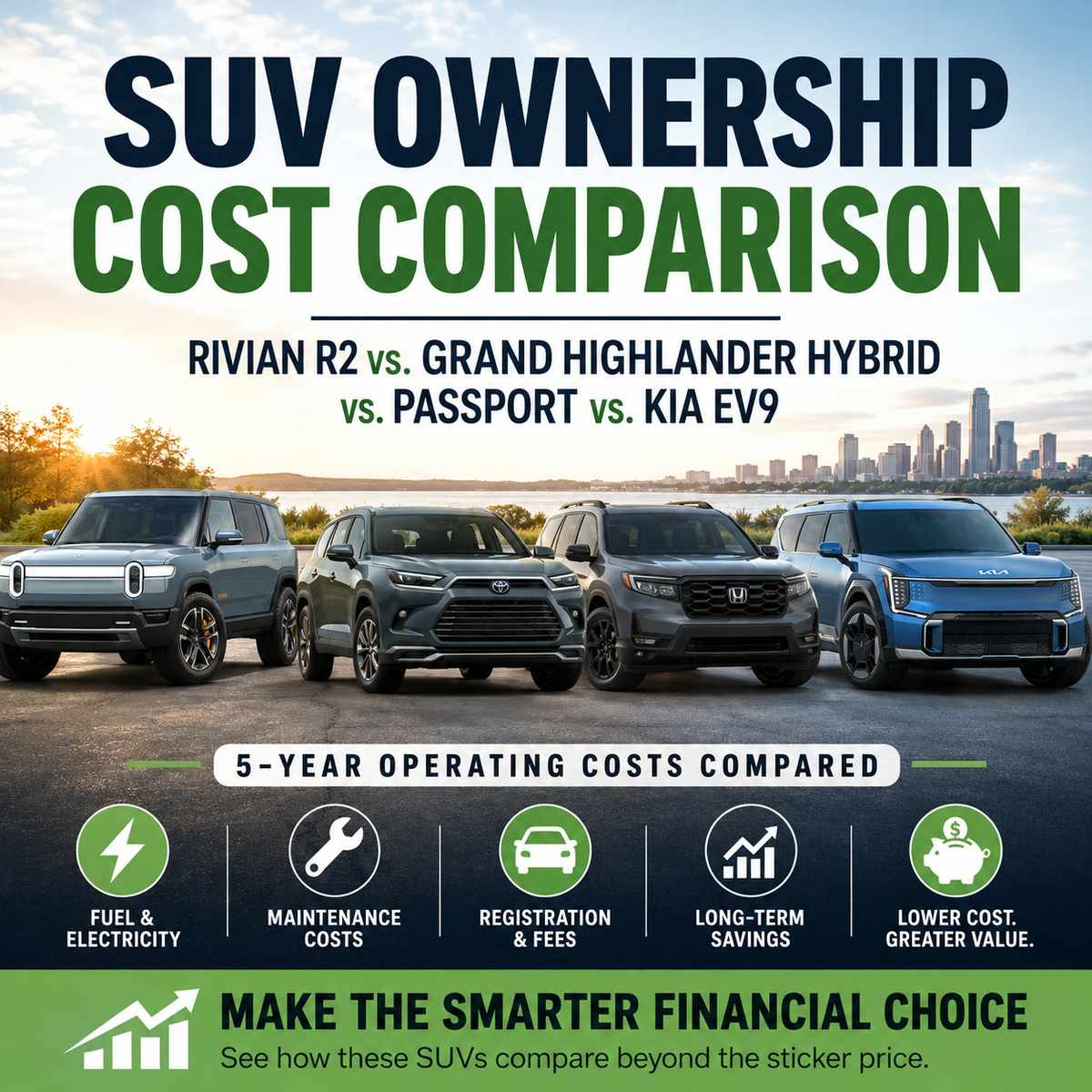
Key Takeaways
- The sticker price doesn’t tell the whole story. Fuel, maintenance, registration fees, insurance, financing, and long-term ownership costs can significantly affect what you’ll actually spend on an SUV.
- Electric SUVs can reduce ongoing operating costs. Based on the assumptions used in this comparison, the Rivian R2 has the lowest estimated fuel and routine maintenance expenses over five years among the SUVs evaluated.
- Fuel prices matter. As gasoline prices increase, the operating-cost advantage of electric vehicles generally grows, while gasoline-powered SUVs become more expensive to drive.
- Think beyond the first five years. Many families keep their vehicles for 10 years or longer. Lower fuel and maintenance costs can continue generating savings long after the vehicle is paid off.
- Choose the SUV that fits your lifestyle—not just your budget. Passenger capacity, cargo space, technology, charging availability, driving habits, and long-term ownership goals are all important factors when comparing today’s electric, hybrid, and gasoline-powered SUVs.
A $45,000 SUV may not actually cost $45,000 to own. Here’s what fuel, maintenance, insurance, depreciation, and resale value can add to the real cost.
Introduction
When shopping for a new SUV, most buyers naturally focus on the sticker price. It’s easy to compare two vehicles with similar MSRPs and assume they’ll cost roughly the same to own.
In reality, the purchase price is only the beginning.
The true cost of owning a vehicle extends far beyond the monthly payment or the amount listed on the window sticker. Fuel or electricity, maintenance, insurance, registration fees, financing costs, depreciation, and resale value all contribute to what you’ll actually spend over the life of the vehicle.
For many families, these ongoing expenses can add tens of thousands of dollars to the overall cost of ownership.
As more affordable electric SUVs enter the market—including the highly anticipated Rivian R2—buyers are asking an important question:
Can an electric SUV actually save money compared to a similarly priced gas or hybrid SUV?
The answer depends on much more than the price of gasoline.
Driving habits, local electricity rates, maintenance requirements, insurance premiums, financing terms, and long-term resale value all play an important role in determining which vehicle is the better financial decision.
In this article, we’ll compare the estimated five-year ownership costs of several popular SUVs expected to compete in the $45,000 to $65,000 price range. Rather than focusing solely on purchase price, we’ll examine the expenses that matter most to your household budget and explore how electric, hybrid, and gasoline-powered SUVs compare over time.
Whether you’re considering a Rivian R2, a hybrid family SUV, or a traditional gasoline model, understanding the full cost of ownership can help you make a more informed—and potentially more affordable—decision.
Why Purchase Price Doesn’t Tell the Whole Story
One of the biggest mistakes vehicle shoppers make is assuming that two SUVs with similar purchase prices will cost roughly the same to own.
In reality, the purchase price represents only one component of a vehicle’s total ownership cost.
Over the course of five years, owners will typically pay for:
- Vehicle purchase price
- Sales tax
- Registration and licensing fees
- Fuel or electricity
- Routine maintenance
- Tires and replacements
- Insurance premiums
- Financing costs (if applicable)
- Depreciation and resale value
Some of these expenses are predictable, while others vary depending on where you live, how much you drive, and the type of vehicle you purchase. However, when combined, they often exceed what many buyers expect.
For example, a $50,000 SUV may ultimately cost its owner $75,000 to $90,000 over five years once operating expenses, financing, depreciation, insurance, and maintenance are included.
That doesn’t necessarily mean the vehicle was a poor purchase. Instead, it illustrates why looking beyond the sticker price is essential when comparing different models.
Electric vehicles often have higher upfront prices than comparable gasoline vehicles, but they can offset some of that difference through lower fuel and maintenance costs. Conversely, gasoline or hybrid SUVs may have lower purchase prices in some cases but higher operating costs over time.
The goal of this comparison isn’t to declare a single “winner.” Instead, it’s to help you understand the complete financial picture so you can choose the SUV that best fits your family’s budget, driving habits, and long-term ownership plans.
Vehicles Included in This Comparison
To provide a meaningful comparison, we selected popular family SUVs that are expected to compete in the $45,000 to $55,000 price range during the 2027 model year. While these vehicles use different powertrains—including gasoline, hybrid, and fully electric—they appeal to many of the same buyers looking for a comfortable, versatile, and family-friendly SUV.
Rather than comparing the Rivian R2 to luxury SUVs costing significantly more, this analysis focuses on vehicles that many households are likely to cross-shop based on price, size, features, and intended use.
| Vehicle | Estimated MSRP | Powertrain | Seating Capacity |
|---|---|---|---|
| Rivian R2 | $45,000–$55,000 | Battery Electric (EV) | 5 |
| Toyota Grand Highlander Hybrid | $46,000–$55,000 | Hybrid | 7–8 |
| Honda Passport | $46,000–$54,000 | Gasoline | 5 |
| Hyundai Santa Fe Hybrid | $42,000–$50,000 | Hybrid | 7 |
| Kia EV9 | $48,000–$56,000 | Battery Electric (EV) | 6–7 |
Each SUV offers a different blend of practicality, technology, efficiency, and performance.
Rivian R2
The Rivian R2 is expected to become one of the most anticipated electric SUVs in its price range. With an estimated starting price around $45,000, it combines long-range electric driving, advanced software, over-the-air updates, and adventure-focused utility into a midsize package designed for everyday family use.
Toyota Grand Highlander Hybrid
The Grand Highlander Hybrid is one of the most practical family SUVs available, offering three rows of seating, impressive fuel economy, and Toyota’s long-standing reputation for reliability. It appeals to buyers who need additional passenger space without making the switch to a fully electric vehicle.
Honda Passport
The Honda Passport represents the traditional midsize gasoline SUV. It offers generous cargo space, standard all-wheel drive on many trims, proven reliability, and familiar ownership for buyers who prefer internal combustion engines.
Hyundai Santa Fe Hybrid
The redesigned Santa Fe Hybrid offers a modern interior, available three-row seating, and excellent fuel economy. It serves as an attractive option for families seeking lower fuel costs without changing their driving habits or relying on public charging infrastructure.
Kia EV9
The Kia EV9 is one of the few fully electric three-row SUVs currently available. Although slightly larger than the Rivian R2, it represents one of the closest electric alternatives for families considering an EV in this general price range.
Why These Vehicles Were Selected
Every family has different priorities, but most SUV buyers are looking for a combination of:
- Comfortable seating for five to eight passengers
- Cargo space for daily life and road trips
- Modern safety technology
- Good fuel economy or driving range
- Reasonable long-term ownership costs
- Strong resale value
- Pricing within a similar budget
These five vehicles represent a diverse mix of traditional gasoline, hybrid, and electric powertrains while remaining close enough in price that many buyers may realistically compare them during the shopping process.
Assumptions Used in Our Comparison
Every cost-of-ownership analysis depends on assumptions. Fuel prices change, electricity rates vary by region, insurance premiums differ between drivers, and individual driving habits can significantly affect operating costs.
To make the comparison as fair and transparent as possible, the following assumptions are used throughout this article.
| Assumption | Value |
| Annual driving distance | 12,000 miles |
| Total ownership period | 5 years |
| Total miles driven | 60,000 miles |
| Average gasoline price | $4.00 per gallon |
| Average residential electricity price | $0.16 per kWh |
| Home charging | 90% of charging sessions |
| Public fast charging | 10% of charging sessions |
| Vehicle ownership period | Five years |
| Driving mix | Combined city and highway |
These assumptions are intended to reflect a typical American household rather than maximize savings for any one vehicle.
For example, drivers who travel 20,000 miles each year may realize substantially greater fuel savings from an electric vehicle, while households that drive fewer than 8,000 miles annually may see a smaller financial difference between gasoline, hybrid, and electric SUVs.
Similarly, electricity rates vary widely across the United States. Charging primarily at home in areas with low electricity costs can significantly reduce an EV’s operating expenses, while relying heavily on public fast chargers may increase overall energy costs.
Because no single set of assumptions perfectly represents every driver, the calculations in this article should be viewed as reasonable estimates rather than precise predictions. Your actual ownership costs will depend on where you live, how much you drive, local fuel and electricity prices, financing terms, insurance premiums, maintenance needs, and future resale values.
By clearly stating these assumptions upfront, readers can better understand how the estimates were developed and adjust the numbers to fit their own circumstances if needed.
Fuel and Electricity Costs
One of the largest ongoing expenses of owning any vehicle is the cost of keeping it moving. Whether you fill up at the gas station or charge at home, energy costs add up over thousands of miles.
Electric vehicles generally cost less to operate per mile than gasoline-powered SUVs, while hybrids often fall somewhere in between. However, the exact savings depend on local fuel prices, electricity rates, annual mileage, driving style, and weather conditions.
For this comparison, we’ll use the assumptions established earlier in the article:
- 12,000 miles driven per year
- 60,000 miles over five years
- Gasoline price: $4.00 per gallon
- Residential electricity: $0.16 per kWh
- 90% home charging
- 10% public charging
Gasoline SUVs
Traditional gasoline SUVs are familiar and convenient, but fuel is one of their largest operating expenses.
Using the Honda Passport as an example:
Estimated Fuel Economy: 23 mpg
Calculation
60,000 miles ÷ 23 mpg = 2,609 gallons
2,609 × $4.00 = $10,436
Estimated five-year fuel cost:
≈ $10,400
Hybrid SUVs
Hybrid SUVs reduce fuel consumption by combining a gasoline engine with an electric motor.
Using a combined fuel economy of approximately 35 mpg:
60,000 ÷ 35 = 1,714 gallons
1,714 × $4.00 = $6,856
Estimated five-year fuel cost:
≈ $6,900
Hybrids offer significant fuel savings without requiring home charging or changes to driving habits.
Electric SUVs
Electric SUVs eliminate gasoline purchases entirely but replace them with electricity costs.
Assuming the Rivian R2 averages approximately 3.4 miles per kWh:
60,000 ÷ 3.4 = 17,647 kWh
17,647 × $0.16 = $2,824
Estimated five-year charging cost:
≈ $2,800
Drivers with lower electricity rates or access to workplace charging or rooftop solar may spend even less.
Estimated Five-Year Energy Costs
| Vehicle Type | Estimated Five-Year Cost |
|---|---|
| Electric SUV | $2,800 |
| Hybrid SUV | $6,900 |
| Gasoline SUV | $10,400 |
An electric SUV could save approximately $7,600 in energy costs compared to a similarly sized gasoline SUV over five years under these assumptions.
Average Annual Energy Cost
| Vehicle Type | Annual Cost |
| Electric SUV | $565 |
| Hybrid SUV | $1,370 |
| Gasoline SUV | $2,090 |
These savings become even larger for households that drive well above the national average.
Estimated Energy Cost Per Mile
| Vehicle Type | Cost Per Mile |
| Electric SUV | 4.7¢ |
| Hybrid SUV | 11.4¢ |
| Gasoline SUV | 17.4¢ |
While fuel prices fluctuate over time, electric vehicles have generally maintained a lower cost per mile than gasoline-powered vehicles when primarily charged at home.
Maintenance Costs
Routine maintenance is another major factor influencing long-term ownership costs.
Gasoline engines contain hundreds of moving components that require periodic servicing. Electric vehicles have far fewer mechanical parts, reducing many routine maintenance requirements.
That doesn’t mean electric vehicles are maintenance-free—they still require tire rotations, brake fluid service, cabin air filters, suspension inspections, and cooling system maintenance—but many common engine-related services simply disappear.
Oil Changes
Gasoline and hybrid vehicles require periodic engine oil and filter changes.
Electric vehicles require:
None
Transmission Service
Gasoline vehicles use complex multi-speed automatic transmissions that require maintenance.
Hybrid vehicles also contain transmission components, although often with different designs.
Most battery-electric vehicles use a simple single-speed reduction gear requiring minimal routine service.
Engine Air Filters
Gasoline engines require intake air filters to protect the engine.
Electric vehicles have no engine air intake system and therefore eliminate this maintenance item.
Spark Plugs
Internal combustion engines require spark plugs that wear over time.
Electric vehicles have no spark plugs, ignition coils, or engine timing systems.
Brake Wear
One advantage of electric vehicles is regenerative braking.
Instead of relying solely on friction brakes, the electric motor helps slow the vehicle while returning energy to the battery.
Benefits include:
- Reduced brake pad wear
- Longer brake rotor life
- Lower brake maintenance costs
Many EV owners report significantly longer brake service intervals than owners of comparable gasoline vehicles.
Coolant Systems
Although EVs do not have engines, they still use liquid cooling systems to regulate battery and power electronics temperatures.
These systems generally require less maintenance than traditional engine cooling systems but still need periodic inspection.
Software Updates
Modern electric vehicles increasingly receive over-the-air software updates.
These updates may improve:
- Navigation
- Battery management
- Charging performance
- Driver assistance features
- Vehicle efficiency
- User interface improvements
Unlike many traditional vehicles, software improvements can continue throughout ownership without requiring a dealership visit.
Estimated Five-Year Routine Maintenance
| Maintenance Item | Electric SUV | Hybrid SUV | Gasoline SUV |
| Oil Changes | $0 | $700 | $900 |
| Transmission Service | Minimal | $300 | $500 |
| Engine Air Filters | $0 | $150 | $150 |
| Spark Plugs | $0 | $300 | $500 |
| Brake Service | $300 | $700 | $900 |
| Coolant & Fluids | $250 | $400 | $500 |
| Cabin Air Filters | $200 | $200 | $200 |
| Tire Rotations & Inspections | $450 | $450 | $450 |
| Miscellaneous Maintenance | $300 | $500 | $600 |
| Estimated Total | ≈ $1,500 | ≈ $3,700 | ≈ $4,700 |
Actual maintenance costs will vary by manufacturer, dealership labor rates, driving conditions, and owner maintenance schedules.
Maintenance Comparison
| Maintenance Item | Gas | Hybrid | EV |
|---|---|---|---|
| Oil Changes | ✓ | ✓ | — |
| Spark Plugs | ✓ | ✓ | — |
| Engine Air Filter | ✓ | ✓ | — |
| Transmission Service | ✓ | Some | — |
| Brake Fluid | ✓ | ✓ | ✓ |
| Tire Rotation | ✓ | ✓ | ✓ |
| Cabin Filter | ✓ | ✓ | ✓ |
| Software Updates | Limited | Limited | Extensive OTA |
Insurance Considerations
Insurance is often one of the least predictable ownership expenses.
Unlike fuel costs, which are largely determined by mileage and energy prices, insurance premiums depend on a wide range of personal and regional factors.
As a result, two owners purchasing the exact same SUV may receive dramatically different insurance quotes.
Repair Costs
Electric vehicles often contain advanced electronics, large battery packs, and specialized body structures.
While EVs generally require less routine maintenance, collision repairs can sometimes be more expensive due to specialized parts and repair procedures.
Fortunately, repair costs continue to improve as manufacturers expand service networks and independent repair shops gain experience with electric vehicles.
Driver Assistance Technology
Many newer SUVs include advanced safety systems such as:
- Automatic emergency braking
- Adaptive cruise control
- Blind-spot monitoring
- Lane-keeping assistance
- Surround-view cameras
These systems can reduce accident frequency, potentially lowering insurance claims over time.
However, sensors and cameras integrated into bumpers and windshields can increase repair costs following even relatively minor collisions.
Regional Differences
Insurance premiums vary substantially depending on where you live.
Factors include:
- Population density
- Weather
- Theft rates
- Accident frequency
- Medical costs
- State insurance regulations
- Repair labor rates
A driver in a rural community may pay significantly less than someone living in a large metropolitan area—even for the same vehicle.
Replacement Parts
New vehicle models sometimes experience higher repair costs during their first few years while replacement parts become more widely available.
As production volumes increase and repair networks expand, parts availability and repair costs often improve.
Driver History
Perhaps the single largest factor affecting insurance premiums is the driver rather than the vehicle.
Insurance companies typically consider:
- Driving record
- Prior claims
- Annual mileage
- Age
- Credit-based insurance score (where permitted)
- Location
- Vehicle usage
- Multi-policy discounts
Because these factors vary widely between households, insurance is much harder to estimate accurately than fuel or maintenance costs.
Why Insurance Costs Are More Difficult to Predict
Fuel costs can be estimated using relatively simple assumptions about annual mileage and energy prices.
Insurance, on the other hand, depends on dozens of variables unique to each driver and household.
For that reason, the insurance discussion in this article is intended to highlight the factors that influence premiums rather than provide specific dollar estimates.
Before purchasing any new SUV—whether electric, hybrid, or gasoline-powered—it’s a good idea to request insurance quotes from multiple providers. A few minutes of comparison shopping can sometimes save hundreds of dollars per year, making insurance one of the easiest ownership costs to reduce.
Depreciation: The Largest Ownership Cost
When comparing vehicles, many buyers spend hours calculating fuel costs and debating the price of gasoline versus electricity. While those expenses certainly matter, they often overlook the single largest cost of owning a new vehicle:
Depreciation.
Depreciation is the difference between what you pay for a vehicle today and what it is worth when you sell or trade it in.
For most new vehicles, depreciation exceeds the cost of fuel, maintenance, registration, or routine repairs during the first five years of ownership.
An Example
Imagine purchasing a new SUV for $50,000.
If it’s worth $28,000 five years later, you’ve lost $22,000 in value.
Compare that with fuel costs:
- Gasoline SUV fuel over five years: ≈ $10,400
- Electric SUV charging over five years: ≈ $2,800
Even though the electric SUV saves approximately $7,600 in energy costs, depreciation still represents a much larger financial expense.
That doesn’t mean depreciation should discourage anyone from buying a new vehicle. Instead, it highlights why understanding resale value is just as important as comparing fuel economy.
What Influences Resale Value?
No one can predict future resale values with certainty, but several factors consistently influence how well vehicles retain their value.
Brand Reputation
Manufacturers known for reliability, durability, and customer satisfaction often enjoy stronger resale values.
Battery Health
For electric vehicles, battery longevity plays an increasingly important role.
As battery technology continues to improve and long-term durability data becomes available, consumer confidence in used EVs may continue to grow.
Consumer Demand
Vehicles with strong demand and limited supply typically depreciate more slowly than those with slower sales or heavy discounting.
Technology
Advanced driver assistance systems, modern infotainment, and over-the-air software updates may help vehicles remain competitive for longer periods.
Warranty Coverage
Remaining factory warranty can significantly increase the appeal of a used vehicle.
Long battery warranties offered by many EV manufacturers may provide additional peace of mind for second and third owners.
Overall Market Conditions
Interest rates, fuel prices, economic conditions, and changing consumer preferences all influence used vehicle values.
For example, periods of high gasoline prices have historically increased demand for more fuel-efficient vehicles.
Charging vs. Fueling
One of the biggest lifestyle differences between electric and gasoline vehicles isn’t performance—it’s how owners “refuel.”
Rather than visiting a gas station every week, many EV owners simply plug in their vehicle overnight and begin each morning with a full battery.
For many households, this changes the ownership experience more than expected.
Advantages of EV Charging
Charge Overnight
Home charging allows owners to begin each day with a nearly full battery without making a separate stop.
Lower Energy Costs
Electricity generally costs less per mile than gasoline, particularly when charging primarily at home.
Fewer Trips to the Gas Station
Many EV owners report going months without visiting a gas station.
Home Convenience
Charging while sleeping or working means the vehicle is often ready whenever needed.
Potential Drawbacks
While electric vehicles offer many conveniences, they may not be ideal for every household.
Apartment Living
Drivers without dedicated parking or home charging may rely more heavily on public charging stations.
Long-Distance Travel
Road trips require planning around charging locations and charging times.
Fortunately, charging infrastructure continues to expand across North America.
Cold Weather
Extremely cold temperatures can temporarily reduce driving range and increase energy consumption.
Public Charging Availability
Charging availability varies significantly by region, particularly in rural areas.
Prospective buyers should evaluate charging options near their home, workplace, and frequently traveled routes.
Technology Comparison
Today’s SUVs increasingly resemble smartphones on wheels.
Technology plays an important role in convenience, safety, entertainment, and even long-term ownership value.
Below are several areas where buyers may notice meaningful differences.
Driver Assistance
Modern SUVs may include:
- Adaptive cruise control
- Automatic emergency braking
- Lane-centering assistance
- Blind-spot monitoring
- Rear cross-traffic alert
- Parking assistance
Infotainment Systems
Large touchscreens, voice controls, streaming services, and connected navigation have become standard features across many new SUVs.
Vehicle Software
Electric vehicles often rely more heavily on software to manage battery performance, charging, navigation, and driver assistance systems.
Over-the-Air Updates
One of the biggest differences between many EVs and traditional vehicles is the ability to receive software improvements without visiting a dealership.
Updates may improve:
- Charging performance
- Navigation
- User interface
- Driver assistance
- Battery efficiency
- New vehicle features
Navigation
Many modern EV navigation systems automatically plan charging stops during long trips and estimate battery levels upon arrival.
Smartphone Integration
Most vehicles now support:
- Apple CarPlay
- Android Auto
- Bluetooth connectivity
- Wireless charging
- Mobile apps
Future Upgrades
As software becomes a larger part of vehicle ownership, manufacturers may continue adding features after purchase.
Family Practicality
Most families purchase an SUV because they need flexibility.
While specifications matter, everyday usability often determines long-term satisfaction.
Important considerations include:
Cargo Capacity
Can the vehicle comfortably carry luggage, groceries, camping gear, or home improvement supplies?
Interior Storage
Cupholders, center consoles, under-floor compartments, USB ports, and charging locations all contribute to daily convenience.
Second-Row Comfort
Families with growing children should consider legroom, headroom, and ease of entry.
Third-Row Seating
Some families require seating for six, seven, or even eight passengers.
Others may prefer additional cargo space instead.
Child Seats
Installing and removing child safety seats should be straightforward.
Rear door openings, LATCH anchors, and second-row space all make a difference.
Outdoor Recreation
Camping equipment, bicycles, kayaks, skis, and sports gear require different amounts of cargo space and roof capacity.
Pets
Families traveling with dogs may prioritize cargo space, flat load floors, and rear climate vents.
Road Trips
Comfortable seating, charging options, storage, navigation, and driver assistance technology become increasingly valuable during long-distance travel.
Long-Term Reliability
Reliability extends beyond routine maintenance.
Every powertrain eventually requires repairs as mileage increases.
Understanding what commonly wears over time can help buyers estimate future ownership costs.
Gasoline Vehicles (ICE)
Common wear items include:
- Water pumps
- Alternators
- Starter motors
- Fuel pumps
- Spark plugs
- Belts
- Hoses
- Exhaust components
- Automatic transmission repairs
Hybrid Vehicles
Hybrid vehicles generally share many components with gasoline vehicles while adding:
- High-voltage batteries
- Electric motors
- Power electronics
Although hybrids have demonstrated excellent long-term reliability, they still require maintenance for both gasoline and electric systems.
Battery-Electric Vehicles
Electric vehicles eliminate many traditional engine components but still contain:
- Electric motors
- Battery cooling systems
- Suspension components
- HVAC systems
- Power electronics
With fewer moving mechanical parts, many routine repairs associated with internal combustion engines simply disappear.
What Typically Happens Over Time?
Around 50,000 Miles
- Tire replacement
- Brake fluid service
- Cabin air filters
- Alignment checks
- Suspension inspections
Around 100,000 Miles
Gasoline vehicles may begin requiring:
- Spark plugs
- Water pumps
- Transmission servicing
- Cooling system repairs
Electric vehicles generally continue with fewer routine drivetrain maintenance items but may require coolant service and other scheduled inspections.
Around 150,000 Miles
At higher mileage, all vehicles may eventually require:
- Suspension components
- Wheel bearings
- HVAC repairs
- Steering components
Battery longevity continues to improve, and many manufacturers provide battery warranties extending eight years or longer.
Environmental Considerations
For many buyers, environmental impact is another important consideration.
Although environmental benefits vary depending on where electricity is generated, several factors are worth evaluating.
Fuel Consumption
Electric vehicles eliminate gasoline consumption during daily driving.
Tailpipe Emissions
Battery-electric vehicles produce no direct tailpipe emissions.
Electricity Generation
The environmental impact of EV charging depends partly on the local electrical grid.
Regions powered primarily by renewable energy generally produce lower lifecycle emissions than regions relying heavily on fossil fuels.
Battery Production
Manufacturing batteries requires energy and raw materials, contributing to the vehicle’s initial environmental footprint.
Researchers continue working to reduce these impacts through improved manufacturing processes and recycling technologies.
Recycling
Battery recycling technology continues to advance, allowing more materials to be recovered and reused in future battery production.
Long-Term Trends
As renewable electricity generation expands and battery technology improves, the environmental profile of electric vehicles is expected to continue evolving.
Five-Year Operating Cost Comparison
The following table compares the estimated ongoing costs of owning each SUV over five years. Rather than attempting to predict individualized expenses such as insurance premiums or future resale values, this comparison focuses on recurring ownership costs that are generally more predictable across most households.
Actual expenses will still vary based on where you live, how much you drive, local fuel and electricity prices, and vehicle maintenance needs. However, these estimates provide a useful illustration of how different powertrains can affect day-to-day ownership costs.
| Expense | Rivian R2 | Toyota Grand Highlander Hybrid | Honda Passport | Kia EV9 |
|---|---|---|---|---|
| Purchase Price | $50,000 | $50,000 | $50,000 | $52,000 |
| Fuel / Electricity | $2,800 | $6,900 | $10,400 | $3,100 |
| Routine Maintenance | $1,500 | $3,700 | $4,700 | $1,700 |
| Registration & Fees | $2,200 | $2,200 | $2,200 | $2,300 |
| Estimated Five-Year Ownership Cost (excluding insurance and depreciation) | ≈ $56,500 | ≈ $62,800 | ≈ $67,300 | ≈ $59,100 |
| Five-Year Savings of R2 vs. Passport | |
|---|---|
| Gas at $3/gallon | ~$5,000 |
| Gas at $4/gallon | ~$7,600 |
| Gas at $5/gallon | ~$10,200 |
| Gas at $6/gallon | ~$12,900 |
Why Aren’t Insurance and Depreciation Included?
Insurance premiums vary widely depending on factors such as:
- Driver age and experience
- Driving record
- ZIP code
- Annual mileage
- Coverage selections
- Deductibles
- Insurance company pricing
Similarly, future resale value depends on market conditions, consumer demand, mileage, vehicle condition, and numerous other factors that cannot be predicted with certainty several years in advance.
Rather than using broad estimates, this comparison focuses on ownership costs that are easier to estimate and compare across vehicles.
Takeaways
Several important trends emerge from this comparison:
- The Rivian R2 has the lowest estimated ongoing operating costs thanks to lower electricity expenses and reduced routine maintenance.
- Hybrid SUVs significantly reduce fuel costs compared with traditional gasoline SUVs while maintaining the convenience of conventional refueling.
- Gasoline SUVs continue to have the highest estimated fuel and routine maintenance costs over five years.
- Registration fees are relatively similar across all four vehicles and represent a much smaller portion of overall ownership costs.
For many households, ongoing operating expenses can differ by $10,000 or more over five years between similarly priced SUVs. Those savings may help offset a higher purchase price, reduce the overall cost of ownership, or simply leave more room in the family budget for other financial goals.
When comparing vehicles, don’t focus solely on the MSRP. Looking at fuel, maintenance, registration, and other recurring expenses provides a more complete picture of what it will actually cost to drive your next SUV for years to come.
Conclusion – Think Beyond the First Five Years
A five-year ownership comparison provides a valuable starting point for evaluating different SUVs, but for many families, it isn’t the end of the story.
According to vehicle ownership trends in the United States, many households now keep their vehicles for 10 years or longer. As vehicles become more expensive and reliability continues to improve, replacing a vehicle every few years is becoming less common.
That makes long-term operating costs increasingly important.
While the purchase price of a vehicle is paid only once, expenses such as fuel, routine maintenance, registration, and repairs continue year after year. Over a decade of ownership, even relatively small annual savings can add up to thousands of dollars.
For example, if an electric SUV saves approximately $1,500 to $2,000 per year in fuel and routine maintenance compared to a similarly priced gasoline SUV, those savings could exceed $15,000 to $20,000 over ten years—before considering potential increases in gasoline prices.
Long-term ownership may also allow buyers to benefit from several additional advantages:
- Lower lifetime fuel or electricity costs
- Reduced routine maintenance requirements
- Fewer engine- and transmission-related service needs
- Continued software improvements through over-the-air updates
- Greater value from spreading the initial purchase price over many years of use
Of course, no single SUV is the right choice for every household.
Some buyers need three rows of seating. Others prioritize towing capacity, off-road capability, advanced technology, or the convenience of rapid gasoline refueling.
The best vehicle is ultimately the one that matches your family’s transportation needs, driving habits, and financial goals.
Rather than focusing solely on the monthly payment or the sticker price, consider the entire ownership experience.
Ask yourself:
- How much will I spend on fuel over the next decade?
- How much routine maintenance should I expect?
- How long do I realistically plan to keep this vehicle?
- Which features will still matter to me five or ten years from now?
Answering those questions often provides a clearer picture than comparing MSRP alone.
As electric vehicles become more mainstream and charging infrastructure continues to expand, buyers have more choices than ever before. Whether you choose an electric, hybrid, or gasoline-powered SUV, taking the time to evaluate long-term operating costs—not just the purchase price—can help you make a more informed financial decision and potentially save thousands of dollars over the life of your next vehicle.
In personal finance, some of the best investments aren’t found in the stock market—they’re the everyday decisions that quietly reduce expenses year after year. Choosing a vehicle with lower long-term operating costs is one example of how a thoughtful purchase today can improve your financial picture for many years to come.
SUV Buying Checklist: Compare More Than Just the Sticker Price
Before purchasing your next SUV, use this checklist to compare the total ownership experience—not just the MSRP.
Budget & Financing
☐ Determine your maximum purchase budget.
☐ Estimate your monthly payment based on your down payment, loan amount, and interest rate.
☐ Compare financing offers from multiple lenders.
☐ Estimate sales tax, title, registration, and dealer fees.
Fuel & Energy Costs
☐ Estimate how many miles you drive each year.
☐ Compare annual fuel or electricity costs.
☐ Check current gasoline prices in your area.
☐ Research residential electricity rates if considering an EV.
☐ Determine whether you can charge at home.
☐ Consider how rising fuel prices could affect long-term ownership costs.
Maintenance & Repairs
☐ Review the manufacturer’s recommended maintenance schedule.
☐ Compare routine maintenance costs.
☐ Understand warranty coverage.
☐ Research local service centers and repair availability.
☐ Estimate tire replacement costs.
Insurance
☐ Request insurance quotes before buying.
☐ Compare deductibles and coverage options.
☐ Ask about available discounts.
☐ Consider annual insurance costs as part of your ownership budget.
Practicality
☐ Does it comfortably seat everyone in your household?
☐ Is there enough cargo space for groceries, luggage, sports equipment, or camping gear?
☐ Will child safety seats fit easily?
☐ Does it meet your towing needs?
☐ Is there enough storage for daily use?
☐ If buying an EV, will the driving range fit your routine?
Technology & Safety
☐ Compare driver assistance features.
☐ Test the infotainment system.
☐ Check smartphone compatibility.
☐ Evaluate navigation and charging-route planning (for EVs).
☐ Consider whether the vehicle receives over-the-air software updates.
Long-Term Ownership
☐ How long do you realistically plan to keep the vehicle?
☐ Compare five-year operating costs.
☐ Research long-term reliability.
☐ Consider expected maintenance after the warranty expires.
☐ Think about future family needs over the next 5–10 years.
Before You Buy
☐ Test drive every vehicle you’re considering.
☐ Compare at least three competing models.
☐ Read professional reviews and owner feedback.
☐ Review warranty coverage and roadside assistance.
☐ Take time to compare the total cost of ownership—not just the monthly payment.