
🏠 Introduction – The Mortgage Term Dilemma
Choosing between a 15-year and 30-year mortgage is one of the most important financial decisions you’ll make as a homeowner. It affects not just your monthly payment, but also your total interest paid, equity growth, and financial flexibility for years to come.
At first glance, the decision seems simple — pay less each month or pay less over time — but in reality, it’s about aligning your mortgage strategy with your broader financial goals.
Let’s break down how these two loan terms compare, their pros and cons, and which might make the most sense for your situation.
🔑 Key Takeaways
- 15-Year Mortgage:
Offers a fast track to financial freedom. You’ll pay significantly less interest overall and build equity twice as fast — but the higher monthly payment requires careful budgeting and a stable income. Best for borrowers who value security and long-term savings over short-term flexibility. - 30-Year Mortgage:
Provides affordability and flexibility, allowing you to manage other goals such as retirement investing, college savings, or building an emergency fund. You’ll pay more interest over time, but you gain cash flow freedom — which can be powerful when used strategically. - Balance Is the Real Goal:
The best mortgage isn’t the one that looks cheapest on paper — it’s the one that aligns with your life stage, priorities, and comfort with risk.
Personal finance isn’t about absolutes; it’s about trade-offs that reflect what stability and opportunity mean to you. - Strategy Beats Simplicity:
Whether you choose 15 or 30 years, success comes from using your mortgage intentionally — paying extra when possible, investing the difference wisely, and integrating your home loan into a larger financial plan designed for growth and peace of mind.
🧭 Understanding Mortgage Terms
A mortgage term is the length of time you have to repay the loan. The most common are 15-year and 30-year fixed-rate mortgages.
Here’s how they differ at a glance:
| Term | Typical Interest Rate | Monthly Payment | Total Interest Paid | Loan Paid Off In |
|---|---|---|---|---|
| 15 Years | Lower (often 0.5–1% less) | Higher | Much Less | 15 Years |
| 30 Years | Higher | Lower | Much More | 30 Years |
In simple terms:
- 15-year loans are faster, cheaper over time, but tougher on your monthly budget.
- 30-year loans are easier on cash flow but cost significantly more in interest.
🧭 The Key Differences Explained
When comparing a 15-year vs. 30-year mortgage, it’s easy to focus on the monthly payment. But the differences go deeper — affecting your total cost, financial flexibility, and even approval odds. Here’s what really matters:
1. Interest Rates: Why Shorter Terms Cost Less
Lenders generally offer lower interest rates on 15-year mortgages because shorter loans carry less risk. The bank gets its money back faster and faces fewer years of potential economic changes or borrower default.
- A 15-year loan might come with an interest rate that’s 0.5% to 1% lower than the same 30-year mortgage.
- Over time, that difference can compound into tens of thousands of dollars in savings.
💡 Example:
If a 30-year fixed mortgage offers 6.5%, a comparable 15-year might be 5.75%. That three-quarters of a percent may not sound like much, but when applied to a $300,000 loan, it can save well over $50,000 in total interest — just from rate reduction alone.
2. Monthly Payments: Higher Discipline, Faster Freedom
A 15-year mortgage compresses repayment into half the time, so your monthly payment will be higher — often 40–60% higher than a 30-year loan on the same amount.
That higher payment means you’re paying down principal — not just interest — much faster. Each payment builds equity and shortens the debt timeline.
The trade-off is cash flow pressure: less monthly flexibility for savings, emergencies, or lifestyle spending.
💡 Rule of Thumb:
Your total housing cost (including taxes and insurance) should stay below 28% of your gross monthly income. If a 15-year loan pushes you well beyond that, it may create long-term stress instead of financial progress.
3. Total Cost: The Power of Compounding Interest
The biggest — and most overlooked — difference is total interest paid.
With a 30-year mortgage, you pay interest for twice as long, and at a higher rate. Even if payments feel comfortable month-to-month, the cumulative interest is staggering.
- A 30-year loan can cost hundreds of thousands more in interest compared to a 15-year.
- The 15-year’s higher payment is offset by the massive reduction in total borrowing cost.
Think of it like this: a 30-year mortgage may buy you comfort today, but it can quietly double the price of your home over time.
4. Flexibility: The 30-Year’s Hidden Advantage
For many households, the 30-year mortgage wins because it keeps options open.
Lower payments free up cash that can be redirected toward retirement savings, investments, or an emergency fund.
If you use that difference strategically — by investing or building a 3–6-month safety net — you can grow your net worth even while paying your mortgage more slowly.
💡 Example:
If you save $600/month from choosing a 30-year instead of a 15-year and invest it in a 401(k) at a 7% annual return, after 15 years you’d have over $187,000 saved — potentially outpacing the interest savings from a shorter loan.
The key is discipline: this strategy only works if the savings are actually invested — not spent.
5. Qualification: Stricter Standards for Shorter Loans
Lenders scrutinize 15-year borrowers more closely. Because payments are higher, they want proof you can sustain them.
- Expect to need a higher income and lower debt-to-income (DTI) ratio.
- A 30-year mortgage, by contrast, is easier to qualify for because monthly obligations are lower.
- Some borrowers use a 30-year to get into a home, then refinance or prepay later as their income grows.
💡 Tip:
If you’re near qualification limits, don’t stretch for a 15-year.
Focus first on financial stability — a smaller payment today gives you the flexibility to grow your savings, then accelerate repayment later when you’re ready.
💰 How Interest Adds Up Over Time
To see the long-term impact, let’s compare a $300,000 mortgage under both options:
| Loan Term | Interest Rate | Monthly Payment | Total Paid Over Loan | Total Interest Paid |
|---|---|---|---|---|
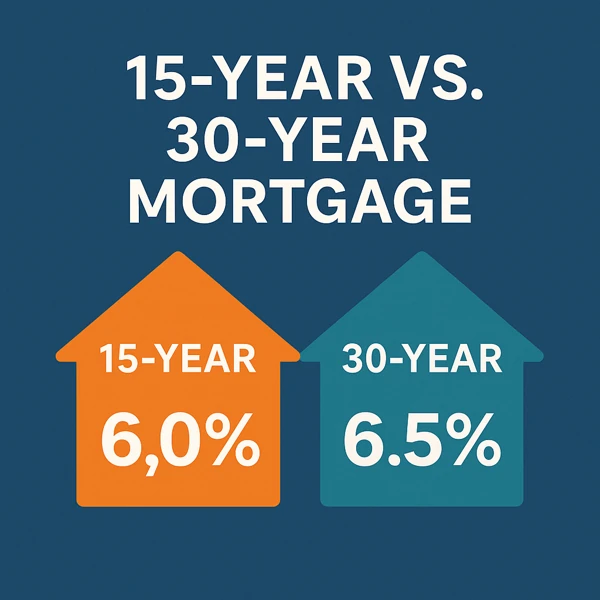
| 15-Year Fixed | 6.0% | $2,531 | $455,610 | $155,610 |
| 30-Year Fixed | 6.5% | $1,896 | $682,560 | $382,560 |
The Takeaway
- The 15-year mortgage saves you roughly $227,000 in interest — almost the price of a second home or a college education.
- However, it comes with a $635 higher monthly payment.
If you can comfortably handle that difference without sacrificing retirement savings, emergency reserves, or financial security, the 15-year option often delivers stronger long-term value.
But if that higher payment would stretch your budget or prevent you from saving elsewhere, the 30-year mortgage may be the smarter strategic choice — especially if you commit to extra principal payments when possible.
💡 Example Strategy:
Even adding just $200 extra per month to your 30-year payment can shorten your payoff by 5–7 years and save tens of thousands in interest — a great middle-ground between affordability and efficiency.
✅ Pros and Cons of a 15-Year Mortgage
Advantages
- Faster payoff: Own your home outright in half the time.
- Less total interest: Save tens or even hundreds of thousands.
- Build equity quicker: More of your payment goes toward principal.
- Lower rates: Typically 0.5–1% less than 30-year rates.
- Peace of mind: Enter retirement debt-free.
Drawbacks
- Higher payments: Strains cash flow, especially with variable income.
- Less flexibility: Fewer funds available for emergencies or investments.
- Harder qualification: Requires stronger income and lower DTI (debt-to-income ratio).
⚖️ Pros and Cons of a 30-Year Mortgage (Expanded)
A 30-year mortgage remains the most popular loan term in America — and for good reason. It offers predictability, flexibility, and accessibility for a wide range of borrowers. However, the same features that make it appealing can also slow wealth building if not managed wisely.
Here’s what to consider before committing to the longer term.
✅ Advantages of a 30-Year Mortgage
1. Lower Monthly Payments: More Breathing Room for Your Budget
Because your repayment is spread over 360 months, your monthly payment is significantly lower than on a 15-year mortgage.
This makes it easier to manage other expenses, qualify for the loan, and maintain a comfortable lifestyle without becoming “house-poor.”
- A 30-year term can often reduce your monthly payment by 30–40% compared to a 15-year loan.
- That difference can help first-time buyers or families with variable income achieve homeownership without over-stretching cash flow.
💡 Tip: Use the extra monthly margin to strengthen your financial foundation — such as funding an emergency reserve or investing in a retirement plan.
2. Greater Financial Flexibility: Aligns with Broader Goals
Lower payments give you the ability to allocate resources toward other priorities, such as:
- Contributing more to a 401(k) or IRA.
- Paying down higher-interest debt like credit cards or student loans.
- Building a college fund, emergency savings, or investment portfolio.
In other words, a 30-year mortgage doesn’t have to mean paying more overall — it can be a strategic financial tool if you use the savings to grow assets elsewhere.
💡 Example:
If you invest $600/month — the typical difference between 30-year and 15-year payments — at a 7% annual return, you could build over $225,000 in 15 years.
3. Optional Prepayment: Flexibility Without Obligation
One of the biggest advantages of a 30-year term is choice. You can:
- Make extra payments toward the principal whenever you’re able.
- Round up your payment each month.
- Apply tax refunds or bonuses to the loan balance.
Doing so shortens the payoff period and saves interest — essentially letting you “act like” you have a 20-year or 15-year loan without committing to it upfront.
💡 Pro Tip:
There’s usually no prepayment penalty on standard fixed-rate loans. Just confirm with your lender that extra payments go directly toward principal, not future interest.
4. Access to a More Affordable Home Purchase
A 30-year mortgage allows buyers to qualify for larger loan amounts because of the lower monthly payment.
This can make the difference between renting and owning — or between a starter home and a long-term family residence.
However, this benefit comes with a warning: affordability should still be based on long-term comfort, not the maximum a bank approves.
💡 Rule of Thumb:
Keep your total housing costs (mortgage, taxes, insurance, and HOA fees) under 28% of gross monthly income to avoid financial strain.
⚠️ Drawbacks of a 30-Year Mortgage
1. Higher Interest Rates: Paying for the Privilege of Time
Because the loan term is twice as long, lenders take on more risk — and compensate for it with a slightly higher rate.
Even a small difference (e.g., 6.5% vs. 6.0%) compounds significantly over 30 years.
💡 Insight:
A rate that’s only 0.5% higher can add tens of thousands of dollars in extra interest over the life of the loan.
2. More Total Interest: The Hidden Cost of Convenience
You’ll often pay nearly double the total interest compared to a 15-year loan.
While your monthly payment feels smaller, the long-term cost is enormous — especially if you never make extra principal payments.
💡 Example:
On a $300,000 loan at 6.5%, you’ll pay about $382,000 in interest over 30 years — compared to $155,000 for a 15-year at 6%.
That’s a $227,000 difference, simply for taking twice as long to repay.
3. Slower Equity Growth: Building Wealth More Gradually
During the early years of a 30-year loan, the majority of your payment goes toward interest, not principal.
That means it takes much longer to build equity — the portion of your home you actually own.
If you plan to sell or refinance within the first decade, you may find that much of your payment history went to interest rather than ownership.
💡 Tip:
Use biweekly payments or annual lump-sum prepayments to accelerate equity growth and reduce total interest.
4. Temptation to Overspend: The “Affordability Trap”
Because the lower payment makes homes look more affordable, some buyers stretch for a more expensive property than they truly need or can sustain long-term.
This increases risk during job loss, economic downturns, or unexpected life changes.
💡 Guideline:
Don’t choose a house based on what you can afford today — choose one that leaves room for future savings, maintenance, and peace of mind.
🧩 Key Decision Factors
Choosing between a 15-year and 30-year mortgage isn’t about which is “better” in general — it’s about which one fits your financial plan, risk tolerance, and life stage.
Here’s how to evaluate the decision strategically:
1. Is Your Income Stable?
- If your income is consistent and predictable (e.g., salaried professional or dual-income household), a 15-year mortgage may make sense.
- If your income varies (freelancer, content creator, or commission-based work), a 30-year mortgage offers vital flexibility — you can always pay extra in good months.
💡 Tip: Stability doesn’t just mean job security; it means confidence you can maintain your payments even through economic downturns.
2. Do You Have a Healthy Emergency Fund?
If you don’t have at least 3–6 months of living expenses saved, it’s wise to opt for the 30-year and direct extra cash toward savings first.
Liquidity protects you from financial stress far more than a faster mortgage payoff.
💡 Example:
A $2,000 monthly emergency fund contribution can prevent taking on high-interest debt if an unexpected expense arises — something a tight 15-year budget might not allow.
3. What Are Your Other Financial Goals?
Consider where the mortgage fits into your full plan:
- Retirement savings (401(k), IRA, Roth IRA)
- College or education funds
- Business startup capital or side projects
- Paying off high-interest credit cards
If achieving those goals requires cash flow, the 30-year mortgage keeps options open.
If you’re already ahead in savings and debt-free elsewhere, the 15-year can help you accelerate wealth through equity growth.
4. How Close Are You to Retirement?
Those within 10–15 years of retirement may want to enter that stage debt-free.
A 15-year mortgage (or accelerated payments on a 30-year) can ensure the home is fully paid off before retirement income replaces wages.
💡 Planning Insight:
The peace of mind of owning your home outright in retirement often outweighs the short-term benefits of a lower monthly payment.
5. What’s the Interest Rate Spread Between the Two?
The benefit of choosing a 15-year mortgage depends largely on the rate difference offered by lenders.
If the 15-year is only 0.25% cheaper, the total savings may be marginal.
But if the spread is 0.75% or more, the long-term cost gap grows significantly.
💡 Tip:
Always run a total cost comparison, not just monthly payment differences. Tools like mortgage calculators or spreadsheets can help visualize the long-term impact.
🧠 Final Thought:
A mortgage isn’t just a debt — it’s a long-term financial instrument.
Your choice should align with your goals for stability, savings, and freedom — not simply the lowest monthly bill or fastest payoff.
📊 Mortgage Scenarios: Choosing the Term That Fits Your Stage of Life
Every borrower’s mortgage decision should reflect where they are in life — financially, professionally, and personally.
Let’s look at how the 15-year vs. 30-year mortgage choice plays out across three common situations: a young family building wealth, a mid-career homeowner balancing priorities, and a near-retiree seeking stability.
👨👩👧 Example Scenario 1: The Young Family — Flexibility and Growth
Scenario:
A 35-year-old couple buys a $400,000 home with 20% down ($80,000), leaving a $320,000 mortgage.
| Loan Type | Rate | Monthly Payment | Total Interest |
|---|---|---|---|
| 30-Year Fixed | 6.5% | $2,024 | $407,000 |
| 15-Year Fixed | 6.0% | $2,703 | $167,000 |
At first, the 15-year looks like the clear winner — it saves them $240,000 in interest.
But that extra $679 per month is significant for a young family managing daycare, retirement savings, and college contributions.
If they choose the 30-year loan and invest that $679 each month in an S&P 500 index fund averaging 7% annual returns, they could accumulate roughly $225,000 in 15 years — almost equal to the interest savings of the shorter mortgage.
The key is discipline: the 30-year only works as a wealth tool if the couple invests the difference, not spends it.
💡 Lesson: The 30-year mortgage favors those who value flexibility and invest strategically.
Used wisely, it can balance lifestyle and long-term growth — but it demands intentional financial behavior.
💼 Example Scenario 2: The Mid-Career Professional — Balancing Affordability and Acceleration
Scenario:
At 42, Chris buys a $450,000 home with 20% down ($90,000), financing $360,000. With a solid income and two kids nearing college, cash flow flexibility matters — but so does long-term debt reduction.
| Loan Option | Rate | Monthly Payment | Total Interest |
|---|---|---|---|
| 30-Year Fixed | 6.5% | $2,278 | $459,000 |
| 20-Year Fixed | 6.25% | $2,617 | $266,000 |
| 15-Year Fixed | 6.0% | $3,038 | $187,000 |
Rather than locking into the higher 15-year payment, Chris chooses the 30-year term for flexibility but commits to paying extra each month — effectively turning it into a 20-year payoff plan.
By adding $300–$400 monthly toward principal:
- He shortens repayment by 10 years
- Saves nearly $200,000 in interest
- Keeps the option to reduce payments during tight months
💡 Lesson: A 30-year loan doesn’t have to last 30 years.
Paying like it’s a 20-year gives you control and adaptability, blending affordability with faster payoff — ideal for mid-career professionals juggling multiple financial priorities.
👵 Example Scenario 3: The Near-Retiree — Security and Peace of Mind
Scenario:
At 55, Maria refinances her remaining $180,000 mortgage and wants to ensure she’s debt-free by retirement at 70.
| Loan Type | Rate | Monthly Payment | Loan Term | Total Interest |
|---|---|---|---|---|
| 30-Year Fixed | 6.5% | $1,138 | 30 years | $229,680 |
| 15-Year Fixed | 6.0% | $1,519 | 15 years | $93,420 |
By choosing the 15-year term, Maria increases her payment by $381 — but guarantees her home will be paid off before she retires.
The savings in total interest ($136,000) and the psychological relief of owning her home outright make the higher payment worthwhile.
💡 Lesson:
For those nearing retirement, peace of mind often outweighs liquidity.
A 15-year loan can lock in stability, reduce long-term costs, and align your mortgage-free milestone with your retirement timeline.
🧩 Summary: Matching the Term to Your Life Stage
| Borrower Profile | Recommended Strategy | Why It Works | Potential Risk |
|---|---|---|---|
| Young Family (30s) | 30-Year + Invest Difference | Maximizes flexibility and investment growth potential. | Requires discipline to avoid lifestyle spending. |
| Mid-Career (40s) | 30-Year Paid Like 20-Year | Balances affordability with accelerated equity growth. | Needs consistent commitment to extra payments. |
| Near-Retiree (50s–60s) | 15-Year | Ensures debt-free retirement and lower total interest. | Higher monthly payment reduces short-term liquidity. |
💡 Final Thought
Your mortgage isn’t just about interest rates — it’s about aligning your loan term with your life goals.
- If you’re building a family or career, flexibility and liquidity matter most.
- If you’re midway through your financial journey, blend flexibility with acceleration.
- And if you’re approaching retirement, focus on stability and peace of mind.
The right mortgage isn’t the one with the lowest payment — it’s the one that supports your next life milestone.
🧮 How to Analyze Your Own Situation
- Use a mortgage calculator to compare monthly payments and total interest.
- Test different extra payment options — adding even $100/month can cut years off a 30-year loan.
- Balance your emergency fund (3–6 months) before committing to higher payments.
- Run a break-even analysis: if you plan to move within 5–7 years, the 15-year may not pay off.
💡 Pro Tip: If you want flexibility, choose a 30-year mortgage but make payments as if it were a 20-year. You’ll gain savings and breathing room.
💸 Tax Considerations: What the Mortgage Interest Deduction Really Means
Many homebuyers assume that a mortgage automatically leads to big tax savings — but that’s not always true under current tax law.
Let’s break down how the mortgage interest deduction works, when it applies, and how it impacts your financial planning.
1. How the Mortgage Interest Deduction Works
Homeowners who itemize deductions on their tax return can deduct the interest they pay on up to:
- $750,000 of qualified home mortgage debt (for loans taken after December 15, 2017), or
- $1,000,000 for older mortgages originating before that date.
This deduction applies to both primary and secondary homes — but only if you itemize.
However, since the Tax Cuts and Jobs Act (TCJA) significantly increased the standard deduction, most Americans no longer itemize.
For 2025, the standard deduction is:
- $14,600 for single filers
- $29,200 for married couples filing jointly
That means unless your combined itemized deductions (mortgage interest, state and local taxes, charitable giving, etc.) exceed those amounts, you’ll simply take the standard deduction — and your mortgage interest won’t reduce your taxable income at all.
💡 Quick Example:
If you pay $9,000 in mortgage interest and $5,000 in state/local taxes, that’s $14,000 total.
If you’re married, that’s still below the $29,200 standard deduction — meaning you wouldn’t itemize, and the interest doesn’t change your tax bill.
2. 15-Year vs. 30-Year Mortgages: The Deduction Difference
The 30-year mortgage generates more interest payments early on, which means larger potential deductions in the early years.
In contrast, the 15-year mortgage builds equity faster, but interest payments drop more quickly — and therefore the deduction declines faster too.
| Year | Loan Type | Annual Interest (Approx.) | Tax Impact If You Itemize (22% Bracket) |
|---|---|---|---|
| Year 1 | 30-Year @ 6.5% | $19,000 | $4,180 tax reduction |
| Year 1 | 15-Year @ 6.0% | $14,000 | $3,080 tax reduction |
| Year 5 | 30-Year @ 6.5% | $17,000 | $3,740 tax reduction |
| Year 5 | 15-Year @ 6.0% | $9,000 | $1,980 tax reduction |
So yes, the 30-year mortgage offers larger deductions up front, but it’s because you’re paying more interest overall.
You save on taxes, but you spend far more on interest — and that’s not a good trade-off.
Remember: A tax deduction is not a dollar-for-dollar savings.
If you spend $1 in interest and deduct it, you might save 22 cents in taxes — but you still spent 78 cents net.
3. When a Deduction Can Be Strategically Useful
The deduction can still provide meaningful value if:
- You have high itemizable deductions already (such as charitable giving or state taxes up to the SALT cap).
- You live in a high-tax state, making it easier to exceed the standard deduction threshold.
- You’re in a higher tax bracket (32% or above) — where the percentage savings per dollar of interest is larger.
- You’re temporarily paying more interest (such as during the first few years of a new 30-year mortgage).
In these cases, it can make sense to time charitable contributions or combine deductions (“bunching”) in one tax year to maximize itemizing benefits.
4. Long-Term Planning Perspective
While some homeowners stretch for a 30-year loan hoping for a “tax break,” that strategy often backfires:
- You pay far more in interest than you ever save in taxes.
- As your mortgage balance declines, your interest (and thus deduction) falls anyway.
- The standard deduction may continue to rise, making itemizing even less common.
Instead of focusing on the tax deduction alone, it’s wiser to:
- View the mortgage as a financing decision, not a tax strategy.
- Maximize retirement contributions (401(k), IRA, HSA) — which often deliver larger tax benefits.
- Choose the mortgage term that best supports your net worth growth, not just your tax refund.
5. When to Talk to a Professional
Tax situations can vary widely based on income level, home value, filing status, and other deductions.
A tax professional or CERTIFIED FINANCIAL PLANNER™ can help you:
- Determine whether you’ll actually benefit from itemizing.
- Run projections on the after-tax cost of each mortgage option.
- Integrate mortgage interest strategy with overall retirement and investment planning.
💡 Example:
Sometimes paying off your mortgage faster and investing the savings can produce higher after-tax returns than maintaining the loan for a deduction.
🔑 Key Takeaway
The mortgage interest deduction is a benefit, not a strategy.
It can slightly reduce your tax bill in certain years, but it shouldn’t drive your mortgage decision.
Always choose the term that maximizes your overall financial flexibility, equity growth, and long-term net worth — and treat any tax savings as a bonus, not a justification for higher debt..
📈 Investment Hurdle Rate: Should You Pay Off the Mortgage or Invest Instead?
Deciding between paying down your mortgage faster or investing the extra money is one of the most common financial crossroads homeowners face.
The right answer depends on your “hurdle rate” — the minimum rate of return your investments must earn to outperform your mortgage’s after-tax cost.
1. Understanding the Hurdle Rate
The hurdle rate is the return you’d need on your investments to justify not paying off your mortgage early.
In simple terms:
If your expected after-tax investment return is greater than your after-tax mortgage interest rate, you’re better off investing.
If it’s lower, paying down the mortgage faster likely makes more sense.
2. Calculating the After-Tax Cost of Your Mortgage
To make a fair comparison, you need to calculate your effective mortgage rate after taxes.
If you can deduct mortgage interest, your effective rate is reduced by your marginal tax rate.
For example:
| Mortgage Rate | Tax Bracket | After-Tax Cost of Debt |
|---|---|---|
| 6.5% | 22% | 5.07% |
| 6.5% | 32% | 4.42% |
| 6.0% | 22% | 4.68% |
| 6.0% | 0% (standard deduction) | 6.0% |
If you don’t itemize, you get no deduction — your after-tax mortgage cost is simply your stated interest rate.
💡 Example:
A homeowner with a 6.5% mortgage in the 22% bracket who itemizes deductions has an effective cost of 5.07%.
That means any investment earning more than 5.07% after tax would outperform paying off the mortgage.
3. Comparing Expected Investment Returns
Now, let’s compare average long-term returns on common investments:
| Asset Type | Average Annual Return (Long-Term) | After-Tax Return (Approx.) | Risk Level |
|---|---|---|---|
| S&P 500 Index Fund | 7%–10% | 5%–8% | Moderate to High |
| U.S. Bonds | 4%–5% | 3%–4% | Low to Moderate |
| High-Yield Savings/CDs | 4%–5% | 3%–4% | Very Low |
| Mortgage Payoff | Equal to your interest rate | 5%–6.5% | Risk-Free |
In essence:
- Paying off a 6.5% mortgage gives you a guaranteed 6.5% return — risk-free and inflation-protected.
- Investing may earn more, but it comes with market risk and variability.
- Therefore, your hurdle rate is roughly 6.5% (or your after-tax equivalent).
4. Tax Strategies That Affect the Comparison
Taxes significantly influence which path is optimal. Here’s how:
A. Tax-Deferred Investing
If you’re investing in 401(k)s, IRAs, or HSAs, your money grows tax-deferred — meaning your effective return is higher because you’re not paying taxes annually.
- A 7% nominal return in a tax-deferred account might effectively behave like an 8–9% taxable return.
- That can tip the scales toward investing over accelerating mortgage payments.
B. Roth Accounts and Future Tax Planning
If you use Roth IRAs or Roth 401(k)s, returns are tax-free at withdrawal, making them ideal for younger borrowers with longer horizons.
In this case, even if the mortgage rate equals your expected market return, the tax-free growth advantage can justify investing instead of early repayment.
C. Mortgage Interest Deduction
If you itemize and deduct interest, your effective mortgage cost falls, reducing your hurdle rate.
If you take the standard deduction, there’s no offset — so paying off the loan early may produce better guaranteed returns.
D. Inflation and Real Rates of Return
Inflation also erodes the real cost of your mortgage.
If inflation runs at 3%, a 6.5% fixed mortgage effectively costs only 3.5% in real terms — since you’re repaying in “cheaper” dollars over time.
That’s another argument for investing if you believe inflation will stay moderate and your investments will outpace it.
5. The Behavioral Side: Comfort vs. Optimization
Not every decision is about math — it’s also about peace of mind.
Some homeowners prefer the emotional return of being debt-free:
- The certainty of lower monthly expenses.
- The stability of owning their home outright.
- Reduced stress during retirement or market downturns.
Others are comfortable carrying strategic debt to pursue higher long-term returns through diversified investing.
There’s no single right answer — only the right fit for your risk tolerance and financial stage.
6. Putting It All Together: Payoff vs. Invest Matrix
| Factor | Favors Paying Off Early | Favors Investing Instead |
|---|---|---|
| Mortgage Rate | Above 6% | Below 5% |
| Tax Bracket | Low or Standard Deduction | High (Itemizing) |
| Investment Horizon | Short (≤10 years) | Long (15+ years) |
| Risk Tolerance | Low | Moderate–High |
| Retirement Goal | Debt-free security | Growth & wealth building |
| Market Conditions | High volatility or low returns | Stable or growing markets |
| Liquidity Needs | Want fewer fixed obligations | Want to preserve cash flow flexibility |
💡 Example:
A 40-year-old with a 6.5% mortgage, 22% tax rate, and a 401(k) returning 8% pre-tax is likely better off investing than paying down the loan.
A 60-year-old nearing retirement with the same mortgage might prefer debt reduction for psychological and cash flow security.
7. Tax-Optimized Hybrid Strategy
For many homeowners, the best answer isn’t either/or — it’s both:
- Keep your 30-year mortgage for flexibility.
- Max out tax-advantaged retirement accounts first.
- Apply any surplus to extra principal payments once your high-yield, tax-deferred, or Roth contributions are fully funded.
This approach blends liquidity, tax efficiency, and debt reduction — creating a smoother path toward financial independence.
🔑 Key Takeaway
The mortgage vs. investing decision isn’t just about returns — it’s about risk, taxes, and timing.
- Paying off the mortgage offers a guaranteed, risk-free return equal to your interest rate.
- Investing offers potentially higher but uncertain returns influenced by taxes and market volatility.
- Your personal hurdle rate — the after-tax mortgage cost — is your decision benchmark.
In short:
If your investments can reliably earn more after tax and inflation than your mortgage costs, invest.
If not — or if peace of mind is your priority — paying down your mortgage is the smarter guaranteed return.
🔄 Alternatives Worth Considering
- 20-Year Mortgage: The middle ground — lower payments than a 15-year but faster payoff than 30.
- Biweekly payments: 26 half-payments a year = one full extra payment annually, cutting years off the loan.
- Refinance strategies: Start with 30-year for affordability, refinance later when income rises.
- Adjustable-Rate Mortgage (ARM): May work for short-term homeowners, but carries rate-reset risk.
🚫 Common Mistakes to Avoid
- Choosing the lowest payment only.
Affordability matters, but so does long-term cost. - Ignoring opportunity cost.
Paying off your mortgage early might mean missing higher-return investments. - Skipping emergency savings.
Don’t lock every dollar into home equity. - Not comparing total loan costs.
Look beyond rate — factor in fees, closing costs, and PMI.
🧠 Summary: Which Mortgage Term Is Better for You?
When it comes to choosing between a 15-year and 30-year mortgage, there’s no single “best” answer — only the one that best supports your financial goals, lifestyle, and peace of mind.
The right term depends on what you value more: freedom from debt or freedom of cash flow.
Choose a 15-Year Mortgage If:
- You can comfortably afford the higher payment without sacrificing your retirement contributions, emergency savings, or quality of life.
- Your goal is to build equity faster and minimize total interest paid.
- You’re nearing retirement and want your home fully paid off within a predictable timeframe.
- You value financial certainty and dislike carrying long-term debt.
- You prefer a guaranteed, risk-free return equivalent to your mortgage rate.
💡 Example:
If you’re stable in your career and already saving adequately for retirement, the 15-year mortgage can fast-track your wealth and provide lasting peace of mind.
Choose a 30-Year Mortgage If:
- You want more monthly flexibility to handle other goals — such as retirement investing, college savings, or business growth.
- Your income is variable or commission-based, and you value having room to breathe during slow months.
- You plan to invest the difference between a 15- and 30-year payment for long-term growth.
- You expect to move, refinance, or upgrade homes within 10–15 years.
- You prefer control over your cash flow, rather than locking it into a fixed higher payment.
💡 Example:
If you’re early in your career or raising a family, the 30-year loan lets you balance homeownership with other major financial priorities — provided you stay intentional with your savings.
Rule of Thumb
If you can handle the 15-year payment without compromising savings, retirement, or liquidity, it’s usually worth it for the guaranteed savings and faster payoff.
If not, use the 30-year mortgage strategically — take advantage of the lower payment, build an emergency fund, and make extra principal payments when possible to reduce long-term interest.
📣 Final Thoughts: The Mortgage as a Financial Planning Tool
Your mortgage is more than a loan — it’s a powerful financial planning instrument that can either accelerate your wealth or quietly drain it, depending on how you use it.
A 15-year mortgage builds equity and security;
a 30-year mortgage builds flexibility and opportunity.
The best choice isn’t about math alone — it’s about aligning your home financing with your life stage, investment strategy, and comfort with risk.
Smart homeowners don’t just pick a loan term — they use it intentionally.
Whether you pay down debt aggressively or leverage flexibility to grow investments, your success depends on consistency, discipline, and long-term vision.
If you’re unsure which path fits your situation, consider working with a CERTIFIED FINANCIAL PLANNER™ who can model:
- After-tax returns and inflation-adjusted projections
- The impact on retirement readiness and liquidity
- Custom scenarios comparing mortgage payoff vs. investing
A personalized financial plan transforms your mortgage decision from a guess into a strategic advantage — helping you build not just a home, but a stronger financial future.
Good reading
- Determining Your Affordable Mortgage Payment
- Renting vs. Buying with a 15- or 30-Year Mortgage – Which Builds More Wealth in the Long Run?
