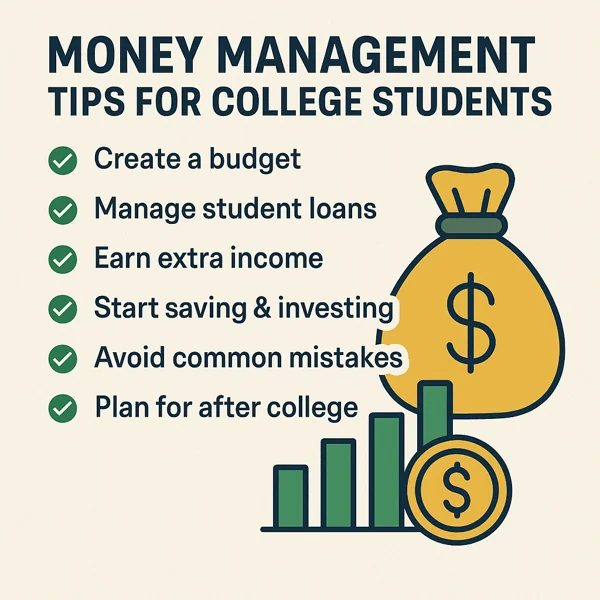
Key Takeaways
- Budgeting in College Builds Financial Control and Awareness
Learn how to create a realistic student budget to manage income, expenses, and savings. Tracking your money helps avoid overspending and lays the foundation for lifelong financial success. - Manage Student Loans and Debt Wisely
Borrow only what you need for tuition and essential costs. Understand the difference between federal and private loans, explore repayment and forgiveness programs early, and develop a clear debt management strategy before graduation. - Earn Extra Income Through Side Hustles and Part-Time Jobs
Increase your cash flow while building valuable experience. Explore side hustles for college students such as freelancing, tutoring, remote work, or internships that boost both income and career skills. - Start Saving and Investing Early to Build Wealth
Establish an emergency fund and begin investing small amounts in index funds, ETFs, or a Roth IRA. Starting early allows compound interest to work in your favor — even small contributions can grow significantly over time. - Avoid Common Financial Mistakes in College
Stay mindful of overspending, credit card debt, and the temptation to live beyond your means. Learning basic personal finance skills — including credit management and tax filing — helps you avoid costly long-term errors. - Plan for Financial Independence After Graduation
Prepare early for post-college life by setting SMART financial goals, building a post-graduation budget, understanding employer benefits, and developing a long-term financial plan that includes loan repayment and retirement savings.
Introduction
College marks a major transition — a time of independence, exploration, and new responsibilities. Yet one of the most important lessons many students overlook isn’t found in the classroom: learning how to manage money wisely. Between tuition, housing, textbooks, meals, and social activities, financial decisions add up quickly. Without a plan, it’s easy to overspend, rely too heavily on credit cards, or build debt that lingers long after graduation.
This guide empowers college students to take control of their finances through practical budgeting, saving, and debt-management strategies. Whether you rely on financial aid, a part-time job, or parental support, you’ll discover how to build a financial foundation that supports both your academic success and long-term goals. Mastering these skills now will help you avoid money stress, make smarter choices, and graduate with confidence — not just a diploma.
1. Why Learning to Budget Is a Lifelong Skill
Budgeting isn’t just about tracking dollars and cents — it’s about shaping habits, mindset, and lifelong financial confidence. When you learn to budget in college, you’re doing more than balancing expenses; you’re developing essential skills that will guide your financial decisions for decades to come.
1. Builds Financial Awareness and Control
Creating and following a budget helps you understand your spending patterns and identify where your money really goes. This awareness transforms money management from guesswork into an intentional practice — helping you feel more in control, even when finances are tight.
2. Reduces Financial Stress
Financial anxiety is one of the most common stressors among college students. Knowing how to budget — and having a plan for emergencies or shortfalls — reduces uncertainty and brings peace of mind. A clear picture of your finances can make you feel more confident about everyday decisions, from buying books to choosing housing options.
3. Teaches Delayed Gratification
Budgeting trains the brain to prioritize needs over wants. By setting aside money for savings or future goals, students learn patience and long-term thinking — essential psychological skills that improve overall self-discipline and decision-making.
4. Encourages Goal-Setting and Accountability
Budgeting connects short-term spending choices to long-term outcomes. When students save for a spring break trip or pay off a small credit card balance, they see tangible results from their effort — reinforcing the link between planning and achievement.
5. Creates a Foundation for Lifelong Success
The budgeting habits formed in college become the backbone of financial stability in adulthood. Whether you’re managing your first salary, buying a home, or saving for retirement, the same principles apply: track your income, plan your spending, and align your money with your values.
In short: budgeting is more than a college survival skill — it’s a mindset that supports every stage of your financial life.
2. Setting Financial Goals: Turning Dreams Into Action
Why Financial Goals Matter
Financial goals are the foundation of every successful money plan. Without them, even the best budget feels aimless — like driving without a destination. Setting clear goals helps you stay motivated, make smarter choices, and measure your progress along the way.
Whether you’re saving for a spring break trip, paying off student loans, or investing for retirement, having defined goals provides direction, structure, and accountability. It transforms financial planning from something you “should do” into something you’re actively achieving.
The Psychology Behind Goal Setting
Money decisions are emotional as much as mathematical. Setting goals creates a sense of purpose and reward, engaging both logic and motivation. When you visualize what your money can accomplish — not just what you’re giving up — you’re far more likely to stay committed.
Behavioral finance research shows that people who write down their financial goals are 42% more likely to achieve them than those who don’t.
The process gives your financial journey structure and clarity.
The SMART Goal Framework
Use the SMART framework to create goals that are clear, realistic, and measurable:
| SMART Component | What It Means | Example |
|---|---|---|
| Specific | Define exactly what you want to achieve. | “Save $1,000 for an emergency fund.” |
| Measurable | Set a target you can track. | “I’ll save $100 per month for 10 months.” |
| Achievable | Make sure your goal fits your income and lifestyle. | “I’ll cut back on takeout to free up $25 a week.” |
| Relevant | Align your goal with your long-term values or priorities. | “This fund will prevent me from relying on credit cards.” |
| Time-Bound | Set a deadline to stay accountable. | “I’ll reach my goal by next June.” |
Example:
Instead of “I want to save more,” say “I’ll save $50 from each paycheck to reach $1,000 in six months for emergencies.”
Short-Term, Mid-Term, and Long-Term Goals
Financial goals work best when divided by time horizon — allowing you to prioritize and build momentum as you go.
1. Short-Term Goals (0–12 months)
These are immediate, achievable objectives that build confidence and habit.
Examples:
- Build a $500 emergency fund
- Pay off a credit card balance
- Save for textbooks or travel
2. Mid-Term Goals (1–5 years)
These require more planning and discipline but deliver major rewards.
Examples:
- Pay off student loans
- Buy a reliable used car
- Save for a move or grad school
3. Long-Term Goals (5+ years)
These are the big milestones that define your financial future.
Examples:
- Buy a home
- Reach financial independence or early retirement (FIRE)
- Build a diversified investment portfolio
By aligning short-term wins with long-term vision, you maintain motivation and clarity at every stage.
How to Prioritize Competing Goals
When everything feels important, prioritize based on impact and timeline:
- Secure first, then grow.
Build an emergency fund before investing aggressively. - Eliminate high-interest debt.
Paying off credit cards yields guaranteed “returns” that no investment can match. - Match free money.
Always contribute enough to employer 401(k) matches before other savings. - Invest for the future.
Once stable, direct extra income toward Roth IRAs, index funds, or other long-term investments.
Tools and Habits for Staying on Track
- Write your goals down — keep them visible (on your phone, mirror, or journal).
- Automate savings — use automatic transfers to make progress without thinking about it.
- Review monthly, adjust quarterly.
Life changes fast after college; your goals should evolve too. - Celebrate milestones.
Reward yourself when you reach mini-goals — it reinforces consistency and joy in progress.
Pro Tip: Tie Every Goal to a “Why”
Saving money for the sake of saving feels abstract. But saving because it means freedom to travel, security to handle emergencies, or power to say yes to opportunities makes the goal emotional — and far more achievable.
Understanding the College Cash Flow Problem
For most students, college is the first time they face adult-level expenses — but without adult-level income. Tuition, housing, textbooks, transportation, and even late-night pizza runs all cost money, yet few students have steady cash coming in to cover it.
According to the College Board, the average annual cost of attendance at a public four-year university in 2025 exceeds $28,000 for in-state students and $46,000 for out-of-state students when factoring in tuition, room, board, and supplies. Private colleges often exceed $55,000 per year. Meanwhile, many students earn less than $10,000 annually from part-time work or internships — if they’re working at all.
This creates what economists call a cash flow imbalance — far more money going out than coming in. It’s one of the main reasons students turn to credit cards, student loans, or parental support to fill the gap.
But here’s the catch: borrowing to cover daily expenses can quickly snowball into long-term debt. Every dollar spent on credit now could cost significantly more later with interest, and many graduates find themselves starting their adult lives already thousands of dollars in the red.
Learning to budget effectively is how you turn this around. When you understand your income and expenses, even small adjustments — like reducing dining-out costs or finding student discounts — can stretch limited funds much further. A well-designed student budget ensures that the money you do have goes toward what matters most: education, essentials, and your future financial independence.
3. Budgeting Basics for College Students
Why Budgeting Is Crucial
Many students arrive at college without prior experience managing money — yet face thousands of dollars in expenses each semester. Without a budget, it’s easy to lose track of where your money goes and overspend on small purchases that add up fast.
A well-structured budget acts as your financial roadmap. It helps you understand your income, control spending, and make informed decisions about what’s truly worth your money. Most importantly, budgeting gives you a sense of control over your financial life — a powerful psychological benefit that reduces stress and improves focus on your studies.
How to Create a Simple, Realistic Budget
Budgeting doesn’t have to be complicated. The 50/30/20 rule is one of the simplest and most effective ways to start:
- 50% – Needs: Rent, groceries, tuition, transportation, insurance, and essential bills
- 30% – Wants: Entertainment, dining out, travel, streaming subscriptions, social activities
- 20% – Savings & Debt Repayment: Emergency fund, paying down student loans or credit cards
Tools to Get Started:
- Budgeting apps such as Mint, You Need a Budget (YNAB), or Goodbudget
- A simple Google Sheets or Excel spreadsheet
- A notes app or cash envelope system if you prefer manual tracking
The key is consistency. Track your expenses weekly, review your progress, and make small adjustments as your spending habits evolve. Budgeting isn’t about restriction — it’s about awareness and freedom to choose how you use your money.
Sample College Student Budgets
Below are examples of how an average monthly budget might look for students living on campus versus off campus.
On-Campus Student Budget (Monthly)
| Category | Amount |
|---|---|
| Rent & Utilities | Included in tuition fees |
| Groceries | $200 |
| Transportation | $50 |
| Books & Supplies | $100 |
| Entertainment | $75 |
| Miscellaneous | $50 |
| Savings/Debt Repayment | $100 |
| Total | $575 |
Off-Campus Student Budget (Monthly)
| Category | Amount |
|---|---|
| Rent & Utilities | $600 |
| Groceries | $300 |
| Transportation | $150 |
| Books & Supplies | $100 |
| Entertainment | $100 |
| Miscellaneous | $75 |
| Savings/Debt Repayment | $150 |
| Total | $1,475 |
Tips to Stick to Your Budget
- Automate what you can: Set up automatic transfers to savings or bill payments to stay on track.
- Use cash or prepaid debit cards for discretionary spending — it’s harder to overspend when you physically see your money leave your wallet.
- Leverage student discounts and free campus resources like gyms, tutoring, and public transportation.
- Cut “leaks” in your budget: Review subscriptions, food delivery habits, or impulse purchases that don’t add long-term value.
- Check in weekly: A five-minute review helps you correct course before small expenses spiral out of control.
Takeaway
Budgeting in college isn’t about deprivation — it’s about building awareness and discipline. Every dollar you manage intentionally brings you closer to your financial goals and gives you confidence that will last long after graduation.
4. Managing Student Loans & Debt Wisely
Understanding Student Loans
Student loans can open the door to higher education — but they also represent one of the largest financial commitments many students will ever make. Understanding the types of loans and how they work is essential to borrowing responsibly.
Federal Student Loans
- Fixed Interest Rates: Rates are set by the federal government and remain stable throughout the life of the loan.
- Flexible Repayment Options: Plans include Standard, Graduated, and Income-Driven Repayment (IDR) options that adjust payments based on your income.
- Borrower Protections: Federal loans offer deferment, forbearance, and even forgiveness programs for eligible public service workers or teachers.
- No Credit Check for Subsidized or Unsubsidized Loans: Unlike private loans, most federal loans don’t require a strong credit history.
Private Student Loans
- Variable or Fixed Interest Rates: Rates can fluctuate with the market, often leading to higher costs over time.
- Credit-Based Approval: You or a co-signer must meet credit standards to qualify.
- Less Flexibility: Limited options for deferment or forgiveness if your financial situation changes.
- Best for Funding Gaps: Consider private loans only after maximizing federal aid, scholarships, and grants.
Borrowing Smartly
The golden rule: borrow only what you absolutely need. It can be tempting to take the maximum loan amount offered, but every borrowed dollar comes with future interest costs.
Smart Borrowing Strategies
- Calculate Real Needs: Estimate tuition, fees, and living costs accurately. Subtract scholarships, grants, and income before borrowing.
- Avoid Using Loans for Non-Essentials: Limit spending on dining out, entertainment, or luxury items with borrowed funds.
- Pay Interest While in School: Even small monthly payments on unsubsidized loans can significantly reduce what you owe after graduation.
- Compare Lenders: If you need a private loan, compare APRs, repayment terms, and co-signer release policies across multiple lenders.
- Track Your Loan Balances: Use tools like StudentAid.gov or budgeting apps to stay aware of your total debt and projected payments.
Repayment Strategies
Planning your repayment strategy before graduation can save thousands of dollars and prevent long-term stress.
Key Repayment Options
- Income-Driven Repayment (IDR): Caps your monthly payment at a percentage of your discretionary income — typically 10–20% — and may lead to loan forgiveness after 20–25 years.
- Public Service Loan Forgiveness (PSLF): Available to borrowers who work full-time in government or nonprofit roles and make 120 qualifying payments under an IDR plan.
- Refinancing: After establishing good credit and stable income, refinancing can reduce your interest rate — but note that doing so eliminates federal protections.
- Auto-Pay Discounts: Enrolling in automatic payments can lower your interest rate (often by 0.25%) and help you avoid missed payments.
- Snowball or Avalanche Method: If managing multiple loans, focus on paying either the smallest balance first (snowball) or the highest interest rate first (avalanche).
Psychological Tip: Don’t Fear Debt — Manage It
Debt can feel overwhelming, but mindset matters. Viewing your student loans as a manageable investment in your future helps you stay proactive rather than anxious. Small, consistent actions — like tracking balances and making early payments — build confidence and long-term control over your finances.
Key Takeaway
Managing student loans wisely means understanding your options, borrowing strategically, and creating a clear repayment plan before graduation. The goal isn’t just to graduate — it’s to graduate financially prepared to build the next stage of your life with minimal debt stress.
5. Scholarships & Grants: Free Money for College
Why Scholarships and Grants Matter
Scholarships and grants are the most powerful tools to reduce college costs because they don’t need to be repaid. Every dollar you earn in scholarships is a dollar less you have to borrow — which can save you thousands in future interest payments. Whether you’re an incoming freshman or a graduate student, there’s free money available if you know where to look and how to apply strategically.
Where to Find Scholarships
You don’t need to rely solely on your college’s financial aid office. Many organizations — from local clubs to national foundations — offer scholarships for a wide variety of qualifications and interests.
1. Federal and State Programs
- Federal Student Aid (FAFSA.gov): Completing the Free Application for Federal Student Aid (FAFSA) is your first step. It determines eligibility for federal grants like the Pell Grant, Supplemental Educational Opportunity Grant (FSEOG), and some state-based aid.
- State Education Agencies: Many states offer merit-based or need-based grants for residents attending in-state colleges.
2. National Scholarship Databases
- Fastweb.com – Matches you to scholarships based on your profile and major.
- Scholarships.com – One of the largest free databases with advanced filtering tools.
- College Board BigFuture – Trusted database with updated listings.
- CareerOneStop.org – A U.S. Department of Labor-sponsored resource for verified opportunities.
3. School Financial Aid Offices
- Most colleges offer institutional scholarships for academic achievement, athletics, leadership, or specific majors.
- Ask your department chair or academic advisor about department-specific scholarships that often receive fewer applicants.
4. Local and Community Opportunities
- Local nonprofits, civic organizations, and businesses often provide smaller scholarships ($500–$2,000) that are easier to win due to lower competition.
- Check with your high school guidance office, church or community group, and credit unions or banks for local scholarship programs.
5. Niche and Identity-Based Scholarships
- Look for scholarships targeting specific majors, career goals, backgrounds, or interests — such as women in STEM, first-generation students, artists, or students with community service records. These often have less competition and better odds of success.
How to Increase Your Chances of Winning
Winning scholarships isn’t just about applying — it’s about applying strategically.
Follow these steps to stand out in the crowd:
1. Apply Early and Often
- Deadlines vary, and many scholarships close months before the academic year starts. Set reminders and apply for multiple opportunities.
- Treat scholarship hunting like a part-time job — consistent effort can yield big results.
2. Write a Compelling Personal Statement
- Tell your story authentically. Highlight obstacles you’ve overcome, your goals, and how the scholarship aligns with your academic and personal growth.
- Use specific examples that demonstrate leadership, community involvement, or persistence.
3. Customize Each Application
- Avoid generic essays. Tailor your responses to match the mission or focus of the organization offering the scholarship.
4. Seek Letters of Recommendation
- Ask teachers, coaches, or supervisors who know you well and can speak to your strengths and character.
- Give them plenty of time and provide your resume or a summary of your achievements to make their job easier.
5. Focus on Niche Scholarships
- Smaller, targeted scholarships — for specific fields, hobbies, or communities — often have less competition and higher success rates. Winning several smaller awards can add up quickly.
Smart Tip: Treat Scholarships Like Stacking Income
Think of scholarships as income streams for your education. You don’t need one big award — you can layer multiple smaller ones. Winning $500 here and $1,000 there can easily offset the cost of textbooks, transportation, or housing for an entire semester.
Key Takeaway
Scholarships and grants are the closest thing to “free money” in higher education. Start early, stay organized, and treat the search process as a key part of your financial plan for college. Every hour you spend applying could save you hundreds — or even thousands — in student loan debt later.
6. Making Money in College: Side Hustles & Income Streams
Why Earning Money in College Matters
Earning income while in college does more than just cover expenses — it builds responsibility, confidence, and financial independence. Even small amounts of income can reduce reliance on student loans, teach time management, and help you graduate with less debt and more real-world experience.
The good news? There have never been more ways for students to earn money — from flexible side hustles and freelance gigs to remote digital opportunities and campus-based jobs that complement your academic schedule.
Best Ways to Earn Money in College
Here are some of the most effective income streams for college students today, categorized by flexibility and potential.
1. Part-Time and Campus Jobs
- Work-Study Programs: Funded by federal aid, work-study jobs let you earn money directly through your university — often with flexible hours and minimal commuting.
- Campus Bookstore, Library, or Dining Services: Convenient, reliable income with a short commute between classes.
- Tutoring or Teaching Assistant Roles: If you excel in certain subjects, tutoring peers can pay well and strengthen your own understanding.
- Resident Advisor (RA): Offers free or discounted housing, a major cost saver in exchange for leadership and dorm responsibilities.
2. Freelancing and Remote Work
- Offer your skills on platforms like Upwork, Fiverr, or Freelancer in writing, graphic design, social media management, or video editing.
- Remote roles such as virtual assistant or content creator allow you to work around class schedules.
- Specialized fields (like coding or marketing) can command higher hourly rates — ideal for students developing professional portfolios.
3. Online and Creative Businesses
- Etsy or Shopify Stores: Sell handmade goods, art, or digital downloads like study planners and templates.
- Blogging or YouTube: Build an audience by sharing insights about student life, budgeting, or creative hobbies.
- Reselling: Flip thrifted clothes, vintage items, or textbooks on eBay, Depop, or Poshmark.
4. Passive Income Opportunities
While not a short-term fix, passive income helps you build wealth over time.
- Investing Apps: Use beginner-friendly platforms like Acorns, Fidelity Spire, or Robinhood Learn to start small with micro-investments.
- Create Digital Products: Sell eBooks, course notes, or design templates.
- Affiliate Marketing: Monetize your blog or social media channels by recommending products you use and trust.
Gig Jobs vs. Steady Part-Time Work
Each income type offers different advantages. Understanding your priorities — flexibility, stability, or growth — will help you choose what works best for your schedule and financial goals.
| Feature | Gig Jobs | Steady Part-Time Work |
|---|---|---|
| Flexibility | High — work when you want | Moderate — set schedule |
| Income Stability | Variable — depends on workload and demand | Consistent — regular paychecks |
| Job Security | Low — income may fluctuate | High — predictable hours |
| Networking & Skills | Builds entrepreneurial skills | Offers professional development and employer references |
| Examples | Freelancing, ridesharing, delivery, pet sitting | Campus jobs, retail, office assistant roles |
Example Scenarios: Students Who Made It Work
Sarah – Freelance Designer
Sarah turned her graphic design talent into a thriving side business on Fiverr and Upwork. By building a portfolio early, she earned enough to pay her rent each semester and later used her portfolio to land an internship at a creative agency.
Jake – Online Reseller
Jake spent weekends thrifting and reselling items on eBay and Poshmark. He made a steady side income averaging $400 a month, which he used to pay for groceries and textbooks without touching his loan money.
Maria – Peer Tutor
Maria began tutoring in math and science through her college’s learning center. Within a semester, she built a private client list and turned her tutoring into a part-time business that paid better than most student jobs.
The Benefits of Work-Study, Internships, and Real Experience
Work-study programs and internships are among the best ways to earn while building your future career.
- Gain Real-World Experience: Work experience enhances your résumé and prepares you for post-graduation employment.
- Build Professional Networks: Internships often lead to strong connections, letters of recommendation, or full-time job offers.
- Balance Learning and Earning: Campus jobs and internships are designed with student schedules in mind, helping you maintain academic performance while building work habits.
Pro Tip: Time Is Your Most Valuable Resource
Before taking on too much, remember: your time has value. Choose side hustles or part-time jobs that fit your goals, provide relevant experience, or build marketable skills. A few focused opportunities can be more rewarding — and profitable — than juggling too many low-paying gigs.
Key Takeaway
Making money in college is about more than earning cash — it’s about building a foundation of financial independence, time management, and real-world experience. Whether you freelance, work on campus, or start your own side business, each paycheck moves you closer to financial confidence and post-graduation success.
7. Credit Cards & Building Credit as a Student
Why Credit Matters Early
Credit is more than just a number — it’s a financial reputation.
Your credit history influences everything from renting an apartment and buying a car to landing certain jobs or qualifying for a mortgage. Starting to build credit responsibly while in college can give you a major head start after graduation.
However, credit cards can be both powerful and dangerous. Used wisely, they open doors to financial opportunity. Used carelessly, they can trap you in debt that takes years to recover from.
Pros & Cons of Student Credit Cards
| Pros | Cons |
|---|---|
| Builds Credit History: Timely payments establish a strong credit score, which improves your financial standing over time. | Risk of Overspending: Easy access to credit can lead to impulse purchases and debt. |
| Emergency Safety Net: Provides access to funds during emergencies when cash isn’t available. | High Interest Rates: Student cards often carry annual percentage rates (APRs) above 20% if balances aren’t paid in full. |
| Rewards & Benefits: Many student cards offer cash back, points, or perks like free credit monitoring. | Potential for Long-Term Debt: Minimum payments can make it hard to pay off balances, especially with variable income. |
| Financial Education: Using a card responsibly teaches accountability and money management. | Credit Score Damage: Missed or late payments can hurt your score for years. |
How to Use Credit Responsibly
Building credit doesn’t mean spending more — it means managing credit strategically.
1. Pay Off Your Balance in Full Each Month
This is the golden rule. Paying your balance in full avoids interest charges and demonstrates responsible use to credit bureaus. Treat your credit card like a debit card — spend only what you can afford to pay off immediately.
2. Keep Your Credit Utilization Below 30%
Your credit utilization ratio (the amount of credit you’re using compared to your total available limit) is a major factor in your credit score.
- Example: If your limit is $1,000, try to keep your balance below $300.
- The best credit users often keep utilization under 10% for optimal scoring results.
3. Make On-Time Payments, Every Time
Payment history accounts for 35% of your credit score. Set up automatic payments or calendar reminders to avoid late fees or missed due dates.
4. Avoid Applying for Multiple Cards at Once
Each credit card application triggers a hard inquiry, which can temporarily lower your credit score. Start with one student card, use it responsibly for 6–12 months, then consider applying for another if needed.
5. Monitor Your Credit Regularly
Use free tools like Credit Karma, Experian, or your card issuer’s credit dashboard to track your score. Monitoring helps catch fraud early and shows how your behaviors affect your credit growth.
6. Understand the Terms Before You Swipe
Read your card agreement carefully. Pay attention to:
- APR (Annual Percentage Rate)
- Grace period before interest applies
- Penalty fees for missed payments
Understanding these details helps you avoid unnecessary costs.
Student-Friendly Credit Card Options to Consider
While product names change often, here are common types of cards that are well-suited for students:
- Student Cash-Back Cards: Offer 1%–5% back on everyday purchases like groceries or gas.
- Secured Credit Cards: Require a refundable deposit (e.g., $200–$500) and are great for those building or repairing credit.
- Credit Union Student Cards: Local credit unions often have lower APRs and fewer fees than major banks.
Always compare annual fees, rewards, and customer service quality before applying.
Pro Tip: Start Small and Build Consistency
Building credit isn’t about how much you spend — it’s about how well you manage what you borrow. A single, well-managed student credit card can establish a strong financial foundation and set you up for success when you later apply for auto loans, apartments, or mortgages.
Key Takeaway
Credit cards are powerful financial tools — but only when used wisely.
By paying on time, keeping balances low, and avoiding unnecessary applications, you can graduate with a solid credit history instead of credit card debt. The habits you build now will follow you into every major financial decision of adulthood.
8. Saving Money: How to Build an Emergency Fund
Why Every College Student Needs an Emergency Fund
Emergencies don’t wait until after graduation. A flat tire, a lost laptop, or an unexpected medical bill can happen at any time — and without savings, these costs can quickly derail your budget or push you into credit card debt.
An emergency fund is your personal financial safety net. It protects you from relying on high-interest loans, credit cards, or borrowing from friends when life takes an unexpected turn. Even a small fund can make a major difference in your financial stability and peace of mind.
Key Benefits:
- Covers unexpected expenses like car repairs, health costs, or travel for family emergencies.
- Reduces financial stress and reliance on credit cards.
- Encourages a habit of saving early, which builds long-term financial security.
How to Save on a Student Budget
Saving money as a student can feel impossible — but small, consistent actions add up faster than you think.
1. Automate Small Transfers
Set up automatic transfers of $5–$10 per week into a dedicated savings account. Treat it like a non-negotiable bill — you’ll barely notice it missing, but your future self will thank you.
2. Cut Back Strategically
You don’t have to sacrifice everything you enjoy. Instead, identify one or two low-value habits to trim:
- Skip one takeout meal per week.
- Share streaming accounts with roommates.
- Choose free campus events over expensive nights out.
3. Take Advantage of Student Perks
Use cashback apps, student discounts, and free resources to stretch every dollar further. Sites like UNiDAYS, Student Beans, and Rakuten can save you hundreds annually.
4. Earn Extra Cash from What You Already Own
Sell unused clothes, old textbooks, or tech gear. Many students have $100–$300 worth of items collecting dust. Try platforms like Facebook Marketplace, Poshmark, or Decluttr.
How to Save $500 in Six Months
Saving $500 may sound intimidating, but breaking it into weekly habits makes it achievable — even on a tight student budget.
| Saving Strategy | Estimated Savings (6 Months) |
|---|---|
| Cut one coffee per week (~$5/week) | $120 |
| Meal plan instead of eating out (~$10/week) | $240 |
| Use student discounts & cashback (~$5/week) | $120 |
| Sell unused clothes or textbooks | $50 |
| Total Estimated Savings | $530 |
That’s over $500 in just half a year, without major lifestyle changes. By the end of the year, continuing the same habits could grow your emergency fund to $1,000 or more.
Additional Cost-Cutting Strategies
Meal Planning & Smart Grocery Shopping:
Buy in bulk, cook at home, and meal prep on weekends. Students who meal plan save an average of $60–$100 per month compared to those who rely on takeout or campus dining.
Get a Roommate or Share Utilities:
Splitting rent and Wi-Fi can reduce your housing costs by $200–$400 monthly — often your biggest expense.
Use Public Transportation or Bike:
Save on gas, parking, and car insurance. Many colleges offer discounted or free student transit passes.
Buy Used or Rent Textbooks:
Check Chegg, Amazon Rentals, or your school’s bookstore resale program. Students save up to 70% compared to new textbook prices.
Take Advantage of Campus Resources:
Free gym access, counseling, career centers, and student events can replace paid memberships or off-campus entertainment.
Pro Tip: Build the Habit, Not Just the Balance
Even if your emergency fund starts small, the habit of saving is what matters most. Treat every deposit — no matter the amount — as a win. Over time, consistent saving trains your brain to prioritize future stability over short-term spending.
Key Takeaway
An emergency fund gives you financial freedom and peace of mind. Start small, stay consistent, and let time and habit do the heavy lifting. Saving even a few dollars each week can protect you from debt, lower stress, and set the foundation for lifelong financial resilience.
9. Investing as a College Student: Start Early, Grow Wealth
Why Investing Matters — Even When You’re in College
You don’t need thousands of dollars to start investing — you just need time. The earlier you begin, the more you benefit from compound growth, where your earnings generate additional earnings year after year.
Think of it as planting a financial seed. Even a small contribution can grow into something significant if you give it enough time.
Example of Compounding Power:
- Investing $20 per month at age 20 with an average annual return of 7% could grow to nearly $47,000 by age 65.
- Wait until age 30 to start, and you’d have only $23,000 — less than half.
Starting early gives you the advantage of time, not timing — consistency matters more than catching the “perfect” market moment.
Beginner-Friendly Investment Options
College students can begin investing safely and intelligently, even with limited funds. Here are accessible options for first-time investors:
1. High-Yield Savings Accounts (HYSA)
- Ideal for short-term goals like textbooks, emergencies, or summer travel.
- Earns more interest than a regular savings account (often 4–5% APY in 2025).
- FDIC-insured and easy to access without risking market losses.
2. Roth IRA (Individual Retirement Account)
- Perfect for students with earned income from part-time or summer jobs.
- Contributions grow tax-free, and withdrawals in retirement are also tax-free.
- Start with as little as $50–$100 using platforms like Fidelity, Vanguard, or Schwab.
- The earlier you contribute, the longer your money compounds — a powerful long-term advantage.
3. Index Funds & ETFs (Exchange-Traded Funds)
- These funds track major markets like the S&P 500, offering diversified, low-cost exposure.
- Ideal for beginners who want steady, long-term growth without picking individual stocks.
- Focus on no-load, low-fee funds — many brokerages now allow fractional investing, meaning you can start with just a few dollars.
4. Robo-Advisors
- Services like Betterment, Wealthfront, and SoFi Invest automatically build and manage a diversified portfolio for you.
- Great for students who want to invest passively while learning the basics.
Pro Tip: Invest for Habits, Not Just Returns
The dollar amounts you invest in college matter less than the habit you create. Starting small teaches discipline, patience, and the mindset of an investor — traits that will serve you for decades. The earlier you start, the easier it becomes to build wealth effortlessly over time.
Key Takeaway
Even if you’re on a student budget, you can start investing today with just a few dollars. Focus on long-term, low-cost investments like Roth IRAs and index funds, automate your contributions, and let time do the heavy lifting.
Start small. Start early. Stay consistent. That’s the foundation of financial independence.
10. Avoidin8. Avoiding Financial Pitfalls in College
The Real Cost of Financial Freedom
College often represents your first taste of independence — and with it, your first exposure to financial responsibility. That freedom, however, can easily become expensive if not managed wisely. Between easy credit, peer pressure, and student loans, it’s simple to make mistakes that can take years to undo. Recognizing these pitfalls early is the first step toward financial confidence and long-term success.
Common Money Mistakes Students Make
Even the most responsible students can fall into financial traps without realizing it. Here are the most frequent (and avoidable) mistakes:
1. Overspending on Credit Cards
Credit cards are convenient, but they can be dangerous if used without discipline. A $200 balance left unpaid can quickly balloon into $300 or more once interest and late fees kick in. Many students discover too late that minimum payments barely reduce principal.
2. Ignoring Student Loan Balances
It’s easy to put off thinking about student loans until after graduation, but that delay can be costly. Interest may accrue while you’re in school, turning a manageable loan into a long-term burden. Checking your balance regularly and understanding repayment options will prevent surprises later.
3. Living Beyond Your Means
Peer pressure and social comparison often drive overspending — whether it’s spring break trips, weekend outings, or trendy tech upgrades. Trying to “keep up” leads to unnecessary debt and financial stress.
4. Failing to Track Expenses
If you don’t know where your money goes, it will control you instead of the other way around. Small daily expenses — coffee, snacks, streaming subscriptions — add up quickly. Awareness is the antidote.
5. Not Saving or Investing Early
The biggest missed opportunity for most students isn’t overspending — it’s waiting to start saving or investing. Even a few dollars invested early can turn into thousands over time. Every month you delay is a month of lost compounding growth.
How to Avoid These Mistakes
1. Learn Personal Finance Basics Early
Financial literacy is your strongest line of defense. Dedicate a few minutes each week to learning — read trusted resources like Jason’s Fin Tips, Investopedia, or MyMoney.gov. Over time, these small lessons build lifelong confidence and resilience.
2. Create a Spending Plan — and Stick to It
A realistic spending plan helps you take control of your finances without feeling deprived. The 50/30/20 rule (50% needs, 30% wants, 20% savings or debt repayment) is a simple but powerful framework. Use budgeting apps like Mint, YNAB, or your bank’s built-in tracker to keep your plan visible and actionable.
3. Distinguish Between Needs and Wants
Before every purchase, pause and ask:
“Do I need this — or do I just want it right now?”
This five-second habit builds financial mindfulness. Over time, you’ll find yourself automatically prioritizing value and purpose over impulse.
4. Seek Guidance from Reputable Sources
If you’re uncertain, talk to people who have your best interest in mind — not those selling a “quick fix.” Consult your school’s financial aid office, a credit union counselor, or a Certified Financial Planner™ professional. Avoid unverified social media influencers promoting “instant wealth” or risky trading schemes.
5. Build an Accountability System
Financial goals are easier to achieve with support. Partner with a roommate, friend, or family member who shares your commitment to financial growth. Checking in monthly on progress — or even celebrating small wins — keeps motivation high and helps prevent relapse into bad habits.
11. The Psychology of Money: Don’t Compare — Prepare
The biggest obstacle to smart money management often isn’t a lack of income — it’s comparison culture. Social media feeds are filled with peers traveling, shopping, and dining out, creating the illusion that everyone else is thriving financially.
The truth: most people are spending, not saving. And what you see online rarely reflects the reality behind the screen.
Financial success isn’t about looking wealthy — it’s about being financially stable.
- True confidence comes from knowing your bills are paid, your savings are growing, and your debt is under control.
- Comparing yourself to others shifts your focus away from your own progress. Preparing — through education, budgeting, and planning — keeps you moving forward on your own terms.
Key Takeaway
Avoiding financial pitfalls in college is about awareness, discipline, and emotional intelligence. Learn the basics, live below your means, and seek credible advice when needed. By mastering these skills early, you’ll graduate with more than a degree — you’ll carry the financial confidence and habits that form the foundation of lifelong independence.
12. Understanding Taxes as a College Student
Do College Students Need to File Taxes?
The short answer: it depends on how much you earn and whether your parents claim you as a dependent.
If you had a job, freelance income, or even interest from savings, you may need to file a tax return — and even if you don’t have to, filing can often lead to valuable refunds or credits.
You must file a tax return if:
- Your earned income (from a job or self-employment) exceeds the IRS filing threshold — typically around $13,850 for single filers (2024 tax year; this adjusts annually for inflation).
- You had self-employment income of $400 or more (from gig work, freelancing, or digital content creation).
- Taxes were withheld from your paycheck and you’re eligible for a refund.
- You received scholarships or grants that exceed qualified education expenses (a rare but possible taxable event).
You should still file even if you’re not required to — because you may qualify for refundable tax credits that put money back in your pocket.
Why Filing Is Worth It — Even with Low Income
Many students skip filing because they assume they don’t earn enough — but doing so can mean missing out on free money.
Common student-friendly tax benefits include:
- Refundable tax credits (like the American Opportunity Credit) that can result in a refund even if you owe no taxes.
- Tax refunds from over-withheld paychecks.
- Credit-building opportunities when you handle your first tax filing correctly — a skill that will benefit you throughout life.
Step-by-Step Guide to Filing Taxes as a Student
Step 1: Determine If You Need to File
Review the IRS filing requirements based on:
- Your total income (earned + unearned)
- Whether your parents claim you as a dependent
- Your filing status (single, married, etc.)
You can check your status at IRS.gov/help/ita.
Step 2: Gather Necessary Documents
Before filing, collect everything you’ll need:
| Document | Purpose |
|---|---|
| W-2 | Reports income and taxes withheld from an employer job |
| 1099-NEC / 1099-K | Reports freelance, self-employment, or gig income (DoorDash, Upwork, OnlyFans, etc.) |
| Form 1098-T | Tuition statement from your college — used to claim education tax credits |
| Form 1098-E | Reports interest paid on student loans |
| Bank Statements | Show interest earned (Form 1099-INT) |
| Scholarship or Grant Letters | Needed if any portion exceeds tuition and required fees |
| Previous Year’s Return | Helps with carryover information and reference |
Step 3: Choose How to File
You have several easy, low-cost options for filing your taxes:
- IRS Free File: Available if your income is below $79,000 (2024 threshold). Visit IRS.gov/freefile.
- Tax Software: Tools like TurboTax, H&R Block, and Cash App Taxes offer free or discounted student versions.
- Volunteer Income Tax Assistance (VITA): IRS-certified volunteers provide free tax prep help to students earning under $64,000.
- Campus Resources: Many universities partner with VITA or offer free student tax clinics each spring.
Step 4: Claim Education-Related Tax Credits
These are the most valuable tax breaks available to college students and their families:
| Tax Credit / Deduction | Value | Eligibility |
|---|---|---|
| American Opportunity Tax Credit (AOTC) | Up to $2,500 per year | For undergraduate students enrolled at least half-time; 40% of credit refundable even if you owe no tax |
| Lifetime Learning Credit (LLC) | Up to $2,000 per return | For students taking college or professional courses (undergraduate or graduate) |
| Student Loan Interest Deduction | Up to $2,500 | Deducts interest paid on qualified student loans |
| Tuition & Fees Deduction (expired for most years) | Varies | Check IRS updates — sometimes reinstated through legislation |
Tip: You can’t claim both the AOTC and LLC for the same student in the same year — compare eligibility to see which provides the biggest benefit.
Step 5: File Your Taxes and Keep Records
- File electronically for faster processing and refunds.
- Set up direct deposit for quick payment (typically within 2–3 weeks).
- Save digital and paper copies of your tax return, W-2s, and 1098 forms — you’ll need them for future financial aid or job applications.
Checklist: What You’ll Need Before Filing
✅ W-2 or 1099 forms (proof of income)
✅ Form 1098-T (college tuition statement)
✅ Form 1098-E (student loan interest)
✅ Bank or investment income statements
✅ Scholarship and grant documentation
✅ Receipts for books, supplies, and required materials
✅ Previous year’s tax return (if available)
How to File Taxes for Free
Many students can file completely free if they know where to look:
- IRS Free File: IRS.gov/freefile
- TurboTax Free Edition: For simple tax returns
- H&R Block Free Online: Includes student credits and W-2 uploads
- VITA programs: Free in-person help at community centers or college campuses
Pro Tip: File Early and Stay Organized
Filing early reduces your risk of identity theft and ensures faster refunds. Create a digital “Tax Folder” (Google Drive, Dropbox, or your laptop) to store all documents as they arrive each year. This small habit builds professional financial organization that will serve you well beyond college.
Key Takeaway
Even if your income is modest, filing taxes as a student is an essential financial milestone. It helps you claim valuable credits, avoid penalties, and practice responsible money management.
Start early, stay organized, and take advantage of every credit available — because every dollar you save or refund you claim is another step toward financial independence.
13. Financial Planning for Life After College
Transitioning to Financial Independence
Graduation marks a major life milestone — and a major financial shift. After college, you’re responsible for managing your income, housing, insurance, and long-term goals, often all at once. Building smart financial habits in your first year out of school lays the groundwork for a lifetime of stability and success.
Your First Goals:
- Create a realistic post-college budget.
Adjust your student spending habits to fit your new cost of living — rent, utilities, groceries, transportation, and taxes. - Understand your new expenses.
Factor in health insurance, renters insurance, and retirement contributions you may not have paid before. - Automate good habits early.
Use direct deposit to automatically send a portion of your paycheck to savings or retirement.
The goal isn’t perfection — it’s progress and consistency.
Your First-Year Post-Graduation Financial Roadmap
A strong start in your first year after graduation can set you on the path to lifelong financial success. Here’s a month-by-month guide:
| Time Frame | Key Financial Actions |
|---|---|
| Months 1–3: Establish Your Foundation | • Create a post-college budget based on your actual take-home pay. • Build or expand your emergency fund (target: $1,000 minimum to start). • Track your spending habits to identify leaks and set financial priorities. • Review your student loan status and grace periods. |
| Months 4–6: Build Stability | • Begin student loan repayment or explore income-driven or deferment options if needed. • Enroll in employer health insurance or purchase coverage through your state marketplace. • Set up automatic retirement savings — even $50–$100 per month in a 401(k) or IRA matters. • Continue growing your emergency fund to one month of living expenses. |
| Months 7–12: Strengthen and Grow | • Aim to have 3–6 months of living expenses saved for emergencies. • Open a Roth IRA or start investing in low-cost index funds or ETFs for long-term growth. • Check your credit score and address any issues early. • Revisit your budget every quarter as your income or expenses change. |
Paying Off Student Loans After College
Student loans are often your first major debt — but with a plan, they don’t have to be overwhelming.
1. Know Your Loans
Review each loan’s balance, servicer, interest rate, and repayment start date. Organize this information in a simple spreadsheet.
2. Prioritize High-Interest Debt
Focus extra payments on loans with the highest interest rates first while making minimum payments on others (the debt avalanche method).
3. Explore Consolidation or Refinancing
Combining loans can simplify repayment and sometimes lower your monthly payments — but be cautious not to lose federal benefits (like income-driven plans or forgiveness options).
4. Use Employer Loan Assistance Programs
Many employers now offer student loan repayment benefits — typically $50–$200 per month toward your balance. Check your HR portal for eligibility.
5. Automate Your Payments
Setting up auto-pay can reduce your interest rate (often by 0.25%) and ensure on-time payments every month.
Understanding Employer Benefits
Your first full-time job often includes benefits beyond your salary — and maximizing them can significantly boost your financial security.
1. Enroll in Retirement Savings Plans (401(k) or 403(b))
- Contribute enough to get the full employer match — it’s essentially free money.
- If your employer doesn’t offer one, open an IRA and set up automatic monthly contributions.
2. Take Advantage of Health & Wellness Benefits
- Choose an insurance plan that fits your medical needs and budget.
- If you have a High-Deductible Health Plan (HDHP), consider contributing to a Health Savings Account (HSA) — funds grow tax-free and roll over year to year.
3. Explore Additional Perks
- Tuition reimbursement for continuing education or professional development.
- Employee stock purchase plans (ESPPs) or stock options for long-term growth.
- Commuter benefits or discounts on insurance and fitness memberships.
Learning how to read your benefits package — and using it strategically — can add thousands of dollars to your net worth each year.
Pro Tip: Upgrade Your Financial Systems
Your financial life is getting more complex — treat it like a small business:
- Use separate accounts for spending, saving, and bills.
- Track your progress with tools like Empower (Personal Capital) or Mint.
- Review your finances monthly and adjust your goals annually.
Key Takeaway
Financial independence isn’t achieved overnight — it’s built step by step through informed decisions and steady habits.
By budgeting, saving, managing debt wisely, and maximizing employer benefits, you’ll move from college graduate to financially confident professional.
Your first year out of college isn’t just the start of your career — it’s the start of your financial legacy.
Conclusion – Take Control of Your Finances Today
Managing your finances in college doesn’t have to be overwhelming. By creating a budget, using student-friendly financial tools, and avoiding common money pitfalls, you can set yourself up for long-term success.
Take Action Now:
- Start a budget today using a free app or template.
- Apply for scholarships and explore side hustles.
- Open a high-yield savings account or Roth IRA.
Do you have any personal finance tips for college students? Share them in the comments below!
Call-to-Action:
- Check out our 10 Budgeting Strategies!
- Follow us on social media for more money tips and exclusive resources.
- Share this post with a friend who needs some budgeting tips!