Introduction – The Power of Knowing How Money Works
Nearly 60% of Americans live paycheck to paycheck, according to a 2024 LendingClub report, and more than one-third couldn’t cover a $400 emergency without borrowing or selling something. These numbers reveal a deeper issue—not a lack of income, but a lack of financial literacy.
Financial literacy isn’t just about understanding dollars and cents—it’s about mastering the skills that turn income into stability, and stability into wealth. In a world of rising living costs, credit dependence, and complex financial products, knowing how money works is as essential as knowing how to read.
When you’re financially literate, you don’t just survive—you thrive. You understand how to:
- Build a sustainable budget that supports your goals.
- Use credit strategically instead of fearfully.
- Save consistently and invest intelligently.
- Plan ahead for taxes, emergencies, and retirement.
- Protect your income and assets through smart risk management.
Financial literacy is the foundation of financial freedom—the ability to make money decisions confidently, reduce stress, and achieve lasting independence. It gives you control over your financial future, empowers your family, and builds a legacy that extends beyond your lifetime.
This guide will help you understand what financial literacy truly means, why it matters now more than ever, and how to strengthen it step by step—so you can create a financial life rooted in confidence, clarity, and purpose.
🔑 Key Takeaways
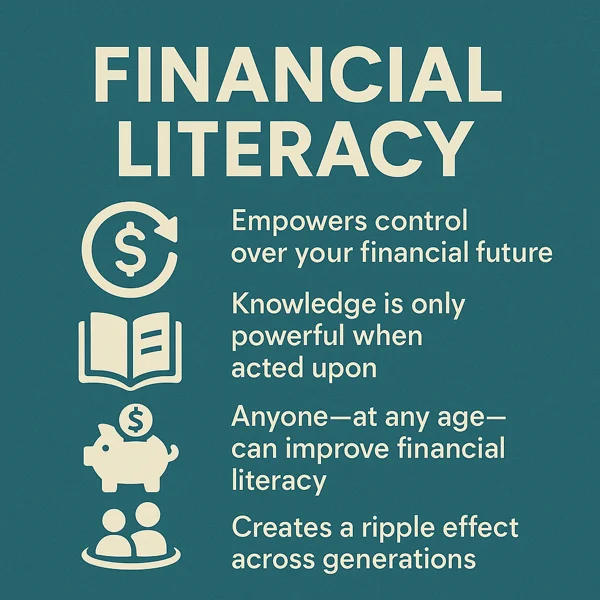
1️⃣ Financial literacy is the foundation of financial freedom.
Understanding how money works—earning, saving, investing, and protecting—gives you control over your financial future instead of leaving it to chance.
2️⃣ Knowledge only matters when it becomes action.
Reading about money is valuable, but applying what you learn—creating a budget, tracking expenses, or starting to invest—is what drives real progress.
3️⃣ It’s never too early or too late to improve your financial skills.
Whether you’re a teen just opening your first bank account or an adult rethinking retirement plans, financial literacy grows with every decision you make.
4️⃣ Money confidence reduces stress and builds lasting security.
When you understand your finances, unexpected bills or market swings no longer feel overwhelming—they become challenges you’re equipped to handle.
5️⃣ Financial literacy creates a ripple effect across generations.
Teaching healthy money habits to children, family, or friends multiplies financial confidence and strengthens community well-being.
6️⃣ The earlier you start, the stronger your foundation becomes.
Time and consistency are your greatest allies. Every dollar saved, debt reduced, or skill learned compounds into long-term financial resilience and freedom.
Empowering yourself with financial knowledge is the first step toward financial independence.
What Is Financial Literacy?
Financial literacy is the ability to understand, manage, and grow your money in a way that aligns with your personal goals and values. It’s not about chasing wealth—it’s about making informed, intentional choices that help you live well today and prepare for tomorrow.
At its heart, financial literacy blends knowledge, behavior, and consistency. Knowing how money works is one part of the equation—applying that knowledge is what transforms it into financial success. For instance, understanding how compound interest works is valuable, but consistently saving or investing to let that interest grow is what builds real wealth over time.
Think of financial literacy as an evolving skill set that empowers you to:
- Make informed financial decisions without fear or confusion.
- Recognize opportunities and risks, from credit offers to investments.
- Adapt to life changes—job shifts, inflation, family needs—without financial chaos.
- Create a sustainable plan that balances current needs with long-term goals.
Key Elements of Financial Literacy
| Element | What It Involves | Why It’s Important |
|---|---|---|
| Budgeting | Tracking income and expenses, setting spending priorities, and aligning money with goals. | Prevents overspending, promotes discipline, and ensures every dollar has a purpose. |
| Saving and Investing | Building emergency funds and using compounding to grow wealth over time. | Creates security in the short term and prosperity in the long term. |
| Credit Management | Understanding credit scores, interest rates, and responsible borrowing. | Builds financial credibility, lowers borrowing costs, and protects against debt traps. |
| Risk Management | Using insurance, diversification, and contingency planning. | Protects your income, health, and assets from unexpected events. |
| Tax Awareness | Knowing how income, deductions, and credits affect your financial plan. | Helps you keep more of what you earn and plan proactively for future obligations. |
Financial literacy isn’t learned overnight—it’s developed through continuous education, hands-on experience, and reflection. Each financial decision—whether paying off debt, adjusting your budget, or starting an investment—teaches you something valuable. Over time, these lessons compound just like interest, strengthening your financial foundation year after year.
The Five Pillars of Financial Literacy
Financial literacy isn’t a single skill—it’s a combination of five interconnected pillars that work together to build financial strength and resilience. Each pillar represents a key area of your financial life. When one is weak, the whole structure can wobble. Strengthening all five creates a foundation that supports stability, independence, and long-term wealth.
1️⃣ Earning – Understanding and Maximizing Your Income
Earning is the foundation of every financial plan. It’s not just about how much you make—it’s about understanding how your income works, how it’s taxed, and how to increase it strategically.
Key Concepts:
- Know the difference between gross pay and net pay (what you actually take home after taxes and deductions).
- Review your pay stubs and withholding allowances to ensure accuracy.
- Diversify income through side hustles, investments, or freelance work.
- Invest in education and certifications that improve your earning potential.
Why It Matters:
The more you understand your earning power, the more effectively you can plan, save, and build wealth. Financially literate individuals treat income as a tool for growth, not just survival.
2️⃣ Spending – Controlling Expenses and Aligning Spending with Values
Spending is where most people lose control—not because they don’t earn enough, but because they don’t know where their money goes.
Mastering this pillar means learning to spend with intention and aligning every dollar with your goals and values.
Key Concepts:
- Create a budget that fits your lifestyle and priorities (try frameworks like the 50/30/20 rule or Hybrid Budgeting™).
- Differentiate between needs, wants, and goals.
- Track every expense for 30 days to identify spending leaks.
- Avoid emotional or impulsive purchases by applying the “24-hour rule.”
Why It Matters:
Intentional spending transforms your finances from reactive to proactive. It’s how you gain control, eliminate debt, and free up money for saving and investing.
3️⃣ Saving – Building Stability and Security
Saving is the act of paying yourself first. It’s about building short-term safety nets and long-term confidence. Without savings, even small setbacks—a car repair, medical bill, or job change—can derail your financial goals.
Key Concepts:
- Establish an emergency fund (3–6 months of expenses).
- Automate transfers to a high-yield savings account.
- Set up goal-based savings (vacations, education, down payments).
- Revisit and adjust your savings goals annually.
Why It Matters:
Savings create stability. They turn unexpected expenses from crises into manageable events and keep you on track toward financial independence.
4️⃣ Investing – Growing Wealth and Beating Inflation
Investing turns money into a wealth-building engine. While saving protects your cash, investing helps it grow and outpace inflation. Financially literate individuals understand the balance between risk and reward, and they use time as their greatest asset.
Key Concepts:
- Learn about stocks, bonds, ETFs, and mutual funds.
- Focus on diversification to manage risk.
- Take advantage of tax-advantaged accounts like 401(k)s, IRAs, and HSAs.
- Understand compound interest and how consistency multiplies results.
Why It Matters:
Investing is how your money works for you—rather than you working for it forever. It’s the bridge between financial comfort and financial freedom.
5️⃣ Protecting – Safeguarding What You’ve Built
The final pillar—often overlooked—is protection. As your financial life grows, so do your responsibilities. Protecting your income, assets, and family ensures that one unexpected event doesn’t undo years of progress.
Key Concepts:
- Maintain adequate insurance coverage (health, life, disability, and property).
- Review beneficiary designations and keep them updated.
- Create or update your estate plan, including wills, powers of attorney, and healthcare directives.
- Consider identity theft protection and emergency backups for digital accounts.
Why It Matters:
Financial protection preserves everything you’ve worked for. It ensures that wealth passes smoothly to your loved ones and that your financial future remains secure no matter what life brings.
📘 Summary Table: The Five Pillars at a Glance
| Pillar | Definition | Why It Matters |
|---|---|---|
| Earning | Understanding income sources, pay structure, and taxes. | Helps you maximize take-home pay and career growth. |
| Spending | Managing expenses with discipline and purpose. | Prevents overspending and aligns money with values. |
| Saving | Setting aside funds for emergencies and goals. | Builds security and creates peace of mind. |
| Investing | Growing wealth through diversified, long-term strategies. | Beats inflation and builds lasting prosperity. |
| Protecting | Using insurance, estate planning, and legal tools. | Safeguards assets and ensures financial continuity. |
Why Financial Literacy Is Essential in 2025
The financial landscape of 2025 is more intricate than ever before. From AI-driven investment platforms to digital-only banks and volatile global markets, the pace of financial innovation far outstrips what most households can keep up with. Financial literacy has become more than a personal skill—it’s a modern survival tool.
Today’s consumers face challenges that require both knowledge and adaptability:
- Persistent inflation continues to erode purchasing power, increasing the true cost of everything from groceries to housing.
- Variable interest rates and fluctuating credit conditions make borrowing riskier and repayment strategies more important than ever.
- Gig-economy and self-employed workers now make up a record share of the workforce, but many lack access to employer-sponsored retirement plans or health benefits.
- Digital finance—including cryptocurrency, online lending, and payment apps—offers convenience but introduces privacy, security, and regulatory risks.
- AI and algorithmic investing have democratized market access while also creating new complexities around data usage, bias, and investor behavior.
Against this backdrop, financial literacy gives you the tools to interpret change, assess risk, and make informed decisions. It transforms uncertainty into opportunity.
According to the National Financial Educators Council (NFEC), the average American lost $1,819 in 2023 due to poor financial decisions and lack of knowledge. That’s nearly a month’s rent in many states—money that could have gone toward debt reduction, savings, or investments.
In 2025, being financially literate isn’t just about balancing a budget. It’s about building resilience in a world where markets, technologies, and policies shift daily. The financially literate individual can:
- Decode complex financial products and avoid scams.
- Anticipate how interest-rate changes affect loans or investments.
- Leverage digital tools safely to automate savings and grow wealth.
- Navigate the transition to self-employment or new economic models confidently.
In short, financial literacy is the bridge between financial survival and financial success.
The Benefits of Being Financially Literate
Becoming financially literate changes every aspect of how you live and plan for the future. It moves you from reaction to intention—giving you control over money instead of letting money control you.
1️⃣ Control and Confidence
Financial literacy helps you make proactive decisions about your income, spending, and investments. You know where your money goes, why it matters, and how to adjust when life changes. This clarity builds lasting confidence and independence.
2️⃣ Smarter Decision-Making
Understanding key principles like interest rates, credit utilization, compound growth, and risk diversification enables you to evaluate options rationally—whether choosing a mortgage, refinancing debt, or investing for retirement.
3️⃣ Reduced Financial Stress
When you maintain a working budget, emergency fund, and debt-repayment plan, financial shocks become manageable rather than catastrophic. Studies consistently show that financial literacy reduces anxiety and improves overall well-being.
4️⃣ Long-Term Wealth Creation
Knowledge of investing, compounding, and tax optimization allows you to build wealth intentionally over time. Even modest, consistent investing can create substantial growth when guided by sound principles and discipline.
5️⃣ Generational Impact
Financial literacy multiplies its impact through teaching. Parents who model and share financial skills raise children who are more likely to budget, save, and invest early—breaking cycles of debt and dependence.
6️⃣ Economic Empowerment
On a larger scale, financially literate citizens strengthen the economy. They save more, default less, and invest in their communities. When individuals thrive financially, neighborhoods, schools, and local businesses grow stronger too.
In Summary
In a rapidly changing economy, financial literacy equals adaptability. It helps you protect what you have, grow what you earn, and pass on knowledge that empowers others. The more you understand about money, the more control you gain over your financial destiny—and that’s the essence of true financial freedom.
The Costs of Not Being Financially Literate
Financial literacy doesn’t just build wealth—it prevents loss.
The absence of financial understanding carries a tangible, measurable price tag. When people don’t know how interest compounds, how credit works, or how to budget effectively, the result isn’t just stress—it’s lost money, lost opportunities, and diminished security.
1️⃣ The Real Financial Cost
According to the National Financial Educators Council (NFEC), the average American lost $1,819 in 2023 due to financial mistakes that could have been avoided with better knowledge. That’s roughly:
- Two months of groceries for a family of four,
- Or one full year of basic emergency fund contributions.
Common avoidable costs include:
- Paying high credit card interest due to unpaid balances.
- Taking out loans with unfavorable terms.
- Missing out on employer 401(k) matches.
- Overpaying taxes or fees through misunderstanding.
- Falling prey to scams or “too good to be true” investments.
Individually, these losses seem small—but over time, they compound. A financially uninformed household may lose tens of thousands of dollars over a lifetime simply from inaction or misinformation.
2️⃣ The Emotional and Psychological Toll
Money stress is one of the most common forms of chronic anxiety in America.
- A 2024 APA survey found that 72% of adults report money as a major source of stress.
- Financial insecurity contributes to insomnia, relationship tension, and burnout.
- Those who lack confidence in financial decision-making are far more likely to delay care, miss payments, or avoid planning altogether.
Without literacy, money becomes a source of fear rather than empowerment. That fear often leads to avoidance behaviors—skipping bills, ignoring bank statements, or overspending to feel temporary relief.
3️⃣ The Generational Impact
Financial illiteracy doesn’t end with one person—it spreads.
Children who grow up in households where money is a source of conflict or secrecy often repeat those patterns as adults. Without financial education, they enter adulthood unprepared to manage debt, credit, or long-term savings.
Conversely, research from the FINRA Investor Education Foundation shows that households where financial discussions are open and educational see higher savings rates and better long-term stability.
Financial literacy, when taught and modeled, breaks cycles of stress and dependence.
4️⃣ The Opportunity Cost
Ignorance about how money grows quietly steals future wealth.
For example:
- Not investing $200 per month starting at age 25 could cost over $400,000 in lost growth by retirement.
- Missing tax advantages—like Roth IRA contributions or HSA deductions—can forfeit thousands in potential savings.
- Delaying debt repayment or refinancing can add years and thousands of dollars in unnecessary interest.
Financial literacy ensures that opportunities for wealth creation aren’t lost to confusion or hesitation.
5️⃣ The Societal Cost
On a national scale, financial illiteracy affects economic resilience.
High debt loads, low savings rates, and widespread financial insecurity strain social programs and reduce overall productivity.
Economists estimate that poor financial decision-making costs the U.S. economy hundreds of billions of dollars annually through lost consumer confidence, higher default rates, and lower investment participation.
In Summary
The true cost of financial illiteracy isn’t just financial—it’s emotional, generational, and societal, it drains household budgets, undermines confidence, and perpetuates inequality.
The good news? Every step toward learning—reading a guide, setting a budget, tracking expenses—turns knowledge into power.
Financial education doesn’t just protect your wallet; it protects your peace of mind, your family’s stability, and your future freedom.
Common Financial Literacy Gaps
Even well-educated, high-income individuals can fall short when it comes to true financial literacy. In fact, research from the FINRA Investor Education Foundation shows that only 37% of U.S. adults can correctly answer basic financial knowledge questions—proof that income and intelligence aren’t substitutes for understanding how money works.
Financial illiteracy doesn’t always look like neglect—it often hides behind daily habits, assumptions, or emotional avoidance. Below are the most common gaps that prevent people from achieving lasting financial confidence.
1️⃣ Credit and Debt Misunderstanding
Many people fail to grasp how credit scores are calculated or how credit utilization affects borrowing power. Carrying high balances—even without missing payments—can lower credit scores and raise future borrowing costs.
Common Mistakes:
- Paying only the minimum balance on high-interest cards.
- Closing old credit lines, which reduces credit history length.
- Ignoring utilization ratios (aim to stay below 30% of your total available credit).
Quick Fix:
Check your credit report at least once a year through AnnualCreditReport.com, and use tools like Experian Boost or Credit Karma to monitor changes.
2️⃣ Confusion About Compound Interest and Investment Risk
Compound interest can be your best friend—or your worst enemy. Too many people underestimate how interest accumulates on debt while failing to harness it for long-term investing.
Common Mistakes:
- Believing investing is “only for the wealthy.”
- Avoiding markets due to fear of volatility.
- Keeping too much in low-yield savings accounts.
Quick Fix:
Learn the “Rule of 72”—divide 72 by your expected annual return to estimate how long it takes for your money to double. Even modest investments made early can multiply dramatically over decades.
3️⃣ Underestimating Insurance and Risk Management
Insurance is often viewed as an expense, not a financial safeguard. Many households are underinsured in key areas like disability or life coverage, while overpaying for policies they don’t need.
Common Mistakes:
- Skipping renter’s or disability insurance due to cost concerns.
- Not reviewing beneficiary designations or coverage limits regularly.
- Overlooking long-term care planning until it’s too late.
Quick Fix:
Review your coverage annually and focus on protecting income first—the most valuable asset most people have.
4️⃣ Ignoring Retirement Planning Until Too Late
Retirement readiness is one of the largest gaps in financial literacy. Many people delay saving, assuming there’s time later—only to discover how much they’ve lost to procrastination and missed compounding.
Common Mistakes:
- Contributing too little to retirement accounts.
- Not taking advantage of employer matches.
- Keeping all assets in cash or overly conservative funds.
Quick Fix:
Start now—even small automatic contributions make a huge impact over time. Use online retirement calculators to visualize how early investing shortens your work horizon.
5️⃣ Taxes and Inflation Blind Spots
Two of the most misunderstood forces in personal finance are taxation and inflation. Both quietly erode income and savings if not managed strategically.
Common Mistakes:
- Failing to plan for annual tax liabilities.
- Overlooking inflation’s impact on purchasing power.
- Ignoring the benefits of tax-advantaged accounts (401(k), IRA, HSA).
Quick Fix:
Integrate tax planning into your year-round financial habits, not just during filing season. Adjust savings and investments annually for inflation.
6️⃣ Behavioral and Emotional Barriers
Finally, financial literacy isn’t just about math—it’s about mindset. Fear, avoidance, and emotional spending derail even the best plans.
Common Mistakes:
- Avoiding financial discussions due to shame or confusion.
- Using shopping or entertainment as emotional relief.
- Letting short-term emotions override long-term goals.
Quick Fix –
Replace guilt with curiosity. Schedule monthly “money check-ins” with yourself or your partner. Use automation to take emotion out of saving and investing decisions.
Summary
Recognizing these gaps is the first step toward progress. Once you identify where your weaknesses lie—whether in credit, risk, or mindset—you can turn blind spots into strengths.
Financial literacy isn’t perfection—it’s evolution. Every new skill learned closes the gap between uncertainty and confidence, moving you closer to lasting financial independence.the first step toward correcting them.
How to Improve Your Financial Literacy
Building financial literacy is a lifelong journey, not a one-time class.
1. Read and Learn Regularly
Explore credible resources—like the CFP Board, FINRA Foundation, or educational platforms such as Jason’s Fin Tips. Aim to learn one new concept each week.
2. Use Financial Tools and Apps
Track spending and investments with tools like:
- YNAB (You Need a Budget)
- Mint or Monarch Money
- Personal Capital / Empower
- Credit Karma or Experian
3. Practice Hands-On Learning
Start small—create a budget, open an IRA, or set up automatic transfers. Learning by doing reinforces financial habits.
4. Consult Professionals
A CERTIFIED FINANCIAL PLANNER™ (CFP®) or Chartered Financial Consultant® (ChFC®) can help you build a personalized financial plan.
5. Stay Informed
Follow reputable financial news outlets. Economic trends—interest rates, inflation, job markets—affect your daily decisions more than you might think.
Financial Literacy Across Life Stages
Financial literacy evolves throughout your life. What matters most in your teens isn’t what matters at 50—and that’s the beauty of financial growth. Each stage brings new priorities, responsibilities, and opportunities to refine your money skills.
| Life Stage | Financial Focus Areas & Practical Tips |
|---|---|
| Teens & Students | Build financial awareness early. Learn budgeting basics and the difference between needs and wants. Open a savings account, set short-term goals, and understand the power of compound interest. Avoid debt traps like high-interest credit cards or “buy now, pay later” schemes. A small habit—like saving 10% of an allowance—can shape lifelong behavior. |
| Young Adults (20s–30s) | Lay the foundation for financial independence. Focus on credit building, managing student loans, and developing a strong emergency fund. Start investing early through workplace retirement plans or IRAs—even small amounts matter. Automate bill payments and savings to reduce decision fatigue. Prioritize paying off high-interest debt while still contributing to long-term goals. |
| Mid-Career (40s–50s) | Optimize, protect, and plan ahead. This is your prime earning stage, but also when expenses peak (mortgage, kids, college costs). Maximize retirement contributions, diversify investments, and review insurance coverage. Revisit your tax strategy—deductions, Roth conversions, and health savings accounts can all add up. Begin estate planning to ensure your family’s financial continuity. |
| Pre-Retirement (50s–60s) | Shift from accumulation to preservation. Evaluate your retirement readiness—calculate expected expenses, income streams, and Social Security timing. Rebalance investments to lower risk exposure while maintaining growth potential. Review healthcare and long-term care options, and finalize estate documents such as wills and beneficiary designations. |
| Parents (Any Age) | Teach by example. Model healthy financial behavior for your children. Involve them in small money discussions—saving for a goal, budgeting for a trip, or comparing prices. Introduce age-appropriate financial tools, like savings jars for young kids or debit cards for teens. The lessons you teach today will shape their relationship with money for life. |
Each life stage brings new opportunities to learn, adapt, and strengthen your financial strategy. The key is to remain flexible—your financial literacy should grow as your life evolves.
The Psychology of Money
Financial success isn’t just mathematical—it’s deeply emotional. Behind every financial decision lies a mix of psychology, habit, and mindset. Understanding how you think about money is as critical as knowing how to earn it.
Emotions Drive Decisions:
Fear, stress, overconfidence, scarcity, and instant gratification often shape spending and investing behaviors more than logic does. For instance, fear may cause someone to avoid investing altogether, while overconfidence might push another to take unnecessary risks.
Know Your Financial Personality:
Ask yourself: Am I a Saver, Spender, Avoider, or Planner?
- Savers value security but may struggle to enjoy their money.
- Spenders enjoy experiences but risk lifestyle inflation.
- Avoiders ignore finances to escape stress, often worsening it.
- Planners thrive on structure but must guard against rigidity.
Recognizing your dominant type helps you make balanced choices and counteract emotional bias.
Behavioral Finance Insights:
Research shows that automatic systems outperform willpower. People who automate savings or debt payments are far more likely to succeed financially because they remove emotion from the equation. Simple strategies—like scheduling transfers right after payday or using “round-up” savings apps—create progress without daily decision fatigue.
Mindset Matters:
Adopt a growth mindset about money. Mistakes aren’t failures—they’re feedback. Every budgeting error, impulse purchase, or missed goal offers data you can learn from. Over time, self-awareness and small habit improvements compound into major results.
Practical Takeaways:
- Replace guilt-based budgeting with goal-based planning.
- Use visual tools—like progress trackers or savings charts—to stay motivated.
- Revisit your money goals quarterly to stay aligned with changing priorities.
- Celebrate small wins—consistency, not perfection, builds wealth.
Ultimately, mastering the psychology of money means mastering yourself. Financial literacy isn’t just about what you know—it’s about how you think, feel, and act when managing your financial life.
Authentic Financial Goal Setting – Aligning Money With What Truly Matters
Setting goals is easy; setting authentic goals is transformative. True financial success isn’t about achieving arbitrary numbers—it’s about building a life that reflects your values, priorities, and purpose.
1️⃣ Start With Self-Reflection
Before setting financial targets, ask yourself:
- What does financial freedom look like for me personally?
- What experiences, not possessions, bring me fulfillment?
- How do my financial goals support my relationships, health, and long-term happiness?
Authentic goals stem from clarity of purpose, not comparison. Avoid setting goals because “everyone else” is investing in real estate or starting side hustles. Define success on your own terms.
2️⃣ Make Goals SMART—and Meaningful
The traditional SMART framework (Specific, Measurable, Achievable, Relevant, Time-bound) works best when anchored in authenticity.
For example:
- Instead of “I want to make more money,” try “I’ll increase my income by $5,000 this year to fund my child’s college savings plan.”
- Instead of “I want to save more,” say “I’ll set up automatic transfers of $300 a month toward a six-month emergency fund by next spring.”
3️⃣ Balance Short-Term and Long-Term Vision
Authentic goals blend today’s satisfaction with tomorrow’s security. Budget for experiences that enrich your life now—while still protecting your future through savings and investing.
4️⃣ Revisit and Adjust
Life evolves—so should your goals. Review them at least twice a year. Celebrate milestones and adjust timelines as needed without guilt. Growth, not perfection, defines financial progress.
Authentic financial goals create alignment between your money and your values. When your financial decisions serve your purpose, discipline feels natural—and wealth becomes a tool for fulfillment, not stress.
Money, Relationships, and Emotional Health – Reducing Stress and Building Harmony
Money is one of the most common sources of conflict in relationships. Yet when managed with transparency and teamwork, it can become a powerful tool for connection and security.
1️⃣ Open Communication Builds Trust
Honest conversations about money—income, debt, goals, and fears—create mutual understanding. Avoid blame and focus on shared solutions. Use language like “we” instead of “you.”
Regularly review budgets together and agree on spending priorities. Couples who discuss finances at least once a month report higher satisfaction and lower stress in studies from the Journal of Family and Economic Issues.
2️⃣ Define Roles and Systems
Partnerships thrive on structure.
- Decide who manages which financial tasks (paying bills, tracking expenses, overseeing investments).
- Create joint goals—like saving for a home or planning a family trip—alongside individual “fun money” accounts for autonomy.
- Use shared financial tools such as Honeydue, Monarch Money, or YNAB to stay aligned in real time.
3️⃣ Build Empathy Around Financial Backgrounds
Everyone brings unique money experiences from childhood—scarcity, abundance, or financial trauma. Recognizing these emotional roots helps reduce judgment and increase compassion. Financial literacy, when shared, bridges those gaps and builds mutual respect.
4️⃣ Protect Family Well-Being
Financial stress affects emotional health, sleep, and even physical wellness. Create buffers:
- Maintain a family emergency fund for peace of mind.
- Discuss insurance, estate plans, and safety nets together.
- Teach children about money in age-appropriate, positive ways to prevent future anxiety.
5️⃣ Celebrate Wins Together
Small victories—paying off debt, reaching savings milestones, or sticking to a budget—deserve celebration. Shared recognition reinforces teamwork and motivation.
Healthy financial relationships are rooted in empathy, communication, and shared vision. When money becomes a topic of collaboration rather than conflict, families experience less stress, stronger bonds, and greater emotional security.
Conclusion – Financial Literacy Is the Gateway to Freedom
Financial literacy isn’t about perfection—it’s about progress. Every budgeting habit, savings goal, or investment you make moves you closer to independence.
In an unpredictable economy, the best investment you can make is in your own financial education. Knowledge compounds just like interest—it grows stronger over time.
📘 Take Action:
Visit the Financial Education Hub on Jason’s Fin Tips to explore free guides, checklists, and educational tools that help you master your money—one smart decision at a time.