✅ Key Takeaways: What You Need to Know About Debt Consolidation
- Debt Consolidation Simplifies and Organizes Your Finances
Combining multiple debts into one payment streamlines your financial obligations, reduces the risk of missed payments, and lowers stress. - Lower Interest Rates Can Lead to Major Savings
Replacing high-interest credit card debt with a lower-rate loan or balance transfer can save you hundreds—or even thousands—over time. - Multiple Consolidation Methods Are Available
From personal loans and 0% balance transfer credit cards to home equity loans and nonprofit Debt Management Plans (DMPs), each method offers unique benefits and risks. Choosing the right fit depends on your credit profile, income, and financial goals. - Discipline is the Key to Long-Term Success
Debt consolidation is not a cure-all. It requires a commitment to budgeting, avoiding new debt, and making consistent on-time payments to truly succeed. - Don’t Overlook Alternatives
For some, strategies like the Balanced Path™ or Summit Strategy™, or alternatives like the snowball or avalanche repayment methods, creditor negotiation, or—in severe cases—bankruptcy, may be more effective or appropriate. - Mental Clarity and Confidence Often Improve
Beyond the numbers, consolidation can also reduce financial anxiety, improve mental focus, and help you regain a sense of control over your financial journey.
🧭 Introduction – Regain Control of Your Finances with Debt Consolidation
Juggling multiple payments, rising interest rates, and financial stress? You’re not alone. Debt consolidation can streamline your finances and reduce long-term costs—if used strategically. In this guide, you’ll discover what debt consolidation is, how it works, when it makes sense, and how to use it effectively to break free from debt.
💬 “The first step to financial freedom is taking control of your story.”
💡 What Is Debt Consolidation?
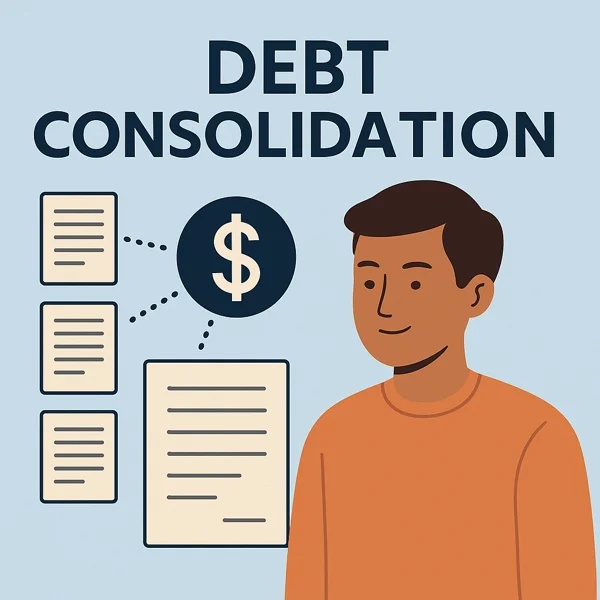
Debt consolidation means combining multiple debts—like credit cards, medical bills, or personal loans—into one monthly payment. This is typically done through a new loan or balance transfer that ideally has a lower interest rate.
Common Reasons to Consolidate Debt:
- High interest on credit cards or payday loans.
- Too many payments causing confusion or late fees.
- Financial anxiety from juggling creditors and missed due dates.
💬 “You don’t have to be rich to be financially free—you just need a plan.”
🔄 How Debt Consolidation Works: Step-by-Step
- Evaluate Your Current Debts
- List your balances, due dates, and interest rates.
- Explore Consolidation Methods
- See options below: loans, balance transfers, DMPs.
- Apply and Qualify
- Submit an application based on creditworthiness.
- Use Funds to Pay Off Existing Debt
- Make One Monthly Payment
- Stick to a consistent, budgeted repayment plan.
🧰 Common Methods of Debt Consolidation
Choosing the right consolidation method depends on your financial goals, credit profile, and whether you own assets. Here’s a more in-depth comparison:
| Method | Best For | Pros | Cons | Example Use Case |
|---|---|---|---|---|
| Personal Loan | Borrowers with good credit | Fixed rate, predictable terms | Higher rates if credit is poor | $10K @ 9% to pay off 22% cards |
| Balance Transfer Credit Card | Those who can repay in 12–18 months | 0% promo APR, no loan needed | High fees, big penalty if promo lapses | $7K balance paid in 15 months |
| Home Equity Loan or HELOC | Homeowners with equity | Low rates, large loan amounts | Risk of foreclosure | $25K HELOC to pay off credit cards |
| Debt Management Plan (DMP) | Consumers overwhelmed by unsecured debt | Guided support, lower negotiated rates | Monthly fees, credit impact | 4-year nonprofit repayment plan |
💡Tip: Always compare at least three offers and read the fine print.
🎯 Benefits of Debt Consolidation
- ✅ Simplified Finances: Fewer due dates, one payment.
- ✅ Lower Interest Rates: Saves money long-term.
- ✅ Improved Credit Utilization: May help your score.
- ✅ Mental Relief: Reduced financial anxiety.
- ✅ Budget Clarity: Predictable fixed payments.
| Benefit | Example Impact |
|---|---|
| Lower Rate | 22% to 9% APR = ~$2,000 saved on $10K in 3 years |
| Fewer Payments | 5 cards → 1 monthly bill |
| Score Boost | Lower utilization improves credit over time |
🧠 Why Simplifying Debt Can Improve Your Mental Health
Debt is more than just numbers—it’s emotional. Managing five or six different bills, due dates, and interest rates can create decision fatigue and mental clutter, which spills into every part of life.
Psychological Benefits of Debt Consolidation:
- ✅ Reduces anxiety by limiting the number of accounts to manage
- ✅ Boosts confidence by creating visible progress
- ✅ Restores focus so you can work on goals like saving or investing
- ✅ Improves sleep and overall wellness
💬 “Financial peace isn’t about having more money—it’s about having fewer worries.” — Jason B. Ball
⚠️ Drawbacks and Risks to Watch Out For
- 💸 Fees: Balance transfer or origination costs.
- 🕒 Longer Terms: More interest over time if stretched.
- 🏠 Risk of Collateral: Home equity loans put your house at risk.
- 🔁 Revolving Debt Risk: New debt can spiral if discipline lapses.
| Risk | Example |
|---|---|
| Transfer Fee | 3% on $10,000 = $300 cost |
| Over-borrowing | Paying off cards, then using them again |
🧠 Is Debt Consolidation Right for You?
Ask Yourself:
- Do I qualify for a lower interest rate?
- Am I committed to not accumulating more debt?
- Is my debt manageable but disorganized?
It’s a Good Fit If:
- You have stable income and fair-to-good credit.
- Your debts are unsecured (credit cards, personal loans).
- You need help staying organized.
🛠️ Tips for a Successful Debt Consolidation Journey
| Tip | Action |
|---|---|
| Research Lenders | Compare at least 3 consolidation options. |
| Budget First | Use apps like YNAB, Mint, or spreadsheets. |
| Avoid New Debt | Don’t reuse paid-off credit cards. |
| Verify Lenders | Avoid scams—check BBB or CFPB listings. |
| Get Help | Consider a certified credit counselor. |
📊 Estimate Your Interest Savings with a Simple Formula
Here’s how to get a quick estimate of how much debt consolidation could save you:
Formula:
(Old Interest Rate – New Interest Rate) × Total Debt × Average Loan Term (in years)
Example:
- You have $10,000 in credit card debt at 22%
- You qualify for a personal loan at 9%
- Repayment term: 3 years
Savings = (0.22 – 0.09) × $10,000 × 3 = $3,900
Even after fees, that’s a substantial savings.
💬 “Don’t just look at the monthly payment—look at the lifetime cost of your debt.”
🧭 Strategies – Balanced Path™ vs. Summit Strategy™
To help clients navigate the debt payoff process, we’ve developed two proprietary strategic frameworks:
🔹 Balanced Path™
This approach merges the psychological win of the snowball method with the efficiency of the avalanche method. You pay off a small account first, then shift to high-interest debts.
Ideal for: People who need early wins to stay motivated but still want long-term savings.
| Feature | Benefit |
|---|---|
| First payoff = smallest debt | Confidence boost |
| Next = highest APR | Accelerates savings |
| Monthly review | Keeps progress on track |
🔸 Summit Strategy™
This method prioritizes maintaining an emergency fund while aggressively tackling debt with the highest interest rates.
Ideal for: Households that want to avoid the cycle of re-borrowing when emergencies hit.
| Feature | Benefit |
|---|---|
| Build $1,000+ reserve | Prevents backsliding |
| Attack high-interest debts | Optimizes cost savings |
| Strategic “no spend” weeks | Speeds up payoff |
💬 “You can’t climb a mountain without footing. That’s what the Summit Strategy™ gives you—financial traction.” — Jason B. Ball
📈 Scenarios of Debt Consolidation Success
Scenario 1: Credit Card Relief
Amy had $10,000 across 3 cards at 22% interest. She secured a personal loan at 9% and saved over $2,000 in interest, finishing her payments in 36 months.
Scenario 2: Home Equity Leverage
Mark used a HELOC to consolidate $30,000 in debt. With a 5-year repayment plan and steady budgeting, his monthly payments dropped by 40%.
🧪 Is Debt Consolidation Right for You? Take This Quick Quiz
Answer these five questions to find out if consolidation might be a fit:
- How much total unsecured debt do you have?
- ☐ Less than $5,000
- ☐ $5,000–$25,000
- ☐ More than $25,000
- What’s your credit score range?
- ☐ Above 720 (Excellent)
- ☐ 660–719 (Good)
- ☐ Below 660 (Fair or Poor)
- Do you own a home or have equity access?
- ☐ Yes
- ☐ No
- Can you commit to NOT using credit cards again during repayment?
- ☐ Yes
- ☐ Unsure
- ☐ No
- How confident are you in managing a monthly budget?
- ☐ Very
- ☐ Somewhat
- ☐ Not at all
Results:
⚠️ Mostly C answers: You may need more foundational financial support before consolidating.
✅ Mostly A/B answers: Debt consolidation may be a good strategy.
🧘 Inspirational Quotes to Encourage Your Journey
💬 “Getting out of debt is like losing weight—it takes discipline, consistency, and belief in a better future.”
⚠️ How to Spot Debt Consolidation Scams and Red Flags
Unfortunately, not all consolidation offers are legitimate. Here’s how to protect yourself:
🚩 Common Red Flags:
- Guaranteed approval regardless of credit
- Upfront fees before services are provided
- No verifiable contact info (no phone number, no address)
- High-pressure tactics or threatening language
- Claims to “wipe away” debt magically
✅ What to Look For Instead:
- Licensed lenders or nonprofit credit counseling agencies
- Transparency about terms, interest rates, and fees
- BBB accreditation or CFPB complaint record
- Referrals from trusted sources
📞 Tip: If in doubt, call your state’s Department of Financial Regulation to verify legitimacy.
🔚 Conclusion
Debt consolidation is more than just simplifying payments—it’s a gateway to financial clarity. With the right plan, tools, and mindset, you can reduce stress, save money, and take back control of your financial life.
Not sure if consolidation is your best option? Explore more financial guides on Jason’s Fin Tips or connect with a nonprofit credit counselor for personalized help.
Check out other posts
- Understanding Secured vs. Unsecured Loans for Consolidation
- Alternatives to Debt Consolidation – Exploring Other Debt Solutions