Introduction
The creator economy has unlocked something powerful—control over your income, your schedule, and your creative direction. Platforms like YouTube, podcasts, and subscription communities have made it possible to build a business on your own terms.
But there’s a trade-off most creators don’t fully recognize at first.
When you step outside traditional employment, you also step outside the system that quietly provides financial stability behind the scenes.
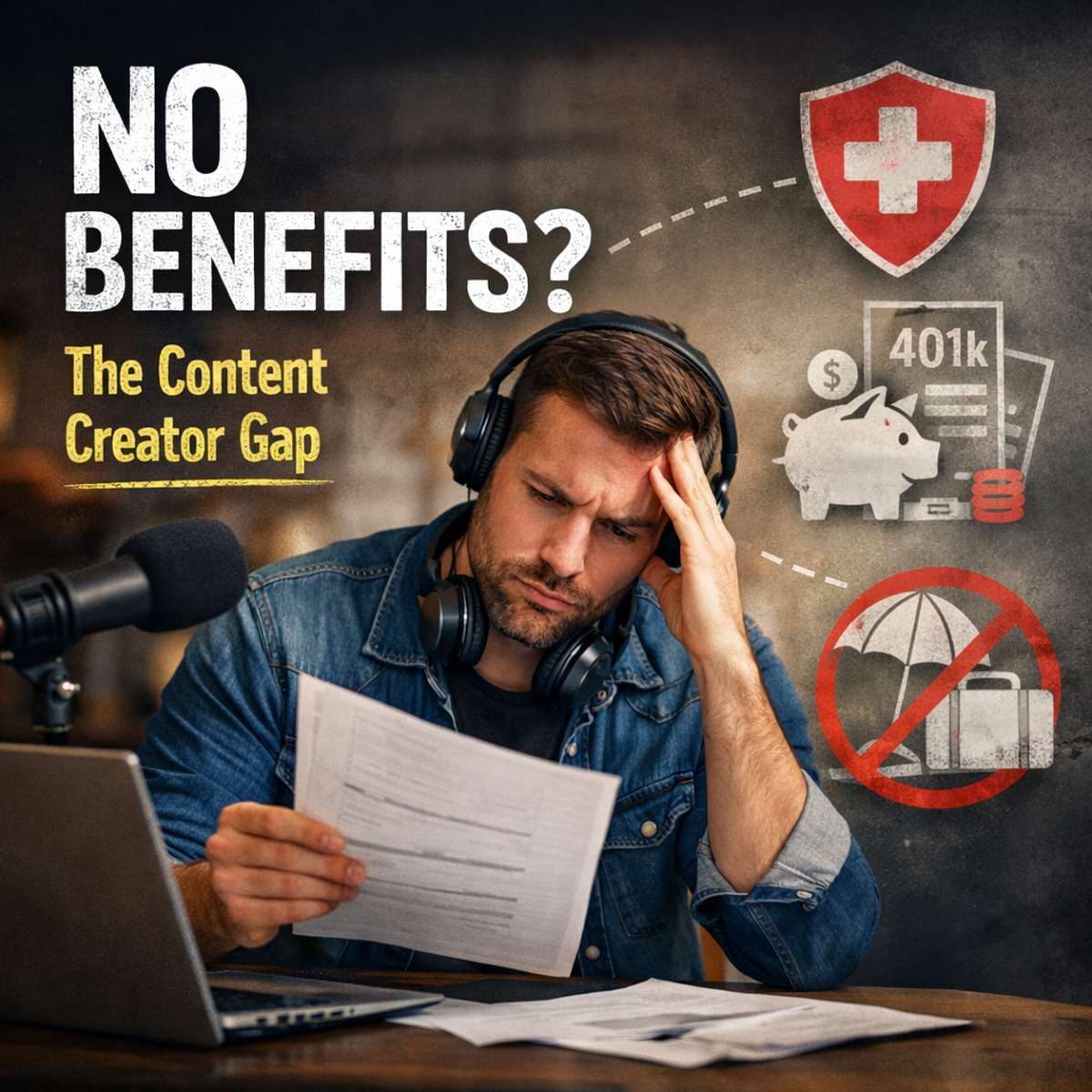
Unlike W-2 employees, most content creators operate as self-employed individuals. That means:
- No employer-sponsored health insurance
- No automatic retirement contributions
- No paid time off
- No built-in financial protections
The Reality
Creative independence doesn’t eliminate responsibility—it transfers it.
You are no longer just the creator. You are also:
- The HR department
- The benefits manager
- The retirement planner
- The risk manager
And if those roles aren’t addressed intentionally, income alone won’t translate into long-term financial stability.
👉 This guide breaks down what creators are missing, what those benefits actually cost, and how to rebuild a system that protects your income, your health, and your future.
🔑 Key Takeaways (Quick-Read Section)
- Content creators typically do not receive employer-sponsored benefits
- Missing benefits include health insurance, retirement plans, paid leave, and disability coverage
- Self-employed individuals must build their own “benefits system”
- Strategic planning can replicate—and in some cases improve—traditional benefits
- Ignoring this gap can lead to long-term financial instability, even with strong income
Section 1: What Are “Traditional Employment Benefits”?
Define Core Benefits
When most people think about compensation, they focus on salary. But for traditional employees, total compensation goes far beyond a paycheck.
Employers often provide a structured package of financial protections and long-term benefits, including:
- Health insurance (medical, dental, vision)
- Retirement plans (such as a 401(k) with employer matching contributions)
- Paid time off (PTO) including vacation, sick leave, and holidays
- Disability insurance (short-term and long-term income protection)
- Life insurance coverage
- Unemployment insurance protections
- Workers’ compensation for job-related injuries
These benefits are not minor perks—they are a foundational part of financial stability.
The Hidden Value of Benefits
According to data from the U.S. Bureau of Labor Statistics, employer-provided benefits can account for approximately 20% to 40% of total compensation.
That means:
- A $70,000 salary could represent $85,000–$98,000 in total value
- A $100,000 salary could actually reflect $120,000–$140,000 in full compensation
👉 For content creators, this is the key shift:
You may earn income—but you are also responsible for replacing the entire benefits structure that employees receive automatically.
Why This Matters Moving Forward
If you don’t account for benefits, you risk overestimating your financial position.
But if you build your own system intentionally, you can:
- Customize your coverage
- Optimize for tax efficiency
- Build long-term wealth on your terms
The difference isn’t income—it’s structure.
Section 2: Why Content Creators Don’t Receive These Benefits
Understanding why benefits are missing is the first step toward rebuilding them effectively.
Structural Differences
Content creators operate under a fundamentally different system than traditional employees:
- Classified as self-employed or independent contractors
Most creators are not employees—they are business owners in the eyes of the IRS. - Platforms are distribution channels—not employers
Whether you earn income from YouTube, Patreon, or other platforms, these companies facilitate revenue—they do not provide benefits. - No HR department or employer-sponsored plans
There is no automatic enrollment, no employer contribution, and no centralized system managing your financial protections.
👉 In short: creators operate outside the traditional employment infrastructure.
Income Model Impact
The way creators earn money directly affects their ability to access benefits:
- Revenue varies month-to-month
Irregular income makes it harder to commit to consistent contributions. - No automatic payroll deductions or contributions
Unlike W-2 employees, nothing is withheld for taxes, retirement, or insurance. - Benefits must be manually selected, funded, and managed
Every decision—from health coverage to retirement savings—is fully self-directed.
👉 This creates both a challenge and an opportunity:
You have complete control—but also full responsibility.
Creator vs Traditional Employee Comparison
| Category | Traditional Employee | Content Creator |
|---|---|---|
| Income Stability | Consistent paycheck | Variable / irregular income |
| Health Insurance | Employer-sponsored | Self-funded |
| Retirement | Employer match (401k) | Fully self-funded |
| Paid Time Off | Paid | Unpaid |
| Taxes | Split with employer | Pays full self-employment tax |
| Benefits Management | Handled by employer | Fully self-managed |
Section 3: The Real Cost of Missing Benefits
The absence of benefits isn’t just an inconvenience—it’s a financial gap that must be filled.
Financial Impact Breakdown
Here’s what traditional employees often receive—and what creators must replace:
| Benefit Type | Typical Employer Value | What Creators Must Cover |
|---|---|---|
| Health Insurance | $5,000–$15,000/year | 100% out-of-pocket premiums |
| Retirement Match | 3–6% of salary | Fully self-funded contributions |
| Paid Time Off | 2–4 weeks paid | Lost income when not working |
| Disability Insurance | Employer-paid or subsidized | Private policy costs |
| Life Insurance | Often included | Must purchase independently |
👉 Key Insight:
Your income is not your true income without benefits.
Why This Matters Financially
When you ignore benefits, you may unintentionally:
- Overestimate your available income
- Under-save for long-term goals
- Leave yourself exposed to financial risk
A creator earning $75,000 without benefits may have less usable financial security than an employee earning $60,000 with full benefits.
👉 This is where strategic planning becomes critical.
Benefits Replacement Cost by Income Level
| Annual Income | Estimated Benefits Cost (25–40%) | Remaining Usable Income (Approx.) |
|---|---|---|
| $40,000 | $10,000 – $16,000 | $24,000 – $30,000 |
| $75,000 | $18,750 – $30,000 | $45,000 – $56,250 |
| $100,000 | $25,000 – $40,000 | $60,000 – $75,000 |
Section 4: Health Insurance for Content Creators
Health insurance is often the most immediate and expensive gap creators face—and the one with the highest financial risk if ignored.
Options Available
Content creators have several paths to secure coverage:
- Marketplace plans via the Affordable Care Act
- Access through Healthcare.gov or state exchanges
- May qualify for income-based subsidies
- Private insurance plans
- Purchased directly through insurers or brokers
- Often more customizable, but may be more expensive
- Health Sharing Ministries (with caution)
- Not traditional insurance
- Limited protections and exclusions may apply
- Spouse or partner coverage
- Often the most cost-effective option if available
Key Considerations
Choosing the right plan requires balancing cost, risk, and coverage:
- Premium vs. deductible trade-offs
Lower premiums often mean higher out-of-pocket costs—and vice versa - Income-based subsidies
Many creators qualify for reduced premiums depending on income level - Out-of-pocket maximums
This is your true worst-case financial exposure in a given year
👉 A low monthly premium doesn’t always mean lower total cost.
Strategic Insight
Health insurance is not just an expense—it’s a risk management tool.
One unexpected medical event without coverage can erase years of financial progress.
👉 Internal Link Opportunity:
Health Insurance Guide for Self-Employed Creators
This deeper guide can walk readers through plan selection, subsidy optimization, and cost comparisons.
Health Insurance Plan Comparison
| Plan Type | Monthly Premium | Deductible | Best For |
|---|---|---|---|
| Bronze | Low | High | Healthy individuals, low usage |
| Silver | Moderate | Moderate | Balanced coverage + subsidies |
| Gold | High | Low | Frequent healthcare needs |
Section 5: Retirement Planning Without an Employer
One of the biggest financial gaps for content creators is the absence of employer-sponsored retirement plans—especially the employer match, which is essentially free money in traditional jobs.
When you’re self-employed, retirement planning becomes fully self-directed.
Self-Employed Retirement Options
Content creators still have access to powerful retirement tools—you just have to set them up yourself:
- Traditional IRA / Roth IRA
- Simple and accessible
- Ideal starting point for new creators
- SEP IRA (Simplified Employee Pension)
- Higher contribution limits
- Based on a percentage of income
- Solo 401(k)
- Combines employee + employer contributions
- Offers the highest flexibility and contribution potential
Key Insight
Without employer matching, creators must take a more proactive approach:
- Contribute consistently, even when income fluctuates
- Increase savings rates—often targeting 15%–25% of income
👉 This replaces both your contribution and the employer portion you no longer receive.
Retirement Plan Comparison
| Plan Type | Contribution Limits | Best For |
|---|---|---|
| IRA | Lower limits | Beginners and early-stage creators |
| SEP IRA | High limits | High-income or variable-income creators |
| Solo 401(k) | Highest flexibility | Advanced planning and maximizing contributions |
Strategic Insight
Retirement planning for creators isn’t just about saving—it’s about building consistency in an inconsistent income environment.
The earlier you implement a system, the easier it becomes to scale over time.
Retirement Contribution Strategy
| Income Level | Suggested Contribution % | Annual Contribution |
|---|---|---|
| $40,000 | 15% | $6,000 |
| $75,000 | 15–20% | $11,250 – $15,000 |
| $100,000 | 20–25% | $20,000 – $25,000 |
Section 6: Paid Time Off Doesn’t Exist—So You Must Plan It
In traditional employment, time off is built into compensation. For creators, it isn’t.
The Hidden Risk
- No work = no income
- Breaks can directly reduce earnings
- Burnout is common in the always-on creator economy
👉 Many creators delay rest because it feels financially risky—which creates long-term sustainability issues.
Strategy: Build Your Own Time-Off System
To create stability, you need to plan for time off just like any other financial goal.
1. Build a “Time-Off Fund”
- Set aside money specifically for planned breaks
- Treat it like a non-negotiable expense
2. Automate savings
- Allocate a percentage of income to fund future downtime
- Even 5–10% can create meaningful flexibility
3. Batch content in advance
- Schedule uploads, posts, or releases ahead of time
- Maintain income flow while stepping away
Strategic Insight
Time off is not lost income—it’s a planned expense that protects long-term productivity and creativity.
Time-Off Fund Planning Table
| Monthly Income | Time-Off Savings (10%) | 3-Month Break Fund |
|---|---|---|
| $3,000 | $300/month | $9,000 |
| $5,000 | $500/month | $15,000 |
| $8,000 | $800/month | $24,000 |
Section 7: Protecting Your Income (Disability & Emergency Planning)
If your income depends on your ability to create, your ability to work is your most valuable financial asset.
Yet this is one of the most overlooked areas in creator financial planning.
Why This Matters
- A short-term illness can disrupt income
- A long-term disability can eliminate it entirely
- Without protection, financial progress can reverse quickly
👉 Traditional employees often have built-in safeguards—creators must build their own.
Key Tools for Income Protection
1. Disability Insurance (Short-Term + Long-Term)
- Replaces a portion of income if you cannot work
- Critical for creators whose income depends on consistent output
2. Emergency Fund
- Minimum: 3–6 months of expenses
- Recommended for creators: 6–12 months, due to income variability
3. Income Diversification
- Multiple revenue streams reduce reliance on a single platform
- Examples: ads, subscriptions, digital products, sponsorships
Strategic Insight
Income protection isn’t about pessimism—it’s about resilience.
The creators who last long-term aren’t just the highest earners—they’re the ones who build systems that can withstand disruption.
Section 8: Taxes and Benefits Are Connected
One of the most overlooked realities in the creator economy is that taxes and benefits are deeply intertwined.
Critical Insight
Traditional employees share tax responsibility with their employer.
Content creators do not.
- Employees pay half of payroll taxes
- Employers cover the other half
- Creators pay both sides through self-employment tax
👉 This structural difference has a direct impact on your financial foundation.
How This Affects Your Financial Strategy
1. Net Income Available for Benefits
Your true usable income is lower than your gross earnings because:
- You must reserve funds for taxes
- You must fund your own benefits (insurance, retirement, etc.)
👉 If you ignore taxes, you risk underfunding everything else.
2. Retirement Contribution Capacity
Higher tax obligations reduce the amount available to invest:
- Less leftover income after taxes
- Greater need for intentional contribution planning
- Increased importance of tax-advantaged accounts
3. Cash Flow Planning
Irregular income + tax obligations = complexity.
- Quarterly estimated tax payments require planning
- Income spikes can create large tax liabilities
- Poor planning leads to penalties and financial stress
👉 Taxes are not separate from your benefits—they directly determine how much you can afford to protect and grow your finances.
Strategic Insight
Taxes are one of your largest expenses as a creator.
Managing them effectively doesn’t just reduce liability—it creates capacity for:
- Health insurance
- Retirement contributions
- Long-term wealth building
Section 9: Building Your Own “Creator Benefits System”
The absence of traditional benefits isn’t a disadvantage—unless you leave it unstructured.
When approached intentionally, creators can build a system that is more flexible and more aligned with their goals than traditional employment benefits.
🧠 The Creator Benefits System
Think of your financial structure as a system built on four core pillars:
1. Protect
This is your financial safety net.
- Health insurance
- Disability insurance
- Emergency fund
👉 Goal: Prevent financial setbacks from becoming financial crises.
2. Grow
This is your long-term wealth engine.
- Retirement accounts (IRA, SEP IRA, Solo 401(k))
- Investments (taxable brokerage, diversified portfolios)
👉 Goal: Turn income into long-term financial independence.
3. Stabilize
This pillar reduces volatility in an unpredictable income environment.
- Income smoothing strategies
- Time-off fund
👉 Goal: Create consistency—even when income fluctuates.
4. Optimize
This is where efficiency and strategy come into play.
- Tax strategy (deductions, timing, planning)
- Expense tracking and financial systems
👉 Goal: Keep more of what you earn and deploy it effectively.
Strategic Insight
This framework transforms a major weakness—lack of benefits—into a structured financial advantage.
Instead of accepting a one-size-fits-all system, you build one tailored to your:
- Income pattern
- Risk tolerance
- Long-term goals
Creator Benefits System Summary
| Pillar | Focus | Key Tools |
|---|---|---|
| Protect | Risk management | Insurance, emergency fund |
| Grow | Wealth building | Retirement accounts, investments |
| Stabilize | Income consistency | Income smoothing, time-off fund |
| Optimize | Efficiency | Tax strategy, expense tracking |
Section 10: Common Mistakes Content Creators Make
Even high-earning creators can struggle financially—not because of income, but because of missing systems.
Here are the most common mistakes to avoid:
1. Ignoring Health Insurance Until It’s Needed
Waiting until a medical issue arises can lead to:
- High out-of-pocket costs
- Limited coverage options
- Long-term financial damage
2. Not Saving for Retirement Early
Delaying retirement contributions means:
- Missing years of compound growth
- Needing to save significantly more later
3. Underestimating Taxes
Many creators:
- Don’t set aside enough for taxes
- Miss quarterly payments
- Face penalties and cash flow stress
4. Failing to Plan for Time Off
Without a system:
- Breaks reduce income
- Burnout becomes more likely
- Productivity declines over time
5. Treating Income as “Fully Spendable”
This is one of the most damaging mistakes.
Your income must cover:
- Taxes
- Benefits
- Business expenses
- Savings and investments
👉 What’s left is your true spending capacity—not the full amount you earn.
Final Insight for This Section
Financial success as a creator isn’t just about how much you make—it’s about how well you structure what you keep.
The difference between short-term income and long-term stability is the system you build around it.
Section 11: Example Scenario (Make It Real)
Understanding the numbers is where this concept truly clicks.
Scenario
- Creator earns: $75,000 per year
- Benefits provided: None
At first glance, $75,000 may feel like a solid income. But once you account for taxes and self-funded benefits, the picture changes significantly.
Breakdown of True Financial Obligations
| Category | Estimated Annual Cost |
|---|---|
| Health Insurance | ~$8,000 |
| Retirement (15%) | $11,250 |
| Emergency Fund Savings | $5,000 |
| Taxes | ~$15,000–$20,000 |
| Total Allocated | $39,250–$44,250 |
What’s Left?
- Gross Income: $75,000
- After Taxes + Benefits:
👉 Remaining usable income: ~$30,750–$35,750
Why This Matters
This example highlights a critical truth:
👉 Your gross income is not your lifestyle income.
Before you spend, you must first fund:
- Taxes
- Insurance
- Retirement
- Financial safety nets
Strategic Insight
A creator earning $75,000 without benefits may have a similar—or even lower—usable income than a traditional employee earning significantly less with full benefits.
This is why many creators feel like:
- “I make good money, but it doesn’t feel like it”
- “My income is high, but my finances still feel unstable”
👉 The missing piece isn’t income—it’s structure.
Section 12: Frequently Asked Questions (SEO Section)
Do content creators get benefits?
No—most content creators are self-employed and do not receive employer-sponsored benefits. They must build their own systems for health insurance, retirement, and financial protection.
What is the biggest financial risk for creators?
The two biggest risks are:
- Lack of income protection
- Inconsistent cash flow
Without systems in place, even high earnings can lead to financial instability.
How much should creators save for retirement?
A general guideline is 15% to 25% of income, depending on:
- Income level
- Long-term goals
- Desired retirement timeline
Because there is no employer match, creators often need to save more than traditional employees.
Do creators need disability insurance?
Yes.
For content creators, income is directly tied to the ability to produce work. Disability insurance helps protect against:
- Injury
- Illness
- Unexpected interruptions to income
👉 Without it, a temporary setback can become a long-term financial problem.
Closing Insight for This Section
Financial clarity comes from understanding the full picture—not just what you earn, but what you must allocate, protect, and plan for.
When you see the numbers clearly, better decisions follow.
🔗 Section 13: Continue Your Financial Journey as a Creator
Building a strong financial foundation as a content creator doesn’t happen in one step—it’s a system that develops over time.
To continue strengthening your financial strategy, explore these essential guides:
- 👉 Budgeting with Irregular Income
Learn how to create stability when your income fluctuates month to month. - 👉 Saving for Taxes as a Creator
Build a simple system to avoid surprises and stay ahead of tax obligations. - 👉 Self-Employment Taxes Guide
Understand how taxes work for creators—and how to plan for them effectively. - 👉 Building a Financial Plan as a Creator
Bring everything together into a clear, actionable roadmap for long-term success.
👉 These resources are designed to work together—helping you move from income generation to full financial control.
Conclusion: Replace What’s Missing—Don’t Ignore It
Traditional employment systems are designed to provide stability automatically.
Content creation is different.
There’s no built-in structure, no automatic enrollment, and no employer quietly handling the details behind the scenes.
You are responsible for building that system yourself.
Core Message
Benefits are not optional—they are essential financial infrastructure.
Without them, even strong income can lead to instability.
With them, you create a foundation for long-term growth, protection, and independence.
Action Steps
Start simple. Focus on building your system one step at a time:
- Evaluate which benefits you currently lack
Identify your biggest gaps first - Start with health insurance and an emergency fund
Protect yourself against immediate financial risks - Open a retirement account
Begin building long-term wealth—even with small contributions - Build a simple benefits system
Create consistency through automation and intentional planning
Call to Action
Take a moment to reflect:
👉 What’s one benefit you’re currently missing—and what’s your first step to replacing it?
That single step can be the difference between short-term income and long-term financial stability.