
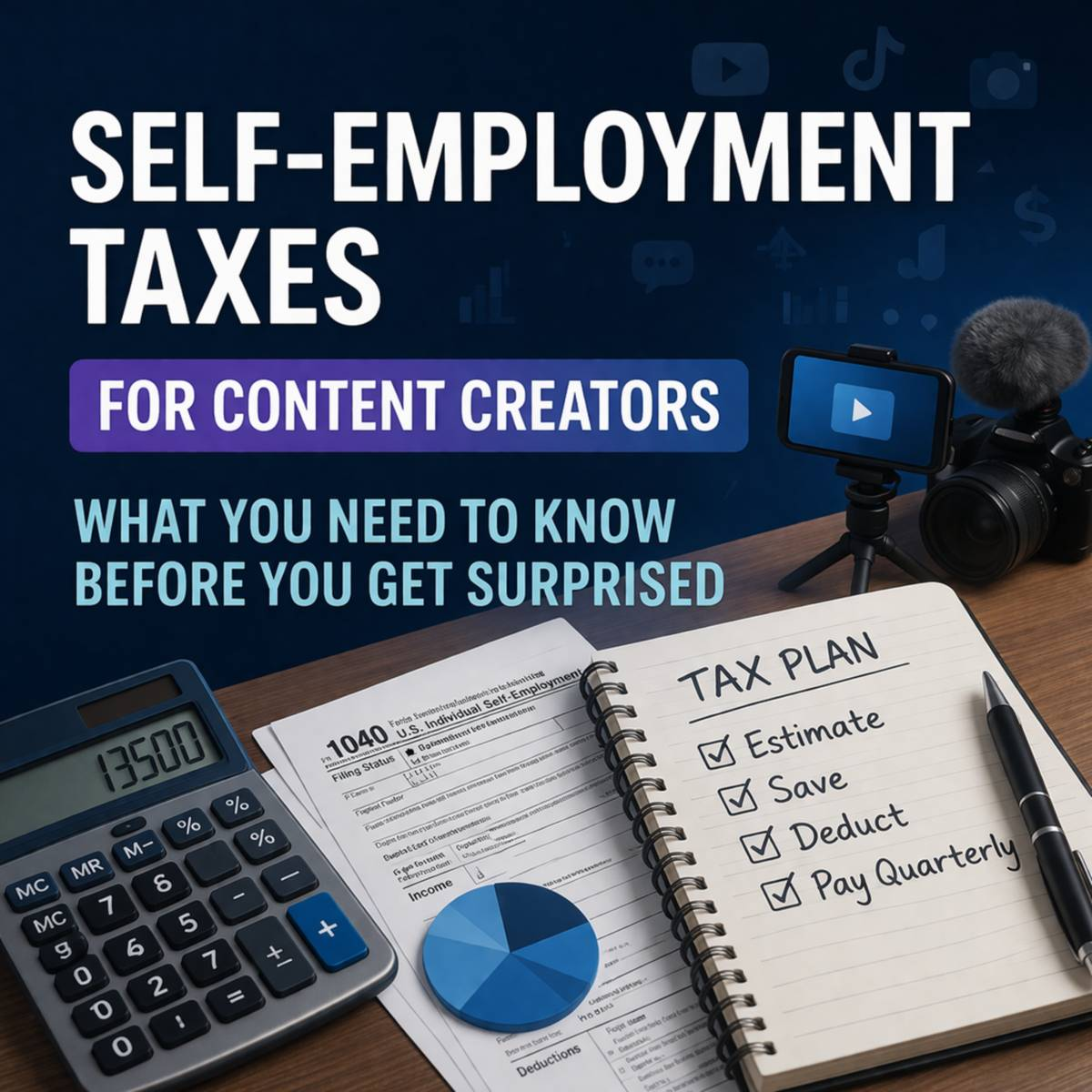
🔹 Introduction: Why Content Creators Get Surprised by Taxes
“You made money online—but no one warned you about the taxes.”
For many content creators, earning your first dollars online feels exciting—almost like found money. Whether it’s ad revenue, brand deals, subscriptions, or tips, the income often arrives without any deductions, paperwork, or immediate obligations.
And that’s exactly where the problem begins.
The Reality Most Creators Don’t See Coming
- Platforms do not withhold taxes from your earnings
- What you receive is gross income—not take-home pay
- Even small amounts of income are fully taxable under IRS rules
This creates a dangerous illusion: it feels like you earned $1,000—but in reality, a portion of that money already belongs to the IRS.
Common Outcomes for Unprepared Creators
- Unexpected tax bills that can reach thousands of dollars
- Penalties and interest for not paying taxes throughout the year
- Stress and financial strain during tax season
For many creators, the first tax bill is not just surprising—it’s overwhelming.
The Good News
This is completely avoidable.
Understanding how self-employment taxes work early on gives you:
- Control over your finances
- Confidence in your decisions
- Clarity about what you truly earn
👉 The difference between struggling with taxes and managing them successfully comes down to one thing: preparation.
🔹 Key Takeaways
If you only remember a few things from this guide, make it these:
- Content creators are typically classified as self-employed
- You may owe two types of taxes:
- Income tax
- Self-employment tax (Social Security + Medicare)
- Taxes are not automatically withheld from your earnings
- You may need to make quarterly estimated tax payments
- Business expenses can reduce your taxable income
- Planning ahead helps you avoid penalties, stress, and cash flow problems
Quick Tax Planning Cheat Sheet
| Action | Why It Matters |
|---|---|
| Save 25%–35% of income | Covers total tax liability |
| Track all expenses | Reduces taxable income |
| Pay quarterly taxes | Avoids penalties |
| Separate bank account | Prevents overspending |
| Keep records year-round | Reduces tax-time stress |
👉 Bottom line: What you earn is not what you keep—unless you plan for taxes.
🧩 Section 1: Why Content Creators Are Considered Self-Employed
One of the biggest misunderstandings among new creators is how the IRS views their income.
IRS Classification: Independent Contractor vs. Employee
Most content creators are classified as independent contractors, not employees.
That means:
- You are running a business, even if it doesn’t feel like one
- You are responsible for reporting income and paying taxes yourself
- No employer is withholding taxes or handling compliance on your behalf
Unlike traditional jobs where taxes are deducted from each paycheck, creator income is paid in full—and the responsibility shifts entirely to you.
Common Examples of Self-Employed Creator Income
If you earn money through any of the following, you are likely considered self-employed:
- YouTube ad revenue
- OnlyFans subscriptions or tips
- TikTok Creator Fund or brand deals
- Affiliate marketing income
- Sponsorships and partnerships
- Freelance or digital product sales
Even if this income is part-time or inconsistent, it is still taxable self-employment income.
Tax Forms You May Receive
Depending on how you earn money, you may receive:
- 1099-NEC → For direct payments from companies or clients
- 1099-K → For payments processed through platforms (PayPal, Stripe, etc.)
Important:
👉 You are required to report all income, even if you do not receive a form.
The Key Implication
Here’s the most important takeaway from this section:
As a content creator, you are responsible for your own taxes—no one is doing it for you.
This includes:
- Tracking your income
- Setting aside money for taxes
- Making estimated payments if required
- Filing accurately at tax time
Now that you understand why creators are treated as self-employed, the next step is understanding what that actually means financially.
🧩 Section 2: What Is Self-Employment Tax? (Plain English Explanation)
If you’re a content creator, one of the most important taxes to understand is self-employment tax—and it’s often the biggest surprise.
Definition: What Is Self-Employment Tax?
Self-employment tax is the tax that covers:
- Social Security
- Medicare
These are the same programs funded through payroll taxes in a traditional job.
Current Rate: How Much Is It?
The self-employment tax rate is:
- 15.3% total
- 12.4% for Social Security
- 2.9% for Medicare
👉 This applies to your net income (your income after expenses).
Why This Tax Exists
When you work a traditional job:
- Your employer pays half of these taxes
- You pay the other half through payroll deductions
But as a content creator, you are both:
- The employee
- The employer
So you are responsible for both halves.
Simple Example
If your net income is $40,000:
- Self-employment tax ≈ $6,120 (15.3%)
And that’s before income tax is even calculated.
Key Insight: This Is Separate From Income Tax
This is where many creators get caught off guard:
Self-employment tax is in addition to your regular income tax—not instead of it.
That means:
- You don’t just owe one tax
- You may owe multiple layers of taxes on the same income
👉 Understanding this early can prevent one of the most common financial mistakes creators make.
🧩 Section 3: Income Tax vs. Self-Employment Tax (Critical Differences)
To fully understand your tax situation, you need to see how these two taxes work together—but differently.
What’s the Difference?
- Income tax is based on your total taxable income and your tax bracket
- Self-employment tax is based on your net earnings from self-employment
They serve different purposes—and both apply to most content creators.
Side-by-Side Comparison
| Tax Type | What It Covers | Typical Rate | Who Pays |
|---|---|---|---|
| Income Tax | Federal income tax (and possibly state tax) based on earnings | Varies (10%–37% federal brackets) | You |
| Self-Employment Tax | Social Security + Medicare | 15.3% | You (both employer + employee portions) |
How They Work Together
Let’s simplify:
- You earn income → Income tax applies
- You earn that income through self-employment → Self-employment tax also applies
👉 This is why your total tax burden can feel higher than expected.
Takeaway
Most content creators underestimate how much they owe because they only think about income tax—not self-employment tax.
That’s how a manageable situation turns into a financial surprise.
Income Tax vs. Self-Employment Tax
| Category | Income Tax | Self-Employment Tax |
|---|---|---|
| What it funds | General government | Social Security + Medicare |
| Typical rate | 10%–37% (federal) | 15.3% |
| Based on | Taxable income | Net self-employment income |
| Who pays | You | You (both employer + employee) |
| Withheld automatically? | Sometimes (W-2 jobs) | No |
🧩 Section 4: Why Taxes Aren’t Taken Out of Creator Income
One of the biggest differences between traditional jobs and creator income is how taxes are handled—or not handled.
No Employer Withholding
In a traditional job:
- Taxes are automatically withheld from your paycheck
- What you receive is already reduced
As a content creator:
- You receive your full earnings upfront
- No taxes are withheld
👉 This creates the illusion that all of the money is yours to spend.
Platforms Are Not Your Employer
Platforms like:
- YouTube
- OnlyFans
- TikTok
- Patreon
…are intermediaries, not employers.
They:
- Process payments
- Provide access to audiences
But they do not:
- Withhold taxes
- Pay employer payroll taxes on your behalf
The Psychological Trap
This is where many creators run into trouble:
“It feels like full income—but it isn’t.”
When money hits your account:
- It feels earned and available
- But a portion of it is already owed in taxes
Without a system in place, it’s easy to spend money that was never truly yours.
Action Tip: Treat Taxes as Already Owed
A simple but powerful shift:
👉 Treat a percentage of every dollar you earn as untouchable
Practical steps:
- Set aside 25%–35% of your income (general guideline)
- Move it into a separate tax savings account
- Don’t view that money as spendable
Now that you understand:
- What self-employment tax is
- How it differs from income tax
- Why taxes aren’t withheld
👉 The next step is learning how and when you actually pay these taxes throughout the year.
📅 Section 5: What Are Quarterly Estimated Taxes?
Once you understand that no taxes are being withheld from your income, the next question becomes:
When do you actually pay them?
IRS Expectation: Pay Taxes Throughout the Year
The IRS operates on a “pay-as-you-go” system.
That means:
- Taxes are expected to be paid as income is earned
- Not just once per year at tax filing time
For employees, this happens automatically through paycheck withholding.
For content creators, you must do this yourself.
Quarterly Deadlines
Instead of paying all your taxes at once, you may need to make four estimated payments per year:
- April (for income earned Jan–Mar)
- June (for Apr–May)
- September (for Jun–Aug)
- January (following year) (for Sep–Dec)
👉 These are known as quarterly estimated tax payments.
Why Quarterly Payments Exist
The goal is simple:
- Prevent large unpaid tax balances
- Ensure steady tax collection throughout the year
- Reduce the risk of underpayment
From a financial planning perspective, this system also helps you:
- Avoid a massive lump-sum tax bill
- Stay in control of your cash flow
What Happens If You Don’t Pay?
If you skip or underpay your quarterly taxes, the IRS may apply:
- Underpayment penalties
- Interest charges on unpaid amounts
Even if you pay everything at tax time, you can still face penalties for not paying on time during the year.
Table: Payment Schedule
| Payment Period | Income Covered | Due Date |
|---|---|---|
| Q1 | Jan 1 – Mar 31 | April 15 |
| Q2 | Apr 1 – May 31 | June 15 |
| Q3 | Jun 1 – Aug 31 | September 15 |
| Q4 | Sep 1 – Dec 31 | January 15 (next year) |
👉 Check out our detailed guide:
“Taxes for Content Creators: Self-Employment and Quarterly Payments”
📊 Section 6: A Simple Example — How Creator Taxes Add Up
Let’s walk through a simplified example to make this real.
Scenario
- Total income: $50,000
- Business expenses: $10,000
- Net income: $40,000
Step 1: Estimate Self-Employment Tax
- 15.3% of $40,000 ≈ $6,120
Step 2: Estimate Income Tax
This depends on your tax bracket, but for a simple estimate:
- Assume ~10%–15% effective rate
- Estimated income tax ≈ $4,000–$6,000
Step 3: Total Estimated Tax Burden
- Self-employment tax: ~$6,120
- Income tax: ~$4,500 (mid-range estimate)
👉 Total taxes ≈ $10,000–$11,000
Example
| Category | Amount |
|---|---|
| Gross Income | $50,000 |
| Expenses | $10,000 |
| Net Income | $40,000 |
| Self-Employment Tax (~15.3%) | ~$6,120 |
| Estimated Income Tax | ~$4,500 |
| Total Estimated Taxes | ~$10,600 |
What This Means in Practice
Out of $50,000 earned:
- You might keep closer to $39,000–$40,000 before personal spending
- And even less after living expenses
👉 This is why many creators feel shocked at tax time—the difference between gross income and usable income is significant.
Key Insight
If you don’t plan for taxes as you earn, you’ll be forced to deal with them all at once later.
⚠️ Section 7: Common Tax Mistakes Content Creators Make
Most tax problems creators face are not due to complexity—they’re due to missed habits and assumptions.
Here are the most common mistakes:
1. Not Setting Aside Money for Taxes
- Spending income as it comes in
- Realizing too late that a portion was never yours
2. Ignoring Quarterly Payments
- Waiting until tax season to think about taxes
- Leading to penalties and large lump-sum bills
3. Mixing Personal and Business Finances
- Using one account for everything
- Making it harder to track income and deductions
4. Not Tracking Expenses
- Missing legitimate deductions
- Paying more tax than necessary
5. Assuming Small Income Doesn’t Count
- Believing taxes only apply to “full-time” creators
- In reality: all income is taxable
6. Waiting Until Tax Season to Get Organized
- Scrambling for receipts and records
- Increasing stress and risk of errors
Engagement Prompt
Take a moment to reflect:
Which of these are you currently doing?
Awareness is the first step.
Common Mistakes
| Mistake | What Happens |
|---|---|
| Not saving for taxes | Large unexpected tax bill |
| Skipping quarterly payments | Penalties and interest |
| Mixing finances | Poor tracking and missed deductions |
| Not tracking expenses | Overpaying taxes |
| Ignoring small income | Underreporting risk |
💸 Section 8: Deductible Expenses for Content Creators
One of the biggest advantages of being self-employed is the ability to reduce your taxable income through deductions.
If you’re not tracking expenses, you may be overpaying taxes—sometimes significantly.
The Key Principle: “Ordinary and Necessary”
The IRS allows you to deduct expenses that are:
- Ordinary → Common and accepted in your type of work
- Necessary → Helpful and appropriate for running your business
👉 If the expense helps you create, grow, or manage your content business, it may qualify.
Common Deductible Expenses for Content Creators
Here are some of the most common categories:
- Equipment
- Cameras, microphones, lighting
- Phones, computers, tablets
- Software & Subscriptions
- Editing software (video, photo, audio)
- Design tools, scheduling platforms, analytics tools
- Home Office
- Portion of rent or mortgage
- Utilities (based on workspace percentage)
- Internet & Phone
- Business-use portion of your internet bill
- Mobile phone usage related to content creation
- Marketing & Advertising
- Paid ads
- Website hosting and domain costs
- Email marketing tools
Simple Deduction Reference Table
| Expense Type | Example | Deductible? |
|---|---|---|
| Equipment | Camera, laptop, microphone | Yes (business use) |
| Software | Editing apps, subscriptions | Yes |
| Home Office | Dedicated workspace portion | Yes (if qualified) |
| Internet/Phone | Business-use percentage | Yes (partial) |
| Marketing | Ads, website costs | Yes |
Why This Matters
Every legitimate expense you deduct:
- Reduces your taxable income
- Lowers both:
- Income tax
- Self-employment tax
👉 Example:
If you earn $50,000 but deduct $10,000 in expenses, you’re only taxed on $40,000.
Action Tip
Start simple:
- Track expenses monthly
- Keep receipts (digital is fine)
- Separate personal vs. business spending
Good recordkeeping isn’t just organization—it’s a tax strategy.
💰 Section 9: How Much Should You Set Aside for Taxes?
One of the smartest financial habits you can build as a content creator is setting aside money for taxes before you spend it.
General Rule: 25%–35% of Net Income
A common guideline is:
- 25%–35% of your net income (after expenses)
This range helps cover:
- Self-employment tax (15.3%)
- Federal income tax
- Potential state taxes
What Affects Your Tax Rate?
Your actual tax percentage may vary based on:
- Income level
- Higher income → higher tax brackets
- State taxes
- Some states have no income tax
- Others can significantly increase your total burden
- Filing status
- Single vs. married
- Dependents and credits
Suggested Savings Guide
| Income Level | Suggested % to Save |
|---|---|
| Under $30,000 | 20%–25% |
| $30,000–$75,000 | 25%–30% |
| $75,000+ | 30%–35% |
Strategy: Use a Separate Tax Savings Account
This is one of the simplest and most effective systems you can implement:
- Open a separate savings account for taxes
- Transfer a percentage of every payment you receive
- Treat that money as untouchable
Why This Works
- Prevents accidental overspending
- Smooths out quarterly payments
- Reduces stress at tax time
If you never see the money as spendable, you won’t miss it.
Monthly Savings Example
| Monthly Income | % Saved | Monthly Tax Savings |
|---|---|---|
| $2,000 | 25% | $500 |
| $4,000 | 30% | $1,200 |
| $6,000 | 30% | $1,800 |
📈 Section 10: What Income Is Taxable for Content Creators?
A common misconception is that only “official” or reported income is taxable.
In reality:
Almost all income you earn as a content creator is taxable—regardless of how you receive it.
Common Types of Taxable Creator Income
- Ad Revenue
- YouTube ads, platform payouts
- Sponsorships & Brand Deals
- Paid promotions
- Product placements
- Affiliate Income
- Commission from links and referrals
- Subscriptions & Tips
- Patreon, OnlyFans, Twitch, etc.
- Digital Products or Services
- Courses, eBooks, consulting
What About Free Products?
In some cases, free products or services may be considered taxable if:
- You receive them in exchange for promotion
- They are part of a business relationship
👉 This is often referred to as non-cash compensation
Important Rule: No Form Doesn’t Mean No Tax
Even if you don’t receive:
- A 1099-NEC
- A 1099-K
You are still required to report all income earned.
Why This Matters
Many creators get into trouble because they assume:
- “If it wasn’t reported, it doesn’t count”
That assumption can lead to:
- Underreporting income
- IRS penalties and audits
Income Type → Taxable?
| Income Type | Taxable? | Notes |
|---|---|---|
| Ad revenue | Yes | Fully taxable |
| Sponsorships | Yes | Cash or equivalent value |
| Affiliate income | Yes | Commission-based |
| Tips & subscriptions | Yes | Even small amounts |
| Free products | Sometimes | If tied to promotion |
Key Takeaway
If you earned it, it’s likely taxable—whether or not you received a form.
🧠 Section 11: When Should You Get Help?
As your income grows and your situation becomes more complex, there comes a point where handling everything yourself may no longer be the best option.
The key is knowing when to make that transition.
Signs You May Need Professional Help
You don’t need a tax professional on day one—but you should strongly consider one if you experience:
- Rapid income growth
- Your earnings increase significantly year over year
- You’re unsure how to adjust your tax strategy
- Multiple income streams
- Ad revenue, sponsorships, affiliates, digital products
- Income coming from different platforms and sources
- Confusion about deductions
- Uncertainty about what qualifies
- Concern about missing deductions—or claiming them incorrectly
- Quarterly payment uncertainty
- Not sure how much to pay or when
- Worried about penalties
Your Options
There are several ways to get help, depending on your needs and budget:
- CPA (Certified Public Accountant)
- Best for complex situations
- Strategic tax planning and compliance
- Ideal for higher-income creators or growing businesses
- Enrolled Agent (EA)
- Licensed by the IRS
- Specializes in tax preparation and representation
- Often more cost-effective than a CPA
- Tax Software
- Best for simpler situations
- Step-by-step guidance for filing
- Good starting point for new creators
Cost vs. Value: A Critical Perspective
Many creators hesitate to pay for professional help—but consider this:
- A mistake in deductions or reporting can cost hundreds or thousands
- Missed tax-saving opportunities can quietly reduce your income over time
- Penalties and interest can add up quickly
In many cases, the cost of getting help is far less than the cost of getting it wrong.
Practical Guidance
- Start with software if your situation is simple
- Upgrade to a professional as your income and complexity grow
- Think of tax help as an investment in accuracy and peace of mind
❓ Section 12: Frequently Asked Questions (FAQ – SEO Optimized)
Do content creators have to pay taxes?
Yes. Most content creators are considered self-employed, which means you are responsible for reporting your income and paying taxes on it. This includes both income tax and self-employment tax.
How much do creators pay in taxes?
It depends on your income, location, and deductions. However, many creators should expect to set aside approximately:
- 25%–35% of their net income
This range typically covers:
- Self-employment tax (15.3%)
- Federal income tax
- Potential state taxes
What happens if I don’t pay quarterly taxes?
If you don’t make required quarterly payments, the IRS may charge:
- Underpayment penalties
- Interest on unpaid taxes
Even if you pay your full tax bill at the end of the year, you can still be penalized for not paying throughout the year.
Can I write off my phone or internet?
Yes—partially.
You can deduct the business-use portion of:
- Your phone
- Your internet
For example:
- If 70% of your phone usage is for your content business, you may be able to deduct 70% of the cost.
Do I need an LLC to file taxes as a content creator?
No. You do not need an LLC to report income or file taxes.
By default, most creators operate as sole proprietors, meaning:
- You report income on your personal tax return
An LLC can provide:
- Legal protection
- Organizational benefits
But it does not automatically reduce taxes on its own.
🔗 Section 13: Continue Your Financial Journey as a Creator
Understanding taxes is just one piece of building a strong financial foundation as a content creator. To truly stay in control of your money, you need systems that support consistency, stability, and long-term growth.
Here are the next steps to help you build a complete financial strategy:
💡 Budgeting with Irregular Income
Learn how to manage inconsistent earnings by:
- Creating a baseline income plan
- Prioritizing essential expenses
- Building stability even when income fluctuates
👉 Recommended next read:
How to Budget with Irregular Income as a Content Creator
💰 Saving for Taxes
Go deeper into:
- Setting up a tax savings system
- Calculating accurate quarterly payments
- Avoiding penalties and cash flow surprises
👉 Recommended next read:
How to Save for Taxes as a Self-Employed Creator
📈 Building a Financial Plan as a Creator
Move beyond short-term survival and start building long-term success:
- Emergency fund planning
- Investing strategies
- Income diversification
- Long-term financial goals
👉 Recommended next read:
Financial Planning for Content Creators: A Step-by-Step Guide
Why This Matters
These topics work together:
- Budgeting creates stability
- Tax planning creates protection
- Financial planning creates growth
When combined, they turn unpredictable income into a structured financial system.
🔹 Conclusion: Don’t Let Taxes Catch You Off Guard
Taxes are one of the most overlooked challenges for content creators—but they don’t have to be.
Taxes are predictable—even if your income isn’t.
Once you understand how they work, you can plan for them, manage them, and avoid the stress that catches so many creators off guard.
Action Steps You Can Take Today
Start simple—but start now:
- ✅ Calculate your estimated tax liability based on your current income
- ✅ Set aside a percentage of every payment immediately (25%–35% is a strong starting point)
- ✅ Track your expenses consistently to reduce your taxable income
- ✅ Plan for quarterly payments so you’re never behind
Take a moment to ask yourself:
Are you prepared for your next tax bill—or hoping it works out?
The difference between financial stress and financial control comes down to preparation.
Keep Learning and Take Action
- Explore the related guides above to strengthen your financial system
- Choose one action today—even something small—and implement it
Because in personal finance:
Progress doesn’t come from knowing more—it comes from doing more.
Back to
