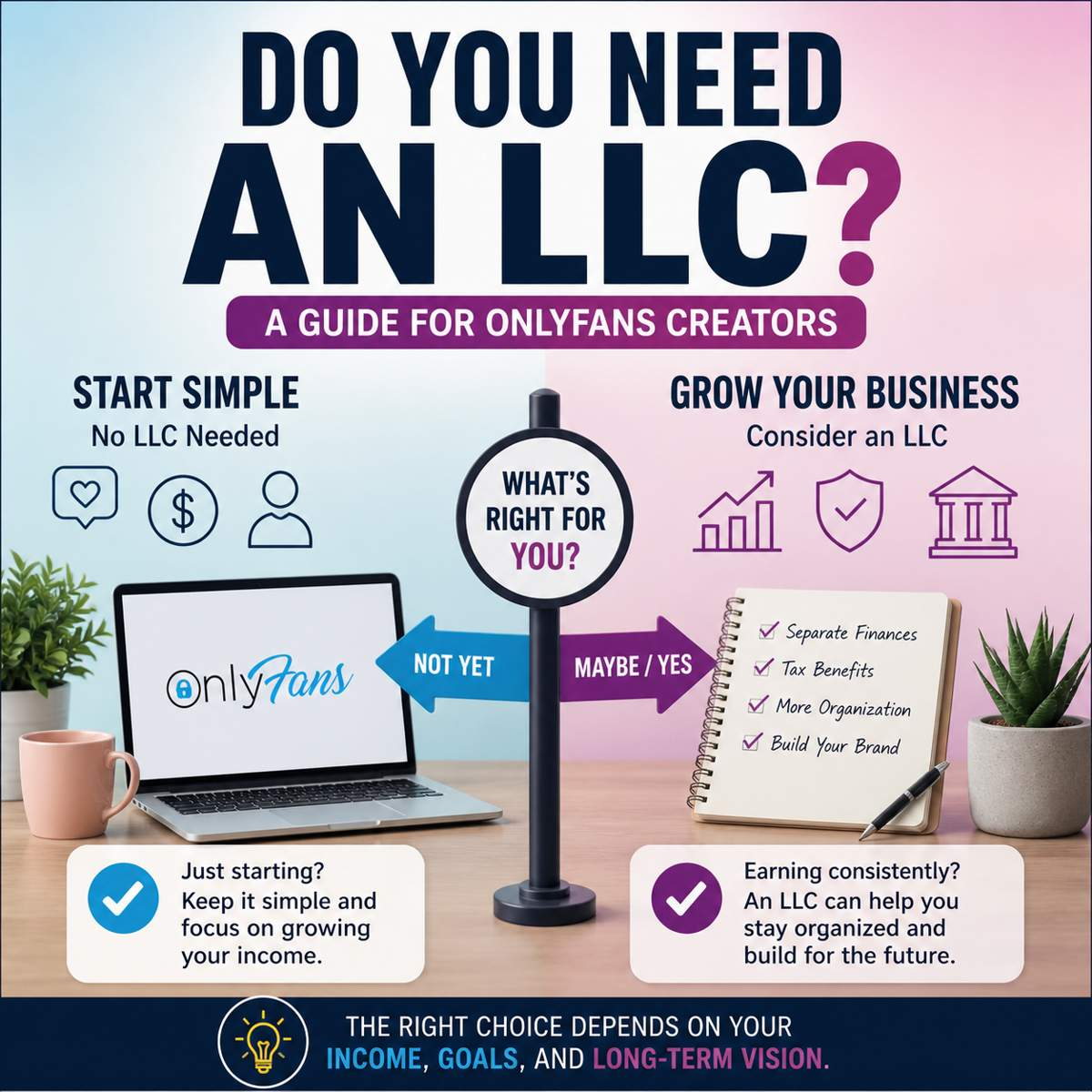
1. 🧾 Do You Need an LLC for OnlyFans? (Quick Answer)
No — you do NOT need an LLC to start earning on OnlyFans.
Most creators begin as sole proprietors and only consider an LLC as their income grows.
✅ When an LLC May Make Sense
You might consider forming an LLC if:
- You’re earning consistent or increasing monthly income
- You want to separate personal and business finances
- You’re treating your OnlyFans account as a long-term business
- You plan to scale, collaborate, or build a brand
❌ When You Likely Don’t Need an LLC Yet
- You’re just starting or testing the platform
- Your income is inconsistent or minimal
- You want to keep things simple and low-cost
💡 Key Insight
👉 For most creators, financial habits matter more than business structure early on.
Focus first on:
- Building consistent earnings
- Tracking income and expenses
- Setting aside money for taxes
📊 Should You Form an LLC as an OnlyFans Creator?
Not every creator needs an LLC right away. The right decision depends on your income level, goals, and how you’re treating your creator work.
Use this simple framework to evaluate your situation:
📊 LLC Decision Guide for OnlyFans Creators
| Situation | LLC Needed? | Why It Matters |
|---|---|---|
| Just starting or testing income | ❌ No | Keep things simple and avoid unnecessary startup and maintenance costs |
| Making consistent monthly income | ⚠️ Maybe | May help with organization, but depends on your long-term goals and complexity |
| Treating OnlyFans as a full business | ✅ Often Yes | Supports scalability, branding, and more structured financial management |
| Want separation of personal and business finances | ✅ Yes | Helps keep bookkeeping clean and improves financial clarity |
| Concerned about liability or risk | ⚠️ Limited Benefit | An LLC can help in some cases, but it does not eliminate all risks |
💡 How to Use This Table
Instead of asking “Do I need an LLC?”, ask:
- Is my income consistent and growing?
- Am I treating this like a long-term business?
- Do I need better financial organization?
👉 If you answered yes to multiple questions, forming an LLC may be worth exploring.
👉 If not, it’s often best to stay simple and focus on building income first.
🔑 Key Takeaways: LLCs and Financial Planning for OnlyFans Creators
Starting an OnlyFans account does not require an LLC, but as your income grows, treating your content like a business becomes increasingly important.
Here are the most important points to understand:
💼 1. OnlyFans Income Is Self-Employment Income
- Earnings are typically treated as self-employment income
- You are responsible for:
- Tracking income
- Managing expenses
- Handling your own taxes
🧾 2. You Do NOT Need an LLC to Start
- Most creators begin as sole proprietors
- An LLC is optional—not required
- Starting simple helps reduce unnecessary costs early on
📈 3. Some Creators Consider an LLC as Income Grows
- When income becomes consistent or significant, an LLC may help:
- Organize finances
- Separate personal and business activity
- It’s a scaling decision—not a starting requirement
📊 4. Financial Organization Matters More Than Structure
Before forming an LLC, focus on:
- Tracking subscriptions, tips, and income
- Recording business expenses
- Setting aside money for taxes
👉 These habits often matter more than your business structure early on
⚠️ 5. LLCs Come With Ongoing Responsibilities
Forming an LLC means:
- State filings and fees
- Compliance requirements
- Ongoing recordkeeping
👉 It’s not just a one-time decision—it’s an ongoing commitment
🛡️ 6. An LLC Does NOT Eliminate All Risks
Even with an LLC, creators may still face:
- Platform-related risks
- Payment disputes
- Privacy concerns
- Income volatility
🧠 7. Long-Term Financial Planning Is Key
Creators earning meaningful income should think beyond the short term:
- Build emergency savings
- Plan for retirement
- Diversify income streams
- Manage taxes proactively
💡 Bottom Line
👉 Most OnlyFans creators don’t need an LLC right away
👉 But as income grows, it can become a useful tool for organization and long-term planning
II. Introduction – Do You Really Need an LLC for OnlyFans?
If you’re making money on OnlyFans, you’ve probably asked yourself:
“Do I need an LLC… or am I overcomplicating this?”
Here’s the reality most creators don’t hear clearly:
👉 You do NOT need an LLC to start earning on OnlyFans.
👉 But in certain situations, forming one can be a smart financial move.
The challenge isn’t finding information—it’s knowing when forming an LLC actually makes sense for your specific situation.
As your income grows, you start facing real business decisions:
- How should you handle taxes?
- Should you separate personal and business finances?
- When does your side income become a real business?
This guide is designed to give you clear, practical answers—without unnecessary complexity.
🎯 What You’ll Learn in This Guide
- When an LLC makes sense for OnlyFans creators
- When it’s better to stay a sole proprietor
- The financial and tax implications of forming an LLC
- A simple framework to decide based on your income and goals
💡 By the end, you’ll know exactly whether you should:
- Keep things simple for now
- Form an LLC
- Or wait until your income reaches a certain level
III. Understanding the Creator Economy as a Business
The rise of digital platforms has created entirely new ways for individuals to generate income. Today, millions of creators earn money through online communities, subscriptions, advertising, sponsorships, and digital products.
Platforms like OnlyFans are part of a broader shift toward direct-to-audience revenue models, where creators earn income directly from their followers rather than relying solely on advertisers or media companies.
For many creators, revenue may come from several sources:
- Monthly subscriptions from fans
- Tips and paid messages
- Custom content requests
- Brand collaborations and sponsorships
- Merchandise or digital product sales
Because of these income streams, creators often operate in a financial environment similar to freelancers, independent contractors, or small business owners.
This model introduces several financial realities:
Self-Employment Income
Income earned through creator platforms is typically treated as self-employment income, meaning creators may be responsible for reporting earnings and paying taxes directly rather than having taxes automatically withheld from a paycheck.
Subscription-Based Revenue
Unlike traditional employment, creator income often depends on subscriber retention and audience engagement. Monthly income can fluctuate depending on subscriber growth, marketing efforts, and platform visibility.
Platform Risk
Creators also rely heavily on the platforms they use. Policy changes, algorithm shifts, or account issues can impact income streams. For this reason, many creators eventually think about diversifying their income across multiple platforms or revenue sources.
Diversification Opportunities
Successful creators often expand beyond a single platform. Some build additional income streams through:
- educational content
- digital products
- affiliate marketing
- community memberships
- merchandise
In this sense, many creators are effectively operating as digital entrepreneurs, managing audience relationships, revenue streams, and business decisions in much the same way that traditional small business owners do.
IV. What Is an LLC and How Does It Work?
A Limited Liability Company (LLC) is one of the most common business structures used by small businesses in the United States. It is designed to provide a balance between simplicity and organizational structure.
At its core, an LLC is a legal entity that allows individuals to operate a business while maintaining a level of separation between their personal and business activities.
Limited Liability Structure
One feature often associated with LLCs is the concept of limited liability, which refers to the idea that a business can exist as a separate legal entity from its owner. In some circumstances, this structure may help distinguish business obligations from personal finances when the business is properly maintained.
However, the level of protection can vary depending on factors such as business practices, state laws, and financial separation between personal and business accounts.
Pass-Through Taxation
For tax purposes, most single-member LLCs are treated as pass-through entities by the Internal Revenue Service. This generally means that the business itself does not pay federal income tax as a separate entity. Instead, profits and losses typically flow through to the owner’s personal tax return.
This structure is similar to how sole proprietorships are taxed, although some LLC owners later explore alternative tax elections as income increases.
Operational Flexibility
LLCs are also popular because they offer flexibility in how a business operates. An LLC can be owned by:
- one individual (single-member LLC)
- multiple partners (multi-member LLC)
The structure can accommodate many types of businesses, from small online ventures to larger companies.
For creators, an LLC can sometimes serve as a formal framework for organizing business income, expenses, contracts, and financial records, especially as a creator’s platform grows over time.
Understanding how LLCs work is an important step before deciding whether forming one makes sense for a particular creator business.
V. Why Some OnlyFans Creators Consider Forming an LLC
As a creator’s online income grows, some individuals begin exploring whether a formal business structure could help them better organize their activities. One option that often comes up is forming a Limited Liability Company (LLC). While an LLC is not required to operate on platforms like OnlyFans, some creators look into this structure as their content work begins to resemble a small business.
There are several reasons why creators sometimes consider forming an LLC.
Separating Personal and Business Finances
One common motivation is the desire to separate personal finances from business-related income and expenses. When content creation becomes a meaningful source of income, creators often find it easier to manage their finances when subscriptions, tips, equipment purchases, and marketing costs are tracked separately from everyday personal spending.
A formal business structure can help reinforce that separation when paired with dedicated business bank accounts and clear financial records.
Preparing for Collaborations and Partnerships
Creators who begin collaborating with other creators, photographers, editors, or brands may also start thinking about operating through a business entity. In some cases, working through a business structure can make it easier to sign contracts, manage revenue sharing, or organize collaborative projects.
While an LLC does not replace the need for clear agreements or professional advice, it can provide a framework for managing business relationships.
Improving Business Organization
As content creation evolves from a hobby into a more structured income stream, creators often face new administrative tasks. These may include tracking expenses, maintaining records of platform payments, and organizing documents related to taxes or partnerships.
Some creators explore LLC structures as a way to formalize the business side of their creator activities, making it easier to manage financial records and separate business operations from personal activities.
Exploring Tax Planning Options
Another reason creators sometimes investigate LLC structures relates to tax planning. Although an LLC itself does not automatically change how income is taxed, it can provide flexibility in how a business is structured over time.
As income grows, some creators explore different tax treatments or financial strategies with the guidance of qualified tax professionals. In those cases, a formal business entity may be part of a broader financial planning discussion.
It is important to understand that an LLC does not automatically guarantee tax savings or legal protection. The benefits of any business structure depend on individual circumstances, income levels, and how the business is managed.
VI. When Creators Typically Decide to Form an LLC
Not every creator forms a business entity at the beginning of their journey. In many cases, individuals operate informally at first and only begin considering a formal structure after certain milestones are reached.
While every situation is different, creators often start exploring LLC structures when their content activities become more consistent and business-oriented.
Consistent or Growing Income
One common milestone is earning consistent income from subscriptions, tips, or paid content. When monthly revenue becomes predictable, some creators begin treating their platform income more like a business and look for ways to organize finances more formally.
At this stage, creators may start keeping more detailed financial records, setting aside money for taxes, and separating business income from personal accounts.
Partnerships and Sponsorship Opportunities
Creators who begin working with brands or collaborating with other creators may also start considering a formal business structure. Sponsorship agreements, promotional partnerships, and licensing opportunities sometimes involve contracts that reference a business entity rather than an individual.
Operating through a business structure can help organize these relationships, although clear agreements and professional advice remain important.
Hiring Help or Building a Team
As a creator’s platform grows, some individuals begin working with editors, photographers, marketing assistants, or managers. When a creator begins paying others for services related to content production or promotion, the administrative side of the business can become more complex.
In these cases, creators may explore business structures that help manage payments, documentation, and financial records more clearly.
Expanding Into Additional Products or Services
Many successful creators eventually expand beyond one platform. Additional revenue streams might include:
- merchandise
- digital products
- coaching or consulting services
- exclusive community memberships
- affiliate partnerships
When a creator’s work expands into multiple income streams, they may start thinking about operating under a business framework that organizes these activities together.
Creator Business Growth Stages
| Creator Stage | Typical Income Level | Business Structure Often Used |
|---|---|---|
| Early creator | Small or inconsistent income | Sole proprietor |
| Growing creator | Consistent monthly revenue | Sole proprietor or LLC |
| Established creator | Significant and stable income | LLC or LLC with S-Corp election |
| Creator entrepreneur | Multiple income streams | LLC with structured financial planning |
VII. Situations Where an LLC May Not Be Necessary
While LLCs are commonly discussed in creator communities, it is important to recognize that not every creator needs a formal business structure immediately. In many cases, individuals begin their creator journey with a simple setup and only explore business entities later.
Understanding when an LLC may not be necessary helps creators make more informed decisions and avoid unnecessary complexity.
Hobby-Level or Early Income
If a creator is earning small amounts of income or simply experimenting with content creation, forming a business entity may not provide meaningful advantages. Many people begin by operating informally while they learn how the platform works and determine whether they plan to continue creating content long term.
During this stage, focusing on basic financial organization—such as tracking income and expenses—may be more practical than establishing a formal business structure.
Early Experimentation With Content Creation
Many creators spend time testing different types of content, audiences, and platforms before building a stable business model. In this early phase, income can be unpredictable and goals may still be evolving.
Creating a business entity too early can sometimes add administrative responsibilities before a creator knows whether they intend to operate long term.
Simple Financial Structure
Creators with straightforward income and limited expenses may find it easier to operate as sole proprietors while they build their audience. In these cases, the financial setup remains relatively simple, and managing taxes and records may not require a formal business structure.
As a creator’s income grows or operations become more complex, the question of forming a business entity may become more relevant. Taking a gradual approach allows creators to evaluate their needs as their platform develops.
VIII. Comparing Business Structures for OnlyFans Creators
Creators exploring business structures often compare several options before deciding how to organize their activities. The most common structures considered by individual creators include sole proprietorships and LLCs.
Each structure has different characteristics related to complexity, financial organization, and administrative requirements.
| Structure | Liability Protection | Complexity | Typical Use |
|---|---|---|---|
| Sole Proprietor | None | Low | Beginners or early-stage creators |
| Single-Member LLC | Limited | Moderate | Creators building a more formal business |
| LLC taxed as S-Corp | Limited | Higher | Higher-income creators exploring tax planning strategies |
Many creators begin as sole proprietors, which simply means they operate the business as individuals without forming a separate entity.
As income grows or business operations expand, some individuals begin considering LLCs as a way to formalize their creator business and organize financial activities more clearly.
In certain cases, creators who operate through an LLC later explore additional tax structures with professional guidance as their income increases. These decisions are typically part of broader financial and tax planning discussions rather than something every creator needs immediately.
Understanding the differences between these structures helps creators evaluate their options and decide what approach best fits their stage of growth.
IX. Cost of Starting and Maintaining an LLC
One factor many creators overlook when researching business structures is the ongoing cost of forming and maintaining an LLC. While starting a Limited Liability Company can help organize a creator business, it also introduces administrative responsibilities and recurring expenses that vary by state.
Understanding these costs helps creators evaluate whether forming an LLC makes sense based on their income level and long-term plans.
Formation Filing Fee
The first cost most creators encounter is the state filing fee required to create the LLC. This fee is paid when submitting the Articles of Organization to the state’s business registry.
Filing fees vary widely depending on the state but typically range between $50 and $500. Some states also offer expedited processing for an additional fee if creators want the formation approved more quickly.
Registered Agent Service
Most states require LLCs to designate a registered agent. This is a person or company responsible for receiving official legal and government documents on behalf of the business.
Creators can sometimes act as their own registered agent if they meet state requirements, but many choose to use a professional service. Registered agent services often cost $50 to $300 per year, depending on the provider.
Using a registered agent service can help maintain privacy by keeping a personal home address off certain public business filings.
Annual Reports and State Fees
Many states require LLCs to submit annual reports or renewal filings to remain in good standing. These reports confirm basic business information such as the company’s address and ownership.
Annual filing fees typically range from $0 to $300 per year, although some states also impose franchise taxes or additional compliance fees.
Creators who fail to submit these filings on time may face penalties or risk having their LLC administratively dissolved by the state.
Accounting and Tax Assistance
As income grows, some creators choose to work with accountants or tax professionals to help manage bookkeeping, tax reporting, and compliance requirements.
While not mandatory, professional guidance can help creators:
- organize financial records
- track business expenses
- prepare for tax reporting
- evaluate financial decisions related to their business structure
Accounting costs vary depending on the complexity of a creator’s finances and the services provided.
The Importance of Planning for Ongoing Costs
Because of these expenses, forming an LLC involves more than just the initial filing fee. Creators should consider both startup and ongoing costs before deciding whether to establish a formal business structure.
For creators earning smaller or inconsistent income, maintaining a simple financial setup may be easier in the early stages. As revenue grows and operations expand, the administrative costs of an LLC may become easier to justify.
Typical LLC Formation and Maintenance Costs
| Expense | Typical Cost Range | When It Applies | Notes |
|---|---|---|---|
| State filing fee | $50 – $500 | One-time when forming LLC | Varies widely by state |
| Registered agent service | $50 – $300/year | Annual | Optional but common |
| Annual report filing | $0 – $300/year | Annual in many states | Required to maintain good standing |
| Accounting or tax preparation | Varies | Annual | Helpful as income grows |
| Business licenses (if required) | Varies | Annual or one-time | Depends on local regulations |
X. Step-by-Step Guide to Forming an LLC
For creators who decide to explore forming an LLC, the process is generally straightforward and follows a series of administrative steps. While specific requirements vary by state, the overall formation process is similar across the United States.
Below is a simplified overview of how many small businesses—including creator businesses—establish an LLC.
Choose the State for Your LLC
The first step is deciding which state will register the business. Most small businesses form an LLC in the state where the owner lives and operates.
This is typically the simplest and most cost-effective approach for creators.
Select a Business Name
Next, creators choose a legal name for the LLC. States usually require the business name to be unique within the state registry and include a designation such as “LLC” or “Limited Liability Company.”
Creators often choose names that align with their personal brand or content identity.
File Articles of Organization
To officially create the LLC, the owner files Articles of Organization with the state’s business filing office. This document registers the company with the state and typically includes:
- the business name
- the registered agent
- the business address
- the owner or member information
Once the filing is approved, the LLC is considered legally formed.
Choose a Registered Agent
Every LLC must designate a registered agent to receive official documents, legal notices, and government correspondence.
The registered agent must have a physical address in the state where the LLC is formed.
Create an Operating Agreement
Although not required in every state, many businesses create an operating agreement that outlines how the LLC will be managed.
For single-member LLCs, this document typically clarifies:
- ownership structure
- how financial decisions are made
- how profits and losses are handled
Even for solo creators, having an operating agreement can help document how the business operates.
Obtain an Employer Identification Number (EIN)
After forming the LLC, creators often apply for an Employer Identification Number (EIN) through the Internal Revenue Service.
An EIN is commonly used for:
- opening business bank accounts
- handling certain tax filings
- issuing payments to contractors
The application is typically free and can be completed online.
Open a Business Bank Account
One of the most important steps after forming an LLC is opening a dedicated business bank account. Keeping business income and expenses separate from personal finances helps maintain organized records and reinforces the separation between the owner and the business.
This separation is often considered an important part of managing any small business responsibly.
XI. Choosing the Right State for Your LLC
When forming an LLC, one of the first decisions is where the business should be registered. For most creators, the simplest option is forming the LLC in the state where they live and operate.
Registering in your home state generally avoids additional paperwork and compliance requirements.
Why Most Small Businesses Form in Their Home State
Creators who work from home or operate primarily online typically conduct business in their state of residence. Because of this, forming an LLC locally is usually the most practical option.
Doing so allows the business to comply with local regulations and simplifies tax reporting and annual filing requirements.
The Complexity of Forming in Another State
Some entrepreneurs hear about forming LLCs in states such as Delaware, Wyoming, or Nevada because of business-friendly laws or perceived tax advantages.
However, if a creator lives and works in another state, they may still need to register the business there as a foreign LLC. This can lead to:
- additional registration fees
- multiple annual reports
- extra administrative requirements
For many small online businesses, forming the LLC in the home state is the most straightforward approach.
Because state laws vary, creators exploring business formation often review their state’s rules or consult qualified professionals before filing.
XII. Naming Your Creator Business
Choosing a name for a creator business involves both legal requirements and branding considerations. The name of an LLC becomes part of the official business record, but it can also influence how audiences and partners perceive the brand.
Branding and Identity
Some creators choose an LLC name that matches their existing online identity or brand. Others prefer a broader business name that allows them to expand into additional projects or platforms in the future.
A strong business name can support activities such as:
- merchandise launches
- brand partnerships
- product development
- website or digital platform expansion
Thinking long term can help creators choose a name that remains useful as their business evolves.
Legal Name Requirements
Most states require LLC names to meet certain rules, including:
- being distinguishable from other registered businesses in the state
- including “LLC” or “Limited Liability Company” in the name
- avoiding restricted words that require additional approvals
Creators usually check name availability through the state’s online business registry before filing formation documents.
Domain Name and Online Presence
Because many creator businesses operate online, it can also be helpful to check whether relevant domain names or social media handles are available. Securing a matching domain name may support future website development or brand expansion beyond a single platform.
Taking time to evaluate both legal and branding considerations can help creators choose a business name that supports their long-term goals.
XIII. Getting an EIN and Setting Up Business Banking
After forming an LLC, many creators take the next step of obtaining an Employer Identification Number (EIN) and setting up a dedicated business bank account. These steps help organize financial activity and reinforce the separation between personal finances and business operations.
What Is an EIN and Why Do Businesses Use It?
An Employer Identification Number (EIN) is a tax identification number issued by the Internal Revenue Service. It functions similarly to a Social Security Number for a business and is commonly used when interacting with financial institutions and government agencies.
Businesses often obtain an EIN for purposes such as:
- opening business bank accounts
- filing certain tax forms
- issuing payments to contractors or collaborators
- identifying the business in financial records
Applying for an EIN is typically free and can often be completed online through the IRS website.
Opening a Business Bank Account
Once an EIN has been issued, many LLC owners open a business bank account in the name of the company. A dedicated account allows income and expenses related to the creator business to be tracked separately from personal transactions.
Using a business account can help creators:
- clearly track subscription and tip income
- organize expenses related to equipment, software, or marketing
- simplify financial reporting at tax time
- maintain more structured financial records
Banks typically request several documents before opening a business account, which may include the LLC formation documents, EIN confirmation, and personal identification.
The Importance of Financial Separation
Maintaining separation between personal and business finances is an important practice for many small businesses. This separation can make bookkeeping easier and help demonstrate that the business operates independently from the owner’s personal finances.
Even creators who operate as sole proprietors often benefit from using a separate account for their creator income and expenses. For LLC owners, maintaining financial separation is commonly viewed as an important part of managing the business responsibly.
XIV. How an LLC Affects OnlyFans Payouts
When a creator forms an LLC, they may choose to update certain payment and tax information associated with their creator account. Platforms like OnlyFans generally allow creators to adjust how income is reported and where payouts are directed.
Understanding these settings can help creators align their platform income with their business structure.
Updating Tax Information (W-9 Forms)
Creators who operate through an LLC may update their tax documentation by submitting a revised W-9 form. The W-9 provides tax identification information that platforms use when issuing tax forms related to creator earnings.
Depending on how the business is structured, creators may list:
- their personal name and Social Security Number (SSN), or
- their LLC name and Employer Identification Number (EIN)
The information submitted on the W-9 helps determine how income is reported to the IRS.
Adjusting Payout Settings
Creators who establish an LLC may also choose to update payout settings within their platform account. For example, they may redirect payments to a business bank account associated with the LLC rather than a personal account.
Using a business account can help keep income and expenses organized within the company’s financial records.
EIN vs. Social Security Number
For many creators, the decision between using an EIN or a Social Security Number depends on how the business is structured and how the creator chooses to manage tax reporting.
Single-member LLCs are often treated as disregarded entities for federal tax purposes, meaning income may still flow through to the owner’s personal tax return. However, some creators prefer to use an EIN for business transactions to help organize financial documentation.
Because reporting rules can vary depending on the business structure, creators often review these decisions with qualified tax professionals before updating their platform information.
XV. Understanding Taxes for OnlyFans Creators with an LLC
Taxes are one of the most important financial considerations for creators who earn income online. Whether operating as a sole proprietor or through an LLC, creator income is typically treated as self-employment income.
Understanding how taxes generally work for LLC owners can help creators prepare for their financial responsibilities.
Pass-Through Taxation
Most single-member LLCs are treated as pass-through entities for federal tax purposes. This means the business itself usually does not pay federal income tax as a separate entity.
Instead, profits and losses from the business typically “pass through” to the owner’s personal tax return. The creator reports this income along with other personal income sources.
Schedule C Reporting
Many single-member LLC owners report business income using Schedule C, a form attached to their personal tax return. Schedule C is used to report:
- business income
- deductible business expenses
- net profit or loss from the business
The net income reported on Schedule C may also be subject to self-employment taxes, which fund programs such as Social Security and Medicare.
Possible S-Corporation Election
As income grows, some business owners explore additional tax structures. In certain cases, an LLC may elect to be taxed as an S-Corporation under rules established by the IRS.
This election can change how income is treated for tax purposes, although it also introduces additional administrative requirements. Because these decisions depend heavily on income level, business structure, and individual circumstances, they are typically evaluated with the assistance of qualified tax professionals.
The Importance of Professional Guidance
Tax laws related to self-employment and small businesses can be complex. Creators who earn meaningful income from their platforms often benefit from working with accountants or tax professionals who understand the financial considerations involved in operating an online business.
Professional guidance can help creators stay compliant with tax laws while making informed financial decisions.
XVI. Bookkeeping and Financial Recordkeeping
Regardless of business structure, maintaining organized financial records is one of the most important habits for any creator business. Good bookkeeping practices help creators understand how their business is performing and prepare for tax reporting.
Tracking Income
Creators typically receive income from several sources, including:
- subscription payments
- tips
- paid messages or custom content
- collaborations or sponsorships
- digital product or merchandise sales
Tracking these income streams regularly helps creators understand how their revenue is generated and identify trends in their business performance.
Tracking Expenses
Creators may also incur a variety of business expenses related to producing and promoting their content. Common examples can include:
- camera or recording equipment
- lighting and production tools
- editing software and subscriptions
- marketing or advertising costs
- internet and technology expenses
Maintaining records of these expenses can help creators organize their finances and prepare accurate financial reports.
Common Business Expenses for Content Creators
| Expense Category | Examples |
|---|---|
| Equipment | Cameras, lighting, microphones |
| Software | Editing tools, subscription platforms |
| Internet and technology | High-speed internet, storage services |
| Marketing | Social media promotion, advertising |
| Professional services | Accounting, legal consultations |
| Production costs | Props, studio rentals, costumes |
Using Accounting Tools
Many creators use simple accounting systems to track their income and expenses. Depending on the size of the business, this might include:
- spreadsheets
- bookkeeping software
- cloud-based accounting tools
These tools can help categorize transactions, generate financial reports, and maintain organized records throughout the year.
Preparing for Tax Reporting
Keeping financial records updated throughout the year can make tax preparation much easier. Organized records help creators identify income, calculate expenses, and prepare accurate reports when filing taxes.
For creators whose income grows significantly, working with a qualified accountant can help ensure financial records remain accurate and compliant with reporting requirements.
Example Monthly Creator Income Tracking
| Income Source | Monthly Revenue Example |
|---|---|
| Subscriptions | $3,200 |
| Tips | $850 |
| Paid messages / custom content | $1,100 |
| Brand collaborations | $1,500 |
| Affiliate income | $350 |
Total Monthly Creator Income: $7,000
XVII. Separating Personal and Business Finances
One of the most important habits for any creator operating as a business is keeping personal and business finances separate. Whether a creator operates as a sole proprietor or through an LLC, maintaining clear financial boundaries can make managing income, expenses, and records much easier.
Separating finances supports several important aspects of running a creator business.
Liability Considerations
For creators who operate through an LLC, maintaining a clear distinction between personal and business finances is often considered an important part of managing the business properly. Mixing personal and business funds can blur the distinction between the owner and the company, which may weaken the practical benefits of operating through a business entity.
Using separate accounts for business transactions can help demonstrate that the business operates independently from personal finances.
Tax Reporting
Financial separation also helps simplify tax reporting. When income and expenses are tracked through a dedicated business account, it becomes much easier to identify the revenue generated by the creator business and the expenses associated with producing that content.
Clear records can help reduce confusion when preparing tax documents and reviewing financial statements.
Financial Clarity
Separating finances also provides creators with a clearer view of how their business is performing. When all creator-related transactions are tracked in one place, it becomes easier to evaluate:
- monthly income trends
- operating costs
- profitability of different types of content
- opportunities for reinvesting in the business
This level of clarity can support better financial decision-making as a creator’s platform grows.
XVIII. Business Insurance Considerations
While business structure is one aspect of managing risk, some creators also explore business insurance as their operations expand. Insurance coverage can help address certain financial risks associated with operating a small business, although the specific needs of each creator may vary.
Insurance decisions depend heavily on the type of content being produced, the scale of the business, and the creator’s individual circumstances.
Liability Coverage
Some small businesses consider general liability insurance, which may provide coverage for certain claims related to business activities. While many creators operate primarily online, liability policies can sometimes apply to situations involving collaborations, events, or other business interactions.
The specific protections offered by insurance policies depend on the coverage selected and the terms of the policy.
Equipment Coverage
Creators often invest in equipment used to produce their content. This can include:
- cameras and lenses
- lighting equipment
- computers and editing hardware
- microphones and recording gear
Some insurance policies may offer protection for business equipment in the event of theft, damage, or loss. Creators who rely heavily on production equipment sometimes review insurance options to understand what coverage may be available.
Managing Broader Business Risks
As a creator’s platform grows, the business may face a wider range of operational risks. Insurance can sometimes be one part of a broader risk management strategy that may also include clear contracts, strong financial recordkeeping, and diversified revenue streams.
Because insurance needs differ widely from one business to another, creators often review options with licensed insurance professionals when evaluating potential coverage.
XIX. Privacy Considerations and Public Records
One common misconception among new business owners is that forming an LLC automatically provides privacy or anonymity. In reality, business formation documents often become part of public state records, which means certain information about the company may be accessible through state business registries.
Understanding how business records work can help creators make informed decisions about their privacy.
Public LLC Filings
When an LLC is formed, information such as the company name, registered agent, and business address is typically filed with the state. In many jurisdictions, this information can be searched through online business databases maintained by the state government.
The level of information available to the public varies depending on the state and the type of business filing.
The Role of Registered Agents
Some creators use registered agent services when forming an LLC. A registered agent receives official government correspondence and legal notices on behalf of the business.
Using a professional service can sometimes allow creators to list the registered agent’s address instead of a personal home address on certain filings, depending on state rules.
Limits of Anonymity
Even with a registered agent, forming an LLC does not necessarily make the business owner anonymous. Ownership information may still appear in certain filings, financial documents, or tax records.
Creators who are concerned about privacy often consider multiple strategies to manage their personal information online, including business structures, digital safety practices, and professional advice when appropriate.
XX. Contracts and Collaborations
As creators grow their platforms, they often begin working with other individuals or organizations. These relationships may involve photographers, editors, brand partners, or other creators. In these situations, written agreements can help clarify expectations and responsibilities for everyone involved.
Contracts play an important role in managing business relationships.
Written Agreements
Written agreements help define the terms of a working relationship. A contract may outline:
- payment terms
- responsibilities of each party
- deadlines or deliverables
- usage rights for content
Having clear agreements can help reduce misunderstandings and provide a reference point if questions arise later.
Licensing Rights
Content creators often produce original material such as photos, videos, or digital artwork. When working with collaborators or brands, agreements may specify how that content can be used.
Licensing terms can address questions such as:
- who owns the content
- where it can be published
- how long it may be used
- whether additional compensation is required for extended use
These details help protect the creator’s intellectual property and ensure that both parties understand the scope of the collaboration.
Brand Partnerships
Creators who partner with companies for promotions, sponsorships, or affiliate marketing often operate under written agreements. These agreements can outline the terms of the partnership, including content requirements, compensation arrangements, and promotional expectations.
As creator businesses expand, contracts become a routine part of professional collaboration. Clear documentation helps ensure that partnerships operate smoothly and that both creators and partners understand their responsibilities.
XXI. Common Mistakes Creators Make When Forming an LLC
Forming an LLC can help organize a creator business, but it is not a complete solution to every financial or operational challenge. Some creators misunderstand what a business structure does and does not accomplish. Recognizing common mistakes can help creators make better decisions as their platform grows.
Assuming an LLC Provides Anonymity
One of the most common misconceptions is that forming an LLC automatically protects a creator’s identity. In reality, many states maintain public business registries, and certain information about the business may be accessible through those records.
While tools such as registered agent services can sometimes limit the exposure of personal addresses in certain filings, an LLC generally does not guarantee anonymity.
Mixing Personal and Business Finances
Another frequent mistake is failing to separate business and personal finances. Some creators continue to use the same bank account for both personal spending and creator-related income or expenses.
This practice can make bookkeeping difficult and may blur the distinction between personal and business activities. Using separate accounts for business income and expenses often helps maintain organized records.
Missing Annual Filings or Compliance Requirements
Many states require LLCs to submit annual reports or renewal filings to maintain good standing. These filings typically confirm basic business information and may involve a small filing fee.
If these reports are missed, the state may impose penalties or eventually dissolve the LLC administratively. Creators who form a business entity often track these deadlines to ensure the company remains compliant.
Misunderstanding Taxes
Another common mistake is assuming that forming an LLC automatically reduces taxes. In many cases, single-member LLCs are treated similarly to sole proprietorships for federal tax purposes.
While certain tax strategies may become available as income grows, business owners typically evaluate those options with qualified tax professionals rather than relying on assumptions about the structure alone.
Understanding these common pitfalls can help creators approach business formation with clearer expectations and better financial habits.
XXII. Post-Formation Checklist for Creator Businesses
Forming an LLC is only the first step in organizing a creator business. Once the business entity is established, several practical steps can help ensure the company operates smoothly and maintains proper records.
The following checklist highlights common actions creators take after forming an LLC.
| Task | Why It Matters |
|---|---|
| Open a business bank account | Helps keep business income and expenses separate from personal finances |
| Update platform payout information | Allows income to flow into the appropriate bank account |
| Track income and expenses | Maintains organized financial records for reporting and analysis |
| Mark compliance deadlines | Ensures annual reports and filings are completed on time |
Completing these steps can help creators maintain the administrative side of their business while focusing on content creation and audience growth.
XXIII. When an LLC Is Not Enough
While an LLC can provide structure and organization for a creator business, it does not eliminate every risk associated with operating online. Creators often face challenges that extend beyond business formation.
Understanding these additional risks can help creators take a broader approach to managing their business.
Platform Bans or Account Restrictions
Creators who rely heavily on a single platform face platform risk. Policies, algorithms, or account enforcement decisions can affect a creator’s ability to earn income on that platform.
Operating through an LLC does not prevent a platform from enforcing its terms of service. For this reason, many creators consider diversifying their presence across multiple platforms over time.
Chargebacks and Payment Disputes
Subscription-based platforms occasionally experience payment disputes or chargebacks initiated by customers. These disputes can reduce revenue or require administrative follow-up.
While a business entity may organize the financial side of operations, it does not eliminate the possibility of disputes related to digital transactions.
Online Harassment or Safety Concerns
Creators with large audiences sometimes encounter online harassment, impersonation, or other digital safety challenges. Business structures typically do not address these issues directly.
Creators often combine multiple strategies—such as digital privacy practices, moderation tools, and platform safety features—to manage these risks.
Privacy Considerations
As discussed earlier, business formation documents may become part of public records in many jurisdictions. Creators concerned about privacy often evaluate multiple approaches to protecting personal information online.
An LLC can be part of that strategy in some situations, but it rarely solves privacy concerns on its own.
Risks Creator Businesses May Face
| Risk | Example | Why It Matters |
|---|---|---|
| Platform policy changes | Account restrictions or bans | Can affect income stability |
| Chargebacks | Subscription payment disputes | Reduces revenue |
| Online harassment | Doxxing or impersonation | Personal safety concerns |
| Privacy exposure | Public business records | Personal information visibility |
XXIV. Long-Term Financial Planning for Creators
While topics like business structure and taxes are important, long-term financial planning remains one of the most critical elements of a sustainable creator career. Income from digital platforms can fluctuate over time, making financial preparation especially important.
Creators who treat their platform income like a business often begin thinking about financial goals beyond the next month or year.
Retirement Savings
Unlike traditional employment, creator income generally does not include employer-sponsored retirement plans. Creators who earn self-employment income often explore retirement savings options available to independent workers.
Regular contributions toward long-term savings can help creators prepare for the future even if platform income changes over time.
Building an Emergency Fund
Income from online platforms can be unpredictable. Subscriber growth, algorithm changes, or shifts in audience interest can all affect monthly revenue.
Because of this variability, many creators prioritize building an emergency fund that can cover several months of living expenses if income temporarily declines.
Income Diversification
Successful creators often explore additional revenue streams beyond a single platform. Diversifying income can reduce dependence on any one source of revenue.
Examples may include:
- digital products or courses
- merchandise
- affiliate partnerships
- educational content
- community memberships
Multiple income streams can help stabilize earnings if one platform becomes less reliable.
Long-Term Wealth Building
For creators who generate consistent income, financial planning may eventually expand beyond business management to include long-term wealth-building strategies. This may involve saving, investing, and managing financial goals over time.
Approaching creator income with a long-term financial perspective can help transform short-term platform earnings into sustainable financial stability.
By combining responsible business practices with thoughtful financial planning, creators can position themselves to manage both the opportunities and uncertainties that come with the digital creator economy.
Financial Priorities for Creator Businesses
| Financial Priority | Why It Matters |
|---|---|
| Emergency savings | Protects against income fluctuations |
| Retirement contributions | Builds long-term financial security |
| Tax planning | Helps manage self-employment obligations |
| Income diversification | Reduces dependence on one platform |
XXV. Frequently Asked Questions About LLCs for OnlyFans Creators
Creators often have similar questions when they begin thinking about business structures and financial organization. The following answers address some of the most common questions about forming an LLC while operating on platforms like OnlyFans.
Do you need an LLC for OnlyFans?
No. Forming an LLC is not required to create an account or earn income on OnlyFans.
Many creators begin operating as sole proprietors, meaning they earn income directly as individuals and report that income on their personal tax returns. As a creator’s income grows or business operations expand, some individuals begin exploring formal business structures such as LLCs for organizational or financial planning purposes.
Can OnlyFans pay an LLC?
In many cases, creators can update their account settings and tax documentation so that payments are associated with their business entity. This may involve updating tax information, such as submitting a W-9 form with the appropriate business details and directing payouts to a business bank account.
Because platform policies and tax reporting requirements can change, creators often review platform instructions and consult financial professionals when making these updates.
Does an LLC reduce taxes?
Forming an LLC does not automatically reduce taxes.
Many single-member LLCs are treated similarly to sole proprietorships for federal tax purposes, meaning income typically flows through to the owner’s personal tax return. In some situations, business owners explore additional tax structures as income grows, but these decisions depend on individual circumstances and usually involve guidance from tax professionals.
Can an LLC protect your identity?
An LLC does not automatically guarantee anonymity.
Business formation documents are often filed with state governments, and certain information about the company may appear in public business registries. While registered agent services can sometimes limit the exposure of personal addresses in certain filings, ownership information may still be associated with the business depending on state laws and financial records.
Creators concerned about privacy typically consider a broader set of strategies beyond business structure alone.
XXVI. Final Thoughts – Building a Sustainable Creator Business
Platforms like OnlyFans have helped transform content creation into a viable source of income for many individuals. What begins as a creative outlet can evolve into a meaningful business opportunity as audiences grow and revenue increases.
As with any business, financial organization and planning become increasingly important over time.
For creators earning income through digital platforms, understanding business structures, tax responsibilities, and financial management practices can help support long-term stability. While forming an LLC is one option some creators explore, it is only one part of managing a sustainable creator business.
The most important principles often include:
- treating creator income with the same discipline as other business income
- maintaining clear financial records
- understanding tax responsibilities
- planning for long-term financial goals
As a creator’s income grows, thoughtful financial planning can help turn short-term platform earnings into a more stable and sustainable financial future.
Every creator’s situation is different, and decisions about business structure, taxes, and financial strategy often depend on individual circumstances. Approaching these decisions carefully—and seeking professional guidance when needed—can help creators build their businesses with confidence while maintaining responsible financial practices.
Educational Disclaimer
The information provided in this article is intended for general educational purposes only and should not be considered legal, tax, or financial advice.
Business formation, tax treatment, and regulatory requirements can vary based on individual circumstances, income levels, and state laws. Decisions related to forming an LLC, selecting a tax structure, or managing a creator business should be made after reviewing your specific situation.
Before making legal or tax-related decisions for your business, consider consulting qualified professionals such as a licensed attorney, certified public accountant (CPA), or other financial professional who can provide guidance based on your individual circumstances.
🔗 Continue Your Financial Journey as a Creator
Building a successful creator business goes beyond forming an LLC. Understanding taxes, compliance, and financial systems is essential for long-term success.
📘 Featured Guide
👉 Does OnlyFans Automatically Take Out Taxes? What Creators Must Know About Income, Withholding & the IRS
Learn how creator income is taxed, what responsibilities you have, and how to avoid common tax mistakes.
📂 Explore Related Topics
- 👉 Taxes and Legal Compliance
Understand your tax obligations, recordkeeping requirements, and compliance strategies as a content creator. - 👉 Personal Finance for Content Creators Hub
Explore a complete roadmap covering income management, taxes, savings strategies, and long-term financial planning for creators. - The Financial Planning Roadmap A clear framework to help you build financial stability in logical stages.
- Jason’s Fin Tips Budgeting Frameworks Learn how to choose and implement a budgeting style that fits your financial life.