I. Introduction – Why Content Creators Need Multiple Income Streams
The creator economy has expanded rapidly over the past decade, transforming how individuals share knowledge, entertainment, and expertise online. What once began as hobby blogging, independent video production, and small social media communities has evolved into a global digital economy where millions of people now earn income by producing content.
Today, creators operate across a wide range of platforms and formats. Blogs, YouTube channels, podcasts, newsletters, livestreams, and social media accounts have all become viable tools for building audiences and generating revenue. For many people, content creation has shifted from a side project to a legitimate business model.
Millions of individuals around the world are now attempting to build businesses online through their content. Some creators focus on education and financial literacy. Others build communities around entertainment, technology, gaming, cooking, travel, art, or lifestyle topics. Regardless of niche, the fundamental opportunity is similar: creators can reach global audiences without the traditional gatekeepers that once controlled publishing, broadcasting, and media production.
Despite this opportunity, the financial side of content creation is often far less stable than it appears from the outside.
Many creators experience significant income fluctuations. Advertising rates can rise and fall depending on the broader economy. Social media platforms frequently adjust algorithms that determine which content is seen by audiences. Monetization policies can change with little warning, affecting how and when creators are paid.
In some cases, creators may spend months building an audience on a single platform only to see their reach decline after an algorithm update or policy shift. When a creator depends heavily on one platform for income, these changes can have immediate financial consequences.
Because of these risks, diversification has become one of the most important strategies for building a sustainable creator business.
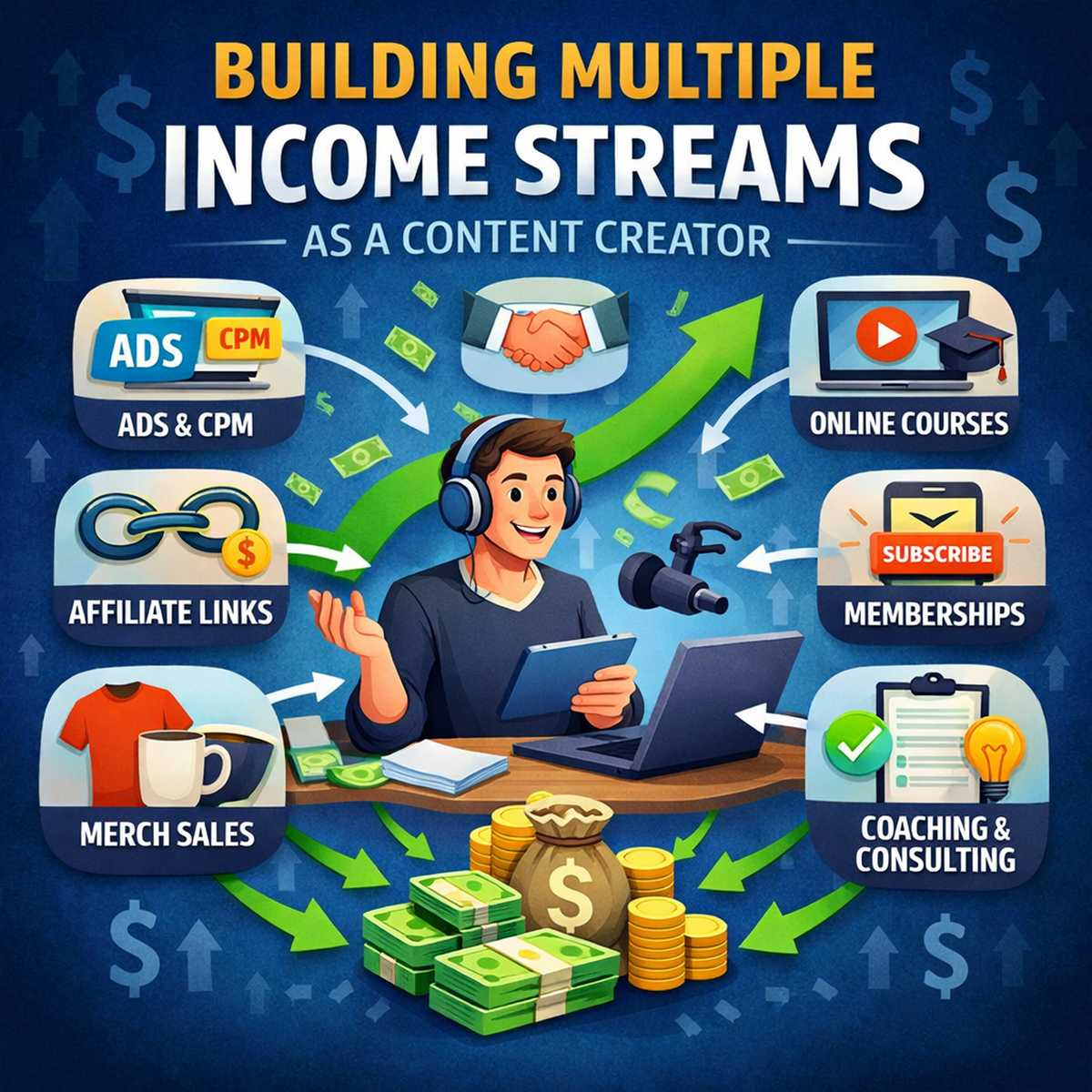
Rather than relying on a single revenue source, many successful creators develop multiple income streams that work together to support their business. These income streams might include advertising revenue, affiliate partnerships, digital products, memberships, consulting services, or merchandise sales.
Over time, diversification helps creators reduce financial volatility and gain greater control over their income.
The creators who achieve the most consistent long-term success rarely depend on a single platform or monetization method. Instead, they treat their content platforms as part of a broader business ecosystem.
The core idea is simple:
The most successful creators treat their platforms like a business with multiple revenue channels, not a single source of income.
II. Key Takeaways: Income Diversification for Creators
Building multiple income streams has become a defining characteristic of financially successful creators. While the specific mix of revenue sources varies by niche and audience, several patterns consistently appear across the creator economy.
Most successful creators earn income from three to seven different revenue streams.
Instead of depending on a single source of revenue, creators often combine several monetization methods. These may include advertising, sponsorships, affiliate marketing, digital products, memberships, and services. Diversifying income helps reduce the financial impact if one source declines.
Relying on a single platform exposes creators to algorithm and policy risk.
Social media platforms and content networks frequently change how content is distributed or monetized. These changes can dramatically affect audience reach and revenue. When creators depend entirely on one platform, they have limited control over their income.
High-margin income streams often come from audience ownership.
Creators who build direct relationships with their audiences—through websites, newsletters, or private communities—typically gain more control over monetization opportunities. These channels allow creators to sell products, services, or memberships without relying exclusively on platform monetization systems.
Digital products and memberships can create recurring revenue.
Courses, guides, templates, and subscription communities allow creators to generate income from their expertise. These products can be sold repeatedly to new audiences, providing scalable revenue over time.
Diversification improves both financial stability and long-term income growth.
A diversified income portfolio allows creators to balance higher-risk income streams, such as advertising revenue, with more stable sources such as memberships or product sales. This combination often leads to more predictable earnings over time.
III. The Financial Reality of the Creator Economy
The creator economy has grown rapidly as digital platforms have expanded. Improvements in publishing tools, video technology, and social media distribution have allowed individuals to reach global audiences without large media companies or traditional broadcasters.
Estimates suggest that more than 50 million people worldwide identify as creators, producing content across platforms such as YouTube, Instagram, TikTok, blogs, podcasts, newsletters, and livestreaming services. Many of these individuals create content part-time, while a smaller percentage rely on it as their primary source of income.
Despite the scale of the creator economy, income distribution within the ecosystem is highly uneven.
A relatively small percentage of creators earn substantial income, while many others generate only modest earnings or none at all. Several factors contribute to this income inequality, including audience size, niche demand, platform algorithms, and access to monetization opportunities.
Full-Time vs. Part-Time Creators
Most creators begin their journey as part-time content producers. They may create videos, write articles, or publish podcasts while maintaining traditional employment. As audiences grow, some creators eventually transition into full-time content production.
However, this transition is often difficult. Building an audience large enough to support full-time income can take years of consistent effort.
Revenue Volatility
Even established creators frequently experience fluctuations in income. Advertising rates may change throughout the year, sponsorship demand may vary, and audience engagement can shift as trends evolve.
This volatility is one reason many creators eventually seek to diversify their income streams.
Platform Dependency
Perhaps the most significant structural challenge facing creators is platform dependency. Platforms control content distribution, audience reach, and monetization rules. When algorithms change or policies shift, creators often have little influence over the outcome.
Because of this dependency, many experienced creators focus on building direct connections with their audience through channels they control, such as websites, email newsletters, and community platforms.
Understanding these realities is essential for anyone attempting to build a sustainable creator business. While the opportunities in the creator economy are substantial, long-term financial stability often requires careful planning, diversified revenue streams, and a strategy that extends beyond a single platform.
IV. Why Relying on a Single Platform Is Risky
For many new creators, a single platform becomes the primary source of traffic, audience engagement, and income. A YouTube channel may generate advertising revenue, a social media account may drive sponsorship deals, or a newsletter platform may deliver subscription income. While this approach can work in the early stages of content creation, relying heavily on one platform introduces significant financial risk.
Platforms control the distribution of content, the rules governing monetization, and the algorithms that determine how audiences discover creators. Because creators do not control these systems, their income can change quickly if the platform changes its policies or priorities.
Understanding the risks associated with platform dependence is essential for building a sustainable creator business.
Algorithm Changes
Most major content platforms use algorithms to determine which posts, videos, or articles appear in front of audiences. These algorithms constantly evolve as platforms attempt to improve engagement, retain users, and prioritize certain types of content.
When an algorithm changes, it can significantly alter how content is distributed. A creator who previously received strong engagement may suddenly see fewer views, reduced reach, or slower audience growth.
These changes are not necessarily targeted at individual creators. Instead, they often reflect broader adjustments in how platforms rank and distribute content. However, the financial consequences for creators can be substantial if their visibility declines.
For creators who depend primarily on advertising revenue or sponsored posts tied to audience reach, algorithm changes can directly affect income.
Policy Changes
Monetization policies on digital platforms can change at any time. Platforms regularly update eligibility requirements, payment structures, and content guidelines that determine how creators earn revenue.
For example, platforms may modify:
- Minimum audience thresholds for monetization
- Content eligibility standards
- Revenue sharing percentages
- Advertising placement policies
When these rules change, creators may suddenly find that their income declines or that their content no longer qualifies for monetization programs.
Because these decisions are controlled entirely by the platform, creators often have little ability to influence the outcome.
Platform Shutdown or Decline
Digital platforms rise and fall over time. History provides numerous examples of once-popular platforms that eventually declined in relevance or disappeared entirely.
Examples often cited in discussions about platform risk include:
- Vine, which shut down despite having a large user base
- MySpace, which once dominated social networking before losing popularity
- Various blogging networks and video platforms that experienced rapid decline after algorithm or ownership changes
Creators who build their entire audience within a single platform ecosystem may struggle if that platform declines or disappears.
This risk highlights the importance of developing audience connections that extend beyond one platform.
Advertising Revenue Fluctuations
Advertising revenue is often influenced by broader economic conditions. When businesses reduce marketing budgets during economic slowdowns, advertising demand may fall across digital platforms.
Lower advertiser demand can lead to reduced CPM (cost per thousand impressions) rates, which directly affect creator earnings from advertising programs.
Sponsorship opportunities can also fluctuate depending on marketing budgets and industry conditions. During periods of economic uncertainty, companies may reduce spending on influencer partnerships and sponsored content.
For creators who rely primarily on advertising income, these fluctuations can lead to unpredictable earnings.
For all of these reasons, experienced creators often view platforms as distribution channels rather than the foundation of their business model. Diversifying both platforms and revenue streams can help protect creators from unexpected disruptions.
Creator Income Stream Risk Table
| Income Stream | Platform Dependence | Stability | Risk Level |
|---|---|---|---|
| Platform ads | High | Medium | High |
| Sponsorships | Medium | Medium | Medium |
| Affiliate marketing | Medium | Medium | Medium |
| Digital products | Low | High | Low |
| Memberships | Low | High | Low |
V. Understanding the Creator Income Ladder
Most creators do not build multiple income streams immediately. Instead, monetization tends to evolve gradually as audiences grow and creators gain experience managing their online presence.
One helpful way to understand this progression is through the concept of the Creator Income Ladder. This framework illustrates how creators often move through different stages of monetization as their audience and authority expand.
While every creator’s path is unique, many follow a similar progression.
Stage 1 – Early Creator
In the early stages of content creation, income opportunities are typically limited. At this point, creators are focused primarily on building an audience and developing consistent content.
Common income sources at this stage include:
Advertising Revenue
Advertising programs offered by platforms or website networks allow creators to earn small amounts of income based on views or traffic. While advertising income can be modest initially, it provides a starting point for monetization.
Affiliate Links
Affiliate marketing allows creators to recommend products or services to their audience and earn commissions on purchases made through referral links. This income stream often works well for educational or review-based content.
During this stage, creators are usually investing more time in audience growth than generating substantial revenue.
Stage 2 – Growing Creator
As a creator’s audience grows and engagement improves, new monetization opportunities become available.
Two of the most common income streams during this stage include:
Sponsorships and Brand Partnerships
Companies often seek creators who have built engaged communities within specific niches. Sponsored content partnerships can provide significantly higher income than advertising programs alone.
Digital Products
Many creators begin developing their own digital products as their audience grows. These may include courses, eBooks, templates, or guides related to their area of expertise.
Digital products allow creators to monetize knowledge directly rather than relying solely on advertising or brand partnerships.
Stage 3 – Established Creator
Creators who reach a more established stage often expand their monetization strategy even further. At this point, income streams may include a combination of scalable products, recurring revenue, and premium services.
Examples include:
Membership Communities
Creators may offer subscription-based communities that provide exclusive content, educational resources, or direct access to the creator. Memberships can create predictable recurring revenue.
Merchandise
Creators with strong brand identity or loyal audiences may introduce branded products such as apparel, accessories, or artwork.
Consulting or Coaching
Creators who develop expertise in a particular field may monetize their knowledge through consulting services, coaching programs, or workshops.
At this stage, the creator’s income is often supported by multiple revenue streams that operate simultaneously.
Creator Income Ladder Table
| Creator Stage | Typical Audience Size | Common Income Streams |
|---|---|---|
| Early Creator | 0 – 10,000 followers | Ads, affiliate links |
| Growing Creator | 10,000 – 100,000 | Sponsorships, digital products |
| Established Creator | 100,000+ | Memberships, merchandise, consulting |
VI. The Most Common Income Streams for Content Creators
Content creators generate revenue through a variety of monetization strategies. While the specific mix varies depending on niche and audience, several income streams consistently appear across the creator economy.
Understanding these categories helps creators identify opportunities to diversify their income and reduce reliance on a single source of revenue.
Some of the most common creator income streams include:
Advertising
Advertising revenue typically comes from display ads on websites, video advertisements on streaming platforms, or sponsored ad placements in podcasts and newsletters. Advertising income usually scales with audience size and traffic.
Sponsorships
Brand partnerships allow creators to promote products or services to their audience in exchange for payment. Sponsorships often involve sponsored videos, blog posts, social media promotions, or newsletter placements.
Affiliate Marketing
Affiliate marketing enables creators to earn commissions by recommending products or services. When audience members make purchases through referral links, the creator receives a percentage of the sale.
Digital Products
Many creators develop digital products such as online courses, eBooks, templates, and downloadable guides. These products can generate scalable income because they can be sold repeatedly to new audiences.
Memberships
Subscription communities allow creators to provide exclusive content or experiences in exchange for recurring monthly payments. Membership programs can help stabilize income through predictable revenue.
Merchandise
Creators with strong brand identity may sell physical products such as apparel, accessories, or artwork. Print-on-demand platforms often allow creators to sell merchandise without maintaining inventory.
Consulting and Coaching
Creators who build authority within a niche may offer consulting services, coaching programs, or workshops that provide direct value to their audience.
Licensing and Royalties
Some creators earn income by licensing their content or intellectual property. This may include licensing photos, videos, music, or written work to media outlets or other platforms.
Each of these income streams offers different advantages, risks, and scalability. Many successful creators build a portfolio of complementary revenue sources, allowing them to balance stable income with opportunities for growth.
In the following sections, we will explore each of these income streams in greater detail and discuss how creators can integrate them into a diversified monetization strategy.
Creator Income Stream Comparison Table
| Income Stream | Startup Difficulty | Income Potential | Scalability | Example Platforms |
|---|---|---|---|---|
| Advertising | Low | Moderate | High | Ad networks, video platforms |
| Sponsorships | Medium | High | Medium | Brand partnerships |
| Affiliate Marketing | Low | Moderate | High | Affiliate programs |
| Digital Products | Medium | High | Very High | Courses, downloads |
| Memberships | Medium | High | High | Community platforms |
| Merchandise | Medium | Moderate | Medium | Print-on-demand stores |
| Consulting/Coaching | Low | High | Low | Private consulting |
| Licensing/Royalties | High | High | High | Media licensing |
VII. Advertising Revenue: The Starting Point for Many Creators
For many content creators, advertising revenue represents the first opportunity to earn income from their work. Advertising programs allow creators to monetize audience attention by displaying or integrating advertisements within their content.
As traffic or viewership increases, advertising revenue can grow alongside audience engagement. However, advertising income is often only one piece of a broader monetization strategy.
Understanding how advertising revenue works—and its limitations—can help creators decide how to incorporate it into a diversified income model.
Common Advertising Revenue Models
Several types of advertising programs are commonly used by creators across different platforms.
Display Advertising
Display advertising is most commonly associated with blogs and websites. These ads appear within webpage content and are typically served through advertising networks.
Common placements include:
- banner ads
- sidebar ads
- in-content display ads
- sticky ads or footer placements
Advertising networks automatically match advertisers with websites based on audience demographics, page content, and advertiser demand. Creators are typically paid based on impressions or clicks.
Display advertising can generate consistent baseline income once a website reaches sufficient traffic levels.
Video Advertising
Video advertising is widely used on video platforms such as YouTube. Creators can earn revenue by allowing ads to appear before, during, or after their videos.
Common video ad formats include:
- pre-roll ads (before the video begins)
- mid-roll ads (during longer videos)
- post-roll ads (after the video ends)
Revenue from video advertising is usually tied to audience views and advertiser demand for specific audiences.
Video advertising can be a powerful revenue source for creators with large or highly engaged audiences.
Podcast Advertising
Podcast creators often monetize through audio advertising placed within episodes.
Podcast ads are typically delivered in one of two ways:
- host-read ads, where the creator personally recommends a product or service
- programmatic ads, which are dynamically inserted into episodes by advertising networks
Host-read ads tend to be more effective because they leverage the trust between the creator and their audience.
Podcast advertising revenue is often negotiated based on audience size and download metrics.
Understanding CPM Models
Many advertising programs use a pricing model known as CPM, which stands for cost per thousand impressions.
Under a CPM model:
- advertisers pay a certain amount for every 1,000 views or impressions
- the platform shares a portion of that revenue with the creator
CPM rates vary widely depending on factors such as:
- audience demographics
- content niche
- advertiser demand
- geographic audience location
For example, niches such as finance, technology, or business often command higher CPM rates than general entertainment content because advertisers are willing to pay more to reach those audiences.
Advantages of Advertising Revenue
Advertising revenue offers several benefits for creators:
- Passive monetization: Once content is published, ads can generate income continuously as audiences view the content.
- Scalability: Advertising income increases as traffic or viewership grows.
- Low barrier to entry: Many platforms allow creators to begin monetizing with relatively small audiences.
Limitations of Advertising Revenue
Despite its advantages, advertising income has several limitations.
Advertising revenue can fluctuate due to:
- changes in advertiser demand
- seasonal marketing cycles
- algorithm adjustments
- economic conditions
Additionally, advertising typically requires large audiences to generate substantial income. Many creators discover that advertising alone does not produce sufficient revenue to sustain a full-time content business.
Because of these limitations, many experienced creators treat advertising as a baseline revenue stream while building additional income sources that offer greater control and higher margins.
Creator Income Streams Ranked by Difficulty
| Income Stream | Setup Difficulty | Time to First Revenue | Best For |
|---|---|---|---|
| Advertising | Low | Fast | New creators |
| Affiliate marketing | Low | Fast | Review/tutorial content |
| Sponsorships | Medium | Medium | Niche audiences |
| Digital products | Medium | Medium | Educational creators |
| Memberships | Medium | Medium | Community builders |
| Merchandise | Medium | Medium | Strong brand identity |
| Consulting | Low | Fast | Expert creators |
| Licensing | High | Slow | Professional creators |
VIII. Brand Sponsorships and Partnerships
Brand sponsorships represent one of the most common and potentially lucrative income streams for content creators. Companies increasingly partner with creators to promote products or services to targeted audiences.
Unlike traditional advertising, sponsorships often involve direct collaboration between creators and brands. These partnerships allow companies to reach engaged communities while allowing creators to monetize their influence and expertise.
How Sponsorship Deals Work
In a typical sponsorship arrangement, a company pays a creator to feature or recommend a product within their content.
This promotion may take several forms.
Sponsored Content
Sponsored content involves content specifically created to highlight a brand or product. Examples include sponsored blog posts, dedicated videos, or social media posts focused on the brand.
Brand Integrations
Brand integrations incorporate a product or service naturally within the creator’s content. For example, a product may appear within a tutorial, review, or educational video.
This approach often feels more authentic to audiences because the product is presented within the creator’s normal content style.
Long-Term Brand Partnerships
Some creators develop ongoing relationships with brands through long-term sponsorship agreements. These partnerships may involve recurring promotions, product collaborations, or ambassador roles.
Long-term partnerships can provide more stable revenue and strengthen brand alignment between creators and companies.
Factors That Influence Sponsorship Pricing
Sponsorship compensation varies widely depending on several factors.
Audience Size
Creators with larger audiences typically command higher sponsorship fees because their content reaches more viewers.
Audience Engagement
Engagement metrics—such as comments, likes, shares, and watch time—often matter more than raw audience size. Highly engaged communities tend to generate stronger results for brands.
Niche Audience Value
Some niches attract advertisers willing to pay higher rates. For example, audiences interested in finance, technology, or professional development may have higher purchasing power, increasing the value of sponsorship opportunities.
Other factors can also influence sponsorship pricing, including content format, campaign scope, and exclusivity agreements.
For many creators, sponsorships become one of the most significant income streams as their audience grows.
IX. Affiliate Marketing and Commission-Based Income
Affiliate marketing allows creators to earn commissions by recommending products or services to their audience. Instead of being paid directly for promotional content, creators earn income when audience members purchase products through referral links.
This model aligns incentives between creators and businesses: companies only pay when a sale occurs, while creators benefit from recommending products they believe their audience will find useful.
How Affiliate Marketing Works
Affiliate marketing typically follows a simple process:
- A creator joins an affiliate program offered by a company or affiliate network.
- The creator receives a unique referral link for a product or service.
- When audience members click the link and make a purchase, the creator earns a commission.
Affiliate links are often included in:
- blog posts
- product reviews
- tutorials or educational content
- video descriptions
- newsletters
Because affiliate marketing is integrated into content, it can generate revenue long after the content is published.
Affiliate Platforms and Networks
Many companies offer their own affiliate programs, while others participate in larger affiliate networks that connect creators with advertisers.
Affiliate platforms often provide:
- referral tracking links
- performance analytics
- payment processing
- promotional resources
These systems allow creators to track how many purchases are generated through their content.
Commission Structures
Affiliate commissions vary depending on the type of product or service being promoted.
Common commission structures include:
- percentage of sale: creators earn a percentage of each purchase
- fixed referral payments: creators earn a flat fee per conversion
- recurring commissions: creators receive ongoing payments for subscription services
Digital products and software services often offer higher commission rates than physical products.
Benefits of Affiliate Marketing
Affiliate marketing offers several advantages for creators.
Scalable Income
Once affiliate content is published, it can continue generating commissions as new audiences discover the content.
Performance-Based Revenue
Affiliate marketing rewards creators for producing content that drives purchasing decisions.
Risks and Considerations
Despite its advantages, affiliate marketing also requires careful management.
Audience Trust
Creators must maintain credibility with their audience. Promoting low-quality products can damage long-term trust and harm a creator’s reputation.
Compliance and Disclosure Rules
Many jurisdictions require creators to disclose affiliate relationships clearly. Transparent disclosure helps maintain ethical standards and regulatory compliance.
When used responsibly, affiliate marketing can become a reliable and scalable component of a creator’s income strategy.
In the next sections, we will explore additional monetization strategies that allow creators to diversify their income even further.
X. Selling Digital Products and Online Courses
As creators build expertise and trust with their audience, many begin developing their own digital products. Digital products allow creators to monetize their knowledge directly, rather than relying solely on advertising revenue or third-party partnerships.
Digital products are often considered one of the highest-margin income streams available to creators because they do not require physical inventory, manufacturing, or shipping. Once created, these products can be sold repeatedly to new customers with minimal additional production costs.
Creators frequently develop digital products that solve specific problems for their audience or provide educational value.
Common Types of Digital Products
Several digital product formats have become especially popular within the creator economy.
Online Courses
Online courses allow creators to package their expertise into structured educational programs. Courses may include video lessons, written materials, exercises, and downloadable resources.
Creators often develop courses around topics such as:
- professional skills
- creative techniques
- business development
- personal finance or investing
- technology tutorials
Courses can be offered as self-paced learning programs or structured multi-week classes.
eBooks
An eBook allows creators to present in-depth knowledge in a downloadable format. eBooks are particularly useful for creators who produce written content such as blogs or newsletters.
Common eBook formats include:
- educational guides
- step-by-step tutorials
- niche expertise manuals
- curated collections of articles or lessons
Templates
Templates are practical tools designed to help audiences implement a process more easily. Examples include planning templates, workflow systems, or financial tracking tools.
Templates can save audiences significant time and provide immediate value.
Financial Tools and Spreadsheets
Creators who focus on education, business, or finance sometimes offer downloadable tools such as spreadsheets, calculators, or planning frameworks. These tools allow audiences to apply concepts in a practical way.
For example, creators might offer:
- budgeting spreadsheets
- investment tracking tools
- tax planning worksheets
- business revenue trackers
Downloadable Guides
Downloadable guides are often shorter resources designed to teach a specific skill or solve a particular problem. These guides may include step-by-step instructions, checklists, and implementation strategies.
Creators sometimes offer guides as standalone products or as entry-level products that introduce audiences to more comprehensive courses.
Advantages of Digital Products
Digital products offer several advantages that make them attractive income streams for creators.
Scalability
Digital products can be sold to unlimited numbers of customers without increasing production costs. Once a course or guide is created, it can generate revenue continuously as new audiences discover it.
High Profit Margins
Because digital products do not require manufacturing or shipping, the cost of delivering each additional sale is typically very low. This allows creators to retain a large portion of the revenue.
Audience Ownership
Selling digital products often requires creators to interact directly with their customers through email lists, websites, or course platforms. This direct relationship strengthens audience ownership and reduces dependence on third-party platforms.
For many creators, digital products eventually become one of the most reliable sources of long-term income.
XI. Memberships and Subscription Communities
Another powerful monetization strategy for creators involves building recurring revenue through memberships or subscription communities.
Instead of selling one-time products, creators provide ongoing value to subscribers who pay a monthly or annual fee. This model can provide greater income stability because revenue arrives on a predictable schedule.
Membership communities often include exclusive content, additional educational materials, or access to private discussions.
Common Membership Platforms
Several platforms support subscription-based communities for creators.
Patreon
Patreon allows creators to offer tiered membership levels with different benefits. Members may receive exclusive content, behind-the-scenes updates, or access to private discussions.
Paid Newsletters
Subscription newsletters delivered through platforms such as Substack allow creators to monetize written content by charging readers for premium articles or research.
Private Communities
Some creators build private communities hosted on platforms such as Discord or Circle. These communities often provide discussion forums, networking opportunities, or direct interaction with the creator.
Benefits of Membership Models
Memberships provide several advantages for creators seeking long-term financial stability.
Predictable Income
Recurring subscriptions allow creators to estimate monthly revenue more accurately than many other monetization methods.
Stronger Audience Engagement
Membership communities often foster deeper relationships between creators and their audience. Subscribers tend to be highly engaged because they are actively investing in the community.
Community Building
Membership platforms encourage audience interaction, collaboration, and shared learning experiences. This community dynamic can strengthen loyalty and increase long-term retention.
Because of these advantages, many creators consider membership programs an important component of their long-term monetization strategy.
XII. Merchandise and Physical Products
For creators with strong brand identity or highly engaged audiences, merchandise can become an additional income stream. Merchandise allows creators to transform their brand, artwork, or messaging into physical products that supporters can purchase.
In many cases, merchandise also serves as a way for audience members to show support for a creator or community they enjoy.
Common Types of Creator Merchandise
Creators often design products that align with their brand or the interests of their audience.
Examples include:
Apparel
Clothing items such as t-shirts, hoodies, hats, or jackets are among the most common forms of creator merchandise. Apparel allows fans to represent their connection to a creator’s community.
Accessories
Accessories may include items such as mugs, phone cases, tote bags, or stickers.
Art Prints
Creators who produce visual content or artwork sometimes sell prints of their designs. These prints can become collectible items for supporters.
Branded Merchandise
Branded products may feature logos, catchphrases, or imagery associated with the creator’s content.
Merchandise works best when creators have developed a strong brand identity and loyal audience.
Print-on-Demand Platforms
One challenge of selling physical products is managing inventory, production, and shipping logistics. To address this challenge, many creators use print-on-demand platforms.
Print-on-demand services produce items only after a customer places an order. This allows creators to sell merchandise without purchasing inventory in advance.
Popular print-on-demand providers include:
- Printful
- Redbubble
These platforms handle manufacturing, printing, shipping, and customer service while the creator receives a portion of each sale.
Although merchandise typically has lower profit margins than digital products, it can still play an important role in a diversified creator income strategy. Merchandise strengthens brand identity while allowing audiences to support creators in a tangible way.
In the next section, we will explore additional advanced monetization strategies such as consulting services, licensing opportunities, and passive income models that further expand creator income potential.
XIII. Coaching, Consulting, and Service-Based Income
As creators develop expertise and authority within their niche, they often discover that their audience values direct access to their knowledge and experience. This demand creates an opportunity to monetize expertise through coaching, consulting, and other service-based offerings.
Unlike advertising or affiliate marketing, which depend largely on audience size, service-based income focuses on delivering personalized value to individuals or organizations. Because these services provide direct guidance, they often command higher prices than many other creator income streams.
For creators who have built credibility within their field, coaching and consulting can become a significant source of revenue.
Common Types of Creator Services
Several service formats are commonly used by creators to monetize their expertise.
Coaching Calls
Coaching sessions typically involve one-on-one conversations where the creator provides guidance, advice, or feedback to a client. These sessions may focus on helping individuals solve specific problems, develop new skills, or implement strategies related to the creator’s area of expertise.
For example, a creator who produces educational content may offer coaching sessions on topics such as:
- business development
- content strategy
- financial planning concepts
- creative skill development
Coaching calls are often scheduled in hourly or multi-session packages.
Consulting Packages
Consulting services are similar to coaching but often focus on providing professional guidance to businesses, organizations, or advanced practitioners. Consulting packages may involve deeper analysis, strategic recommendations, or project-based support.
Examples of consulting services offered by creators include:
- marketing strategy consulting
- brand development guidance
- technical or educational consulting
- financial planning education and strategy discussions
Consulting engagements may last from a single session to several months depending on the complexity of the project.
Workshops and Training Programs
Some creators expand their services by offering workshops or training programs designed to teach specific skills to groups of participants.
Workshops may be delivered through:
- live virtual training sessions
- multi-session educational programs
- in-person seminars or conferences
These events allow creators to provide educational value to multiple participants simultaneously while maintaining a service-oriented business model.
Advantages of Service-Based Income
Coaching and consulting offer several important benefits for creators.
High Revenue Potential
Because these services provide direct access to expertise, creators can often charge significantly higher prices per client compared with other monetization methods. Even creators with relatively small audiences may generate meaningful income from consulting or coaching engagements.
Deep Audience Relationships
Service-based work allows creators to build stronger relationships with their audience. Clients who receive personalized guidance often develop long-term loyalty to the creator’s brand.
Limitations of Service-Based Income
Despite the potential financial rewards, service-based income also presents certain limitations.
Limited Scalability
Coaching and consulting rely on the creator’s time and attention. Unlike digital products or affiliate marketing, service income cannot easily scale to thousands of customers simultaneously. Each new client requires additional time and effort from the creator.
For this reason, many creators treat coaching and consulting as either a premium offering or a temporary step toward developing scalable products such as courses or memberships.
XIV. Licensing, Royalties, and Intellectual Property Revenue
As creators build recognizable brands and produce valuable content, additional monetization opportunities may emerge through licensing and intellectual property agreements.
These opportunities allow creators to earn income from the use of their work without necessarily producing new content for each transaction.
Licensing Content
Licensing allows other individuals or organizations to use a creator’s content in exchange for payment. This arrangement grants permission to use the content while allowing the creator to retain ownership of the intellectual property.
Content that may be licensed includes:
- photographs
- videos
- music
- written articles
- educational materials
For example, a photographer may license images to media organizations or marketing agencies. A video creator may license footage for documentaries, advertising campaigns, or educational programs.
Licensing agreements typically specify how the content may be used and how long the license remains valid.
Royalties
Royalty payments allow creators to receive ongoing income when their intellectual property continues to generate value. Royalties are commonly associated with creative industries such as music, publishing, and film.
Examples of royalty income include:
- music streaming royalties
- book royalties from publishers
- licensing payments for reused media content
- intellectual property used in other products or productions
Royalty arrangements can provide recurring income streams when content continues to be used over time.
Publishing Deals
Creators who develop written content may also receive publishing opportunities. Traditional publishing agreements often involve advances and royalty payments based on book sales.
Publishing deals can expand a creator’s reach while providing additional income opportunities tied to intellectual property.
Media Rights
In some cases, creators may negotiate agreements allowing media organizations to use their content for broadcast, streaming, or distribution. These agreements may involve licensing fees or revenue sharing arrangements.
Although licensing and intellectual property income is less common for early-stage creators, it can become an important revenue stream for creators who produce original and highly valuable content.
XV. Creator Funds and Platform Monetization Programs
Many digital platforms have introduced monetization programs designed to reward creators for producing popular or engaging content. These programs may include creator funds, bonus incentives, tipping systems, and audience donation features.
While these programs can provide useful supplemental income, they often operate within platform-controlled ecosystems and may change over time.
Platform Creator Funds
Some platforms establish creator funds that distribute payments to creators based on content performance metrics such as views, engagement, or audience growth.
Creator funds are typically designed to encourage content production and platform activity. Payments are usually determined by proprietary algorithms that calculate how revenue is distributed among creators.
Because these programs rely on platform-controlled formulas, earnings can vary widely from one creator to another.
Bonus Programs
Platforms sometimes offer limited-time bonus incentives that reward creators for achieving specific milestones. These bonuses may be tied to:
- video view counts
- audience engagement metrics
- participation in new platform features
Bonus programs are often temporary initiatives used by platforms to encourage adoption of new tools or formats.
Tipping Features
Many platforms allow viewers to send small monetary tips directly to creators during livestreams or through integrated tipping systems.
Tips are usually voluntary contributions from audience members who wish to support a creator’s work.
Fan Donations
In addition to platform-based tipping systems, creators may also receive voluntary financial support from fans through donation features integrated into their content channels.
Donations often occur during livestream events, community fundraising campaigns, or special content releases.
Why These Programs Should Be Supplemental
While creator funds and tipping systems can provide meaningful additional revenue, most experienced creators do not rely on them as their primary business model.
Several factors contribute to this perspective:
- payment formulas may change without notice
- platform policies may evolve over time
- earnings can fluctuate significantly
Because these programs operate entirely within platform ecosystems, creators have limited control over how payments are calculated or distributed.
For this reason, many creators treat platform monetization programs as supplemental income sources that complement other revenue streams such as digital products, memberships, or consulting services.
Building a diversified income portfolio allows creators to benefit from platform programs while maintaining greater financial independence over the long term.
XVI. Building Passive Income as a Creator
One of the most attractive financial goals for many creators is building passive income—revenue that continues to generate earnings long after the original content has been produced.
In the creator economy, passive income does not mean income that requires no work. Instead, it refers to revenue generated from content or products that continue earning money over time without requiring continuous active effort.
Creators typically invest significant time upfront creating the content, product, or system that produces the income. Once published or launched, that asset can continue generating revenue as new audiences discover it.
Passive income allows creators to move beyond a purely time-for-money model and begin building income-producing digital assets.
Common Passive Income Sources for Creators
Several types of content and products can generate passive income over extended periods.
Digital Downloads
Digital downloads include products such as templates, checklists, guides, spreadsheets, and resource bundles. Once created, these products can be sold repeatedly through a website or digital storefront.
Examples might include:
- budgeting spreadsheets
- content planning templates
- downloadable guides
- financial tracking tools
Because digital downloads do not require manufacturing or shipping, they can generate income with minimal ongoing effort after launch.
Evergreen Video Content
Video platforms such as YouTube allow creators to publish content that continues receiving views months or even years after publication.
Videos that address long-term topics—such as tutorials, educational explanations, or product comparisons—often continue attracting viewers through search and recommendations.
As long as these videos remain relevant, they can continue generating:
- advertising revenue
- affiliate commissions
- audience growth
Affiliate Content
Affiliate marketing can also produce passive income when creators publish content recommending useful products or services.
Examples include:
- product review articles
- software tutorials
- educational guides with recommended tools
As audiences discover this content through search engines or social media, affiliate links can continue generating commissions.
Online Course Sales
Courses are another powerful form of passive income. Once a course is created and hosted on a platform or website, new students can enroll without requiring additional work from the creator.
Courses may include:
- recorded lessons
- downloadable resources
- structured learning modules
Although creators may occasionally update course content, most of the work occurs during the initial creation process.
The Role of Evergreen Content
A key element of passive income is evergreen content.
Evergreen content focuses on topics that remain useful and relevant for extended periods of time rather than short-lived trends or current events.
Examples of evergreen topics include:
- how-to guides
- educational tutorials
- product comparisons
- foundational skill training
Because evergreen content continues attracting audiences long after publication, it can support long-term income streams such as advertising, affiliate marketing, and product sales.
For many creators, building a library of evergreen content becomes one of the most effective strategies for developing sustainable passive income.
Passive Income Opportunities Table
| Passive Income Source | Setup Effort | Ongoing Maintenance | Long-Term Potential |
|---|---|---|---|
| Evergreen videos | Medium | Low | High |
| Affiliate blog content | Medium | Low | High |
| Digital downloads | Medium | Low | High |
| Online courses | High | Medium | Very High |
| Membership content library | High | Medium | High |
XVII. Audience Ownership: The Most Important Creator Asset
While platforms provide distribution and audience discovery, experienced creators often recognize that their most valuable asset is not the platform itself—it is their direct relationship with their audience.
Audience ownership refers to the ability for creators to communicate directly with their followers without relying entirely on third-party platforms.
This concept is critical because platforms control how content is distributed, how monetization works, and how algorithms prioritize different creators. When a creator builds their entire audience within a platform ecosystem, they remain dependent on that platform’s rules.
Creators who prioritize audience ownership gain greater independence and long-term stability.
Email Lists
Email newsletters remain one of the most powerful tools for audience ownership. When someone subscribes to a creator’s email list, the creator gains a direct communication channel that does not depend on social media algorithms.
Email lists allow creators to:
- share new content directly with subscribers
- promote digital products or services
- announce events or educational programs
- maintain engagement with their audience
Because email communication reaches subscribers directly, it often produces stronger engagement than social media posts.
Websites
Websites serve as a central hub where creators can publish content, host products, and maintain control over their digital presence.
A creator’s website can include:
- articles or blog posts
- digital product stores
- educational resources
- membership programs
- contact information and business partnerships
Unlike social media platforms, creators maintain full control over the design, structure, and monetization opportunities on their website.
Private Communities
Some creators also build private communities where audience members can interact with each other and with the creator directly.
These communities may exist on platforms such as forums, chat servers, or membership networks.
Private communities allow creators to:
- build deeper relationships with their audience
- facilitate discussions around shared interests
- offer exclusive resources or learning experiences
Benefits of Audience Ownership
Creators who prioritize audience ownership often gain several long-term advantages.
Reduced Platform Dependency
When creators maintain direct communication channels with their audience, they are less vulnerable to changes in platform algorithms or policies.
Stronger Monetization Potential
Direct relationships often lead to higher engagement and stronger trust. Audiences who feel connected to a creator are more likely to purchase products, join memberships, or support the creator’s work.
For these reasons, many experienced creators treat audience ownership as the foundation of their long-term business strategy.
Audience Ownership Channels Table
| Channel | Control Level | Monetization Potential | Example Uses |
|---|---|---|---|
| Email list | Very High | High | Product launches, newsletters |
| Website/blog | Very High | Very High | ads, affiliates, products |
| Private community | High | High | memberships, networking |
| Social media | Low | Moderate | discovery and audience growth |
XVIII. How to Choose the Right Income Streams for Your Niche
Not every monetization strategy works equally well for every type of creator. The most effective income streams often depend on the creator’s niche, audience interests, and content format.
Different audiences have different expectations and purchasing behaviors, which can influence which monetization models perform best.
Understanding these differences can help creators choose revenue streams that align with their audience’s needs.
Monetization Strategies by Niche
Below are several examples illustrating how monetization strategies may vary across different creator niches.
| Niche | Best Income Streams |
|---|---|
| Education | courses, memberships |
| Entertainment | advertising, sponsorships |
| Finance | affiliate partnerships, courses |
| Art | merchandise, digital downloads |
Creators in educational niches often benefit from selling courses or membership communities because audiences are seeking structured learning resources.
Entertainment creators frequently rely on advertising and sponsorships because their content attracts large audiences and high engagement.
Finance creators may focus on affiliate partnerships and educational products because audiences often want tools, guidance, and financial learning resources.
Artists and designers often monetize their work through merchandise, digital downloads, or print sales.
Aligning Income Streams with Audience Needs
The most successful creators typically design monetization strategies that naturally align with their content and audience expectations.
For example:
- educational creators may develop structured learning products
- lifestyle creators may collaborate with brands aligned with their audience
- technical creators may recommend software tools through affiliate programs
- artists may sell prints or digital artwork
Rather than attempting every monetization method available, creators often benefit from focusing on a few strategies that best serve their audience.
When income streams align with audience interests, monetization feels more natural and sustainable—both for the creator and for the community they have built.
Monetization by Niche Table
| Creator Niche | Best Monetization Models | Why It Works |
|---|---|---|
| Education | Courses, memberships | audiences seek structured learning |
| Entertainment | Ads, sponsorships | high viewership and engagement |
| Finance | Affiliate tools, courses | audiences want actionable tools |
| Technology | Affiliate software, sponsorships | product reviews drive purchases |
| Art/Design | Merchandise, prints | visual content converts to products |
| Gaming | Sponsorships, livestream donations | real-time engagement |
XIX. A Step-by-Step Plan to Build Multiple Creator Income Streams
Building multiple income streams rarely happens overnight. Most successful creators develop monetization strategies gradually as their audience grows and their expertise becomes more recognized.
Rather than attempting to implement every possible income stream at once, creators often follow a progression that allows them to build trust with their audience first and introduce monetization in stages.
The following roadmap outlines a practical approach to developing a diversified creator income strategy.
Step 1 – Build an Audience
The foundation of any successful creator business is a loyal and engaged audience. Before focusing heavily on monetization, creators should concentrate on producing high-quality content that provides genuine value to viewers, readers, or listeners.
This stage involves:
- consistently publishing useful or entertaining content
- identifying a clear niche or topic area
- developing a recognizable voice or brand
- engaging with audience comments and feedback
Trust is essential. Audiences are more likely to support creators financially when they feel that the content provides meaningful value.
Many creators spend months or even years focusing primarily on audience growth before significant income opportunities emerge.
Step 2 – Monetize With Ads or Affiliates
Once a creator begins attracting consistent traffic or viewership, basic monetization opportunities often become available.
Two of the simplest ways to begin generating income are advertising and affiliate marketing.
Advertising
Advertising programs allow creators to earn revenue based on impressions or views. While advertising income may start small, it provides a baseline monetization method that grows alongside audience size.
Affiliate Marketing
Affiliate marketing allows creators to recommend products or services relevant to their audience and earn commissions when purchases are made through referral links.
Because affiliate marketing aligns revenue with product recommendations, it can integrate naturally into educational or review-based content.
At this stage, the goal is not maximizing profit but learning how monetization works while maintaining audience trust.
Step 3 – Add Sponsorships
As a creator’s audience grows, brand sponsorship opportunities often begin to appear. Companies frequently collaborate with creators who have developed engaged communities within specific niches.
Successful sponsorships typically share several characteristics:
- the product aligns with the creator’s content
- the brand fits the audience’s interests
- the promotion feels authentic rather than forced
Creators who carefully choose sponsorship partners tend to maintain stronger credibility with their audience.
Sponsorship income can significantly exceed advertising revenue for many creators, especially when working with brands that value niche audiences.
Step 4 – Create a Digital Product
After building an audience and gaining experience with sponsorships or affiliate marketing, many creators introduce digital products.
Digital products allow creators to monetize their knowledge directly while offering valuable resources to their audience.
Examples include:
- educational courses
- downloadable guides
- templates or toolkits
- digital planning systems
Digital products introduce scalable income, meaning that creators can sell the same product repeatedly without increasing production costs.
For many creators, digital products eventually become one of the most important income streams.
Step 5 – Build Recurring Revenue
The final stage of many creator business models involves developing recurring revenue streams.
Recurring revenue provides more predictable income compared with one-time purchases or fluctuating advertising revenue.
Examples include:
- membership communities
- subscription newsletters
- premium content libraries
- ongoing educational programs
Recurring revenue models can help stabilize income and support long-term growth for creator businesses.
When combined with advertising, sponsorships, and digital products, subscriptions often form a strong foundation for a diversified creator income strategy.
Creator Monetization Timeline Table
| Creator Stage | Focus | Income Opportunities |
|---|---|---|
| Audience Building | Content and trust | None or minimal |
| Early Monetization | Ads, affiliate links | Small revenue |
| Growth Phase | Sponsorships | Moderate revenue |
| Expansion Phase | Digital products | Scalable income |
| Mature Business | Memberships | Predictable revenue |
XX. Financial Planning Considerations for Content Creators
While building multiple income streams can increase revenue opportunities, it also introduces financial complexity. Creators who operate as independent businesses must manage taxes, track income sources, and plan for income fluctuations.
Understanding the financial side of the creator business is essential for long-term sustainability.
Taxes
Most creator income is classified as self-employment income in many jurisdictions. This means creators are typically responsible for managing their own tax obligations rather than having taxes automatically withheld from payments.
Depending on location, creators may need to account for:
- income taxes
- self-employment taxes
- local or state taxes
Creators often benefit from setting aside a portion of their income throughout the year to cover future tax obligations.
Self-Employment Tax Responsibilities
Self-employed individuals may also be responsible for taxes that would normally be shared between employees and employers in traditional workplaces.
These taxes often fund programs such as social insurance or retirement systems.
Because these taxes are calculated based on net earnings, maintaining accurate financial records is essential.
Income Tracking
Creators who generate revenue from multiple sources must track income carefully.
Revenue may come from several channels, including:
- advertising networks
- affiliate programs
- sponsorship payments
- digital product sales
- membership subscriptions
Tracking income streams helps creators understand which monetization strategies are most profitable and where future growth opportunities may exist.
Many creators use accounting software or financial tracking tools to monitor business income and expenses.
Cash Flow Management
Creator income can fluctuate significantly from month to month. Advertising rates may change, sponsorship campaigns may occur irregularly, and product launches may create temporary spikes in revenue.
Managing cash flow is therefore an important skill for creators.
Strategies that help manage income volatility include:
- maintaining consistent budgeting practices
- setting aside savings during strong revenue months
- avoiding large fixed expenses tied to unpredictable income
Emergency Funds
Because income volatility is common in the creator economy, maintaining an emergency fund can provide financial stability.
An emergency fund allows creators to continue operating their business during periods when revenue declines or unexpected expenses arise.
Financial stability enables creators to focus on producing quality content rather than responding to short-term financial pressure.
XXI. Common Mistakes Creators Make When Diversifying Income
While building multiple income streams can strengthen a creator’s business, diversification must be approached carefully. Some creators encounter challenges when attempting to monetize too quickly or without a clear strategy.
Understanding common mistakes can help creators avoid problems that may harm their long-term growth.
Monetizing Too Early
Some creators attempt to monetize their content before establishing trust with their audience. When monetization appears too aggressive early in the content creation process, audiences may perceive the content as promotional rather than valuable.
Creators often benefit from focusing first on providing consistent value and building audience relationships before introducing multiple revenue streams.
Promoting Low-Quality Products
Affiliate marketing and sponsorships can be effective monetization strategies, but they require careful product selection.
Promoting products that are low quality or unrelated to the creator’s niche can damage credibility and erode audience trust.
Creators who prioritize audience value over short-term profits typically build stronger long-term relationships with their community.
Relying on One Platform
Even creators who diversify income streams sometimes depend too heavily on a single platform for traffic and audience discovery.
If a platform changes its algorithm or policies, creators who rely exclusively on that platform may experience sudden declines in reach.
Building multiple distribution channels—such as websites, newsletters, and social media platforms—can help reduce this risk.
Ignoring Taxes
Some creators underestimate the complexity of managing taxes as a self-employed individual.
Failing to set aside funds for taxes or neglecting to track income properly can lead to financial stress when tax payments become due.
Maintaining accurate financial records throughout the year helps avoid unexpected tax burdens.
Failing to Track Revenue Streams
Creators who generate income from multiple sources may struggle to understand which strategies are actually producing meaningful results.
Without tracking revenue carefully, it becomes difficult to identify:
- which income streams are most profitable
- which content generates the most value
- where future investment should be directed
Monitoring income streams allows creators to refine their strategy and focus on the areas that produce the greatest long-term growth.
By avoiding these common mistakes, creators can build diversified income streams that support sustainable business growth while maintaining the trust of their audience.
XXII. Example Creator Income Portfolio (Hypothetical Case Study)
To better understand how multiple income streams work together, it can be helpful to examine a simplified example of a diversified creator income portfolio.
Consider a hypothetical creator who produces educational content about personal finance and financial planning. Over time, the creator has built an audience across a blog, a video platform, and an email newsletter. Rather than relying on a single revenue source, the creator has developed several complementary income streams.
Below is an example of how that creator’s monthly income might be structured.
| Income Stream | Monthly Revenue |
|---|---|
| Advertising | $2,000 |
| Sponsorships | $3,500 |
| Affiliate Marketing | $1,500 |
| Digital Products | $2,000 |
| Memberships | $1,000 |
Total Monthly Revenue: $10,000
How Diversified Income Improves Stability
In this example, no single income stream represents the majority of the creator’s earnings. This diversification helps protect the business from sudden changes in any one revenue source.
For example:
- If advertising revenue declines due to seasonal advertiser demand, income from digital products or sponsorships may help offset the difference.
- If sponsorship opportunities temporarily slow down, recurring membership revenue may provide predictable baseline income.
- Affiliate marketing and digital products can continue generating revenue from evergreen content that remains useful over time.
This layered income structure creates a more resilient business model. Instead of relying on a single platform or monetization strategy, the creator has built a portfolio of income sources that work together.
Over time, many creators gradually adjust their income mix to favor revenue streams that provide greater control and higher profit margins, such as digital products or memberships.
Example Creator Revenue Breakdown Table
| Income Stream | Monthly Revenue | Percentage of Total |
|---|---|---|
| Advertising | $2,000 | 20% |
| Sponsorships | $3,500 | 35% |
| Affiliate Marketing | $1,500 | 15% |
| Digital Products | $2,000 | 20% |
| Memberships | $1,000 | 10% |
| Total | $10,000 | 100% |
XXIII. Frequently Asked Questions About Creator Income Streams
Many creators have similar questions when they begin exploring how to monetize their content. The following answers address several common concerns about building multiple income streams.
How many income streams should a creator have?
There is no universal number of income streams that works for every creator. However, many successful creators generate revenue from three to seven different sources.
The goal is not simply to add more income streams, but to build a balanced portfolio of monetization methods that complement one another. Some income streams may provide stability, while others offer higher growth potential.
Which income streams are the most profitable?
Profitability often depends on a creator’s niche, audience, and business model. However, several income streams frequently offer higher profit margins than others.
Examples include:
- digital products such as courses or templates
- membership communities
- consulting or coaching services
These income streams often provide greater control over pricing and revenue compared with platform-controlled advertising programs.
Can small creators build multiple income streams?
Yes. Creators do not need millions of followers to begin developing diversified income streams.
Smaller creators with highly engaged audiences may successfully monetize through methods such as:
- affiliate partnerships
- niche digital products
- coaching or consulting services
- small membership communities
In many cases, audience engagement and trust matter more than raw follower numbers.
How long does it take to monetize content?
The timeline for monetization varies widely among creators. Some creators begin earning small amounts of income within a few months, while others may spend a year or more building their audience before meaningful revenue appears.
Factors that influence monetization speed include:
- content niche
- audience growth rate
- platform monetization policies
- consistency of content production
Creators who focus on long-term value and audience trust often build stronger and more sustainable income streams over time.
XXIV. Final Thoughts – Building a Sustainable Creator Business
The creator economy offers remarkable opportunities for individuals to share knowledge, build communities, and develop independent businesses. However, long-term success in this space rarely depends on a single platform or revenue source.
Creators who approach their work as a business tend to build more resilient financial models. Instead of relying solely on advertising revenue or platform monetization programs, they develop multiple income streams that support their work over time.
Diversification helps protect creators from unexpected disruptions such as algorithm changes, advertising fluctuations, or shifts in platform policies.
At the same time, building multiple income streams requires patience and thoughtful planning. Most creators gradually expand their monetization strategies as their audience grows and their expertise develops.
Perhaps most importantly, successful creator businesses are built on trust. Audiences support creators who provide consistent value, maintain transparency, and recommend products or services that genuinely benefit their community.
For creators seeking long-term sustainability, the path forward often involves building a diversified income portfolio while maintaining strong relationships with their audience.
As you consider your own creator journey, it may be helpful to evaluate your current monetization strategy.
- Which income streams currently support your content?
- Are you relying too heavily on a single platform or revenue source?
- What opportunities exist to diversify your income in ways that serve your audience?
By thoughtfully expanding your monetization strategy, you can move closer to building a creator business that is both financially stable and aligned with the value you provide to your audience.
Back to: