Introduction
Electric vehicles can cost dramatically less to fuel than gasoline-powered vehicles. But that doesn’t necessarily mean buying an EV will save you money.
That distinction matters.
Suppose you’re driving a paid-off gasoline vehicle and spending $200 per month on fuel. You find an EV that would cost only $50 per month to charge at home. Saving $150 per month sounds attractive—but if replacing your existing vehicle requires taking on a $500 monthly payment, you haven’t suddenly saved $150.
On the other hand, that isn’t the whole calculation either.
Your existing vehicle continues to consume gasoline, depreciate and require maintenance and repairs. The new EV has value at the end of the financing period. Manufacturer incentives, tax credits or state rebates can reduce its acquisition cost. Low-interest financing can further change the economics.
The financial question therefore isn’t simply:
How much money will an EV save me on gas?
A better question is:
At what point will the total economic cost of owning the EV become lower than continuing to own and operate my gasoline vehicle?
That’s your EV break-even point.
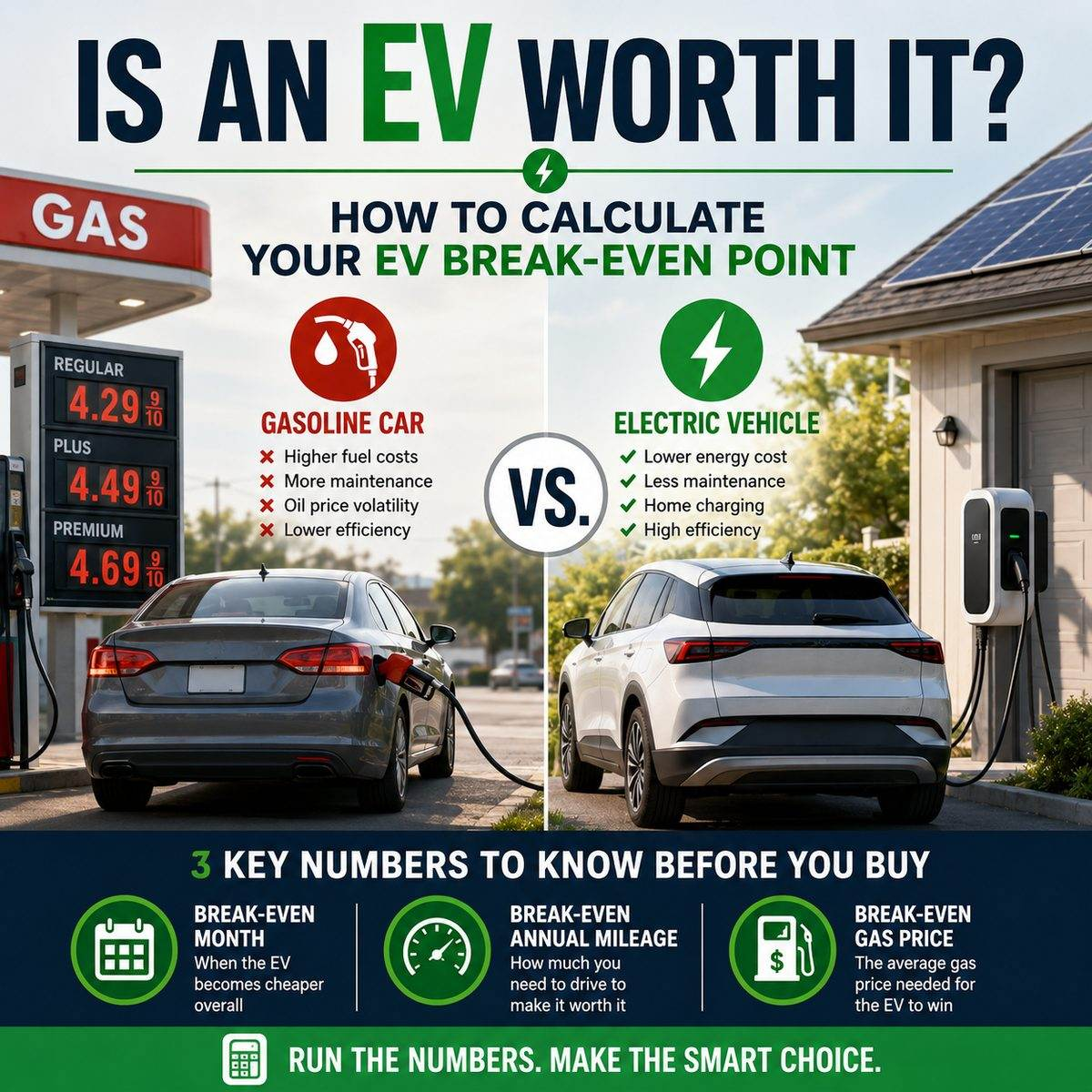
In this article, we’ll build a framework for estimating three particularly useful numbers:
- Break-even month: When does the EV become the less expensive choice?
- Break-even annual mileage: How much do you need to drive for the EV to make financial sense?
- Break-even gasoline price: At what average gas price does the EV become the better economic choice?
Instead of assuming that EVs are always cheaper—or always more expensive—we can let the numbers answer the question.
1. What Does EV Break-Even Mean?
An EV’s break-even point is the point at which its cumulative economic cost becomes equal to or lower than the alternative you’re comparing it with.
That alternative matters.
If you’re choosing between a $40,000 gasoline SUV and a $40,000 electric SUV, the calculation can be relatively straightforward. If you’re deciding whether to replace a reliable, paid-off 15-year-old car with a new $40,000 EV, the hurdle is much higher.
That’s why there isn’t one universal EV break-even point.
Your calculation depends on factors including:
Vehicle price + financing + depreciation + energy + maintenance + insurance + taxes and fees − remaining vehicle value
for each vehicle.
Cash-flow break-even isn’t the same as economic break-even
This is an important distinction.
Suppose your gasoline vehicle costs:
$250 per month in gasoline
while an EV would cost:
$50 per month in electricity.
That’s a $200 monthly energy savings.
But suppose buying the EV creates a $400 monthly payment.
Your immediate cash flow changes by:
+$400 payment − $200 energy savings = $200 more per month
You haven’t reached cash-flow break-even.
However, simply comparing those monthly expenses can also be misleading.
Part of the EV payment is effectively purchasing an asset that will still have value later. Meanwhile, the older gasoline vehicle continues depreciating and may incur increasingly expensive repairs.
That’s why I prefer looking at economic break-even.
At any point in time, we can compare: EV Economic Costvs.Gas Vehicle Economic Cost
Break-even occurs when: EV Economic Cost≤Gas Vehicle Economic Cost
Present value makes the comparison even better
There’s one additional consideration: the time value of money.
A dollar spent five years from now isn’t economically equivalent to a dollar spent today.
Suppose an automaker offers 0% financing for 72 months. You don’t have to hand the manufacturer the entire purchase price today. Some of that money isn’t paid until years into the future.
A present-value calculation recognizes that difference.
The basic formula is: PV=(1+r)tFV
where:
- PV = present value
- FV = future payment or expense
- r = discount rate
- t = time
You don’t need to calculate this manually for every car payment. Later, we’ll incorporate it into our EV break-even model.
For now, the important takeaway is simple:
A good EV comparison should consider not only how much you spend, but when you spend it and what each vehicle is still worth afterward.
That gives us a much better picture than comparing monthly payments or gasoline expenses alone.
2. Start With Energy Cost Per Mile
Before worrying about depreciation, financing and resale value, we can calculate the easiest part of the comparison: how much energy each vehicle needs to travel one mile.
This is also where EVs can have a substantial advantage.
Gasoline and electricity are sold using completely different units. Gasoline is priced per gallon, while electricity is priced per kilowatt-hour (kWh).
Comparing $4 per gallon with 15 cents per kWh doesn’t tell us much.
Instead, convert both into:
Cost per mile
Gasoline cost per mile
For a gasoline vehicle, the formula is: Gas Cost Per Mile=Vehicle MPGGas Price
Suppose your vehicle averages 22 MPG.
At $3 per gallon: $3.00÷22=$0.136
That’s about 13.6 cents per mile.
At $4: $4.00÷22=$0.182
or 18.2 cents per mile.
And at $5: $5.00÷22=$0.227
or approximately 22.7 cents per mile.
| Gasoline Price | 22-MPG Vehicle Fuel Cost |
|---|---|
| $3.00/gallon | 13.6¢/mile |
| $3.50/gallon | 15.9¢/mile |
| $4.00/gallon | 18.2¢/mile |
| $4.50/gallon | 20.5¢/mile |
| $5.00/gallon | 22.7¢/mile |
| $6.00/gallon | 27.3¢/mile |
That means gasoline prices don’t have to change very much before annual transportation costs change substantially—particularly for someone who drives a lot.
EV electricity cost per mile
For an EV, we can use: EV Cost Per Mile=100kWh per 100 miles×Electricity Rate
Suppose an EV consumes 30 kWh per 100 miles.
That’s: 30÷100=0.30 kWh per mile
If home electricity costs 15 cents per kWh: 0.30×$0.15=$0.045
So the EV costs approximately:
4.5 cents per mile
in electricity.
Now we can make a meaningful comparison:
| Vehicle/Energy Assumption | Energy Cost Per Mile |
|---|---|
| 22-MPG car at $3 gas | 13.6¢ |
| 22-MPG car at $4 gas | 18.2¢ |
| 22-MPG car at $5 gas | 22.7¢ |
| EV at 30 kWh/100 mi and 15¢ electricity | 4.5¢ |
At $4 gasoline, the difference is:
18.2¢ − 4.5¢ = 13.7¢ per mile.
At $5 gasoline:
22.7¢ − 4.5¢ = 18.2¢ per mile.
That’s the basic engine behind EV energy savings.
Use your actual electricity rate
Be careful with this calculation.
The economics of charging an EV at home can be very different from relying heavily on public DC fast charging.
Ideally, use the marginal cost of the electricity you’ll actually use to charge the vehicle, including any applicable time-of-use pricing.
You should also allow for charging losses. Not every kilowatt-hour drawn from the wall makes it into the battery.
A conservative calculation can therefore use the EV’s expected wall-to-wheel electricity consumption rather than relying solely on the vehicle’s advertised battery capacity and EPA range.
The goal isn’t to make the EV look as inexpensive as possible.
It’s to create a realistic estimate of what you’ll actually spend.
3. Calculate Your Annual Energy Savings
Once you know each vehicle’s energy cost per mile, calculating annual savings is straightforward.
The formula is: Annual Energy Savings=(Gas Cost/Mile−EV Cost/Mile)×Annual Miles
Let’s continue using:
- Gas vehicle: 22 MPG
- Gasoline: $4.50/gallon
- EV: 30 kWh/100 miles
- Home electricity: $0.15/kWh
The gasoline vehicle costs: $4.50÷22=$0.2045/mile
or approximately 20.5 cents per mile.
The EV costs: 0.30×$0.15=$0.045/mile
or 4.5 cents per mile.
The difference is approximately:
16 cents per mile
That doesn’t sound enormous until you multiply it by thousands of miles.
| Annual Miles | 22-MPG Gas Car at $4.50 | EV at 4.5¢/Mile | Approx. Annual Energy Savings |
|---|---|---|---|
| 5,000 | $1,023 | $225 | $798 |
| 10,000 | $2,045 | $450 | $1,595 |
| 12,500 | $2,557 | $563 | $1,994 |
| 15,000 | $3,068 | $675 | $2,393 |
| 20,000 | $4,091 | $900 | $3,191 |
| 25,000 | $5,114 | $1,125 | $3,989 |
| 30,000 | $6,136 | $1,350 | $4,786 |
This table illustrates one of the most important principles in EV economics:
Annual mileage can matter just as much as gasoline prices.
Someone driving only 5,000 miles per year saves about $800 annually under these assumptions.
Someone driving 30,000 miles saves almost $4,800 per year.
Over six years, ignoring changes in energy prices and the time value of money, that could represent roughly:
5,000 miles/year: ~$4,800 in energy savings
versus
30,000 miles/year: ~$28,700 in energy savings.
That’s an enormous difference.
A 50-mile commute can add up quickly
Consider someone commuting 50 miles round trip, five days a week, 50 weeks per year.
That’s: 50×5×50=12,500 miles/year
At $4.50 gasoline, our 22-MPG vehicle costs approximately:
$2,557 per year in gasoline.
Our EV costs approximately:
$563 per year in home electricity.
Annual difference:
$1,994
Over six years, that’s nearly $12,000 in nominal energy savings if those energy prices remained constant.
But—and this is crucial—that does not mean you should spend $35,000 on an EV simply to save $12,000 on energy.
We still haven’t accounted for:
- the value of your existing vehicle,
- the EV’s purchase price,
- depreciation,
- financing,
- maintenance and repairs,
- insurance,
- registration and road-use fees,
- or what each vehicle will be worth when you eventually sell it.
Energy savings are only one component of the EV break-even calculation.
But now we have the first building block.
We know how much cheaper each mile is.
Next, we need to determine how much additional capital you’re actually committing when you replace your existing vehicle with the EV.
4. Don’t Forget the Vehicle You’re Replacing
One of the easiest mistakes in an EV comparison is treating a paid-off vehicle as though it has no economic value.
If you own a gasoline vehicle worth $5,000, keeping it does not cost you $0. You have $5,000 of capital tied up in that vehicle.
You could:
- Continue driving it.
- Sell it and invest the proceeds.
- Trade it toward another vehicle.
- Sell it privately and use the proceeds toward an EV.
Economists and financial planners refer to this as an opportunity cost.
A $5,000 paid-off car isn’t a free car
Suppose you’re comparing:
Current gasoline vehicle
- Market value: $5,000
- No loan
with:
New EV
- Purchase price after incentives: $32,000
If you sell the existing vehicle for $5,000 and use the proceeds toward the EV, you might finance: $32,000−$5,000=$27,000
From a cash-flow perspective, that’s exactly what happens.
But from an economic perspective, you shouldn’t conclude that the EV only costs $27,000.
You exchanged a $5,000 asset you already owned for $5,000 of equity in the new vehicle.
That’s why a good break-even analysis should track the value of both vehicles, rather than simply subtracting a trade-in from the EV price and forgetting about it.
Compare depreciation, not just purchase prices
Suppose the current vehicle is worth $5,000 today and you expect it to be worth $1,000 in six years.
Its estimated depreciation is: $5,000−$1,000=$4,000
Now suppose an EV costs $32,000 after incentives and is expected to be worth $13,000 six years later.
Its estimated depreciation is: $32,000−$13,000=$19,000
The EV’s incremental depreciation is therefore: $19,000−$4,000=$15,000
That’s a much more useful number than simply saying:
“The EV costs $32,000 and my current car is paid off.”
The EV’s lower energy and maintenance costs need to overcome approximately $15,000 of additional depreciation, plus any differences in financing, insurance, taxes and fees.
This also explains why replacing an old paid-off car is one of the hardest tests for EV economics.
If an EV can eventually break even against a functioning vehicle you already own, that’s a much stronger financial case than comparing an EV with another new vehicle you were already planning to purchase.
5. Calculate the EV’s True Acquisition Cost
Sticker price isn’t necessarily what an EV costs you.
Dealer discounts, manufacturer incentives and government rebates can substantially change the calculation.
Start with: Effective Purchase Price =Selling Price−Dealer Discounts−Manufacturer Incentives−Applicable Rebates
Then add any acquisition expenses that aren’t already included, such as registration, documentation fees or taxes where applicable.
Example
Suppose an EV has a $35,000 selling price.
You receive:
- $1,000 dealer discount
- $500 manufacturer incentive
- $2,000 state EV rebate
The effective vehicle price becomes: $35,000−$1,000−$500−$2,000=$31,500
If you then trade a vehicle worth $5,000: $31,500−$5,000=$26,500
may be the approximate amount you need to finance, before applicable fees.
But remember the distinction from the previous section:
$31,500 is the EV’s effective acquisition price.
$26,500 is approximately how much additional cash or financing you need after exchanging your $5,000 asset.
Those aren’t the same economic number.
Keep the four parts of the transaction separate
When negotiating a vehicle purchase, I prefer evaluating four components separately:
1. Vehicle selling price
What is the dealer actually charging before incentives?
2. Incentives and rebates
Which manufacturer, state, utility or other incentives apply, and can they be combined?
3. Financing
What APR and term are you receiving?
4. Trade-in
What is the dealer actually paying for your existing vehicle?
Combining everything into a single statement such as “Your payment will only be $399 per month” makes it much harder to determine whether you’re getting a good deal.
A dealer can offer an attractive trade-in allowance while giving you less of a discount on the new vehicle—or offer a lower purchase price while using expensive financing.
For break-even analysis, we want the actual economics of each component.
6. Financing Can Dramatically Change the Answer
Two identical EVs purchased for the same price can have very different economic costs if one is financed at 0% and the other at 8%.
Suppose you finance $30,000 for 72 months.
At 0%, the payment is: $30,000÷72=$416.67/month
Total interest:
$0
At a higher interest rate, part of every payment represents financing cost rather than purchasing the vehicle itself.
That financing expense makes the EV’s break-even hurdle larger.
Why 0% financing is particularly valuable
There’s another benefit that isn’t obvious from simply adding the payments.
Money has a time value.
If an automaker allows you to pay $416.67 five years from now instead of requiring that $416.67 today—and charges no interest for doing so—the future payment has a lower present economic value.
For example, at a hypothetical 5% annual discount rate: PV=(1+r)tFV
A $5,000 payment due five years from now has a present value of approximately: $5,000÷1.055≈$3,918
That doesn’t mean the lender forgives the difference. You’ll still pay $5,000.
It means $5,000 five years from now doesn’t have the same purchasing power or opportunity cost as $5,000 today.
This becomes particularly important when comparing:
A paid-off older car that continuously requires gasoline and repairs
with
a new EV financed at a very low promotional rate.
The EV’s payments are spread into the future, while some of the gasoline and repair savings begin immediately.
Don’t buy a vehicle just because financing is cheap
There’s an important warning here.
A 0% loan can improve the economics of a vehicle you already have a good reason to purchase.
It does not make an unnecessarily expensive vehicle inexpensive.
Paying $50,000 interest-free still means paying $50,000.
The relevant question is whether the combination of:
purchase price + financing + depreciation + operating expenses
is better than your alternative.
7. Maintenance and Repair Costs Matter
Energy gets most of the attention in EV comparisons, but maintenance and repairs can materially change the break-even point.
A gasoline vehicle has systems that an EV simply doesn’t need.
Depending on the vehicle, those can include:
- Engine oil and oil filters
- Spark plugs
- Fuel system components
- Exhaust components
- Emissions-control equipment
- Engine cooling components
- Belts and related engine accessories
- Conventional transmission components and service
EVs eliminate many of these items because their drivetrains are mechanically simpler.
That doesn’t mean an EV costs nothing to maintain.
EV owners still need to budget for items such as:
- Tires
- Suspension components
- Wiper blades
- Cabin air filters
- Brake inspections and eventual service
- Applicable coolant/service items
- Alignment
- General wear and repairs
Tires deserve special attention
EVs can be heavy and deliver substantial instantaneous torque.
Depending on the model, driving habits and tire selection, tire replacement can therefore be a meaningful ownership expense.
Don’t build a break-even model that assumes:
Gas vehicle maintenance = expensive
and
EV maintenance = zero.
That’s not realistic.
Older vehicles create repair uncertainty
Maintenance becomes particularly important when the vehicle being replaced is already 15 or 20 years old.
Suppose you estimate:
Older gasoline vehicle: $1,500/year average maintenance and repairs
New EV: $500/year average maintenance and repairs
That’s an estimated: $1,500−$500=$1,000/year
EV advantage.
Over six years: $1,000×6=$6,000
before discounting future expenses.
But an older vehicle’s repairs won’t conveniently arrive at exactly $125 every month.
You might have:
Year 1: $600
Year 2: $900
Year 3: $2,700
Year 4: $500
That’s why I prefer treating maintenance as an expected long-term cost rather than pretending we can predict the exact month a water pump, air conditioner, suspension component or transmission will fail.
For a more conservative analysis, you can also run multiple scenarios:
Low-repair scenario
Expected-repair scenario
High-repair scenario
If the EV only wins under the high-repair scenario, the financial case isn’t particularly strong.
If it wins even when the existing vehicle remains relatively reliable, the case is much stronger.
8. Insurance Can Move the Break-Even Point
Insurance is one expense you should avoid estimating if you can obtain an actual quote.
A new EV may cost more to insure than an older gasoline vehicle because the new vehicle is worth more and collision repairs can be expensive.
But insurance pricing depends on far more than the vehicle’s propulsion system.
Insurers consider factors such as:
- Vehicle model
- Repair costs
- Driver history
- Location
- Annual mileage
- Coverage levels
- Deductibles
- Household drivers
- Available discounts
That means the only really useful comparison is:
What would my insurer charge me for this specific EV compared with the vehicle I already own?
Why even a modest insurance difference matters
Suppose your EV saves:
$2,000 per year in energy
and:
$1,000 per year in expected maintenance and repairs.
That’s: $3,000/year
of operating-cost savings.
But suppose insurance costs another:
$800 per year.
Your net operating advantage falls to: $3,000−$800=$2,200/year
Over six years, that’s a nominal difference of: $800×6=$4,800
That’s enough to move an EV’s break-even point by many months—or potentially years.
Conversely, if insurance costs are approximately equal, the EV gets to keep essentially its entire energy and maintenance advantage.
Compare equivalent coverage
When requesting quotes, make sure you’re comparing the same:
Liability limits
Collision and comprehensive coverage
Deductibles
Uninsured/underinsured motorist coverage
and other applicable options.
Otherwise, you can accidentally make one vehicle appear less expensive simply because the insurance quote provides less protection.
At this point, we have accounted for energy, the value of the existing vehicle, acquisition cost, financing, maintenance and insurance.
But we’re still missing what may be the single largest ownership expense of all:
depreciation.
That’s where the EV break-even calculation gets especially interesting.
9. Depreciation Is Often the Biggest Cost
Gasoline and electricity are highly visible expenses because you pay for them throughout the year. Depreciation is different. You don’t receive a monthly depreciation bill, but that doesn’t make the expense any less real.
For many vehicles, depreciation can be one of the largest costs of ownership.
Suppose you purchase an EV for an effective price of $32,000 after discounts and incentives.
Six years later, you estimate that it’s worth $13,000.
Your estimated depreciation is:$32,000−$13,000=$19,000
Now consider the older gasoline vehicle you’re thinking about replacing.
Suppose it’s worth $5,000 today and an estimated $1,000 six years from now.
Its depreciation would be:$5,000−$1,000=$4,000
The EV therefore incurs approximately:$19,000−$4,000=$15,000
of additional depreciation relative to keeping the existing vehicle.
That’s the hurdle our EV savings need to overcome.
Don’t compare $32,000 with $0
This is where break-even calculations can go wrong.
If your current car is paid off, it is tempting to compare:
New EV: $32,000
versus:
Paid-off car: $0
But your current vehicle isn’t worth zero. It might be a $5,000 asset.
Likewise, the EV doesn’t become worthless after six years. It might still be worth $13,000.
A better comparison is:Purchase/Current Value−Future Value
In our example:
| Vehicle | Value Today/Effective Price | Estimated Value in 6 Years | Depreciation |
|---|---|---|---|
| Existing gas car | $5,000 | $1,000 | $4,000 |
| New EV | $32,000 | $13,000 | $19,000 |
| Incremental EV depreciation | $15,000 |
Now compare that $15,000 incremental depreciation with the operating savings we’ve already calculated.
Suppose the EV saves approximately:
$2,000/year in energy
plus:
$1,000/year in expected maintenance and repairs.
That’s roughly:$3,000/year
of operating-cost advantage.
A very rough first-pass calculation would be:$15,000÷$3,000=5 years
That is not yet our true break-even calculation. It ignores financing, present value, changing vehicle values, insurance and other expenses.
But it immediately tells us something useful: this isn’t necessarily a 15-year proposition. Under these assumptions, the EV could plausibly recover its additional depreciation within a normal ownership period.
Residual-value assumptions deserve skepticism
Future vehicle values are estimates.
EV technology may improve rapidly. Battery prices could decline. Used-EV demand could strengthen or weaken. Gasoline prices could change. Individual models may depreciate very differently.
The same uncertainty applies to an older gasoline vehicle.
For that reason, I wouldn’t rely on a single residual-value forecast.
A stronger analysis can use:
Low residual value
Expected residual value
High residual value
If the EV only works financially under an optimistic resale assumption, that tells you something important about the risk of the decision.
10. The Complete EV Break-Even Formula
We can now combine the pieces.
For an EV, cumulative economic cost at a future point can be represented conceptually as:EV Costt=PV(Purchase/Payments)+PV(Electricity)+PV(Maintenance)+PV(Insurance)+PV(Fees)−PV(Resale Value)
For the gasoline vehicle:Gas Costt=Current Vehicle Value+PV(Gasoline)+PV(Maintenance)+PV(Insurance)+PV(Fees)−PV(Future Vehicle Value)
The EV reaches economic break-even when:EV Costt≤Gas Costt
That looks complicated, but the logic is straightforward.
We’re asking:
If I stopped the comparison today, how much wealth would each transportation choice have consumed?
What goes into the EV side?
The EV calculation should include:
Acquisition cost: What did the EV actually cost after discounts and applicable incentives?
Financing: How much interest are you paying, and when are payments made?
Electricity: How much energy does the EV consume and what will charging cost?
Maintenance: Tires, service and expected repairs.
Insurance: Only the difference matters if coverage is otherwise equivalent.
Registration and fees: Including any EV-specific fees.
Remaining vehicle value: What could you reasonably sell the EV for at that point?
What goes into the gasoline side?
The same principle applies.
Current vehicle value: What could you sell the vehicle for today?
Gasoline: MPG × mileage × expected gasoline price.
Maintenance and repairs: Particularly important for an aging vehicle.
Insurance: Again, compare equivalent coverage.
Registration and fees
Remaining vehicle value: What is the car expected to be worth at that point?
Why present value matters
Imagine two alternatives that each ultimately cost $30,000.
Option A requires almost all $30,000 today.
Option B spreads much of the expense over six years at 0% financing.
Those are not economically identical.
Present-value analysis discounts future cash flows:PV=(1+r)tCFt
For monthly calculations, we can use a monthly discount rate:rm=(1+r)1/12−1
Then discount each month’s expenses back to today.
This is especially useful when comparing promotional financing, gasoline expenses, repairs and other costs occurring at different times.
Don’t confuse precision with certainty
A spreadsheet can calculate an answer to the penny.
That doesn’t mean the future will cooperate.
Gas prices, electricity rates, repairs and resale values are uncertain.
So instead of saying:
“The EV will break even in exactly month 63.”
I prefer something like:
“Our base-case estimate is month 63, with a reasonable range of approximately months 52–75 depending on energy prices, repairs and resale values.”
That’s much more useful financial planning.
11. Calculate Your Break-Even Month
Once we’ve defined the costs, we can run the calculation month by month.
At month one:EV Economic Cost1
is compared with:Gas Economic Cost1
Then month two.
Then month three.
And so on.
The first month in which:EV Economic Costt≤Gas Economic Costt
becomes the estimated:
EV Break-Even Month
Suppose our model produces the following simplified result:
| Ownership Period | Lower-Cost Alternative |
|---|---|
| 12 months | Gas vehicle |
| 24 months | Gas vehicle |
| 36 months | Gas vehicle |
| 48 months | Gas vehicle |
| 60 months | Nearly equal |
| 64 months | Break-even |
| 72 months | EV |
| 84 months | EV |
| 120 months | EV by a larger amount |
The interpretation is straightforward.
If you expect to own the EV for only three years, buying it to save money probably doesn’t work under these assumptions.
If you expect to own it for eight or ten years, the economics may be considerably better.
Your ownership period matters
This is why break-even shouldn’t be viewed in isolation.
Suppose:
EV A breaks even in month 42.
EV B breaks even in month 85.
If you normally replace vehicles every five years, those are very different propositions.
I’d therefore calculate not only the crossover month but also the projected economic position at:
3 years
5 years
6 years
and
10 years
A useful output might look like:
Estimated break-even: Month 64
3-year result: Gas vehicle ahead by $X
5-year result: Gas vehicle ahead by $Y
6-year result: EV ahead by $Z
10-year result: EV ahead by $XX
That tells you far more than a simple statement that an EV “saves money.”
What if there is no break-even?
That’s a perfectly valid result.
A model might show that the EV doesn’t break even within 10 years.
That doesn’t automatically mean you shouldn’t buy it.
You may value safety, technology, performance, convenience, environmental benefits or simply owning a newer vehicle.
But you shouldn’t call those benefits financial savings.
The break-even model helps separate:
“I want this vehicle.”
from:
“This vehicle will save me money.”
Both can be legitimate reasons to make a purchase. They’re just different reasons.
12. Calculate Your Break-Even Mileage
We can also turn the problem around.
Instead of asking:
When does the EV become cheaper?
ask:
How many miles do I need to drive each year for the EV to become the better financial choice?
This can be one of the most useful numbers in the entire analysis because EV energy savings generally increase with mileage.
Suppose our gas vehicle costs:
20.5 cents per mile in gasoline
while our EV costs:
4.5 cents per mile in electricity.
Energy savings are approximately:20.5¢−4.5¢=16¢/mile
Every additional 1,000 miles driven therefore produces approximately:1,000×$0.16=$160
of additional energy savings.
At:
5,000 miles: ~$800/year
10,000 miles: ~$1,600/year
15,000 miles: ~$2,400/year
20,000 miles: ~$3,200/year
30,000 miles: ~$4,800/year
That’s before maintenance differences.
Why high-mileage drivers can have very different EV economics
Consider two people purchasing the exact same EV.
One drives 6,000 miles per year.
The other drives 25,000 miles.
They paid the same purchase price.
Their vehicles may experience different depreciation and maintenance, but the high-mileage driver gets far more opportunity to substitute inexpensive electricity for gasoline.
At a 16-cent-per-mile energy advantage:
6,000 miles produces approximately:6,000×$0.16=$960/year
25,000 miles produces:25,000×$0.16=$4,000/year
That’s why asking whether “EVs save money” without knowing annual mileage isn’t particularly useful.
Finding the actual break-even mileage
The complete calculation asks:
At what annual mileage does the present value of EV operating savings overcome the EV’s additional economic cost within my expected ownership period?
For example, a hypothetical six-year analysis might produce:
| Annual Mileage | Six-Year Result |
|---|---|
| 5,000 | Gas vehicle strongly favored |
| 10,000 | Gas vehicle favored |
| 12,500 | Close |
| 15,000 | Approximate break-even |
| 20,000 | EV favored |
| 30,000 | EV strongly favored |
These numbers are illustrative, not universal.
Your threshold depends on the actual vehicles, energy prices, maintenance, financing and residual values.
But the concept is extremely useful:
Break-Even Annual Mileage
If your model says you need to drive 22,000 miles annually and you only drive 8,000, buying the EV solely to save money probably doesn’t make sense.
If the threshold is 9,000 miles and you drive 20,000, the economic case is much stronger.
13. Calculate Your Break-Even Gas Price
There is one more variable consumers frequently worry about:
What happens if gasoline prices fall?
That’s a legitimate concern.
If you buy an EV when gasoline costs $5 per gallon but your financial case only works if gasoline remains above $4.75 for the next six years, your expected savings are heavily dependent on an unpredictable commodity price.
A better model asks:
At what sustained average gasoline price does the EV become the less expensive alternative?
That’s your:
Break-Even Gas Price
Start with fuel cost per mile
Remember:Gas Cost/Mile=MPGGas Price
For a 22-MPG vehicle:
| Gas Price | Gasoline Cost Per Mile |
|---|---|
| $2.50 | 11.4¢ |
| $3.00 | 13.6¢ |
| $3.50 | 15.9¢ |
| $4.00 | 18.2¢ |
| $4.50 | 20.5¢ |
| $5.00 | 22.7¢ |
| $5.50 | 25.0¢ |
| $6.00 | 27.3¢ |
Our example EV remains around 4.5 cents per mile at a 15-cent electricity rate and 30 kWh/100-mile consumption.
So even at $2.50 gasoline, the EV has a substantial energy-cost advantage.
But remember:
Energy break-even isn’t ownership break-even.
The EV may save money on every mile driven while still costing more overall because of additional depreciation, financing, insurance or other expenses.
Run multiple gasoline scenarios
Instead of forecasting one gasoline price for the next six or ten years, I’d stress-test the decision.
For example:
| Long-Term Average Gas Price | Break-Even Result |
|---|---|
| $2.50 | EV may not break even |
| $3.00 | Break-even substantially delayed |
| $3.50 | Economics improve |
| $4.00 | EV becomes increasingly competitive |
| $4.50 | Base-case EV economics strengthen |
| $5.00 | Break-even moves earlier |
| $6.00 | EV operating advantage becomes substantial |
Again, those are directional examples. The actual crossover should come from the complete model.
Don’t build your purchase decision around today’s gas price
Gasoline can move rapidly.
A geopolitical event can push oil prices higher. A recession can reduce demand. New production can increase supply. Refinery closures can affect regional gasoline markets even when crude prices decline.
Predicting the exact gasoline price five years from now isn’t necessary.
Instead, determine:
At $3 gas, what happens?
At $4?
At $5?
Then ask yourself:
How dependent is my decision on gasoline remaining expensive?
If the EV works financially even at $3.25 gasoline, that’s a much more robust proposition than an EV that requires $5.50 gasoline to break even.
The best EV deals don’t require heroic assumptions
This is ultimately what I would look for.
A financially compelling EV purchase shouldn’t require:
- gasoline staying at unusually high prices,
- electricity never increasing,
- perfect EV resale values,
- enormous repair bills on your existing vehicle,
- or unusually high annual mileage.
The stronger the deal, the more conservative assumptions it can withstand.
That leads us naturally to the next part of the analysis: putting all of these variables into a real-world example and seeing how the break-even point changes when gasoline, electricity and mileage move.
14. A Real-World Example: Replacing an Older Gas Car With a New EV
Now let’s put the framework into practice.
Consider a household with an older gasoline sedan that is still functional and paid off. The owner is considering selling it and purchasing a new EV.
We’ll use illustrative assumptions rather than trying to predict the economics of any particular vehicle.
The existing gasoline car
Assume:
- Current value: $5,000
- Fuel economy: 22 MPG
- Annual driving: 12,500 miles
- Expected gasoline price: $4.00 per gallon
- Expected maintenance and repairs: $1,500 per year
- Estimated value after six years: $1,000
Annual gasoline consumption would be:12,500÷22≈568 gallons
At $4 per gallon:568×$4≈$2,273/year
Add $1,500 in expected maintenance and repairs, and our simplified annual operating cost becomes approximately:$2,273+$1,500=$3,773/year
before insurance, registration and depreciation.
The new EV
Now suppose the household finds an EV with:
- Effective purchase price after incentives: $32,000
- Financing: 0% for 72 months
- Efficiency: 30 kWh/100 miles
- Home electricity: $0.15/kWh
- Annual mileage: 12,500 miles
- Expected maintenance: $500/year
- Estimated value after six years: $13,000
- Insurance difference: $0
The EV uses approximately:12,500×0.30=3,750 kWh/year
At 15 cents per kWh:3,750×$0.15=$563/year
Add $500 of estimated annual maintenance:$563+$500=$1,063/year
The operating-cost difference becomes:$3,773−$1,063=$2,710/year
That’s a substantial advantage for the EV.
But we’re still not done.
Now include depreciation
The gasoline car falls from $5,000 to an estimated $1,000:$5,000−$1,000=$4,000
The EV falls from $32,000 to an estimated $13,000:$32,000−$13,000=$19,000
The EV therefore incurs approximately:$19,000−$4,000=$15,000
of additional depreciation.
A quick, undiscounted approximation gives us:$15,000÷$2,710≈5.5 years
So our rough calculation points toward a break-even period somewhere around five to six years.
That doesn’t mean month 66 is guaranteed.
A proper model would calculate vehicle values and expenses month by month and discount future cash flows to present value.
But the example illustrates why the answer isn’t obvious.
The EV costs substantially more upfront, while the older car costs substantially more to operate.
Break-even is the point where those two economic forces cross.
15. What Happens If Gas Prices Fall?
One of the biggest risks in an EV savings calculation is anchoring the analysis to today’s gasoline price.
Suppose gasoline is currently $5 per gallon.
It would be tempting to calculate six years of savings using $5 gasoline.
But what happens if gasoline averages $3.25 over your actual ownership period?
Your EV still costs less for energy, but your savings decline.
Using our 22-MPG vehicle and 12,500 annual miles:
| Gas Price | Annual Gas Cost | EV Electricity Cost | Annual Energy Savings |
|---|---|---|---|
| $2.50 | $1,420 | $563 | $858 |
| $3.00 | $1,705 | $563 | $1,142 |
| $3.50 | $1,989 | $563 | $1,426 |
| $4.00 | $2,273 | $563 | $1,710 |
| $4.50 | $2,557 | $563 | $1,994 |
| $5.00 | $2,841 | $563 | $2,278 |
| $6.00 | $3,409 | $563 | $2,847 |
The relationship is significant.
At $3 gasoline, the EV saves roughly $1,142 annually on energy.
At $5 gasoline, it saves about $2,278.
That’s almost twice as much.
Use a long-term assumption, not today’s price
For a six- or ten-year ownership decision, I wouldn’t try to predict one precise gasoline price.
Instead, I’d model several scenarios.
For example:
Low-gas scenario: $3.00
Base case: $4.00
High-gas scenario: $5.00
Then calculate the EV’s break-even point under each.
You might discover something like:
| Scenario | Estimated Result |
|---|---|
| $3 gas | EV doesn’t break even during expected ownership |
| $4 gas | EV breaks even late in ownership |
| $5 gas | EV breaks even substantially earlier |
That’s much more informative than building the entire purchase decision around today’s price at the pump.
Ask how much your decision depends on expensive gasoline
This creates a useful stress test.
If the EV only makes sense financially with gasoline above $5 per gallon, your investment thesis depends heavily on high gasoline prices.
If the EV works with $3 gasoline, the financial case is much more resilient.
This is the same principle I would use when evaluating an investment or retirement projection:
Don’t ask whether the plan works under your favorite assumption. Ask how many reasonable assumptions it can survive.
16. What Happens If Electricity Prices Rise?
Gasoline isn’t the only variable that can change.
Electricity rates can rise too.
Suppose our EV consumes 30 kWh per 100 miles and travels 12,500 miles annually.
Annual electricity consumption is approximately:12,500×0.30=3,750 kWh
Now vary the electricity rate:
| Electricity Rate | Annual EV Energy Cost | Cost Per Mile |
|---|---|---|
| $0.10/kWh | $375 | 3.0¢ |
| $0.15/kWh | $563 | 4.5¢ |
| $0.20/kWh | $750 | 6.0¢ |
| $0.25/kWh | $938 | 7.5¢ |
| $0.30/kWh | $1,125 | 9.0¢ |
| $0.40/kWh | $1,500 | 12.0¢ |
Even relatively small changes in electricity rates affect the break-even calculation.
But notice something else.
At 30 cents per kWh, our EV still costs approximately 9 cents per mile for electricity.
Our 22-MPG gasoline vehicle at $4 per gallon costs:$4÷22=18.2 cents/mile
The EV retains a sizable energy advantage.
At 40 cents per kWh, however, EV energy costs rise to 12 cents per mile.
The advantage is still there, but it’s much smaller.
Your local electricity rate matters
This is why national averages aren’t necessarily useful when making an individual purchase decision.
The relevant number is:
What will I actually pay for the additional electricity used to charge my vehicle?
That may depend on:
- Your utility
- Residential rate structure
- Time-of-use pricing
- Seasonal rates
- EV charging programs
- Whether you have solar
- When you normally charge
Someone paying 11 cents per kWh overnight has very different economics from someone paying 35 cents.
Don’t forget charging losses
An EV battery doesn’t receive every kilowatt-hour pulled from the wall.
There are losses associated with charging and other factors.
For a conservative household calculation, I prefer estimating wall-to-wheel electricity consumption rather than simply dividing battery capacity by EPA range.
If your vehicle reports 27 kWh/100 miles while driving, you might model something modestly higher at the wall.
Again, we’re not trying to make the EV win.
We’re trying to determine whether it actually does.
17. Home Charging vs. Public Fast Charging
Where you charge can matter almost as much as what EV you buy.
A homeowner charging overnight at residential electricity rates can have dramatically different economics from someone who depends primarily on public DC fast chargers.
Suppose our EV consumes 30 kWh per 100 miles.
At 15 cents per kWh:30×$0.15=$4.50/100 miles
That’s:
4.5 cents per mile
But suppose public fast charging costs 45 cents per kWh:30×$0.45=$13.50/100 miles
That’s:
13.5 cents per mile
At 60 cents per kWh:30×$0.60=$18/100 miles
or:
18 cents per mile
Compare that with our 22-MPG gasoline vehicle at $4 per gallon:$4÷22=18.2 cents per mile
Suddenly, the EV’s enormous energy-cost advantage has nearly disappeared.
Charging location can change the entire conclusion
Here’s the comparison:
| Energy Source | Approx. Cost Per Mile |
|---|---|
| EV — home at $0.15/kWh | 4.5¢ |
| EV — charging at $0.30/kWh | 9.0¢ |
| EV — fast charging at $0.45/kWh | 13.5¢ |
| EV — fast charging at $0.60/kWh | 18.0¢ |
| 22-MPG gas car — $4 gas | 18.2¢ |
That’s why I would be cautious with broad claims such as:
“EVs cost 4 cents per mile to drive.”
Some do—for some owners, under some charging conditions.
Others don’t.
Calculate your blended charging rate
Most EV owners won’t charge 100% in one location.
You might charge:
90% at home
and
10% on road trips.
Suppose home charging costs 15 cents per kWh and fast charging costs 50 cents.
Your blended electricity rate would be:(0.90×$0.15)+(0.10×$0.50)=$0.135+$0.05=$0.185/kWh
At 30 kWh/100 miles:0.30×$0.185=5.55 cents/mile
That’s still quite inexpensive.
But someone relying on public charging for 80% of their electricity could get a very different result.
Home charging is a financial asset
For EV ownership, access to inexpensive home charging can have meaningful economic value.
You’re effectively purchasing transportation energy at residential electricity rates while you sleep.
For homeowners considering an EV, I would therefore calculate the cost of installing a Level 2 charger separately.
If installation costs $1,500, that expense belongs in the break-even model.
But if the charger lasts through two or three EVs, allocating the entire installation cost to the first vehicle may also be overly conservative.
The important thing is to account for it rather than ignore it.
18. When Buying an EV to Save Money Probably Doesn’t Make Sense
After all of these calculations, it’s important to acknowledge something:
Sometimes keeping the gasoline vehicle is clearly the better financial decision.
EVs can have lower operating costs without being the lower-cost ownership choice.
Here are several situations where buying an EV primarily to save money may not make sense.
You don’t drive very much
If you drive 4,000 miles annually, there simply aren’t many miles over which to recover the EV’s higher capital cost.
Suppose the EV saves 15 cents per mile in energy.
At 4,000 miles:4,000×$0.15=$600/year
That’s useful, but it isn’t enough to justify spending tens of thousands of dollars unnecessarily.
Your existing vehicle is reliable and efficient
Replacing a 15-MPG SUV and replacing a 45-MPG hybrid are very different financial propositions.
At $4 gasoline:
15 MPG costs:$4÷15=26.7¢/mile
45 MPG costs:$4÷45=8.9¢/mile
If the EV costs 5 cents per mile, the first vehicle creates enormous potential energy savings.
The second doesn’t.
The EV has a large price premium
Suppose the gasoline vehicle you would otherwise purchase costs $30,000.
The comparable EV costs $50,000.
A $20,000 premium creates a significant hurdle.
Even $2,000 per year of operating savings could take many years to overcome it.
Purchase-price parity—or something close to it—is one of the strongest ingredients in favorable EV economics.
You can’t charge inexpensively
If you live in an apartment and depend almost entirely on expensive DC fast charging, the EV’s energy advantage may shrink substantially.
That doesn’t necessarily make the EV a poor choice.
But the financial case should use your actual charging situation, not someone else’s home electricity rate.
Insurance is substantially more expensive
An additional $100 per month in insurance means:$100×12=$1,200/year
If the EV is only saving $1,500 annually on energy, insurance could consume most of that advantage.
Get the quote before buying.
You replace vehicles frequently
Suppose your EV is projected to break even in year six.
If you normally replace vehicles every three years, the six-year break-even point isn’t particularly helpful.
Depreciation is often heaviest during the early years of vehicle ownership.
Frequently replacing new vehicles can overwhelm energy savings.
Financing is expensive
A high interest rate can materially increase the EV’s economic cost.
If you’re financing $35,000 at 8% while keeping your current car requires no financing, interest expense creates another hurdle that operating savings must overcome.
Your existing vehicle has years of inexpensive life remaining
This may be the hardest scenario for a new EV to beat.
Imagine you own a reliable $7,000 vehicle that:
- gets 35 MPG,
- needs little maintenance,
- has inexpensive insurance,
- and could reasonably operate another six years.
Buying a $40,000 EV solely to save money on energy is unlikely to be an easy financial case.
And that’s okay.
A financially suboptimal purchase can still be a perfectly reasonable purchase
Personal finance isn’t about pretending utility doesn’t matter.
You may want:
- newer safety technology,
- better reliability,
- more cargo space,
- better performance,
- quieter driving,
- newer driver-assistance systems,
- less exposure to gasoline prices,
- or simply a vehicle you enjoy more.
Those benefits have value.
But I wouldn’t label them financial savings.
There’s an important distinction between:
“I can afford this EV and believe the benefits are worth the cost.”
and:
“Buying this EV will save me money.”
The purpose of break-even analysis is not to tell you which vehicle you’re allowed to buy.
It’s to make sure you understand what you’re paying for—and whether the financial savings you’re expecting are actually likely to materialize.
19. When the EV Economics Become Compelling
The previous section looked at situations where buying an EV primarily to save money may not work.
Now let’s look at the other side.
Certain combinations of vehicle price, mileage, energy costs and ownership period can make the economics substantially more attractive.
You drive a lot
High annual mileage is one of the strongest factors working in an EV’s favor.
Suppose a gasoline vehicle costs 18 cents per mile for fuel and an EV costs 5 cents per mile for electricity.
The difference is:18¢−5¢=13¢/mile
At 5,000 miles per year, that’s:5,000×$0.13=$650/year
At 30,000 miles:30,000×$0.13=$3,900/year
The purchase price doesn’t change because you drive more miles, but the opportunity to recover that purchase price through operating savings increases dramatically.
You can charge inexpensively at home
Cheap home electricity can be one of the most valuable ingredients in EV ownership.
An EV consuming 30 kWh/100 miles costs:
3 cents/mile at 10¢/kWh
4.5 cents/mile at 15¢/kWh
6 cents/mile at 20¢/kWh
If your gasoline alternative costs 15–20 cents per mile for fuel, that’s a meaningful recurring advantage.
You’re replacing an inefficient vehicle
The worse the fuel economy of the vehicle you’re replacing, the greater the potential energy savings.
At $4 gasoline:
| Gas Vehicle Efficiency | Fuel Cost Per Mile |
|---|---|
| 15 MPG | 26.7¢ |
| 20 MPG | 20.0¢ |
| 25 MPG | 16.0¢ |
| 30 MPG | 13.3¢ |
| 40 MPG | 10.0¢ |
| EV at 15¢/kWh and 30 kWh/100 mi | 4.5¢ |
Replacing a 15-MPG SUV can produce a very different result from replacing a 40-MPG hybrid.
The EV is competitively priced
This may be the most important factor of all.
If the EV costs $15,000 more than the comparable gasoline vehicle, lower operating costs have a large hurdle to overcome.
If the difference is $2,000—or the EV is actually cheaper after incentives—the calculation changes dramatically.
Dealer discounts, manufacturer incentives and applicable tax credits or rebates should therefore be incorporated before comparing vehicles.
Financing is inexpensive
A 0%, 1.9% or similarly low promotional rate can materially improve the economics compared with financing at typical market rates.
This is particularly important when the alternative is paying cash.
If you can leave money invested or earning interest while making interest-free payments over several years, the present value of the purchase cost falls.
You’re replacing an aging vehicle
An older vehicle introduces repair risk.
A functioning 15-year-old car may continue operating reliably for years.
It may also need a transmission, air-conditioning repair, suspension work or several smaller repairs.
We shouldn’t automatically assume catastrophe.
But expected repair costs belong in the model.
You plan to keep the EV
The longer the ownership period, the more time the EV has to accumulate operating savings.
If break-even occurs in year five and you keep the EV for ten years, you potentially have another five years during which the operating advantage continues accumulating.
That’s very different from selling immediately after reaching break-even.
The strongest cases combine several advantages
The EV economics become particularly compelling when several conditions occur together:
High mileage + inexpensive home charging + inefficient existing vehicle + competitive EV price + inexpensive financing + long ownership period
You don’t necessarily need all six.
But the more boxes you can check, the stronger the financial case becomes.
20. The Three Numbers to Calculate Before Buying an EV
After working through all these variables, I’d reduce the decision to three primary numbers.
These provide a much better answer than asking whether EVs are generally cheaper than gasoline vehicles.
1. Break-Even Month
This answers:
How long do I need to own the EV before it becomes the lower-cost alternative?
If your break-even calculation says month 52, you need approximately four years and four months before the EV’s cumulative economic advantage offsets its higher initial costs.
That result becomes meaningful when compared with how long you expect to own the vehicle.
If you plan to sell in three years, that’s not a particularly attractive financial proposition.
If you normally keep vehicles for ten years, it could be.
2. Break-Even Annual Mileage
This answers:
How much do I need to drive for the EV’s operating savings to justify its additional cost?
Suppose your six-year break-even mileage is:
14,000 miles per year
If you drive 7,000 miles, the financial case may be weak.
If you drive 25,000, it may be strong.
This is why two people can buy the exact same EV at the exact same price and have very different financial outcomes.
3. Break-Even Gas Price
This answers:
What sustained gasoline price makes the EV economically preferable?
Suppose your model determines that the EV breaks even over six years with average gasoline prices of:
$3.60 per gallon
If your long-term assumption is $4, the economics look reasonably favorable.
If break-even requires $5.75 gasoline, the decision depends much more heavily on persistently high fuel prices.
I would add a fourth number: savings at your expected sale date
Break-even tells you when the lines cross.
It doesn’t tell you how much you’re expected to save.
Suppose two EVs both break even in year five.
After ten years:
EV A saves $2,000.
EV B saves $15,000.
Those aren’t equivalent outcomes.
Your model should therefore calculate:Projected Savings at Expected Sale Date
For example:
| Output | Example |
|---|---|
| Break-even month | 61 |
| Break-even annual mileage | 14,200 |
| Break-even gas price | $3.65 |
| 3-year EV advantage | -$5,200 |
| 5-year EV advantage | -$300 |
| 6-year EV advantage | +$1,800 |
| 10-year EV advantage | +$9,700 |
Negative numbers mean the gasoline alternative remains less expensive. Positive numbers mean the EV is ahead.
This gives you a much more complete picture.
21. EV Break-Even Quick-Check Worksheet
You can perform a basic version of this analysis before visiting a dealership.
Start by gathering the following information:
| Input | Your Number |
|---|---|
| Current vehicle market value | $_____ |
| Current vehicle MPG | _____ MPG |
| Expected long-term gasoline price | $_____/gal |
| Annual mileage | _____ |
| EV selling price | $_____ |
| Dealer/manufacturer incentives | $_____ |
| Tax credits/rebates | $_____ |
| EV efficiency | _____ kWh/100 mi |
| Expected electricity rate | $_____/kWh |
| Percentage charged at home | _____% |
| Current vehicle maintenance/repairs | $_____/year |
| EV maintenance | $_____/year |
| Insurance difference | $_____/year |
| EV-specific registration/fees | $_____/year |
| Charger/installation cost | $_____ |
| Loan APR | _____% |
| Loan term | _____ months |
| Expected ownership period | _____ years |
| Current vehicle future value | $_____ |
| EV future value | $_____ |
| Discount rate | _____% |
First, calculate energy cost per mile
For gasoline:MPGGas Price
For electricity:100kWh per 100 miles×Electricity Rate
Subtract the two and multiply by annual mileage.
That gives you your approximate annual energy savings.
Next, estimate annual operating savings
Add expected maintenance savings:Energy Savings+Maintenance Savings
Then subtract any additional EV costs:−Additional Insurance−Additional Registration/Fees
This gives you a useful first-pass estimate of the EV’s annual operating advantage.
Then compare depreciation
Calculate:EV Purchase Price−EV Future Value
and:Current Vehicle Value−Current Vehicle Future Value
The difference represents the EV’s approximate incremental depreciation.
A rough quick-check is:Simple Break-Even Years≈Annual Net Operating SavingsIncremental EV Depreciation
This isn’t a substitute for the complete present-value model.
But it’s an excellent screening tool.
If the quick check produces 18 years, you probably don’t need a complicated spreadsheet to determine that buying the EV solely for financial savings is difficult to justify.
If it produces four or five years, the deal deserves a closer look.
22. Stress-Test the Answer Before You Buy
A break-even calculation is only as useful as the assumptions behind it.
Rather than relying on one forecast, change the major variables.
I would run at least three scenarios.
Conservative scenario
Use assumptions unfavorable to the EV:
- Lower gasoline prices
- Higher electricity rates
- Lower EV resale value
- Fewer repairs on the existing vehicle
- Higher EV maintenance
- Lower annual mileage
Base-case scenario
Use your best reasonable estimates.
Avoid choosing assumptions simply because they produce the result you want.
EV-favorable scenario
Then test:
- Higher gasoline prices
- Lower charging costs
- Higher annual mileage
- More repairs on the aging vehicle
- Better EV residual value
You might get something like:
| Scenario | Break-Even |
|---|---|
| Conservative | No break-even within 10 years |
| Base case | Month 64 |
| EV-favorable | Month 39 |
That’s extremely useful information.
The answer isn’t:
“The EV breaks even in month 64.”
The better conclusion is:
“My expected break-even is around year five, but reasonable outcomes range from roughly three years to more than ten.”
Now you’re making a decision with an understanding of the uncertainty.
23. Beware of False Precision
Financial models can create a dangerous illusion.
If a spreadsheet says:
Break-even = 63.7 months
it looks extraordinarily precise.
But the underlying assumptions might include:
- gasoline prices six years from now,
- electricity rates,
- future maintenance,
- future insurance premiums,
- EV depreciation,
- the resale value of your current vehicle,
- and how many miles you’ll actually drive.
None of those variables can be predicted to the nearest dollar.
So I wouldn’t make a purchase decision based on whether the model says month 61 or month 64.
Instead, think in ranges.
For example:
Expected break-even: approximately years 5–6
Then identify which assumptions could materially change the answer.
This is a basic principle of financial planning:
Use precision for the calculation, but humility for the forecast.
24. Don’t Ignore the Value of Keeping Your Options Open
There’s one additional financial concept worth considering: optionality.
Suppose your existing car is running well.
You don’t necessarily have to replace it today.
Waiting another year may provide:
- Lower EV prices
- New models
- Better battery technology
- Different incentives
- Better financing
- More charging infrastructure
- More information about EV resale values
But waiting has costs too.
You continue buying gasoline.
Your existing vehicle continues aging.
You may incur repairs.
And its resale value may decline.
The decision isn’t simply:
EV versus gas car.
It can also be:
Buy the EV today versus reconsider the decision in 12 months.
For someone with a reliable existing vehicle, that’s a legitimate alternative to include in the analysis.
25. Should You Include Environmental Benefits?
This article is focused primarily on household finances, so I wouldn’t assign an arbitrary dollar amount to environmental benefits in the break-even calculation.
That doesn’t mean they have no value.
A consumer may reasonably care about:
- Local air pollution
- Greenhouse gas emissions
- Reduced petroleum consumption
- Energy security
- Noise
- Supporting new technologies
But those considerations are different from personal financial savings.
I prefer keeping the financial calculation transparent.
Calculate the EV’s economic result first.
Then ask:
Are the EV’s nonfinancial benefits worth any remaining premium to me?
For example, suppose your model shows that the EV will cost approximately $2,000 more over eight years.
You might still happily pay that difference for the vehicle’s performance, technology, convenience or other benefits.
That’s a personal decision.
But now you know approximately what you’re paying for those benefits.
Conclusion: Don’t Ask Whether EVs Are Cheaper—Calculate When Yours Becomes Cheaper
There isn’t a universal answer to whether an EV will save you money.
For one household, an EV could produce thousands of dollars in savings.
For another, replacing a reliable gasoline vehicle with an expensive EV could increase transportation costs substantially.
The difference comes down to the numbers.
Start with:
What does each vehicle cost per mile for energy?
Then account for:
Purchase price.
The value of the vehicle you’re replacing.
Financing.
Depreciation.
Maintenance and repairs.
Insurance.
Registration and charging costs.
Future resale value.
And finally, the time value of money.
From there, calculate the numbers that actually help you make the decision:
Your break-even month
Your break-even annual mileage
Your break-even gasoline price
Your projected savings at the date you expect to sell the vehicle
That changes the question from:
“Are EVs cheaper than gas cars?”
to something much more useful:
“Under realistic assumptions for my household, when does this particular EV become the less expensive choice?”
That’s the calculation I would want to make before signing the paperwork.
And sometimes the answer will be never.
Sometimes it will be ten years.
Sometimes it could be three or four years.
All three answers are useful because the purpose of the analysis isn’t to prove that an EV is a good deal.
It’s to find out whether your EV deal actually is one.
Back to