
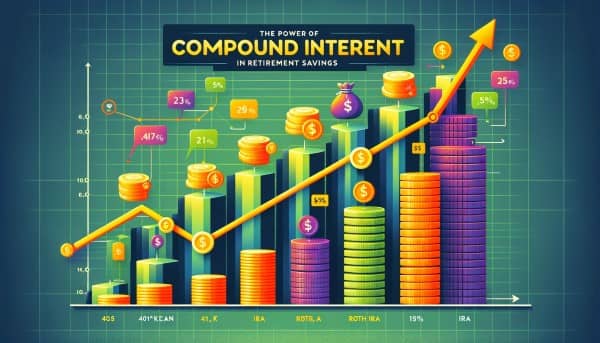
I. Introduction
“Albert Einstein called compound interest the eighth wonder of the world. For retirement savings, it can be the key to financial security.”
Compound interest is one of the most fundamental concepts in finance, yet its implications are often underestimated. In the realm of retirement savings, it plays a crucial role in growing wealth over time, transforming modest contributions into substantial nest eggs. Understanding the mechanics of compound interest and how it applies to various retirement plans can make the difference between a comfortable retirement and financial strain. This blog post aims to illuminate how compound interest works and its profound impact on retirement savings, empowering readers to take charge of their financial future.
In this post, we will cover:
- Understanding Compound Interest: A breakdown of what compound interest is and how it differs from simple interest.
- How Compound Interest Affects Retirement Savings: An exploration of how compounding works over time and its implications for different retirement accounts.
- Strategies to Maximize Compound Interest: Practical ways to leverage compounding to grow retirement savings more effectively.
- Real-World Examples: Case studies illustrating the growth of retirement accounts for early and late savers, emphasizing the power of compound interest.
II. Understanding Compound Interest
Compound interest is a form of interest that accumulates on both the initial principal (the original amount invested or saved) and the interest that has been added to it over time. This differs from simple interest, which calculates interest solely on the initial principal, yielding less growth over time.
How it Works:
- Interest Earned on Initial Principal:
- In the first compounding period, the interest is calculated on the initial principal. For example, if you invest $1,000 at a 5% annual interest rate, you would earn $50 in the first year.
- Interest Earned on Accumulated Interest:
- In subsequent periods, interest is calculated on both the initial principal and the accumulated interest. Continuing the example, in the second year, the 5% interest would apply to the new total of $1,050, resulting in $52.50 in interest earnings. This cycle continues, leading to exponential growth over time.
Frequency of Compounding:
- Annually: Interest compounds once per year, leading to a moderate rate of growth.
- Semi-Annually: Compounds twice a year, accelerating growth.
- Quarterly: Compounds four times a year, yielding even greater returns.
- Monthly: Compounds twelve times a year, resulting in even faster growth.
The frequency of compounding can significantly impact the amount of interest earned over time. For instance, monthly compounding generates more interest compared to annual compounding due to the more frequent addition of interest to the principal.
Table 1: Impact of Consistent Contributions Over Time
| Contribution Amount | Annual Return | Time Period | Total Contributions | Total Savings |
|---|---|---|---|---|
| $200/month | 5% | 20 years | $48,000 | $81,486 |
| $200/month | 5% | 30 years | $72,000 | $159,686 |
| $200/month | 7% | 30 years | $72,000 | $227,495 |
| $200/month | 10% | 30 years | $72,000 | $417,977 |
III. How Compound Interest Affects Retirement Savings
Long-Term Impact: Even modest contributions to retirement savings can grow significantly over time due to compound interest. For instance, a monthly contribution of $200 to a retirement account earning a 6% annual return can grow into over $200,000 in 30 years. This exponential growth is the result of compounding, where interest continually adds to the principal, creating a snowball effect. This shows how consistent contributions, no matter how small, can lead to substantial savings over time.
The Time Factor: Time is one of the most critical elements in maximizing compound interest’s potential. The earlier you start saving, the more time your money has to grow. For example, an individual who begins saving $200 per month at age 25 and continues until retirement at age 65 will amass significantly more wealth than someone who begins at age 45, even if they contribute the same amount. Starting early allows more compounding cycles, leading to greater growth.
Investment Options: Various retirement savings vehicles offer different opportunities for leveraging compound interest:
- 401(k): A workplace retirement plan that allows pre-tax contributions, which grow tax-deferred until withdrawal. Employer matching programs can amplify compounding by increasing the initial contributions.
- IRA (Traditional or Roth): Individual Retirement Accounts offer tax-advantaged growth. Traditional IRAs allow for pre-tax contributions with tax-deferred growth, while Roth IRAs allow after-tax contributions, with tax-free growth and withdrawals.
- Other Vehicles: Various accounts, such as SEP IRAs and SIMPLE IRAs, cater to specific groups (e.g., self-employed individuals), offering similar benefits and allowing the power of compounding to take effect.
Comparing these options, we see that all provide opportunities for compound interest to grow wealth. However, the specific tax advantages and structures may influence which option is best for a given individual or family.
Table 2: Comparison of Retirement Savings Vehicles
| Account Type | Contribution Limits (2024) | Tax Treatment | Compounding Features |
|---|---|---|---|
| 401(k) | $22,500 (under 50) | Pre-tax contributions, tax-deferred growth | Employer matching; tax-deferred compounding |
| Traditional IRA | $6,500 (under 50) | Pre-tax contributions, tax-deferred growth | Tax-deferred compounding |
| Roth IRA | $6,500 (under 50) | After-tax contributions, tax-free growth | Tax-free compounding; tax-free withdrawals |
| SEP IRA | 25% of compensation or $66,000 | Pre-tax contributions, tax-deferred growth | Ideal for self-employed individuals |
IV. Strategies to Maximize Compound Interest
Consistent Contributions: Regular contributions to retirement accounts are crucial to maximizing compound interest. Whether it’s $50 or $500 a month, consistent contributions ensure that your retirement savings steadily grow. This consistency creates a foundation for compound interest to work its magic, enabling small amounts to accumulate into significant sums over time. Automating contributions through direct deposits or standing orders can help maintain this regularity.
Choosing High-Yield Accounts: Selecting accounts or investments with higher yields can significantly accelerate the compounding process. For example, opting for stocks or mutual funds with a track record of strong returns can lead to higher overall growth. Similarly, high-interest savings accounts or fixed-income investments can provide steady returns, fueling compounding. Compare the yield rates of various options, considering factors such as risk tolerance and investment horizon, to choose the best strategy.
Reinvesting Returns: Reinvesting dividends and interest payments is another strategy to maximize compound interest. Instead of cashing out these returns, reinvesting them back into your retirement account allows for continuous compounding, leading to exponential growth. For instance, mutual funds and ETFs often offer dividend reinvestment programs (DRIPs) that automatically reinvest earnings, adding to the principal and accelerating compounding.
Table 3: Frequency of Compounding and Growth Impact
| Compounding Frequency | Principal ($1,000) | Annual Return | Value After 10 Years |
|---|---|---|---|
| Annually | $1,000 | 6% | $1,791 |
| Semi-Annually | $1,000 | 6% | $1,814 |
| Quarterly | $1,000 | 6% | $1,824 |
| Monthly | $1,000 | 6% | $1,828 |
V. Examples
Scenario 1: Early Starter: John is 25 years old and decides to start saving for retirement by contributing $200 per month to a retirement account earning an average annual return of 7%. After 10 years, John’s account has grown to approximately $35,000, thanks to compound interest. Continuing these contributions, by the time John reaches 65, his account has amassed over $500,000. This substantial growth illustrates how starting early provides more compounding cycles, allowing interest earnings to build exponentially over time.
Scenario 2: Late Bloomer: Mark begins saving for retirement at age 45, contributing $200 per month to a similar account earning 7% annually. By age 65, Mark’s account has grown to around $105,000. While still a notable amount, this figure is significantly lower than John’s due to the reduced number of compounding cycles and contributions.
Comparison: The stark difference between John’s and Mark’s retirement savings highlights the power of time and compound interest. John, starting 20 years earlier than Mark, benefits from twice as many contributions and compound interest cycles, resulting in a retirement nest egg nearly five times larger. This comparison emphasizes the importance of starting early to maximize retirement savings, underscoring how even modest, consistent contributions can lead to substantial long-term growth.
VI. Conclusion
Summary: In this post, we’ve explored the concept of compound interest and its significant impact on retirement savings. We’ve clarified how compound interest works, its long-term effects on retirement accounts, and how different savings vehicles leverage compounding. Additionally, we outlined strategies for maximizing compound interest, including consistent contributions, choosing high-yield accounts, and reinvesting returns. Real-world examples further illustrated the differences between early and late savers, emphasizing the exponential growth potential of compound interest over time.
To secure your financial future, it’s essential to start or continue contributing to retirement accounts. Remember, even modest contributions can grow significantly due to compound interest, especially when you start early. Take action now to leverage this powerful financial tool and build a comfortable retirement nest egg.
Further Reading: For readers looking to deepen their knowledge, consider exploring the following resources:
- “The 401(k) Handbook” by Sarah O’Brien – A comprehensive guide to maximizing 401(k) benefits.
- “Investing for Retirement” by John Templeton – A practical guide to different retirement savings options and strategies.
- “The Magic of Compound Interest” by Investopedia – An in-depth look at how compound interest works and its applications in personal finance.
