
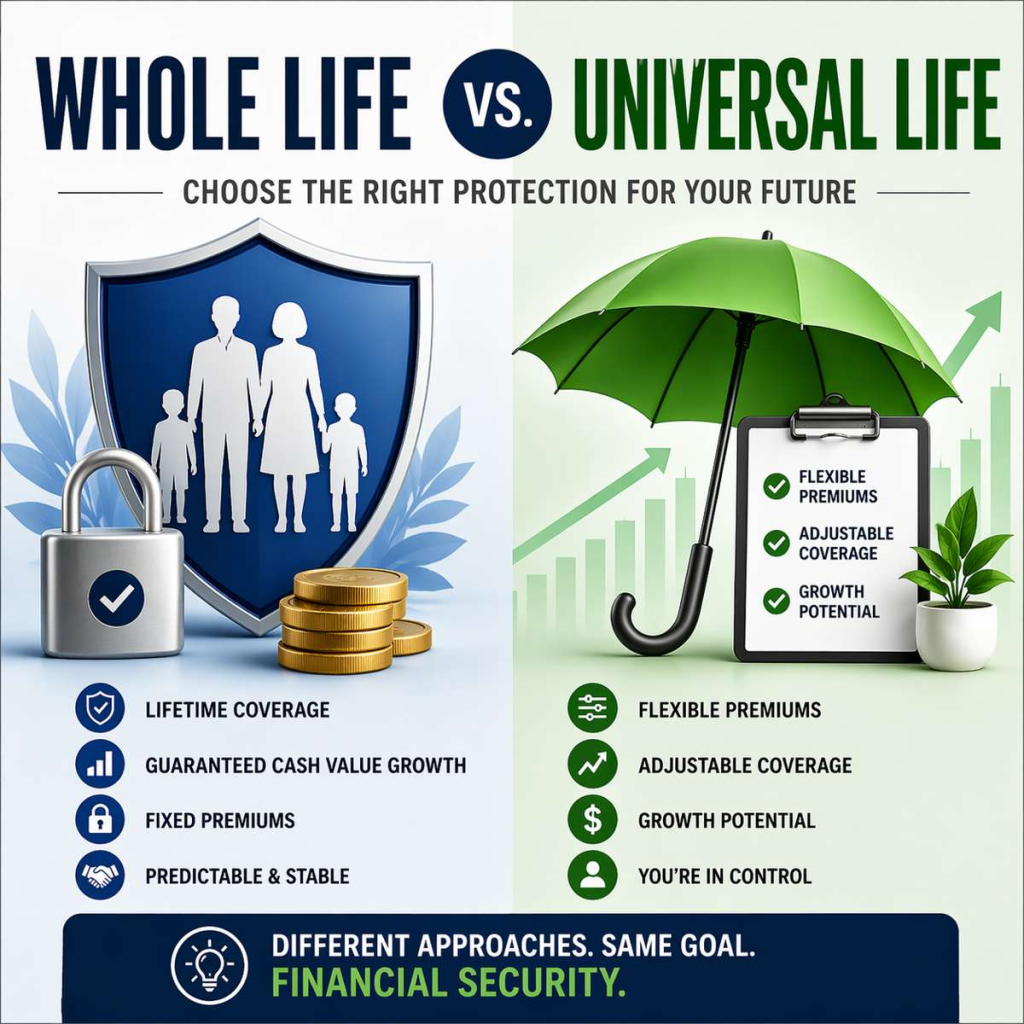
Whole Life vs. Universal Life Insurance: Complete Guide Outline
🧭 Introduction: Understanding Your Life Insurance Options
Choosing between whole life and universal life insurance is one of the most important—and often misunderstood—decisions in financial planning.
Both policies offer lifetime coverage and cash value growth, but they are built on fundamentally different philosophies:
- One prioritizes certainty and guarantees
- The other emphasizes flexibility and adaptability
At first glance, the differences may seem subtle. But over time, they can significantly impact:
- Your long-term costs
- Your policy performance
- Your financial stability
The challenge is that many people focus on features or sales illustrations rather than understanding how each policy actually behaves over decades.
This guide breaks down the key differences between whole life and universal life insurance in a clear, practical way—so you can make a decision that aligns with your broader financial plan.
🧠 Quick Answer — Whole Life vs. Universal Life
Whole life insurance provides fixed premiums, guaranteed cash value growth, and lifelong coverage, making it a strong choice for individuals seeking stability and predictability. Universal life insurance offers flexible premiums, adjustable coverage, and variable growth potential, but requires active management and carries more uncertainty.
👉 Key takeaway: Choose whole life for certainty and long-term guarantees, or universal life for flexibility and customization.
📌 Key Takeaways
- Premium Structure Matters: Whole life offers fixed premiums, while universal life allows flexible payments that can change over time.
- Growth Is Different: Whole life provides guaranteed cash value growth; universal life depends on interest rates or market-linked performance.
- Complexity Varies: Whole life is straightforward and low maintenance, whereas universal life requires ongoing monitoring and adjustments.
- Risk Profiles Differ: Whole life emphasizes stability and guarantees; universal life introduces variability and potential policy risk if underfunded.
- Use Case Alignment Is Critical: Whole life fits long-term certainty and legacy planning, while universal life suits those needing flexibility and adaptability.
- Long-Term Planning Impact: The wrong choice can lead to higher costs, underperformance, or policy lapse—making alignment with your financial plan essential.
📘 What You’ll Learn in This Guide
Before diving deeper, here’s a quick overview of what this guide will help you understand:
- The core differences between whole life and universal life insurance
Learn how structure, guarantees, and flexibility shape each policy type - How each policy performs over time
See how funding, growth assumptions, and long-term behavior impact outcomes - The risks and trade-offs most people overlook
Understand the hidden pitfalls—like underfunding, cost increases, and unrealistic expectations - A clear framework to help you choose the right option
Use a practical decision-making approach based on your financial goals, income, and risk tolerance
📊 Whole Life vs. Universal Life at a Glance
🔹 Side-by-Side Comparison Table
| Feature | Whole Life Insurance | Universal Life Insurance |
|---|---|---|
| Premium Structure | Fixed premiums that remain level for life | Flexible premiums that can be adjusted (within policy limits) |
| Cash Value Growth | Guaranteed growth with potential dividends (in participating policies) | Variable growth based on interest rates, indexed performance, or investments |
| Death Benefit Flexibility | Typically fixed and guaranteed | Adjustable—can increase or decrease over time (subject to underwriting and policy rules) |
| Risk Level | Low risk due to guarantees and predictable structure | Moderate risk due to performance variability and funding requirements |
| Complexity | Simple and easy to manage (“set it and forget it”) | Moderate to high complexity requiring ongoing monitoring and adjustments |
| Cost Structure | Higher, stable premiums with built-in guarantees | Potentially lower initial premiums, but costs can increase over time |
| Best For | Individuals seeking long-term stability, guarantees, and low maintenance | Individuals needing flexibility, adaptable coverage, and customizable funding strategies |
🧠 Key Insight
The core difference comes down to certainty vs. flexibility:
- Whole life insurance is designed for predictability and long-term stability
- Universal life insurance is designed for adaptability but requires active management
👉 Understanding this trade-off is essential—because the wrong choice isn’t just inefficient, it can lead to higher costs, underperformance, or even policy lapse over time.
🧭 What Is Whole Life Insurance?
Whole life insurance is a type of permanent life insurance designed to provide lifetime coverage, predictable costs, and guaranteed financial outcomes. It combines a death benefit with a cash value component that grows steadily over time, making it a foundational tool in long-term financial planning.
🔹 Core Features
- Lifetime Coverage
Coverage remains in force for your entire life, as long as premiums are paid. - Fixed Premiums
Premiums are locked in and do not increase, providing long-term cost certainty. - Guaranteed Cash Value
A portion of your premium builds cash value at a guaranteed rate. - Dividends (If Applicable)
Some policies may pay dividends, which can be used to increase cash value, reduce premiums, or enhance the death benefit.
🔹 How It Works
- Premium Allocation (Insurance + Cash Value)
Each premium payment is split between:- The cost of insurance (death benefit)
- The cash value component (savings element)
- Growth Mechanics
Cash value grows at a guaranteed rate, and in some cases may increase further through dividends (not guaranteed). - Policy Guarantees
Whole life policies are built on contractual guarantees, including:- Fixed premiums
- Guaranteed death benefit
- Minimum cash value growth
👉 This structure creates a highly predictable financial tool, unlike more flexible—but variable—policy types.
⚖️ Pros and Cons
✔️ Advantages
- Predictability
You know exactly what you’re paying and what you’re getting. - Stability
Market conditions do not directly impact guaranteed values. - Long-Term Guarantees
Ideal for individuals prioritizing certainty over performance variability.
❌ Disadvantages
- Higher Premiums
Costs are typically higher than other policy types, especially early on. - Less Flexibility
Premiums and structure are fixed, offering limited adjustment options. - Slower Growth Potential
Compared to market-linked policies, growth is more conservative.
🎯 Best Use Cases
Whole life insurance is best suited for:
- Estate Planning
Providing guaranteed funds for heirs, taxes, or wealth transfer strategies - Legacy Goals
Creating a predictable financial asset to pass on - Conservative Financial Strategies
Individuals who prioritize stability, guarantees, and low risk over higher—but uncertain—returns
👉 Continue learning: Whole Life Insurance
🔄 What Is Universal Life Insurance?
Universal life insurance is a form of permanent life insurance designed around flexibility and customization. It allows you to adjust how much you pay, how your policy grows, and—within limits—how much coverage you carry over time.
Unlike whole life insurance, universal life is not fully “set and forget.” It functions more like a financial tool that requires periodic review, especially as interest rates, market performance, and personal income change.
🔹 Core Features
- Flexible Premiums
You can adjust premium payments over time (within policy guidelines), paying more, less, or occasionally skipping payments if sufficient cash value exists. - Adjustable Death Benefit
Coverage can often be increased or decreased, subject to underwriting and policy rules. - Interest-Based or Market-Linked Growth
Cash value growth depends on:- Interest rates (traditional UL)
- Market index performance (IUL)
- Investment subaccounts (VUL)
🔹 Types of Universal Life
- Traditional Universal Life (UL)
- Growth tied to declared interest rates
- More stable but lower upside potential
- Indexed Universal Life (IUL)
- Growth linked to a market index (e.g., S&P 500)
- Includes caps (limits gains) and floors (limits losses)
- Variable Universal Life (VUL)
- Cash value invested in subaccounts similar to mutual funds
- Higher growth potential—but also higher risk
👉 Each type balances risk, return, and complexity differently.
🔹 How It Works
- Cost of Insurance (COI)
The policy deducts insurance costs from your cash value over time. These costs typically increase with age. - Cash Value Accumulation
Remaining funds are allocated to the cash value account, where they grow based on the selected crediting method (interest, index, or investments). - Impact of Funding Levels
- Underfunding: Can erode cash value and increase risk of lapse
- Adequate funding: Maintains policy stability
- Overfunding: May enhance growth and long-term performance
👉 Universal life policies are highly sensitive to how they are funded over time.
⚖️ Pros and Cons
✔️ Advantages
- Flexibility
Adjust premiums and coverage as your financial situation evolves. - Customization
Choose how your cash value grows and tailor the policy to your goals. - Potential for Higher Returns
Market-linked options may outperform guaranteed policies over time (with added risk).
❌ Disadvantages
- Complexity
Requires understanding of policy mechanics, costs, and performance assumptions. - Risk of Underfunding
Insufficient contributions can lead to declining cash value or policy lapse. - Requires Monitoring
Ongoing review is essential to ensure the policy remains on track.
🎯 Best Use Cases
Universal life insurance is best suited for:
- Variable Income Earners
Individuals who need flexibility in how and when they fund premiums - Advanced Planning Strategies
Those exploring tax-advantaged growth or cash value optimization - Long-Term Flexibility Needs
Individuals who anticipate changing financial circumstances over time
👉 Continue learning: Universal Life Insurance
⚖️ Whole Life vs. Universal Life — Key Differences Explained
Understanding the differences between whole life and universal life insurance goes beyond features—it’s about how each policy behaves over time within your financial plan. The sections below break down the practical trade-offs that matter most.
🔹 Premium Structure
- Whole Life:
Fixed premiums that remain level for the life of the policy - Universal Life:
Flexible premiums that can be increased, decreased, or occasionally skipped (within policy limits)
Implications for Budgeting:
- Whole life provides predictable, stable expenses, making it easier to plan long-term
- Universal life offers cash flow flexibility, but requires discipline to avoid underfunding
👉 Insight: Flexibility can be powerful—but without consistent funding, it can create long-term risk.
🔹 Cash Value Growth
- Whole Life:
- Guaranteed growth
- Potential dividend enhancements (not guaranteed)
- Stable, conservative accumulation
- Universal Life:
- Growth tied to interest rates, indexes, or investments
- Potential for higher returns—but with variability
Risk vs. Reward Tradeoff:
- Whole life prioritizes certainty and predictability
- Universal life introduces performance variability and outcome uncertainty
👉 Insight: This is not just a growth difference—it’s a philosophical shift between guarantees and market sensitivity.
🔹 Policy Management
- Whole Life:
- Minimal oversight required
- Designed as a “set it and forget it” policy
- Universal Life:
- Requires ongoing monitoring
- Funding levels, performance, and costs must be reviewed regularly
👉 Insight: Universal life is closer to an active financial strategy, not a passive insurance product.
🔹 Cost Structure
- Whole Life:
- Higher, fixed premiums
- Costs are front-loaded to support guarantees and long-term stability
- Universal Life:
- Lower initial premiums (in many cases)
- Costs can increase over time, especially as the cost of insurance rises
Long-Term Cost Implications:
- Whole life = consistent, predictable total cost
- Universal life = variable cost structure that may increase significantly later
👉 Internal Link Opportunity: Life Insurance Cost Page
🔹 Risk and Stability
- Whole Life:
- Low risk due to contractual guarantees
- Not directly impacted by market fluctuations
- Universal Life:
- Moderate risk due to performance variability
- Exposure to interest rates or market performance (depending on policy type)
Key Risks to Understand:
- Policy Lapse Risk (Universal Life):
Underfunding or poor performance can cause the policy to lapse - Market Exposure:
Indexed and variable policies introduce varying degrees of market-related risk
👉 Insight: Whole life is designed to minimize surprises, while universal life requires active risk management over time.
🧠 Key Takeaway
The core difference is not just structural—it’s strategic:
- Whole life insurance = stability, guarantees, and simplicity
- Universal life insurance = flexibility, customization, and variability
Choosing between them means deciding how much control vs. certainty you want in your long-term financial plan.
📈 Policy Behavior Table
| Feature | Whole Life Behavior | Universal Life Behavior |
|---|---|---|
| Premium Changes | Never | Adjustable |
| Cash Value Growth | Linear & predictable | Variable & performance-based |
| Cost Structure | Front-loaded | Back-loaded |
| Management Required | Minimal | Ongoing |
| Outcome Variability | Low | High |
🧮 Example Scenario: Comparing Outcomes Over Time
Understanding the difference between whole life and universal life insurance becomes much clearer when you look at how each policy performs over time. The following simplified scenario highlights how structure and funding decisions can lead to very different outcomes.
🔹 Scenario Setup
Let’s assume:
- Age: 35
- Health: Standard (average underwriting class)
- Coverage Amount: $500,000
- Time Horizon: 20+ years
Two individuals choose different strategies:
- Person A: Whole Life Insurance
- Person B: Universal Life Insurance
🔹 Whole Life Outcome
- Stable Growth
Cash value grows at a guaranteed rate, with potential dividend enhancements over time. - Predictable Values
Policy projections are highly reliable, with minimal deviation from expected outcomes. - Consistent Funding
Fixed premiums ensure the policy remains properly funded without ongoing adjustments.
👉 Result:
A steady, predictable financial asset that performs as expected regardless of market conditions.
🔹 Universal Life Outcome
- Variable Growth Scenarios
Cash value performance depends on:- Interest rates
- Index performance
- Investment returns (depending on policy type)
- Impact of Underfunding
- Well-Funded Policy:
Strong long-term growth and policy stability - Underfunded Policy:
- Cash value erosion
- Rising internal costs
- Increased risk of policy lapse
- Well-Funded Policy:
- Performance Sensitivity
Small changes in assumptions (returns, funding levels) can lead to significantly different outcomes over time.
👉 Result:
A policy that can outperform—or underperform—depending on management, funding discipline, and market conditions.
🧮 Long-Term Outcome Comparison Table
| Scenario | Whole Life Outcome | Universal Life Outcome |
|---|---|---|
| Strong Market Conditions | Steady growth | Higher potential growth |
| Poor Market Conditions | Stable, unchanged | Reduced growth or decline |
| Underfunded Policy | Still stable (if premiums paid) | Risk of lapse |
| Overfunded Policy | Moderate improvement | Significant upside potential |
| No Policy Monitoring | No major impact | Increased risk over time |
🧠 Key Insight
This comparison highlights a fundamental truth:
- Whole life insurance delivers certainty
- Universal life insurance introduces variability
Over a 20–30 year period, that difference becomes magnified:
- Whole life reduces the risk of unexpected outcomes
- Universal life increases both opportunity and uncertainty
👉 The real decision isn’t just about returns—it’s about how much control, risk, and responsibility you’re willing to take on in your long-term financial plan.
💰 Cost Comparison — Which Is More Expensive?
Cost is one of the most misunderstood aspects of life insurance—especially when comparing whole life and universal life. The reality is that both can be expensive, but for very different reasons depending on how the policy is structured and managed.
🔹 Whole Life Costs
- Higher Premiums
Whole life insurance typically requires higher, fixed premium payments from the start. These premiums are designed to fully fund the policy over time. - Built-In Guarantees
The higher cost reflects what you’re buying:- Guaranteed death benefit
- Guaranteed cash value growth
- Long-term policy stability
👉 Insight: You are essentially prepaying for certainty and long-term guarantees, which reduces the risk of future surprises.
🔹 Universal Life Costs
- Lower Starting Premiums
Universal life policies often begin with lower initial payments, making them more accessible upfront. - Potential Increases Over Time
Costs are not fixed and can rise due to:- Increasing cost of insurance (COI) with age
- Changes in interest rates or market performance
- Insufficient funding in earlier years
👉 Insight: Lower upfront cost does not necessarily mean lower lifetime cost—it often shifts cost risk into the future.
🔹 Hidden Costs to Watch
Understanding the “hidden” or less obvious costs is critical—especially with universal life policies.
- Cost of Insurance (COI) Increases
COI rises as you age, which can significantly impact long-term affordability if not properly funded. - Fees and Charges
Policies may include:- Administrative fees
- Investment management fees (for VUL)
- Index-related caps and participation limits (for IUL)
- Policy Lapse Risks
If the policy becomes underfunded:- Cash value may be depleted
- Additional premiums may be required
- Coverage could lapse entirely
👉 Insight: Many policy issues arise not from the product itself, but from misunderstanding how costs evolve over time.
🧠 Key Takeaway
- Whole life insurance = higher, predictable costs with built-in guarantees
- Universal life insurance = lower initial cost, but greater long-term cost uncertainty
👉 The real question isn’t just “which is cheaper?”—it’s which cost structure aligns with your financial plan and risk tolerance over time.
👉 Continue learning: Life Insurance Cost
💰 Cost Over Time Table
👉 Place under: Cost Comparison section
| Time Period | Whole Life Cost | Universal Life Cost |
|---|---|---|
| Early Years | High | Lower |
| Mid-Term | Stable | Increasing |
| Later Years | Stable | Potentially much higher |
| Lifetime Cost Predictability | High | Low to Moderate |
| Risk of Unexpected Costs | Low | Moderate to High |
⚠️ Risks and Common Mistakes to Avoid
Even well-designed life insurance policies can underperform—or fail entirely—when they’re misunderstood or misused. The most common issues aren’t about the product itself, but about how it’s selected, funded, and managed over time.
🔹 Whole Life Mistakes
- Overcommitting to Premiums
Whole life requires consistent, long-term payments. Committing to premiums that strain your budget can lead to:- Policy surrender
- Lost value in early years
- Disruption to your broader financial plan
- Misunderstanding Returns
Whole life is designed for stability—not high growth. Expecting market-like returns can lead to disappointment and poor decision-making.
👉 Insight: Whole life works best when viewed as a conservative, long-term financial tool, not a high-return investment.
🔹 Universal Life Mistakes
- Underfunding Policies
Paying only the minimum—or skipping contributions—can:- Erode cash value
- Increase reliance on internal policy funding
- Lead to policy lapse
- Ignoring Performance
Universal life requires ongoing oversight. Failing to review:- Interest crediting
- Market performance
- Policy projections
can result in unexpected shortfalls.
- Over-Relying on Projections
Policy illustrations often assume favorable conditions. Real-world outcomes may differ due to:- Market changes
- Interest rate shifts
- Rising costs
👉 Insight: Universal life is not passive—it requires active financial management and periodic adjustments.
🔹 Strategic Mistakes
- Buying Based on a Sales Pitch
Many policies are sold based on:- Optimistic projections
- Selective benefits
- Incomplete explanations of risks
- Not Aligning With Your Financial Plan
Choosing the wrong type of policy can:- Create unnecessary costs
- Limit flexibility
- Undermine long-term goals
- Cash flow
- debt management
- investing strategy
- retirement planning
🧠 Key Takeaway
The biggest risks in life insurance are not always obvious—they come from misalignment and mismanagement:
- Whole life risks = overcommitment and unrealistic expectations
- Universal life risks = underfunding and lack of oversight
👉 The solution is simple in concept—but critical in execution:
Choose a policy that fits your financial plan—and manage it accordingly over time.
⚠️ Risk Comparison Table
| Risk Type | Whole Life | Universal Life |
|---|---|---|
| Policy Lapse Risk | Low | Moderate to High |
| Market Risk | None (guaranteed) | Varies by policy type |
| Funding Risk | Low | High |
| Complexity Risk | Low | High |
| Mismanagement Risk | Low | High |
🧠 How to Choose Between Whole Life and Universal Life
Choosing the right policy comes down to how you think about risk, control, and long-term planning. Instead of focusing on features alone, use a structured approach to align the policy with your financial reality.
🔹 Decision Framework
Before selecting a policy, ask yourself:
- Do you value certainty or flexibility?
Are you more comfortable with guaranteed outcomes, or do you prefer adaptable options with variable results? - Can you actively manage a policy?
Are you willing to review funding levels, performance, and projections over time? - Is your income stable or variable?
Do you need consistent payments, or do you benefit from flexibility in how premiums are funded?
👉 Insight: Your answers to these questions will often point clearly toward the right policy structure.
🔹 Choose Whole Life If:
- You want guarantees and predictable outcomes
- You prefer simplicity and low maintenance
- You value long-term stability over flexibility
- You are comfortable committing to fixed, ongoing premiums
👉 Whole life is best suited for individuals who want a structured, dependable financial tool.
🔹 Choose Universal Life If:
- You want flexibility in premiums and coverage
- You are comfortable managing complexity over time
- You can monitor and adjust your policy as needed
- You’re comfortable with variability in performance and outcomes
👉 Universal life is best suited for individuals who want control and adaptability, and are willing to take on more responsibility.
📊 Decision Table
| If You Value… | Choose Whole Life | Choose Universal Life |
|---|---|---|
| Predictability | ✅ Yes | ❌ Limited |
| Flexibility | ❌ No | ✅ Yes |
| Simplicity | ✅ Yes | ❌ No |
| Control Over Funding | ❌ No | ✅ Yes |
| Guaranteed Outcomes | ✅ Yes | ❌ No |
| Growth Potential | ❌ Moderate | ✅ Higher (with risk) |
| Low Maintenance | ✅ Yes | ❌ No |
👉 Why this matters:
This is a featured snippet magnet and helps users make a decision quickly.
📍 Where This Fits in Your Financial Plan
Life insurance is not a standalone decision—it’s a core step in a broader financial planning process.
🔹 The Financial Planning Roadmap
- Step 1: Build Your Financial Foundation
Establish basic financial stability and organization - Step 2: Create an Emergency Fund
Protect against short-term financial shocks - Step 3: Manage and Reduce Debt
Strengthen your financial position - 👉 Step 4: Insurance & Risk Management (You Are Here)
Protect income, assets, and long-term goals - Step 5+: Investing and Wealth Building
Focus on growth after protection is in place
🔹 Why This Step Matters
- Protects Against Financial Disruption
Life insurance ensures that unexpected events do not derail your financial plan or impact your family’s stability - Enables Long-Term Planning
With risk managed, you can confidently move forward with:- Investing
- Retirement planning
- Wealth-building strategies
🧠 Key Takeaway
The decision between whole life and universal life is not just about insurance—it’s about how you structure financial protection within your overall plan.
👉 Get this step right, and everything that follows—investing, saving, and wealth building—has a much stronger foundation.
❓ Frequently Asked Questions
🔹 Is whole life better than universal life?
Neither policy is inherently better—it depends on your goals. Whole life is better for certainty, guarantees, and simplicity, while universal life is better for flexibility and customization. The right choice is the one that aligns with your financial plan and risk tolerance.
🔹 Can universal life insurance lapse?
Yes. Universal life insurance can lapse if the policy becomes underfunded or if cash value is depleted due to rising costs or poor performance. This is why ongoing monitoring and proper funding are critical.
🔹 Why is whole life more expensive?
Whole life insurance typically has higher premiums because it includes:
- Guaranteed lifetime coverage
- Guaranteed cash value growth
- Fixed pricing that does not increase over time
👉 You are paying more upfront for long-term certainty and stability.
🔹 Which policy builds more cash value?
It depends:
- Whole life:
Provides steady, guaranteed cash value growth - Universal life:
May offer higher growth potential, but results vary based on:- Market performance
- Interest rates
- Funding strategy
👉 Universal life can outperform—but also underperform—depending on how it’s managed.
🔹 Can you switch between policies?
Not directly. You generally cannot convert a whole life policy into a universal life policy (or vice versa). However, you may be able to:
- Replace a policy (subject to underwriting)
- Use a 1035 exchange to transfer value into a new policy
👉 Any change should be carefully evaluated to avoid tax consequences or loss of benefits.
📚 Related Life Insurance Topics
🔹 🧭 Start Here
- Types of Life Insurance
Understand the different policy structures and how they fit into your financial plan - Term vs Permanent Life Insurance
Learn when temporary coverage makes sense versus lifetime protection - How Much Life Insurance Do You Need
Calculate the right coverage amount based on your income, debts, and goals
🔹 🚀 Continue Learning
- Life Insurance Cost
Explore what drives premiums and how to manage long-term costs - Indexed Universal Life (IUL)
Understand how market-linked growth strategies work within insurance - Variable Life Insurance
Learn how investment-based policies function and the risks involved - How to Buy Life Insurance
Step-by-step guidance on selecting and purchasing the right policy
🏁 Final Thought
Choosing between whole life and universal life insurance isn’t about finding the “best” product—it’s about finding the right fit for your financial strategy.
- It’s not about features—it’s about alignment
- It’s not about products—it’s about planning
- It’s not about short-term decisions—it’s about long-term outcomes
👉 When life insurance is properly aligned with your financial plan, it becomes a powerful tool for protection, stability, and long-term success.
🚀 Next Steps
- 👉 Explore the Life Insurance Hub to deepen your understanding
- 👉 Continue building your plan with the Financial Planning Roadmap
Your financial plan is a system—make sure your insurance strategy strengthens it, not complicates it.