
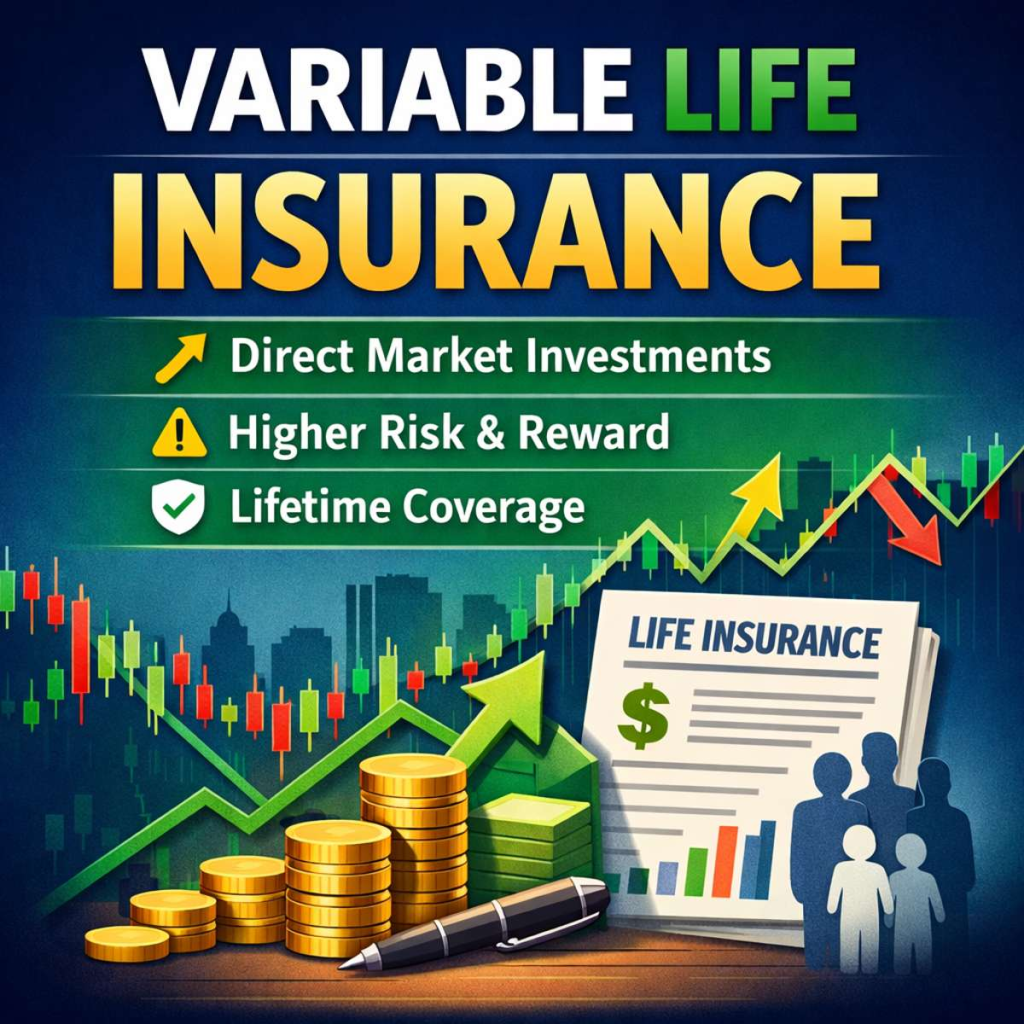
Variable Life Insurance: How It Works, Pros & Cons, and When It Makes Sense
🟩 Introduction
Variable Life Insurance is a type of permanent life insurance that combines a lifetime death benefit with a cash value component invested directly in market-based subaccounts. Unlike more structured policies, the growth of a variable life policy depends on the performance of underlying investments such as stocks and bonds, giving policyholders exposure to both market gains and losses.
This direct investment exposure is what sets Variable Life Insurance apart. While it offers the potential for higher long-term returns compared to other life insurance products, it also introduces greater volatility and risk. Policy value can fluctuate significantly over time, and outcomes depend not only on market conditions but also on how investments are allocated and managed.
This guide is designed for individuals who want a clear, practical understanding of how Variable Life Insurance works and how it compares to other options. Whether you are evaluating advanced financial strategies or simply trying to understand the trade-offs, this page will walk you through the key features, risks, and real-world considerations.
At its core, Variable Life Insurance combines permanent life coverage with direct investment exposure, offering higher potential returns—but with increased risk and complexity.
⚡ What Is Variable Life Insurance (Quick Answer)
Variable Life Insurance is a type of permanent life insurance that allows policyholders to invest cash value directly into market-based subaccounts. This structure offers higher growth potential than other policy types but also exposes the policy to investment risk and market volatility.
🔑 Key Takeaways
- Permanent life insurance with an investment component
- Cash value is directly invested in market-based subaccounts
- Higher growth potential—but no downside protection
- Policy value fluctuates with market performance
- Best suited for individuals comfortable with investment risk
🧠 How Variable Life Insurance Works
Variable Life Insurance combines lifetime coverage with a cash value component that is directly tied to investment performance. Unlike other life insurance products, the growth of the policy depends on how underlying investments perform over time.
🔹 The Two Parts of a Variable Life Policy
Death Benefit
Provides a payout to beneficiaries if the insured passes away. This is the core insurance function of the policy.
Investment-Linked Cash Value
A portion of your premium is allocated to investment subaccounts. The value of this component changes based on market performance.
🧩 How They Interact Over Time
- Early in the policy, more premium may go toward insurance costs and fees
- Over time, if investments perform well, the cash value can grow significantly
- If investments underperform, cash value may decline, which can impact policy sustainability
👉 The balance between protection and investment performance is central to how the policy functions long term.
🔹 Investment Subaccounts Explained
Variable life policies offer investment options called subaccounts, which function similarly to mutual funds.
- May include stock, bond, or balanced portfolios
- Policyholders typically choose how funds are allocated
- Performance depends on market conditions and investment decisions
👉 Key Difference vs IUL:
Variable life provides direct market exposure, meaning there are no caps on gains—but also no floors to protect against losses.
🔹 How Policy Value Changes Over Time
Because the cash value is invested in the market:
- Market gains can increase policy value
- Market losses can reduce cash value
- Performance depends on allocation and market cycles
👉 This creates a higher potential for growth—but also introduces greater volatility compared to other life insurance types.
💡 Key Insight
Variable Life Insurance shifts more responsibility to the policyholder. Outcomes are driven not just by the product itself, but by investment choices, market conditions, and long-term discipline.
📊 Key Features of Variable Life Insurance
Variable Life Insurance offers a unique combination of permanent life coverage and direct investment exposure, making it one of the more flexible—but also more complex—policy types available.
🔹 Direct Investment Control
Policyholders typically have control over how the cash value is invested through subaccounts.
Investment Allocation Options
- Choose from stock, bond, or balanced portfolios
- Adjust allocations over time based on goals and risk tolerance
- Ability to shift strategy as market conditions or personal circumstances change
👉 This level of control makes variable life more similar to traditional investing than other insurance products.
🔹 No Caps on Upside
Unlike Indexed Universal Life (IUL), variable life policies do not limit potential gains.
Growth Potential
- Full participation in market performance
- No cap restricting returns in strong market years
- Opportunity for higher long-term growth
👉 However, higher upside comes with increased exposure to market volatility.
🔹 Full Exposure to Market Risk
Variable life policies are directly tied to investment performance.
Risk Considerations
- Cash value can decline during market downturns
- No built-in floor to protect against losses
- Performance depends on both market conditions and allocation decisions
👉 This makes variable life the highest-risk option among common permanent life insurance types.
🔹 Flexible Policy Structure
Variable life policies offer flexibility in both funding and structure.
Policy Flexibility
- Adjustable premiums (within limits)
- Potential to modify death benefit structure
- Ability to adapt policy over time
👉 Flexibility can be beneficial—but also requires careful planning and monitoring.
⚖️ Pros and Cons of Variable Life Insurance
Understanding the trade-offs is essential when evaluating whether variable life insurance fits into your financial strategy.
🔹 Advantages
Unlimited Growth Potential
- No caps on returns
- Direct participation in market gains
Investment Flexibility
- Ability to choose and adjust investment allocations
- Opportunity to tailor strategy based on risk tolerance
Tax-Deferred Growth
- Earnings grow tax-deferred within the policy
- Potential tax advantages if structured and managed properly
Potential for Higher Long-Term Returns
- Greater upside compared to fixed or structured insurance products
- May benefit from long-term market growth
🔹 Disadvantages
Market Risk (Can Lose Value)
- Cash value fluctuates with the market
- Losses are possible, especially in downturns
High Complexity
- Requires understanding of both insurance and investment concepts
- More moving parts than simpler policy types
Fees and Costs
- Includes insurance costs, administrative fees, and investment-related expenses
- Fees can reduce net returns over time
Requires Active Management
- Ongoing monitoring and adjustments may be necessary
- Poor investment or funding decisions can negatively impact performance
⚖️ Pros vs Cons Table
| Advantages | Disadvantages |
|---|---|
| Unlimited growth potential | Market risk (losses possible) |
| Investment flexibility | High complexity |
| Tax-deferred growth | Fees reduce returns |
| Lifetime coverage | Requires active management |
💡 Key Insight
Variable Life Insurance offers greater control and higher potential rewards, but it also places more responsibility on the policyholder. Success depends not just on the product—but on investment decisions, discipline, and long-term strategy.
🧮 Example: How Variable Life Performs Over Time
To understand how Variable Life Insurance behaves in practice, it’s helpful to look at a simplified example of how cash value can change over time based on market performance.
📊 Scenario
Assume the policy’s cash value is invested in market-based subaccounts:
- Year 1: Market +15% → Policy value increases significantly
- Year 2: Market -20% → Policy value declines
- Year 3: Market +10% → Policy value partially recovers
🔍 What This Shows
Direct Market Exposure
Unlike structured policies, Variable Life reflects actual market performance:
- Gains are fully realized in strong years
- Losses directly reduce policy value in down years
Volatility and Recovery
- Market declines can significantly impact cash value
- Recovery depends on future market performance
- Timing and consistency matter for long-term outcomes
👉 This creates a more volatile growth pattern compared to other life insurance types.
Compounding Impact
- Losses can have a lasting effect because future growth starts from a lower base
- Strong returns may take time to recover prior declines
👉 This is why long-term discipline and investment strategy are critical.
📉 Market Volatility Example Table
| Year | Market Return | Policy Impact |
|---|---|---|
| Year 1 | +15% | Significant growth |
| Year 2 | -20% | Value declines |
| Year 3 | +10% | Partial recovery |
| Scenario | Variable Life | IUL |
|---|---|---|
| +15% market | +15% (full gain) | ~7–10% (capped) |
| -20% market | -20% (loss) | 0% (floor) |
💡 Key Insight
👉 Unlike Indexed Universal Life (IUL):
- No floor protection — losses are possible in negative market years
- No cap on gains — full participation in market upside
Variable Life Insurance offers greater growth potential—but that potential comes with real exposure to market risk and volatility.
💰 Costs and Fees in Variable Life Policies
Like other permanent life insurance products, Variable Life includes multiple layers of costs. Because it also involves investment components, the fee structure can be more complex and can significantly affect long-term performance.
🔹 Mortality & Expense Charges
These cover the core insurance component and risk assumed by the insurer.
- Cost of insurance (COI) for the death benefit
- Mortality and expense (M&E) risk charges
- Typically increase as the insured ages
👉 These costs are ongoing and can reduce available cash value over time.
🔹 Investment Management Fees
Because cash value is invested in subaccounts:
- Each subaccount has its own management fee
- Similar to mutual fund expense ratios
- Fees vary based on investment selection
👉 These costs directly reduce net investment returns.
🔹 Administrative Costs
These cover policy maintenance and operations:
- Policy administration fees
- Recordkeeping and processing
- Rider costs (if applicable)
👉 While often smaller individually, these fees compound over time.
🔹 Impact Over Time
The combined effect of these costs can:
- Reduce long-term growth
- Increase the amount needed to sustain the policy
- Amplify the impact of market downturns
👉 Understanding total cost—not just potential returns—is essential.
For a broader comparison of insurance pricing, see:
👉 Life Insurance Cost
💰 Cost Breakdown Table
| Cost Type | What It Covers | Impact |
|---|---|---|
| COI (Insurance Cost) | Death benefit | Increases over time |
| M&E Charges | Insurance risk | Reduces returns |
| Investment Fees | Subaccounts | Ongoing drag |
| Admin Fees | Policy maintenance | Compounds over time |
📉 Investment Risk and Volatility
Variable Life Insurance is directly tied to market performance, which introduces both opportunity and risk.
🔹 Value Fluctuates With Markets
- Cash value rises and falls with investment performance
- No built-in protection against losses
- Market downturns can significantly reduce policy value
🔹 Requires Risk Tolerance
- Policyholders must be comfortable with volatility
- Short-term losses are possible—even in long-term strategies
- Investment decisions play a major role in outcomes
🔹 Long-Term Horizon Is Essential
- Time helps smooth out market fluctuations
- Long-term discipline is key to realizing growth potential
- Short-term use increases the risk of poor outcomes
💡 Key Insight
Variable Life Insurance offers greater growth potential, but also requires acceptance of market-driven volatility. Unlike more structured policies, performance depends heavily on both market conditions and investment decisions.
🔄 Policy Loans, Withdrawals, and Lapse Risk
Variable Life policies allow access to cash value—but this flexibility comes with additional risks, especially in volatile market conditions.
🔹 How Loans and Withdrawals Work
- Policyholders can borrow against or withdraw from cash value
- Loans accrue interest over time
- Withdrawals may reduce available policy value
👉 These features can provide flexibility but must be used carefully.
🔹 Market Downturns Increase Lapse Risk
Because cash value fluctuates:
- Market losses can reduce available funds
- Lower cash value may not cover policy costs
- Increased likelihood of policy lapse during downturns
👉 This risk is higher than in policies with downside protection.
🔹 Loans Can Amplify Risk
- Loan balances grow over time due to interest
- Reduced cash value limits recovery potential
- Combined with market losses, this can strain the policy
👉 Improper loan use is a common cause of policy failure.
🔹 Lapse Scenarios
A policy may lapse if:
- Cash value falls too low
- Costs exceed available funds
- Loans and fees outweigh growth
👉 If a policy lapses, especially with outstanding loans, it may result in tax consequences.
💡 Key Insight
In Variable Life Insurance, flexibility comes with responsibility. Market volatility and loan usage can interact in ways that increase risk, making active monitoring and disciplined management essential for long-term success.
⚠️ Risks and Common Misunderstandings
Variable Life Insurance is often misunderstood because it blends insurance with investing. Clarifying how risk actually works is essential before relying on it in a financial plan.
🔹 Market Risk vs Insurance Protection
- Insurance still exists:
The policy maintains a death benefit as long as it remains properly funded and in force. - But cash value is exposed:
The investment portion is directly tied to market performance and can rise or fall based on underlying assets.
👉 This means you can have life insurance protection while simultaneously experiencing declines in cash value.
🔹 Performance Assumptions vs Reality
- Returns depend on allocation:
Outcomes are driven by how funds are invested across subaccounts (stocks, bonds, etc.), not by a fixed or structured crediting method. - Not guaranteed:
Unlike whole life—or even IUL—there are no built-in protections like floors. Returns are entirely dependent on market performance and investment decisions.
👉 Assumptions about consistent growth can lead to unrealistic expectations if market volatility is not fully considered.
💡 Key Insight
Variable Life Insurance shifts much of the outcome from the product itself to the policyholder’s investment decisions and market conditions. Understanding this distinction is critical for setting realistic expectations.
🔄 Variable Life vs Other Life Insurance Options
Comparing Variable Life to other policy types helps clarify where it fits within the broader life insurance landscape.
🔹 Variable Life vs Indexed Universal Life (IUL)
| Feature | Variable Life | IUL |
|---|---|---|
| Market Exposure | Direct | Indirect |
| Downside Protection | None | Yes (floor) |
| Upside | Unlimited | Capped |
👉 Key Difference:
Variable life offers full market participation, while IUL provides structured growth with downside protection.
🔹 Variable Life vs Whole Life
- Variable Life:
Focuses on growth through market exposure, with flexible and potentially volatile outcomes - Whole Life:
Emphasizes guaranteed growth, stable premiums, and predictable performance
👉 Key Trade-Off:
Growth potential vs guarantees
🔹 Variable Life vs Term Life
- Variable Life:
Combines lifetime coverage with investment exposure - Term Life:
Provides temporary, low-cost protection with no investment component
👉 Key Trade-Off:
Investment + permanence vs simple, affordable protection
💡 Key Insight
Each policy type serves a distinct role:
- Term Life → Protection
- Whole Life → Stability
- IUL → Structured growth
- Variable Life → Market-driven growth
Understanding these roles helps ensure the right tool is used for the right purpose within a financial plan.
📊 Variable Life vs Other Policies
| Feature | Term Life | Whole Life | IUL | Variable Life |
|---|---|---|---|---|
| Coverage Length | Temporary | Lifetime | Lifetime | Lifetime |
| Cash Value | No | Guaranteed | Index-linked | Market-based |
| Market Exposure | None | None | Indirect | Direct |
| Downside Protection | N/A | Yes | Yes (floor) | None |
| Upside Potential | None | Limited | Capped | Unlimited |
| Complexity | Low | Low | High | Very High |
| Best Use | Protection | Stability | Flexibility | Growth potential |
🧠 When Variable Life Insurance Makes Sense
Variable Life Insurance is best suited for individuals who understand and are comfortable with the risks associated with market-based investing. It is not a general-purpose solution, but rather a tool for specific financial situations.
🔹 High Risk Tolerance
- Comfortable with market fluctuations and potential losses
- Willing to accept short-term volatility for long-term growth potential
- Understands that cash value can decline in down markets
👉 Variable life requires a mindset similar to long-term investing, not guaranteed outcomes.
🔹 Long-Term Investors
- Time horizon of 20+ years
- Ability to stay invested through market cycles
- Focus on long-term growth rather than short-term performance
👉 A longer time frame helps absorb volatility and improve the chances of achieving favorable outcomes.
🔹 Advanced Planning Scenarios
- Individuals who have already built a strong financial foundation
- Those integrating insurance into broader wealth strategies
- Situations where flexibility and investment control are priorities
👉 Variable life is typically considered after core planning elements are in place.
🧠 “When It Makes Sense” Decision Table
| Situation | Fit |
|---|---|
| High risk tolerance | ✅ Strong fit |
| Long-term investor (20+ years) | ✅ Good fit |
| Comfortable managing investments | ✅ Strong fit |
| Low risk tolerance | ❌ Poor fit |
| Short-term planning | ❌ Not suitable |
| Need guaranteed outcomes | ❌ Use whole life |
💡 Key Insight
Variable Life Insurance works best for those who approach it as a long-term, market-driven strategy, not a guaranteed financial solution.
🚫 When Variable Life May Not Be a Good Fit
There are many situations where Variable Life Insurance may introduce unnecessary risk or complexity.
🔹 Low Risk Tolerance
- Discomfort with market volatility
- Preference for stable or predictable outcomes
- Concern about potential losses
👉 Other policy types may better align with these preferences.
🔹 Short Time Horizon
- Limited time reduces the ability to recover from market downturns
- Early costs can outweigh short-term benefits
👉 Variable life is not designed for short-term financial needs.
🔹 Need for Stability
- Preference for guaranteed growth or fixed outcomes
- Desire for simplicity in financial products
👉 Whole life or term insurance may be more appropriate in these cases.
💡 Key Insight
If stability, predictability, or simplicity are priorities, Variable Life Insurance may not be the right fit. Choosing a simpler approach can often lead to better outcomes.
📊 Life Insurance Risk Spectrum
| Policy Type | Risk Level | Growth Potential |
|---|---|---|
| Term Life | None | None |
| Whole Life | Low | Low |
| IUL | Moderate | Moderate |
| Variable Life | High | High |
🧭 How Variable Life Fits Into a Financial Plan
Variable Life Insurance occupies a unique position between insurance and investing. It should be viewed as part of a broader strategy—not as a foundational financial tool.
🔹 Risk Management + Investing Hybrid
- Provides life insurance protection
- Combines it with direct market exposure
- Blends elements of protection and growth
👉 This hybrid nature is what differentiates it from other policy types.
🔹 Advanced Strategy Layer
- Typically used after foundational planning is complete
- May complement retirement accounts and taxable investments
- Can support long-term financial flexibility
👉 It is most effective when integrated into a comprehensive plan.
🔹 Not a Foundational Tool
- Not a replacement for emergency savings
- Not a substitute for core retirement accounts
- Not ideal as a first step in financial planning
👉 Variable life works best as a supplement—not a starting point.
💡 Key Insight
Variable Life Insurance is most effective when it is strategically layered into a broader financial plan, supporting long-term goals while complementing—not replacing—traditional investing and protection strategies.
❓ Frequently Asked Questions (FAQ)
🔹 Can you lose money in variable life?
Yes. Because the cash value is invested directly in market-based subaccounts, it can decline during market downturns. Unlike some other policies, there is no floor protection, so losses are possible.
🔹 Is variable life better than IUL?
Neither is inherently better—they serve different purposes.
- Variable Life: Direct market exposure with higher potential returns and higher risk
- IUL: Structured growth with downside protection and capped upside
👉 The better option depends on your risk tolerance, goals, and preference for flexibility versus protection.
🔹 Who should consider variable life insurance?
Variable life may be appropriate for individuals who:
- Have a high tolerance for investment risk
- Are comfortable managing investment allocations
- Have a long-term planning horizon
- Are incorporating insurance into broader financial strategies
👉 It is generally not intended for those seeking simple or guaranteed outcomes.
💡 Key Insight
Variable Life Insurance requires both financial discipline and investment awareness. It is most suitable for individuals who understand the trade-offs between risk and potential reward.
🏁 Final Thoughts
Variable Life Insurance represents the highest-risk, highest-potential-reward category among common permanent life insurance options.
- Offers significant growth potential through market exposure
- Provides lifetime coverage alongside investment opportunities
- Requires a strong understanding of both insurance and investing principles
However, with that potential comes responsibility:
- Performance depends on market conditions and decisions
- Costs and volatility must be managed carefully
- Long-term commitment is essential
👉 Variable life is not a shortcut—it is a strategic tool that can be effective when used thoughtfully within a broader financial plan.
🔗 Continue Learning About Life Insurance
🧭 Start Here
📊 Compare Options
🚀 Strategy
- Cash Value Life Insurance Strategies
- Tax Benefits of Life Insurance
💡 Next Step
Understanding how different policy types work together can help you build a more balanced and effective financial plan. Focus on how each option fits your goals—rather than trying to make one product do everything.