
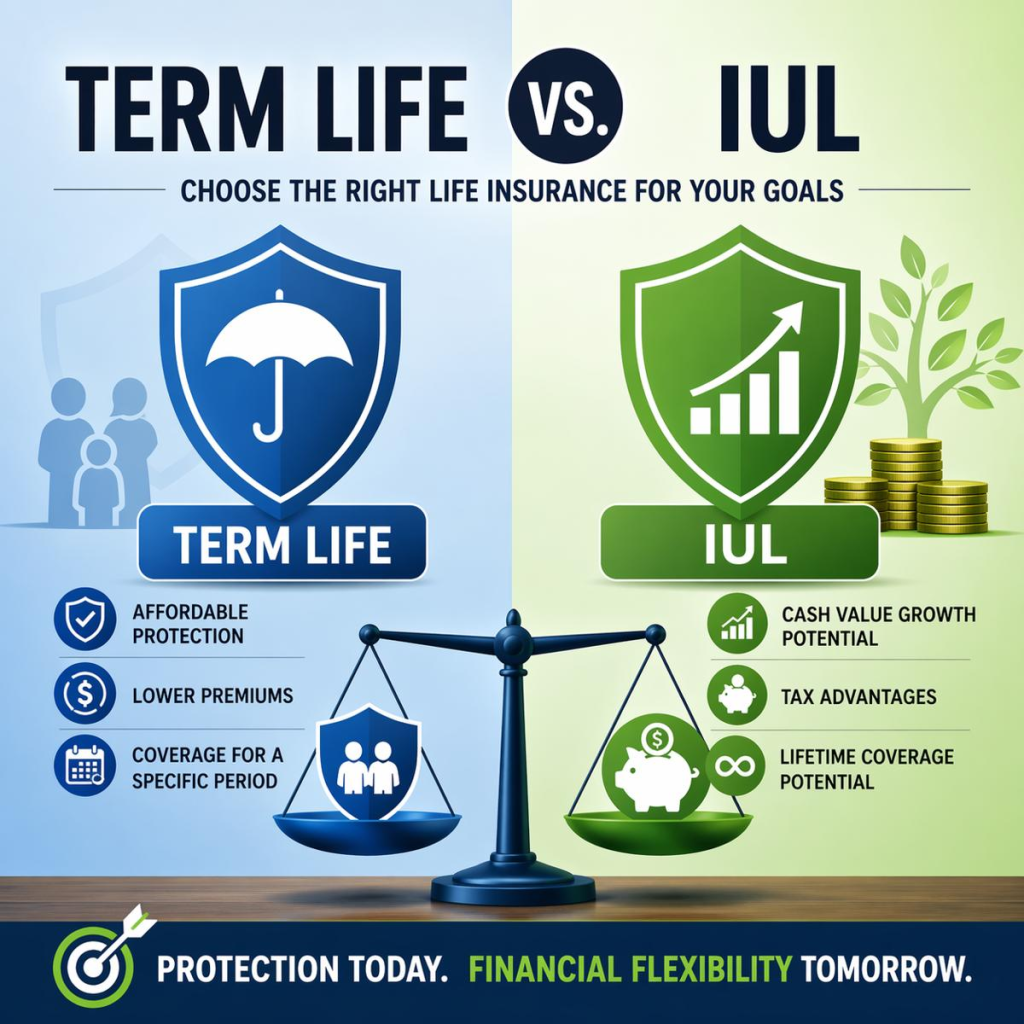
Term Life Insurance vs. Indexed Universal Life (IUL): Which Should You Choose?
Introduction
A comparison between term life insurance and Indexed Universal Life (IUL) is one of the most valuable decision frameworks you can build—because it directly addresses the core tension most people face: low-cost protection vs. complex, long-term financial strategy.
Below is a comprehensive, SEO-driven guide designed to:
- Capture featured snippets through clear, direct answers
- Support strong internal linking across your insurance content
- Build topical authority within life insurance and financial planning
- Guide readers toward informed, goal-based financial decisions
Quick Answer — Term vs. IUL (At a Glance)
- Term Life Insurance: Best for affordable, straightforward income protection for a specific period (typically 10–30 years)
- Indexed Universal Life (IUL): Best for long-term strategies involving flexible premiums, cash value growth, and potential tax advantages
👉 Key takeaway:
If your goal is pure protection, term life insurance is typically the most efficient and cost-effective choice.
If your goal is a multi-purpose financial strategy that blends insurance with long-term planning features, IUL may be worth evaluating—but it requires careful design, funding, and ongoing management.
Key Differences in 60 Seconds
When comparing term life insurance and Indexed Universal Life (IUL), the differences come down to cost, complexity, flexibility, and long-term purpose. Here’s a clear side-by-side view:
| Feature | Term Life Insurance | Indexed Universal Life (IUL) |
|---|---|---|
| Coverage duration | Fixed term (10–30 years) | Lifetime (if funded properly) |
| Cost | Low | High |
| Cash value | None | Yes |
| Complexity | Very low | High |
| Investment exposure | None | Linked to market index (e.g., S&P 500) |
| Flexibility | Limited | High |
| Risk | Low | Moderate |
👉 Key insight:
Term life is designed for simplicity and efficiency, while IUL is designed for flexibility and long-term financial structuring—but with added complexity and risk considerations.
What You’ll Learn in This Guide
This guide is structured to help you move beyond surface-level comparisons and make a well-informed financial decision. Specifically, you’ll learn:
- The structural differences between term life insurance and IUL policies
- Real-world use cases and when each option makes the most sense
- The true cost, risk exposure, and long-term performance trade-offs
- A step-by-step decision framework to align your choice with your financial plan
- Common pitfalls and misconceptions that can lead to costly mistakes
👉 Why this matters:
Choosing the wrong type of life insurance isn’t just a product decision—it can impact your long-term financial stability, protection strategy, and wealth-building plan.
What Is Term Life Insurance?
Term life insurance is the most straightforward form of life insurance, designed to provide pure financial protection for a defined period. It focuses on one primary goal: ensuring your beneficiaries receive a payout if something happens to you during your highest financial responsibility years.
How Term Life Insurance Works
- Coverage lasts for a set period (typically 10, 20, or 30 years)
- Pays a death benefit to your beneficiaries if you pass away during the term
- Does not include any savings or investment component
👉 In simple terms: you are paying for protection only, not wealth accumulation.
Key Characteristics
- Fixed premiums (in most policies) — predictable and easy to budget
- Pure insurance structure — no cash value or investment layer
- Simple and transparent — easy to understand, with minimal moving parts
👉 Key insight:
Because there is no cash value component, costs are significantly lower compared to permanent life insurance options.
Best Use Cases
Term life insurance is most effective when aligned with temporary financial risks:
- Income replacement — ensuring your family can maintain their lifestyle
- Mortgage protection — covering outstanding home loan obligations
- Supporting dependents — protecting children or a spouse during working years
👉 Practical example:
A 30-year term policy can align with a mortgage payoff timeline and the years your children are financially dependent.
👉 Internal link: Term Life Insurance Guide
Ideal Buyer Profile Comparison
| Profile Factor | Term Life | IUL |
|---|---|---|
| Age range | 25–50 | 35–60+ |
| Income level | Any | Higher income preferred |
| Financial complexity | Low to moderate | Moderate to high |
| Primary goal | Protection | Strategy + protection |
| Budget flexibility | Limited | Strong cash flow required |
| Financial literacy needed | Low | High |
👉 Why this matters:
This table helps users answer: “Is this even for someone like me?”—a key decision moment.
What Is Indexed Universal Life (IUL) Insurance?
Indexed Universal Life (IUL) insurance is a form of permanent life insurance that combines lifelong coverage with a cash value component tied to market index performance. It is often positioned as a hybrid financial tool, blending insurance protection with long-term planning features—but it comes with added complexity.
How IUL Works
- Provides permanent life insurance coverage (as long as the policy is properly funded)
- Builds cash value over time, with growth linked to a market index such as the S&P 500
- Uses caps (maximum returns) and floors (minimum returns, often 0%) to limit both gains and losses
👉 Important clarification:
Your money is not directly invested in the market. Instead, the insurer credits interest based on index performance, subject to policy limits and fees.
Key Characteristics
- Flexible premiums and death benefit — allows adjustments over time
- Tax-deferred growth — cash value grows without current taxation under current law
- Complex fee structure — includes insurance costs, administrative fees, and potential surrender charges
👉 Key insight:
Flexibility can be a strength—but it also increases the risk of underfunding or mismanagement if not actively monitored.
Best Use Cases
IUL is typically considered in more advanced planning scenarios:
- High-income earners seeking additional tax-advantaged strategies beyond traditional accounts
- Long-term estate or legacy planning where permanent coverage is needed
- Supplemental retirement income strategies (when structured and funded properly)
👉 Practical consideration:
IUL tends to work best when integrated into a broader financial plan, rather than used as a standalone solution.
👉 Internal link: Indexed Universal Life Insurance Guide
Cost Comparison: Term vs. IUL
Understanding cost is one of the most critical factors when choosing between term life insurance and Indexed Universal Life (IUL). While both provide a death benefit, the pricing structure and long-term financial impact differ significantly.
| Cost Factor | Term Life | IUL |
|---|---|---|
| Monthly premium | Low | High |
| Cost transparency | High | Moderate to Low |
| Fees | Minimal | Multiple layers |
| Long-term cost | Low (if term ends) | High |
Breaking Down the Differences
- Monthly Premiums:
Term life is designed to be affordable, often costing a fraction of permanent policies. IUL premiums are higher because they fund both insurance costs and a cash value component. - Cost Transparency:
Term policies are straightforward—you pay a fixed premium for a defined benefit. IUL policies involve more moving parts, including internal charges and crediting methods that can be harder to fully evaluate. - Fee Structure (IUL-specific):
IUL policies may include:- Cost of insurance (COI)
- Administrative fees
- Surrender charges
- Cost of riders
- Spread and participation rate adjustments
- Long-Term Cost Considerations:
Term life can be extremely cost-efficient if your need for coverage is temporary. IUL, by contrast, is a long-term financial commitment that requires consistent funding to perform as illustrated.
👉 Key insight:
Industry data (including sources such as LIMRA and National Association of Insurance Commissioners) consistently shows that term life insurance can cost 5–15 times less than permanent policies for the same death benefit.
👉 What this means for your financial plan:
Lower cost doesn’t mean lower value—it means greater efficiency for pure protection needs, which is often the primary objective for many households.
Time Horizon Comparison
Time horizon is one of the most important factors when choosing between term life insurance and Indexed Universal Life (IUL). A policy that makes sense for a temporary protection need may not be the right fit for lifelong planning—and a permanent policy may be unnecessary if your need is short-term.
| Time Horizon | Term Life | IUL |
|---|---|---|
| 0–10 years | Strong fit | Weak fit |
| 10–20 years | Strong fit | Moderate fit |
| 20+ years | Limited (expires) | Strong fit |
| Lifetime planning | Not designed for this | Designed for this |
Why Time Horizon Matters
Term life insurance works best when your need for coverage is tied to a specific financial obligation, such as raising children, replacing income during working years, or covering a mortgage.
IUL is designed for longer-term planning because it combines permanent coverage with cash value potential. However, it typically requires time, funding discipline, and ongoing management to work as intended.
👉 Key takeaway:
If your insurance need is temporary, term life is usually the better fit. If your planning need is permanent and you have the budget and risk tolerance for complexity, IUL may be worth evaluating carefully.
Cost Efficiency vs. Value Trade-Off
One of the biggest mistakes people make when comparing term life and Indexed Universal Life (IUL) is focusing only on price. The better question is:
What are you getting in return for the cost?
| Dimension | Term Life | IUL |
|---|---|---|
| Cost efficiency | Very high | Low |
| Benefit efficiency | High (for protection) | Moderate |
| Flexibility value | Low | High |
| Long-term leverage | Low | Moderate |
| Simplicity value | Very high | Low |
How to Interpret This Table
- Term Life Insurance
Maximizes efficiency. You get the most protection for the lowest cost, with minimal complexity. - Indexed Universal Life (IUL)
Trades efficiency for flexibility and potential long-term utility—but requires higher cost, more involvement, and realistic expectations.
👉 Key insight:
Term life is optimized for efficiency and simplicity.
IUL is optimized for flexibility and long-term structuring—but at a cost.
👉 Why this matters:
This comparison helps you move beyond “cheap vs. expensive” and focus on trade-offs, which is how real financial decisions should be made.
Cash Value and Growth Potential
One of the defining differences between term life insurance and Indexed Universal Life (IUL) is the presence—and structure—of cash value. This is where IUL begins to function less like pure insurance and more like a financial planning tool with multiple moving parts.
| Feature | Term Life | IUL |
|---|---|---|
| Cash value | None | Yes |
| Growth potential | N/A | Moderate (capped) |
| Loss protection | N/A | Floor (often 0%) |
| Liquidity | N/A | Loans/withdrawals |
How to Interpret These Differences
- Cash Value:
Term life provides no savings component—its value is entirely in the death benefit. IUL builds cash value over time, which can be accessed under certain conditions. - Growth Potential:
IUL growth is tied to a market index such as the S&P 500, but returns are limited by caps and participation rates. This means you participate in some upside—but not all. - Loss Protection:
Many IUL policies include a floor (often 0%), meaning your cash value won’t decline due to negative market years. However, this does not eliminate the impact of fees. - Liquidity:
IUL allows access to cash value through loans or withdrawals, which can be useful—but also introduces additional complexity and risk.
Important Considerations
- Caps limit upside performance
Even in strong market years, your returns are restricted by policy limits - Fees reduce net returns
Insurance costs and administrative charges can significantly impact long-term outcomes - Policy loans can impact sustainability
Borrowing against the policy reduces available cash value and can increase the risk of lapse if not managed properly
👉 Key takeaway:
IUL is not a direct investment—it’s a hybrid insurance-financial product that requires careful structuring, realistic expectations, and ongoing management to perform as intended.
Ideal Buyer Profile Comparison
Not every life insurance strategy fits every person. One of the fastest ways to narrow your decision is to compare your situation against the typical profile for each option.
| Profile Factor | Term Life | IUL |
|---|---|---|
| Age range | 25–50 | 35–60+ |
| Income level | Any | Higher income preferred |
| Financial complexity | Low to moderate | Moderate to high |
| Primary goal | Protection | Strategy + protection |
| Budget flexibility | Limited | Strong cash flow required |
| Financial literacy needed | Low | High |
How to Use This Table
- If you’re earlier in your career, building your financial foundation, or working within a tighter budget, term life is typically the better fit.
- If you have higher income, more complex financial goals, and the ability to fund a long-term strategy, IUL may be worth evaluating carefully.
👉 Key insight:
This isn’t about which product is “better”—it’s about which one aligns with your stage of life, financial capacity, and planning needs.
👉 Why this matters:
This table helps readers quickly answer:
“Is this designed for someone like me?”
That moment of clarity is often what moves someone from research → decision.
Risk Comparison
When evaluating term life insurance versus Indexed Universal Life (IUL), risk is not just about market exposure—it’s about structure, assumptions, and long-term sustainability. Understanding these risks is critical to making an informed decision.
| Risk Type | Term Life | IUL |
|---|---|---|
| Market risk | None | Indirect |
| Policy lapse risk | None (if paid) | Moderate to High |
| Complexity risk | Low | High |
| Return variability | None | Moderate |
| Assumption risk | None | High |
How to Interpret These Risks
- Market Risk:
Term life is not exposed to market performance. IUL has indirect exposure, as returns are linked to an index such as the S&P 500, subject to caps and floors. - Policy Lapse Risk:
With term insurance, coverage remains in force as long as premiums are paid. IUL policies can lapse if cash value becomes insufficient to cover internal costs—especially if underfunded or if performance underdelivers expectations. - Complexity Risk:
Term life is simple and predictable. IUL involves multiple variables (crediting methods, fees, funding levels), increasing the risk of misunderstanding or mismanagement. - Return Variability:
Term has no return component. IUL returns can fluctuate year to year based on index performance, caps, participation rates, and fees. - Assumption Risk:
Term life requires no performance assumptions. IUL illustrations often rely on projected returns that may not materialize, creating a gap between expected vs. actual outcomes.
👉 Key takeaway:
Term life minimizes risk through simplicity. IUL introduces additional layers of financial and structural risk that must be actively managed over time.
What Can Go Wrong
No insurance strategy is risk-free. The key is understanding where problems can arise and how likely they are. Term life and Indexed Universal Life (IUL) fail in very different ways—term through expiration risk, and IUL through design, funding, and performance risk.
| Issue | Term Life | IUL |
|---|---|---|
| Coverage expiration | Yes | No (if funded) |
| Rising costs later | Possible (renewal) | Possible |
| Underperformance | N/A | Caps limit returns |
| Policy failure | Rare | Possible if underfunded |
| Misunderstanding | Low | High |
How These Risks Show Up in Real Life
- Coverage Expiration (Term Life)
Term policies end after a set period. If coverage is still needed later in life, renewal costs can increase significantly, especially with age or health changes. - Rising Costs Later
- Term: Renewal premiums after the initial term can become expensive
- IUL: Internal insurance costs typically increase over time, which can pressure the policy if not properly funded
- Underperformance (IUL)
Growth is tied to an index such as the S&P 500, but caps and fees can significantly limit returns, especially over long periods. - Policy Failure (IUL)
One of the most overlooked risks. If the policy is:- Underfunded
- Based on overly optimistic projections
- Not actively managed
- Misunderstanding the Product
Term life is straightforward. IUL is not. Many policyholders:- Misinterpret projected returns as guarantees
- Underestimate the impact of fees
- Overlook the need for ongoing monitoring
👉 Key takeaway:
Term life’s primary risk is running out of coverage.
IUL’s primary risk is policy breakdown due to complexity, costs, and unmet assumptions.
Understanding this distinction is essential for aligning your insurance choice with your long-term financial plan.
Policy Management Requirements
One of the most overlooked differences between term life insurance and Indexed Universal Life (IUL) is the level of ongoing involvement required. This has real implications for long-term success—especially with more complex policies.
| Factor | Term Life | IUL |
|---|---|---|
| Ongoing management | Minimal | Active monitoring required |
| Adjustments needed | Rare | Periodic |
| Risk of mismanagement | Low | Higher |
| Time commitment | Low | Moderate |
What This Means in Practice
- Term Life Insurance
Once the policy is in place, there is typically little to manage. As long as premiums are paid, coverage remains intact. This makes it ideal for individuals seeking a set-it-and-forget-it solution. - Indexed Universal Life (IUL)
IUL requires ongoing attention, including:- Monitoring cash value performance
- Adjusting premiums if needed
- Reviewing policy sustainability over time
👉 Key insight:
The flexibility of IUL is a double-edged sword—it allows customization, but also introduces ongoing responsibility and potential for error.
Simplicity vs. Control Spectrum
| Factor | Term Life | IUL |
|---|---|---|
| Simplicity | Very high | Low |
| Control | Low | High |
| Transparency | High | Moderate |
| Required involvement | Minimal | Active |
| Risk of user error | Very low | Higher |
Best Fit by Financial Goal
Choosing between term life and IUL becomes much clearer when you align each option with your primary financial objective.
| Financial Goal | Best Option |
|---|---|
| Affordable protection | Term Life |
| Income replacement | Term Life |
| Estate planning | IUL |
| Tax-advantaged growth | IUL |
| Simplicity | Term Life |
| Flexibility | IUL |
How to Use This Framework
- If your priority is cost-effective protection during key life stages, term life is typically the better fit.
- If your goal involves long-term planning, flexibility, and potential tax advantages, IUL may play a role—if properly structured.
👉 Key takeaway:
Start with your goal—not the product. The right choice becomes much clearer when your financial objective drives the decision rather than product features alone.
Policy Design Sensitivity Table
| Factor | Term Life | IUL |
|---|---|---|
| Sensitivity to funding | Low | Very high |
| Sensitivity to fees | Low | High |
| Sensitivity to assumptions | None | High |
| Impact of poor design | Minimal | Significant |
Tax Treatment Comparison
Taxes are one of the most important—and often misunderstood—aspects of life insurance. While both term life and Indexed Universal Life (IUL) offer tax advantages, they function very differently when it comes to long-term planning.
| Tax Feature | Term Life | IUL |
|---|---|---|
| Death benefit | Tax-free (generally) | Tax-free (generally) |
| Cash value growth | N/A | Tax-deferred |
| Withdrawals | N/A | Tax-advantaged (if structured properly) |
| Policy loans | N/A | Potentially tax-free |
| Risk of taxable event | None | Possible if policy lapses |
How to Interpret These Differences
- Death Benefit (Both Policies)
In most cases, life insurance death benefits are income tax-free to beneficiaries, making both options effective for protection and legacy planning. - Cash Value Growth (IUL Only)
IUL policies allow cash value to grow on a tax-deferred basis, meaning you are not taxed annually on gains. - Withdrawals and Loans (IUL Only)
- Withdrawals may be structured to minimize taxes
- Policy loans are often not taxed if the policy remains in force
- Tax Risk (IUL Only)
If a policy lapses with outstanding loans or gains, it can trigger a taxable event, potentially creating an unexpected tax liability.
👉 Key insight:
The tax advantages of IUL are real—but they depend heavily on proper structuring, funding, and long-term management.
👉 Why this matters:
Tax-related decisions are among the most financially impactful. This comparison not only helps clarify how each policy is treated, but also aligns with broader tax planning strategies, which tend to drive high-value, high-intent search traffic.
Exit Strategy: What Happens Later?
One of the most overlooked aspects of choosing a life insurance policy is what happens down the road—not just when everything goes right, but when plans change, performance varies, or life circumstances shift.
| Scenario | Term Life | IUL |
|---|---|---|
| Outlive policy | Coverage ends | Coverage continues (if funded) |
| Stop paying premiums | Policy lapses | May continue using cash value |
| Need cash early | Not available | Loans/withdrawals possible |
| Change strategy | Replace policy | Adjust funding/structure |
| Poor performance | No impact | May require intervention |
How to Think About Exit Strategy
- Term Life Insurance
Term life has a clearly defined outcome:- If you outlive the term, coverage ends
- If you stop paying, the policy lapses
- There is no built-in flexibility or recovery mechanism
- Indexed Universal Life (IUL)
IUL offers more flexibility—but also more moving parts:- Cash value may help sustain the policy if premiums stop
- You can access funds through loans or withdrawals
- Policy adjustments are possible over time
👉 Key takeaway:
Term life has a clear and predictable exit path.
IUL has a flexible but more complex exit strategy, where outcomes depend on funding, performance, and ongoing decisions.
Example Scenarios
Understanding how term life insurance and Indexed Universal Life (IUL) work in practice can make the decision much clearer. Below are common real-world situations that highlight when each option may be appropriate.
Scenario 1: Young Family on a Budget
- Goal: Protect income for the next 20 years while raising children and paying down major debts
- Best fit: Term Life
Why it works:
A young family typically needs maximum coverage at the lowest possible cost. Term life allows you to secure a large death benefit during your highest-risk years without straining your monthly budget.
👉 Key insight:
This approach aligns coverage with temporary financial responsibilities—such as a mortgage and dependent children.
Scenario 2: High-Income Professional
- Goal: Tax diversification and long-term legacy planning
- Best fit: IUL (with careful design)
Why it works:
High-income individuals may already be maximizing traditional retirement accounts. IUL can provide:
- Additional tax-deferred growth potential
- A permanent death benefit for estate planning
- Access to cash value for supplemental income strategies
👉 Key insight:
IUL is most effective here when it is properly structured and overfunded relative to minimum requirements, not used as a basic protection tool.
Scenario 3: Business Owner
- Goal: Combine flexible financial tools with protection
- Best fit: Depends on funding capacity and planning strategy
Why it works:
Business owners often have:
- Irregular income
- Multiple financial priorities
- A need for both protection and flexibility
In this case:
- Term life may be used for cost-effective protection (e.g., key person coverage or debt protection)
- IUL may be considered as part of a broader strategy if there is sufficient cash flow and long-term planning intent
👉 Key insight:
The right solution often involves layering strategies, not choosing a single product in isolation.
👉 Final takeaway:
Your life stage, income level, and financial goals should drive the decision—not the product itself.
Decision Framework — How to Choose
Choosing between term life insurance and Indexed Universal Life (IUL) should start with your financial goal, not the product features. The right policy depends on what you need the insurance to accomplish, how much you can afford, and how much complexity you are comfortable managing.
Step-by-Step Process
1. Define Your Primary Goal
Start by asking:
Do I need affordable protection, or am I looking for a broader financial strategy?
- If your main goal is income replacement, term life is usually the better fit.
- If your goal includes permanent coverage, cash value growth, or legacy planning, IUL may be worth evaluating.
👉 Key question:
Are you buying life insurance to protect your family, or are you trying to build a long-term planning tool?
2. Evaluate Your Budget
Budget is one of the biggest deciding factors.
- Term life generally offers the most coverage for the lowest premium.
- IUL requires higher and more consistent funding to work properly.
If an IUL policy is only funded at the minimum level, it may not perform as expected and could become harder to maintain later.
👉 Key question:
Can you comfortably fund the policy long term without sacrificing emergency savings, retirement contributions, or debt repayment?
3. Assess Your Risk Tolerance
Term life carries very little product complexity. You pay the premium, and the coverage stays in place during the term.
IUL introduces more variables, including:
- Caps and participation rates
- Policy fees
- Crediting methods
- Cash value performance
- Potential policy loan risk
👉 Key question:
Are you comfortable managing a more complex policy where outcomes depend on funding, fees, and long-term assumptions?
4. Consider Your Time Horizon
Term life works best when your insurance need is temporary, such as:
- Raising children
- Paying off a mortgage
- Covering working years
- Protecting income during a defined period
IUL is designed for longer time horizons and generally requires patience, funding discipline, and ongoing review.
👉 Key question:
Is your insurance need temporary, permanent, or part of a broader estate or tax strategy?
5. Align With Your Overall Financial Plan
Life insurance should not be chosen in isolation. It should fit into your larger financial picture, including:
- Emergency savings
- Retirement planning
- Debt management
- Tax planning
- Estate planning
- Family protection goals
👉 Final takeaway:
If you need simple, affordable protection, term life is usually the cleaner solution. If you have advanced planning needs, strong cash flow, and a long-term strategy, IUL may have a role—but only when carefully designed and regularly reviewed.
Common Misconceptions
Misunderstanding life insurance—especially Indexed Universal Life (IUL)—can lead to poor decisions and unrealistic expectations. Clearing up these misconceptions is essential for making a sound financial choice.
“IUL is a stock market investment” → It is not
IUL policies are often marketed alongside market-based concepts, but they are not direct investments.
- Cash value growth is linked to a market index such as the S&P 500
- Your money is not actually invested in the market
- Returns are limited by caps, participation rates, and fees
👉 Reality:
IUL is an insurance product with an index-based crediting strategy, not an investment account.
“Term is a waste of money” → It provides critical protection
This is one of the most common and misleading statements.
- Term life delivers pure risk protection at a low cost
- It ensures your family is financially protected during critical years
- It aligns with temporary financial obligations (income, mortgage, dependents)
👉 Reality:
Term life is not a waste—it is often the most efficient way to protect your financial foundation.
“IUL guarantees high returns” → Returns are capped and fee-reduced
IUL illustrations can sometimes create unrealistic expectations.
- Returns are capped, limiting upside in strong markets
- Fees and insurance costs reduce net performance
- Actual outcomes depend on long-term assumptions that may not materialize
👉 Reality:
IUL offers controlled growth potential, not guaranteed high returns.
“Permanent insurance is always better” → Depends on use case
Permanent policies like IUL can be valuable—but only in the right context.
- They are more expensive and complex
- They require long-term commitment and proper funding
- They are not necessary for every financial situation
👉 Reality:
The “best” option depends on your goals, budget, and overall financial plan—not the product category.
👉 Key takeaway:
Most mistakes in life insurance decisions come from misaligned expectations.
Focus on what the policy is designed to do—and whether that aligns with your financial objectives.
Frequently Asked Questions
Is IUL better than term life insurance?
It depends on your goals—protection vs. long-term financial strategy.
- If your primary need is affordable income protection, term life is typically the better choice.
- If you are looking for a multi-purpose financial tool with long-term planning features, IUL may be considered—when properly structured.
👉 Key takeaway:
There is no universally “better” option—only what is better aligned with your financial plan.
Can you lose money in an IUL?
You typically won’t lose value due to market declines because most policies include a floor (often 0%).
However:
- Fees and insurance costs can reduce overall performance
- Poor funding or excessive loans can weaken the policy over time
👉 Key takeaway:
While downside market risk is limited, performance risk still exists.
Why is term life so much cheaper?
Because it provides pure insurance coverage without investment or cash value features.
- No savings component
- No complex fee structure
- No long-term accumulation element
👉 Key takeaway:
You are paying strictly for risk protection, which keeps costs significantly lower.
Which builds more value over time?
- IUL has cash value potential and may build value over time (depending on performance, fees, and funding)
- Term life does not build cash value
👉 Key takeaway:
If your goal is wealth accumulation or cash value access, IUL has that capability.
If your goal is efficient protection, term life is typically the better fit.
Related Life Insurance Topics
Building a strong understanding of life insurance goes beyond comparing two products. The resources below will help you deepen your knowledge and connect this decision to your broader financial plan.
Start Here
- How Much Life Insurance Do You Need
Learn how to calculate the right coverage amount based on income, debt, and long-term goals - Term vs. Permanent Life Insurance
Understand the foundational differences before diving into specific policy types
Continue Learning
- Whole Life Insurance
Explore guaranteed permanent coverage with fixed premiums and cash value growth - Universal Life Insurance
Learn about flexible permanent policies and how they differ from IUL - Types of Life Insurance
A complete overview of available policy options and how they fit different needs - Life Insurance Cost
Break down pricing factors, including age, health, coverage amount, and policy type - Back to Life Insurance Hub
Final Thought
Choosing between term life and Indexed Universal Life (IUL) is not about finding the “best” product—it’s about aligning the right tool with the right financial objective.
- Term life excels at efficient protection
- IUL can serve advanced planning needs, but requires careful design, ongoing monitoring, and realistic expectations
👉 Call to action:
Before making a decision, ask yourself:
Am I solving for protection, or am I trying to build a financial strategy?
That single question will guide you toward a decision that aligns with your long-term financial plan and helps you avoid costly mistakes.
Back to the Insurance Hub