
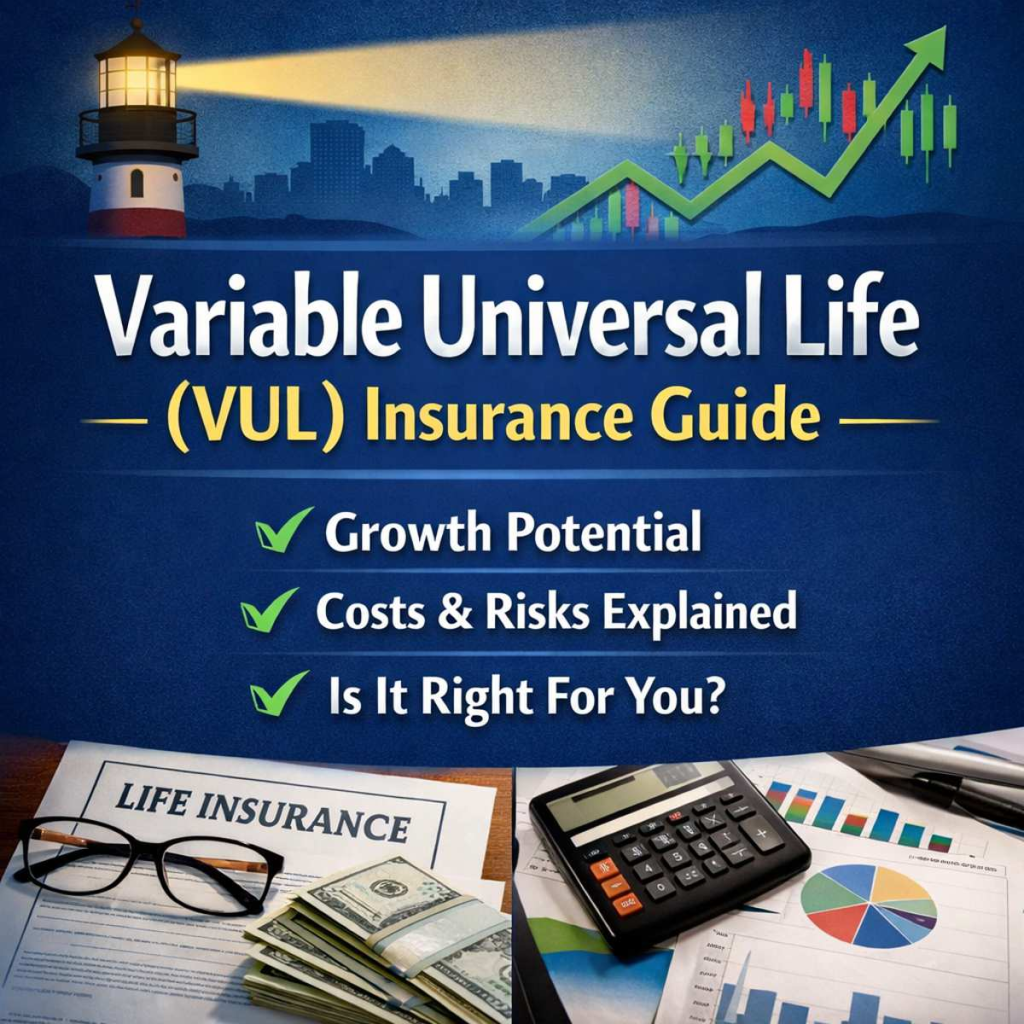
Variable Universal Life (VUL) Insurance: How It Works, Pros & Cons, and When It Makes Sense
🟩 Introduction
Variable universal life (VUL) insurance is one of the most complex—and often misunderstood—types of permanent life insurance available today. It combines lifelong coverage with market-based investment options, offering both growth potential and significant risk.
Unlike simpler policies, VUL requires active management, thoughtful funding, and long-term discipline. When structured properly, it can serve as a strategic financial tool. When misunderstood, it can become expensive and unstable.
This guide breaks down exactly how VUL works, what it costs, the risks involved, and how to determine whether it fits into your financial plan.
⚡ What Is Variable Universal Life (VUL) Insurance? (Quick Answer)
Variable universal life (VUL) insurance is a type of permanent life insurance that combines:
- A death benefit for financial protection
- A cash value component invested in market-based subaccounts (similar to mutual funds)
The policy’s value can increase or decrease based on market performance, and policyholders have flexibility to adjust premiums and death benefits over time.
👉 In simple terms:
VUL gives you investment upside potential—but without downside protection, and with added complexity..
📌 Key Takeaways
- VUL combines insurance and investing
You get lifelong coverage plus access to market-based growth through investment subaccounts. - Returns are not guaranteed
Your cash value rises and falls with the market—there are no caps, but also no safety floor. - Flexibility comes with responsibility
You can adjust premiums and benefits, but poor funding decisions can increase risk. - Fees can significantly impact performance
Costs—including insurance charges and investment fees—can reduce long-term returns. - Best suited for advanced financial strategies
VUL is typically more appropriate for high-income individuals with long time horizons and established financial foundations.
🧭 Should You Consider Variable Universal Life Insurance?
Variable universal life (VUL) insurance is not a one-size-fits-all solution. It is a specialized financial tool that works best in specific situations—and can create problems when used incorrectly.
Before diving deeper, it’s important to quickly assess whether VUL even belongs in your financial strategy.
🔹 Quick Decision Framework
Use this simple framework as an initial filter:
| Situation | VUL Fit |
|---|---|
| High income and maxed retirement accounts | ✅ Strong fit |
| Long-term horizon (20+ years) | ✅ Strong fit |
| Comfortable with market risk | ✅ Necessary |
| Wants guaranteed outcomes | ❌ Poor fit |
| Limited or inconsistent income | ❌ High risk |
| Prefers simple financial products | ❌ Not ideal |
👉 Bottom line:
VUL is best viewed as an advanced strategy—not a starting point.
🔹 Who VUL Is Best For
Variable universal life insurance may make sense if you:
- Have high, stable income and excess cash flow
- Have already maxed out tax-advantaged accounts (401(k), IRA, etc.)
- Are looking for additional tax-deferred growth opportunities
- Have a long investment horizon (typically 20+ years)
- Are comfortable actively managing or monitoring investments
- Have estate planning or legacy goals
👉 In these cases, VUL can function as a supplemental planning tool, not a replacement for core financial strategies.
🔹 Who Should Avoid VUL
VUL is generally not appropriate if you:
- Are still building your financial foundation (budgeting, emergency fund, debt reduction)
- Need guaranteed outcomes or stable returns
- Have limited flexibility in your monthly cash flow
- Prefer simple, low-cost investment options
- Do not fully understand the risks involved
👉 For many individuals, term life insurance + traditional investing is often a more efficient and flexible approach.
🧠 How Variable Universal Life Insurance Works
At its core, VUL is a hybrid financial product that combines life insurance protection with market-based investing. Understanding how these components interact is essential to evaluating its risks and benefits.
🔹 The Two Parts of a VUL Policy
A VUL policy has two primary components:
1. Death Benefit (Insurance Protection)
- Provides a payout to beneficiaries upon death
- Can often be structured as:
- Level death benefit
- Increasing death benefit (linked to cash value)
👉 This is the core insurance function—protecting your family or financial obligations.
2. Investment-Based Cash Value
- A portion of your premium is allocated to investment subaccounts
- These function similarly to mutual funds, with options such as:
- Stock funds
- Bond funds
- Balanced portfolios
👉 The performance of these investments directly impacts your policy’s value.
🔹 Flexible Premiums and Death Benefit
One of the defining features of VUL is flexibility:
- You can adjust premium payments within limits
- You may be able to increase or decrease the death benefit
- More premium = more investment growth potential
- Less premium = increased risk of policy instability
👉 However, flexibility introduces responsibility:
Underfunding a VUL policy is one of the most common causes of failure.
🔹 Investment Subaccounts Explained
VUL policies allow you to allocate your cash value among investment subaccounts, which operate similarly to professionally managed funds.
Key characteristics:
- Market-based returns (no guarantees)
- Wide range of asset classes
- Policyholder-directed allocation
👉 Important distinction:
Unlike indexed universal life (IUL), VUL has:
- No cap on gains
- No protection against losses
🔹 How Policy Value Changes Over Time
The value of a VUL policy is dynamic and influenced by several factors:
- Market performance → drives investment growth or loss
- Premium contributions → support sustainability
- Policy fees and insurance costs → reduce value over time
- Age of the insured → increases cost of insurance
👉 Over time:
- Strong market returns + proper funding → policy growth
- Poor returns + underfunding → increased risk of lapse
This interaction between market performance and policy structure is what makes VUL both powerful—and risky.
📊 Key Features of VUL Policies
Variable universal life (VUL) insurance stands out because of its combination of flexibility, investment exposure, and long-term planning potential. However, each feature comes with trade-offs that should be carefully evaluated.
Core Features at a Glance
- Flexible Premiums
You can adjust how much you pay (within limits), allowing you to increase contributions during strong income years or reduce them when needed. - Adjustable Death Benefit
Policies can often be structured as:- Level death benefit
- Increasing death benefit tied to cash value
- Direct Market Exposure
Cash value is invested in subaccounts linked to equity and bond markets, providing:- Higher growth potential
- Greater volatility
- Tax-Deferred Growth
Investment gains grow without current taxation, which can improve long-term compounding. - No Cap on Investment Returns
Unlike indexed policies, VUL allows full participation in market gains. - No Downside Protection
Losses are not buffered—market declines directly reduce your policy value.
📊 Feature Summary Table
| Feature | Benefit | Trade-Off |
|---|---|---|
| Flexible premiums | Adaptable to income | Risk if underfunded |
| Adjustable death benefit | Customizable coverage | Can add complexity |
| Market-based investing | Higher growth potential | Exposure to losses |
| Tax-deferred growth | Compounding advantage | Depends on long-term performance |
| No cap on returns | Unlimited upside | No protection from downturns |
👉 Key insight:
Every advantage in VUL is paired with a corresponding risk. Understanding both sides is essential.
⚖️ Pros and Cons of Variable Universal Life Insurance
VUL is often marketed based on its upside potential—but a balanced evaluation requires understanding both its strengths and its limitations.
🔹 Advantages
- Unlimited Growth Potential
Unlike capped insurance products, VUL allows full participation in market gains. - Investment Control and Flexibility
You can allocate funds across different subaccounts based on your risk tolerance and goals. - Tax-Deferred Accumulation
Earnings grow tax-deferred, and properly structured withdrawals or loans may be tax-advantaged. - Flexible Funding Structure
Premiums can be adjusted, and policies can be strategically overfunded to enhance performance. - Potential Estate Planning Benefits
Death benefits can provide tax-efficient wealth transfer to beneficiaries.
🔹 Disadvantages
- Market Risk
Policy value fluctuates with market performance, and losses can significantly impact sustainability. - High Complexity
VUL requires ongoing monitoring, understanding of investments, and careful funding decisions. - Fee Drag
Costs—including insurance charges, administrative fees, and investment expenses—can materially reduce returns. - Risk of Policy Lapse
Poor performance or underfunding can cause the policy to collapse, potentially triggering taxes. - No Guarantees
Unlike whole life or some indexed policies, there are no minimum return protections.
⚖️ Decision Snapshot
| If You Value… | VUL Fit |
|---|---|
| Growth potential | ✅ Strong |
| Flexibility | ✅ Strong |
| Simplicity | ❌ Weak |
| Guarantees | ❌ Weak |
| Low cost | ❌ Weak |
👉 Bottom line:
VUL offers powerful flexibility and growth potential—but only for those who understand and can manage its risks.
🧮 Example: How VUL Performs Over Time
Understanding how variable universal life (VUL) insurance performs requires looking beyond averages and focusing on real-world market behavior.
Unlike fixed or indexed policies, VUL is directly tied to market performance—meaning results are non-linear, volatile, and highly dependent on timing and funding decisions.
🔹 Basic 3-Year Market Scenario
Let’s walk through a simplified example to illustrate how market returns affect a VUL policy.
📊 Scenario Assumptions:
- Initial investment: $50,000
- No additional contributions (for simplicity)
- Returns mirror market performance
| Year | Market Return | Policy Value |
|---|---|---|
| Year 1 | +15% | $57,500 |
| Year 2 | -20% | $46,000 |
| Year 3 | +10% | $50,600 |
📌 Key Observations:
- Volatility matters more than averages
Even after a strong recovery year, the policy has barely returned to its starting value. - Losses hurt more than gains help
A 20% loss requires a 25% gain just to break even. - Timing risk is real
Early negative returns can significantly impact long-term outcomes.
👉 Takeaway:
VUL performance is path-dependent—not just based on long-term averages.
🔹 Impact of Underfunding vs Overfunding
While market performance is critical, funding strategy is equally important—and often the deciding factor between success and failure.
📉 Underfunded Policy Scenario
- Premiums kept at minimum levels
- Market experiences volatility or downturn
- Rising insurance costs (COI) begin to consume cash value
Result:
- Cash value declines faster
- Policy becomes unstable
- Increased risk of lapse
- Potential tax consequences if policy fails
👉 Reality:
Many VUL policies fail not because of poor markets—but because they are underfunded.
📈 Properly Funded (or Overfunded) Policy Scenario
- Premiums exceed minimum requirements
- Stronger cash value base
- Better ability to absorb market downturns
Result:
- Greater long-term stability
- Reduced lapse risk
- More efficient compounding
- Increased flexibility for future withdrawals or loans
📊 Funding Impact Comparison
| Factor | Underfunded Policy | Properly Funded Policy |
|---|---|---|
| Market downturn impact | Severe | Moderate |
| Lapse risk | High | Lower |
| Long-term growth | Limited | Stronger |
| Flexibility | Reduced | Increased |
📌 Key Insight:
👉 VUL is not just an investment decision—it is a funding strategy.
The combination of:
- Market performance
- Fee structure
- Contribution levels
…determines whether a policy becomes:
- A long-term asset
or - A financial liability
💰 Costs and Fees in VUL Policies
Variable universal life (VUL) insurance is often promoted for its flexibility and growth potential—but those benefits come at a cost. Understanding the fee structure is critical, because costs can significantly reduce long-term performance.
Unlike traditional investments, VUL policies layer multiple types of fees, many of which increase over time.
🔹 Cost of Insurance (COI)
The cost of insurance (COI) is the charge for the death benefit portion of the policy.
- Based on:
- Age
- Health
- Policy size
- Typically increases as you get older
- Deducted regularly from the policy’s cash value
👉 Key insight:
Even if investments perform well, rising insurance costs can erode gains over time.
🔹 Investment Management Fees
Each subaccount within a VUL policy carries its own investment expenses, similar to mutual funds.
- Expense ratios vary by fund
- Often higher than low-cost index funds
- Can include:
- Management fees
- Fund operating costs
👉 Over time, even a 1%–2% fee difference can significantly reduce compounded returns.
🔹 Administrative Fees
VUL policies include various administrative charges, such as:
- Policy maintenance fees
- Recordkeeping costs
- Mortality and expense (M&E) charges
These fees are typically:
- Deducted monthly
- Built into the policy structure
- Not always transparent in early illustrations
🔹 Surrender Charges
If you cancel or withdraw from the policy early, you may face surrender charges.
- Most common in the first 10–15 years
- Decline gradually over time
- Can significantly reduce available cash value
👉 This makes VUL a long-term commitment, not a short-term strategy.
📊 Total Cost Impact
When combined, these fees can meaningfully impact performance:
👉 Real-world framing:
Total annual costs in a VUL policy can exceed 2%–4% depending on structure, funding, and investment choices.
📌 Why Costs Matter
- Higher fees = lower net returns
- Lower returns = higher lapse risk
- Lapse risk = potential tax consequences
👉 Bottom line:
Fees are one of the most important—and most overlooked—factors in VUL performance.
👉 Continue learning:
For a broader breakdown of pricing across policy types, see the Life Insurance Cost guide.
🧩 Policy Design, Funding, and Flexibility
One of the most important—and least understood—aspects of VUL is how the policy is designed and funded.
Two policies with identical investment performance can produce very different outcomes depending on how they are structured from the beginning.
🔹 Minimum Funding vs Optimal Funding
VUL policies allow flexible premiums, but there is a critical distinction:
- Minimum funding
- Keeps the policy active
- Leaves little margin for market volatility
- Increases long-term risk
- Optimal funding
- Builds stronger cash value early
- Improves long-term sustainability
- Reduces reliance on market performance alone
👉 Key insight:
Minimum funding often leads to maximum risk.
🔹 Overfunding Strategies
Overfunding a VUL policy means contributing more than the minimum required premium to:
- Accelerate cash value growth
- Improve policy stability
- Reduce the relative impact of fees
- Create more flexibility for future loans or withdrawals
However, overfunding must be done carefully to avoid tax issues.
🔹 Corridor Requirements and IRS Compliance
To maintain favorable tax treatment, VUL policies must comply with IRS guidelines, including:
- Minimum death benefit relative to cash value
- Limits on how quickly cash value can grow
If a policy is overfunded too aggressively, it can become a:
👉 Modified Endowment Contract (MEC)
Which results in:
- Loss of tax advantages on withdrawals
- Different tax treatment for loans
🔹 Impact on Long-Term Performance
Policy design directly affects:
- Growth potential
- Fee efficiency
- Lapse risk
- Tax outcomes
📊 Design Impact Comparison
| Design Approach | Outcome |
|---|---|
| Underfunded policy | High risk of lapse |
| Minimally funded | Limited growth, higher sensitivity |
| Properly funded | Balanced growth and stability |
| Strategically overfunded | Strongest long-term performance (if compliant) |
📌 Key Insight:
👉 VUL success is driven more by design and funding discipline than by investment returns alone.
🏁 Strategic Takeaway
This is where many policies succeed—or fail:
- Strong design + disciplined funding → long-term asset
- Weak design + inconsistent funding → financial liability
⚠️ Policy Loans, Withdrawals, and Lapse Risk
One of the most appealing aspects of variable universal life (VUL) insurance is the ability to access cash value during your lifetime. However, this flexibility comes with important risks—especially if withdrawals or loans are not managed carefully.
🔹 How Policy Loans Work
VUL policies allow you to borrow against your cash value rather than withdrawing it directly.
- Loans are typically:
- Not subject to immediate taxation
- Secured by your policy’s value
- The insurance company charges interest on the loan
- Your invested cash value may continue to grow (depending on policy structure)
👉 Important distinction:
- You are borrowing against the policy, not removing funds outright
📌 Key Considerations
- Unpaid loans reduce the death benefit
- Loan interest compounds over time
- Excess borrowing can weaken the policy
👉 Insight:
Policy loans can be powerful—but they must be actively managed.
🔹 Tax Implications of Loans and Withdrawals
VUL policies offer potential tax advantages, but only if structured and maintained properly.
- Policy loans
- Generally not taxable if the policy remains in force
- Withdrawals
- Typically taxed on a gain-first basis (depending on structure)
- May reduce cash value permanently
👉 Critical point:
Tax treatment depends on:
- Policy classification
- Funding history
- Whether the policy remains active
🔹 Sequence of Returns Risk
One of the most overlooked risks in VUL is sequence of returns risk—the timing of gains and losses.
- Early losses can:
- Reduce the base for future growth
- Increase reliance on remaining cash value
- Taking loans or withdrawals during a downturn:
- Locks in losses
- Accelerates policy decline
👉 Example:
- Market drops 20%
- You withdraw or borrow funds
- Remaining value has less capacity to recover
👉 Key insight:
Timing matters as much as long-term returns in a VUL policy.
🔹 What Happens When a Policy Lapses
A policy lapse occurs when the cash value is no longer sufficient to cover:
- Cost of insurance (COI)
- Fees and charges
🚨 Consequences of a Lapse
- Loss of life insurance coverage
- Termination of the policy
- Potential taxable event on gains
👉 If the policy has outstanding loans:
- The IRS may treat the loan balance as taxable income
📌 Key Insight:
👉 A lapse can create a tax bill—even if you never received cash in hand.
💡 Tax Advantages and Limitations of VUL
VUL policies are often positioned as tax-advantaged tools—but these benefits depend entirely on proper design, funding, and long-term management.
🔹 Tax-Deferred Growth
- Investment gains inside the policy grow tax-deferred
- No annual capital gains or dividend taxes
👉 Benefit:
- Compounding can occur more efficiently over time
🔹 Tax-Free Loans (When Structured Properly)
- Policy loans can be accessed without immediate taxation
- Often used as a supplemental income strategy
However:
- Loans are not truly “free”
- Interest accrues
- Improper use can destabilize the policy
👉 Key insight:
Tax-free access depends on the policy staying in force.
🔹 Modified Endowment Contract (MEC) Rules
If a VUL policy is funded too aggressively, it can become a:
👉 Modified Endowment Contract (MEC)
📊 What Triggers MEC Status?
- Exceeding IRS premium limits
- Overfunding too quickly
🚫 Consequences of MEC Status
- Loans and withdrawals become taxable
- May incur penalties if taken before age 59½
- Loss of many tax advantages
👉 Bottom line:
Overfunding must be done strategically—not blindly.
🔹 Tax Consequences of Policy Failure
If a VUL policy lapses or is surrendered:
- Gains in the policy become taxable as ordinary income
- Outstanding loans may be treated as distributions
📌 Example Scenario:
- Total premiums paid: $200,000
- Policy value: $300,000
- Loan balance: $100,000
- Policy lapses
👉 Taxable income:
- $100,000 gain may be taxed—even if no cash is received
📌 Key Insight:
👉 The biggest tax risk in VUL is not during success—it’s during failure.
🏁 Strategic Takeaway
VUL offers unique tax advantages—but only under specific conditions:
- Proper funding
- Careful loan management
- Long-term policy stability
Without those, the same features that create tax benefits can:
👉 Turn into unexpected tax liabilities
🚨 Risks and Common Misunderstandings
Variable universal life (VUL) insurance is often presented as a flexible, growth-oriented solution—but many policies underperform or fail due to misunderstood risks and unrealistic expectations.
Understanding these risks is essential before incorporating VUL into a financial plan.
🔹 Market Risk vs Structural Risk
Most discussions about VUL focus on market risk, but in practice, structural risk is often more dangerous.
📉 Market Risk
- Investment subaccounts rise and fall with the market
- Short-term losses are expected
- Long-term returns depend on asset allocation and discipline
👉 This is the visible risk—and the one most people focus on.
⚠️ Structural Risk
Structural risk refers to how the policy is designed and funded, including:
- Insufficient premium contributions
- Rising cost of insurance (COI) over time
- High internal fees
- Poor allocation strategy
👉 Even in a reasonable market environment, a poorly structured policy can fail.
📊 Key Distinction
| Risk Type | What Drives It | Impact |
|---|---|---|
| Market Risk | Investment performance | Volatility in value |
| Structural Risk | Policy design and funding | Long-term sustainability |
📌 Key Insight:
👉 Market downturns can hurt a VUL policy—but poor design can destroy it.
🔹 Illustrations vs Reality
When VUL policies are presented, they often include illustrations showing projected growth over time. These projections are based on assumed rates of return—but they are not guarantees.
📊 Common Illustration Assumptions
- Annual returns of 6%–8%
- Consistent growth over long periods
- Stable policy costs relative to performance
⚠️ The Reality
- Markets are volatile, not smooth
- Returns are uneven and unpredictable
- Fees and rising insurance costs reduce net performance
👉 As a result:
- Actual outcomes often differ significantly from projections
- Policies may require higher funding than initially expected
📌 Key Insight:
👉 Illustrations show what could happen—not what will happen.
🔹 Long-Term Performance Assumptions
VUL success depends heavily on long-term assumptions—but small changes can lead to dramatically different outcomes.
📉 Common Overestimations
- Assuming consistently high returns
- Ignoring fee drag
- Underestimating insurance cost increases
- Overlooking periods of market decline
📊 Real-World Considerations
- Returns may be lower than projected
- Early losses can reduce long-term compounding
- Higher fees can erode gains over time
📊 Example Impact of Assumptions
| Assumed Return | Potential Outcome |
|---|---|
| 8% | Strong growth, high sustainability |
| 6% | Moderate growth, manageable risk |
| 4% | Limited growth, higher lapse risk |
📌 Key Insight:
👉 A difference of just 1–2% in returns can determine whether a VUL policy succeeds or fails.
🏁 Strategic Takeaway
The biggest risks in VUL are not always obvious:
- Market risk is visible—but manageable
- Structural risk is hidden—but often more damaging
- Unrealistic expectations can lead to poor decisions
👉 Bottom line:
VUL requires realistic assumptions, disciplined funding, and ongoing oversight to perform as intended.
💥 Example Scenario: When a VUL Policy Fails
Variable universal life (VUL) insurance does not typically fail overnight. Instead, problems build gradually through a combination of market performance, funding decisions, and rising costs.
This example illustrates how a policy can deteriorate—even when it initially appears to be working.
🔹 Underfunding + Market Decline Example
📊 Scenario Setup:
- Annual premium: Minimum required funding
- Initial years: Moderate market growth
- Mid-period: Market downturn (-15% to -25%)
- Policyholder begins taking small loans
📉 What Happens:
- Market decline reduces cash value
- Investment losses shrink the policy’s base
- Minimum funding provides little cushion
- Limited contributions fail to offset losses
- Loans compound the problem
- Borrowed funds reduce the remaining value
- Interest accrues over time
📌 Result:
- Policy value declines faster than expected
- Recovery becomes more difficult
- Risk of instability increases
👉 Key takeaway:
VUL policies are vulnerable when market losses and low funding occur at the same time.
🔹 Rising Costs and Policy Collapse
Even if markets recover, another force continues working in the background:
👉 The cost of insurance (COI) increases with age
📊 What This Means Over Time:
- Early years:
- COI is relatively low
- Investment growth may offset costs
- Later years:
- COI rises significantly
- Fees consume a larger portion of cash value
📉 Compounding Effect:
When combined with:
- Prior market losses
- Outstanding policy loans
- Insufficient funding
…the policy may reach a tipping point.
🚨 End Result:
- Cash value can no longer cover:
- Insurance costs
- Policy fees
👉 The policy lapses
⚠️ Financial Consequences:
- Loss of life insurance coverage
- Termination of the policy
- Potential taxable income event on gains
- Loan balances may be treated as taxable distributions
🔹 Lessons Learned
This type of outcome highlights several critical lessons:
📌 Lesson 1: Funding Matters More Than You Think
Minimum funding increases vulnerability. Stronger funding improves resilience.
📌 Lesson 2: Market Risk Is Only Part of the Story
Even average returns may not be enough if the policy is poorly structured.
📌 Lesson 3: Costs Increase Over Time
Rising insurance costs can quietly erode policy value, especially in later years.
📌 Lesson 4: Loans Require Active Management
Unmanaged borrowing can accelerate decline and increase lapse risk.
📌 Lesson 5: VUL Requires Ongoing Oversight
This is not a “set it and forget it” product—it requires monitoring and adjustment.
🧠 Final Insight
👉 Most VUL failures are not caused by a single issue—but by a combination of:
- Underfunding
- Market volatility
- Rising costs
- Poor loan management
🏁 Strategic Takeaway
A VUL policy can be a valuable tool when structured and managed properly.
But when key risks are ignored, it can:
👉 Transition from a long-term asset
to
👉 A financial liability with unexpected consequences
🔄 VUL vs Other Life Insurance Options
Variable universal life (VUL) insurance is just one option within a broader life insurance landscape. Comparing it to other policy types helps clarify when it may—or may not—be the right fit.
🔹 VUL vs Variable Life
Both policies offer market-based investment exposure, but they differ in flexibility.
| Feature | VUL | Variable Life |
|---|---|---|
| Premium flexibility | ✅ Flexible | ❌ Fixed |
| Death benefit | Adjustable | Typically fixed |
| Investment control | Yes | Yes |
| Complexity | High | Moderate |
👉 Key difference:
VUL provides more flexibility, but also requires more active management.
🔹 VUL vs Indexed Universal Life (IUL)
These two are often compared because both are “universal life” policies—but their investment structures are fundamentally different.
| Feature | VUL | IUL |
|---|---|---|
| Market exposure | Direct | Indirect (index-linked) |
| Upside potential | Unlimited | Capped |
| Downside protection | ❌ None | ✅ Floor (typically 0%) |
| Risk level | High | Moderate |
👉 Key insight:
- VUL = higher risk, higher potential reward
- IUL = more controlled growth with downside protection
🔹 VUL vs Whole Life
Whole life focuses on guarantees and stability, while VUL emphasizes growth potential.
| Feature | VUL | Whole Life |
|---|---|---|
| Returns | Market-based | Guaranteed + dividends |
| Risk level | High | Low |
| Flexibility | High | Low |
| Cost | Variable, often high | Predictable, often high |
👉 Key insight:
Whole life prioritizes certainty—VUL prioritizes growth.
🔹 VUL vs Term Life
This is one of the most important comparisons from a financial planning perspective.
| Feature | VUL | Term Life |
|---|---|---|
| Coverage duration | Permanent | Temporary |
| Cash value | Yes | No |
| Cost | High | Low |
| Investment component | Yes | No |
👉 Strategic perspective:
Many individuals may benefit more from:
👉 Term life insurance + separate investing
rather than combining both into a single product.
📌 Summary Comparison
| Policy Type | Risk | Growth Potential | Flexibility | Cost |
|---|---|---|---|---|
| VUL | High | High | High | High |
| IUL | Moderate | Moderate | Moderate | Moderate |
| Whole Life | Low | Low | Low | High |
| Term Life | None | None | Low | Low |
📊 VUL vs Investing Separately (Brokerage Account Comparison)
A key question many people ask is:
👉 Is it better to invest inside a VUL policy—or invest separately?
This comparison helps clarify that decision.
🔹 Tax Treatment Differences
| Feature | VUL | Brokerage Account |
|---|---|---|
| Growth | Tax-deferred | Taxable annually |
| Withdrawals | Potentially tax-advantaged | Capital gains taxes apply |
| Complexity | High | Low |
👉 Insight:
VUL can offer tax advantages, but they depend on proper structure and long-term policy stability.
🔹 Fee Structures
| Feature | VUL | Brokerage Account |
|---|---|---|
| Insurance costs | Yes | None |
| Investment fees | Often higher | Often lower (especially index funds) |
| Administrative fees | Yes | Minimal |
👉 Key takeaway:
VUL typically has significantly higher total costs.
🔹 Flexibility and Liquidity
| Feature | VUL | Brokerage Account |
|---|---|---|
| Access to funds | Loans/withdrawals | Direct access |
| Restrictions | Policy rules apply | Minimal |
| Surrender penalties | Possible | None |
👉 Insight:
Brokerage accounts provide greater flexibility and liquidity.
🔹 Risk Comparison
| Feature | VUL | Brokerage Account |
|---|---|---|
| Market risk | Yes | Yes |
| Structural risk | Yes (policy design) | No |
| Lapse risk | Yes | No |
👉 Key distinction:
VUL introduces an additional layer of risk beyond investing alone.
🧠 Strategic Perspective
The core difference is this:
- VUL = bundled product (insurance + investing + tax strategy)
- Brokerage account = pure investing
📌 Decision Insight:
👉 VUL may make sense if:
- You need permanent insurance
- You’ve maxed other tax-advantaged options
- You understand the complexity
👉 Separate investing may be better if:
- You prioritize simplicity
- You want lower costs
- You value liquidity and control
🏁 Bottom Line
There is no universally “better” option—but there is a better fit based on your financial situation.
👉 The key is understanding that:
VUL is not just an investment—it is a structured financial strategy with trade-offs.
🧭 When Variable Universal Life Insurance Makes Sense
Variable universal life (VUL) insurance is not a foundational financial product—it is a strategic tool best used in specific circumstances.
It tends to make the most sense when the core elements of a financial plan are already in place.
✅ VUL May Be Appropriate If You:
- Have high and stable income with excess cash flow
- Have already maxed out traditional tax-advantaged accounts (401(k), IRA, HSA)
- Need permanent life insurance coverage
- Have a long-term time horizon (typically 20+ years)
- Are comfortable with market risk and investment volatility
- Are seeking additional tax-deferred or tax-advantaged growth strategies
- Have estate planning or wealth transfer goals
📌 Strategic Use Cases
VUL is most commonly used for:
- Supplemental tax-advantaged accumulation
- Long-term wealth building strategies
- Estate planning and legacy transfer
- Income flexibility through policy loans (if managed properly)
👉 Key insight:
VUL works best as a complement to a strong financial plan—not a substitute for one.
🚫 When VUL May Not Be a Good Fit
For many individuals, VUL introduces unnecessary complexity, cost, and risk.
❌ VUL May Not Be Appropriate If You:
- Are still building your financial foundation
(budgeting, emergency fund, debt reduction) - Need predictable or guaranteed outcomes
- Have limited or inconsistent income
- Prefer low-cost, simple investment strategies
- Are uncomfortable with market volatility
- Do not plan to actively monitor or manage the policy
📌 Common Better Alternatives
In many cases, a simpler approach may be more effective:
- Term life insurance for protection
- Brokerage or retirement accounts for investing
👉 This combination often provides:
- Lower costs
- Greater flexibility
- Reduced complexity
⚠️ Important Perspective
👉 Many VUL policies are sold—not strategically implemented.
That distinction matters.
👶➡️👨👩👧👦➡️👴 When in Life Does VUL Make the Most Sense?
The effectiveness of VUL depends heavily on timing within your financial life cycle.
🔹 Early Career
Typical characteristics:
- Lower income
- Higher financial uncertainty
- Focus on building foundational habits
📊 VUL Fit: ❌ Generally Not Ideal
- Limited cash flow makes consistent funding difficult
- Higher priority should be:
- Emergency savings
- Debt management
- Retirement contributions
👉 Better approach:
- Term life (if needed)
- Low-cost investing
🔹 Peak Earning Years
Typical characteristics:
- Higher income
- Greater financial stability
- Increased tax exposure
📊 VUL Fit: ✅ Potentially Strong
- More capacity to properly fund the policy
- Opportunity to use VUL as:
- Supplemental tax strategy
- Estate planning tool
- Longer time horizon allows for market recovery and compounding
👉 This is often the optimal window for VUL consideration.
🔹 Pre-Retirement and Retirement
Typical characteristics:
- Focus shifts to preservation and income
- Reduced tolerance for volatility
📊 VUL Fit: ⚠️ Situational
- Existing policies may still provide value
- New policies may be less effective due to:
- Shorter time horizon
- Higher insurance costs
- Reduced ability to recover from losses
👉 Key consideration:
- Managing existing VUL policies becomes more important than starting new ones
🏁 Strategic Takeaway
VUL is highly dependent on:
- Financial readiness
- Time horizon
- Funding discipline
📌 Bottom Line:
- Early stage → ❌ Focus on fundamentals
- Peak earning years → ✅ Best opportunity
- Later years → ⚠️ Evaluate carefully
👉 Final insight:
The success of a VUL policy is not just about the product—it’s about when and how it is used.
⚠️ Common VUL Mistakes to Avoid
Variable universal life (VUL) insurance can be a powerful tool—but only when used correctly. Many policies underperform or fail due to avoidable mistakes, often stemming from misunderstanding how the product works.
❌ Mistake 1: Underfunding the Policy
- Paying only the minimum premium
- Leaving little margin for market volatility
- Increasing the likelihood of lapse
👉 Why it matters:
Minimum funding often leads to maximum risk.
❌ Mistake 2: Overestimating Investment Returns
- Assuming consistent 6%–8% growth
- Ignoring market volatility
- Failing to account for fee drag
👉 Reality:
Returns are uneven and uncertain, not smooth and predictable.
❌ Mistake 3: Ignoring Fees and Costs
- Overlooking cost of insurance (COI) increases
- Underestimating investment and administrative fees
- Failing to evaluate long-term cost impact
👉 Why it matters:
Fees compound just like returns—but in the opposite direction.
❌ Mistake 4: Taking Loans Too Early or Aggressively
- Borrowing before sufficient cash value is built
- Allowing loan balances and interest to compound
- Weakening the policy’s long-term stability
👉 Key risk:
Poor loan management can accelerate policy failure.
❌ Mistake 5: Treating VUL as a Guaranteed Product
- Assuming protection from losses
- Confusing VUL with indexed or whole life policies
- Ignoring downside risk
👉 Important distinction:
VUL has no floor—losses are real.
❌ Mistake 6: “Set It and Forget It” Mentality
- Not reviewing performance regularly
- Failing to adjust contributions or allocations
- Ignoring early warning signs of instability
👉 Reality:
VUL requires ongoing oversight and active management.
📌 Key Insight
👉 Most VUL failures are not caused by the market alone—but by poor decisions over time.
🧭 How VUL Fits Into a Financial Plan
Variable universal life insurance should not be viewed in isolation. It is most effective when integrated into a broader, structured financial plan.
Think of VUL as one component within a multi-step strategy—not the foundation itself.
🔹 Role in Risk Management
At its core, VUL is still a life insurance product.
Key Functions:
- Provides a death benefit to protect dependents
- Helps cover:
- Income replacement
- Debt obligations
- Long-term financial needs
Strategic Consideration:
- VUL can serve as permanent coverage, but:
- It may not be the most cost-effective solution for pure protection
- Term insurance is often more efficient for early-stage needs
👉 Insight:
VUL should complement—not replace—core risk management strategies.
🔹 Role in Wealth Building
VUL can function as a supplemental wealth-building vehicle, particularly for higher-income individuals.
Potential Benefits:
- Tax-deferred growth
- Flexible contributions
- Ability to access funds through policy loans
Limitations:
- Higher fees compared to traditional investments
- Greater complexity
- Dependence on proper funding and performance
👉 Strategic positioning:
VUL is best used after maximizing traditional investment options, not before.
🔹 Role in Estate Planning
VUL can play a meaningful role in estate and legacy planning, particularly for individuals with long-term wealth transfer goals.
Key Advantages:
- Death benefit paid to beneficiaries
- Potential for tax-efficient wealth transfer
- Can help:
- Provide liquidity for estate taxes
- Equalize inheritances
- Support legacy planning objectives
Important Consideration:
- Effectiveness depends on:
- Policy stability
- Long-term performance
- Proper design and funding
👉 Insight:
In estate planning, consistency and reliability matter as much as growth.
🏁 Strategic Takeaway
VUL fits into a financial plan as:
- A risk management tool (life insurance)
- A supplemental wealth strategy
- A potential estate planning vehicle
📌 Final Perspective:
👉 It is not:
- A primary investment vehicle
- A replacement for retirement accounts
- A shortcut to guaranteed growth
👉 It is:
A specialized tool that works best when integrated into a disciplined, well-structured financial plan.
❓ Frequently Asked Questions (FAQ)
Is VUL insurance worth it?
Variable universal life (VUL) insurance can be worth it in the right circumstances, but it is not suitable for everyone.
- It may be valuable if you:
- Have high income and excess cash flow
- Have already maximized traditional retirement accounts
- Need permanent life insurance and tax-advantaged growth
- It may not be worth it if you:
- Need simplicity or guarantees
- Are still building your financial foundation
👉 Bottom line:
VUL is a strategic tool—not a default solution.
Can you lose money in a VUL?
Yes, you can lose money in a VUL policy.
- Cash value is invested in market-based subaccounts
- Market declines directly reduce policy value
- Fees and insurance costs continue regardless of performance
👉 Key insight:
VUL has no downside protection—losses are real and can impact long-term sustainability.
What happens if the policy lapses?
If a VUL policy lapses:
- Life insurance coverage ends
- The policy is terminated
- Any gains in the policy may become taxable as ordinary income
If there are outstanding loans:
- The loan balance may also be treated as taxable income
👉 Important:
A lapse can trigger a tax bill—even if no cash is received.
How much should you fund a VUL?
Funding levels depend on your goals, but general principles include:
- Avoid minimum funding when possible
- Aim for consistent, sufficient contributions
- Consider strategic overfunding (within IRS limits)
👉 Key insight:
Proper funding is one of the most important factors in VUL success.
Is VUL better than IUL?
VUL and indexed universal life (IUL) serve different purposes:
- VUL
- Higher growth potential
- Higher risk
- Direct market exposure
- IUL
- More controlled growth
- Downside protection (floor)
- Capped upside
👉 Bottom line:
VUL is not “better”—it is simply a different risk-reward profile.
Can a VUL replace retirement accounts?
In most cases, no—VUL should not replace traditional retirement accounts.
- Retirement accounts offer:
- Lower costs
- Simpler structure
- Established tax advantages
- VUL may serve as:
- A supplemental strategy
- An additional tax-advantaged layer
👉 Best practice:
Maximize retirement accounts first, then evaluate VUL as a complement.
Fresh from the blog
-
How to Cash Out Life Insurance (Without Costly Mistakes): Options, Taxes, and Smart Strategies
💡 Quick Answer: Can You Cash Out Life Insurance? Yes—but only certain types of policies allow you to access cash value. ✅ Permanent Life Insurance (Whole, Universal, Variable) Policies such as whole life, universal life, and variable life insurance build cash value over time, which you can access in several ways: ❌ Term Life Insurance […]
-
How Life Insurance Supports Estate Planning: A Complete Guide to Protecting Your Family and Legacy
1. Introduction – Why Life Insurance Is a Critical Estate Planning Tool Estate planning is ultimately about preparing your family for the future—financially, legally, and emotionally. It ensures that your assets are protected, your wishes are honored, and the people you care about are supported long after you’re gone. Yet even the strongest estate plan […]
-
Understanding Permanent Life Insurance: Types, Costs, Cash Value & Long-Term Benefits
1. Introduction: What Makes Insurance “Permanent”? Permanent life insurance refers to a category of policies designed to provide lifelong coverage while also building cash value over time. Unlike term insurance—which expires after a set period—permanent life insurance stays in force for your entire lifetime as long as required premiums are paid. That lifetime promise is […]
-
A Complete Guide to Term Life Insurance – How It Works, What It Covers, and When You Need It
1. What Is Term Life Insurance? Definition and purpose Term life insurance is a form of life insurance that provides a death benefit for a set number of years, known as the “term.” If death occurs during this period and the policy is active, beneficiaries receive a lump-sum payout. The primary purpose is income protection […]


🔗 Continue Your Life Insurance Strategy
Building a strong financial plan requires understanding how different pieces work together. Use the resources below to continue developing your strategy.
🔹 Start Here
- How Much Life Insurance Do You Need
Learn how to calculate the right coverage based on income, debt, and long-term goals - Term vs Permanent Life Insurance
Understand the key differences and when each approach makes sense
🔹 Compare Your Options
- Types of Life Insurance
Explore term, whole, universal, indexed, and variable policies - Life Insurance Cost Breakdown
Understand what drives premiums and how to evaluate pricing
🔹 Build Your Financial Plan
- Financial Planning Roadmap
A step-by-step framework for building long-term financial stability - Investing Basics
Learn how to build wealth through disciplined investing
🏁 Final Thoughts
Variable universal life (VUL) insurance is one of the most flexible—and complex—financial products available.
It offers:
- Growth potential
- Tax advantages
- Long-term planning flexibility
But it also requires:
- Careful design
- Consistent funding
- Active management
📌 Final Perspective
VUL is not inherently good or bad—it is context-dependent.
- Used correctly → it can support long-term financial goals
- Used incorrectly → it can become costly and unstable
🧠 Closing Insight
👉 The difference comes down to:
- Understanding the structure
- Managing the risks
- Aligning the strategy with your broader financial plan
🚀 Final Takeaway
VUL is not a shortcut to wealth—it is a tool that requires discipline, knowledge, and long-term commitment.