
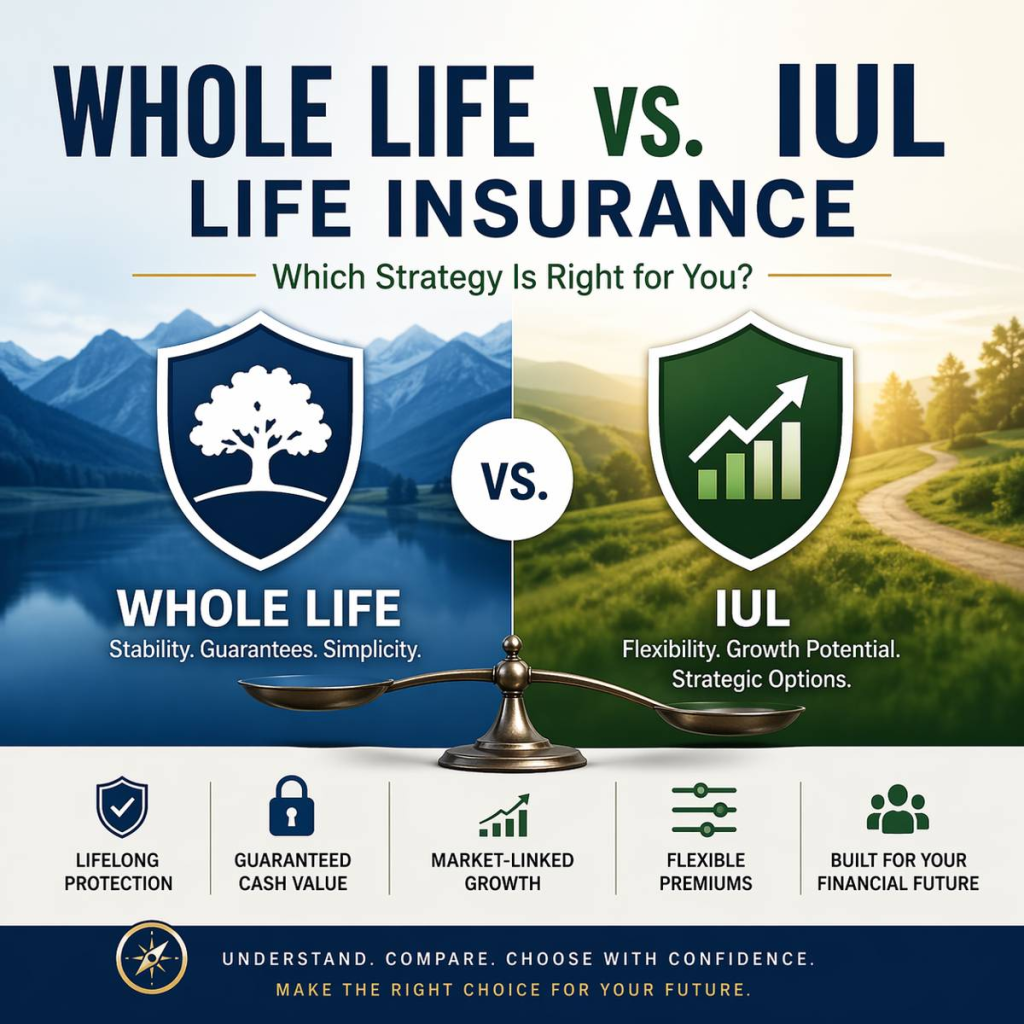
Whole Life vs. IUL Life Insurance: Which Is Right for Your Financial Plan?
Introduction
Choosing between whole life insurance and indexed universal life (IUL) insurance is one of the most misunderstood decisions in financial planning. Both are forms of permanent life insurance, both build cash value, and both are often marketed as long-term financial tools—but they operate very differently beneath the surface.
This decision matters more than most people realize. The wrong choice can lead to higher costs, underperformance, or even policy failure over time. The right choice, on the other hand, can support long-term goals like wealth preservation, tax-advantaged growth, or legacy planning.
This guide is designed to cut through the noise. Instead of focusing on sales-driven narratives, you’ll get a clear, structured, and decision-focused framework to help you understand how each policy works—and which one may align best with your financial plan.
Quick Answer — Whole Life vs. IUL
Whole life insurance offers guaranteed premiums, predictable cash value growth, and long-term stability. Indexed universal life (IUL) provides flexible premiums and market-linked growth potential, but with added complexity and variable outcomes. The best choice depends on your financial goals, risk tolerance, and willingness to actively manage the policy.
- Whole Life Insurance
- Guarantees and predictability
- Simple, structured design
- Stable long-term growth
- Indexed Universal Life (IUL)
- Flexible premiums and benefits
- Growth tied to market index performance
- More complex with variable results
👉 The key takeaway: the better option isn’t universal—it depends on how each policy fits into your broader financial strategy and comfort with risk.
Key Differences in 60 Seconds
| Feature | Whole Life Insurance | Indexed Universal Life (IUL) |
|---|---|---|
| Premium Structure | Fixed and predictable | Flexible (can vary over time) |
| Growth Method | Guaranteed growth + potential dividends | Market-linked (subject to caps and floors) |
| Risk Level | Low | Moderate |
| Flexibility | Limited | High |
| Complexity | Simple and transparent | More complex with multiple variables |
Who Each Policy Is Best For
Whole Life Insurance — Ideal Profile
Whole life insurance is best suited for individuals who prioritize stability, predictability, and long-term guarantees within their financial plan.
- Risk-averse individuals who prefer certainty over variability
- Estate and legacy planners focused on wealth transfer and permanent coverage
- High-income savers seeking stable, tax-deferred accumulation
- Those who value a “set it and forget it” approach with minimal ongoing management
- Individuals looking for consistent, disciplined savings behavior built into the policy
👉 In practice, whole life often fits best when the goal is financial stability and long-term preservation, rather than maximizing growth.
Indexed Universal Life (IUL) — Ideal Profile
Indexed universal life (IUL) insurance is better suited for individuals who want flexibility and are comfortable navigating a more complex financial product.
- Flexible planners who want control over premiums and policy structure
- Individuals with a higher risk tolerance who can accept variable outcomes
- Tax-advantaged growth seekers looking to supplement retirement income strategies
- Those willing to actively monitor and adjust their policy over time
- Individuals interested in optimizing cash value accumulation beyond guaranteed returns
👉 IUL tends to work best when the goal is growth potential and flexibility, and the policy is properly structured and actively managed.
What You’ll Learn in This Guide
This guide is designed to give you a clear, practical understanding of how these two strategies compare in real-world financial planning.
- Core structural differences between whole life and IUL policies
- Real-world performance expectations, beyond marketing illustrations
- The key risks and trade-offs that are often overlooked
- A step-by-step decision-making framework to help you choose the right option
By the end, you’ll be equipped to evaluate not just which policy is “better,” but which one is better for your specific financial goals and long-term strategy.
Understanding the Basics of Permanent Life Insurance
What Is Permanent Life Insurance?
Permanent life insurance is designed to provide lifelong coverage, as long as premiums are maintained. Unlike term life insurance—which covers you for a specific period (such as 10, 20, or 30 years)—permanent policies combine insurance protection with a built-in savings component.
Here’s the key distinction:
- Term Life Insurance
- Temporary coverage
- Lower cost
- No cash value
- Designed purely for income protection
- Permanent Life Insurance
- Lifelong coverage
- Higher cost
- Includes a cash value component
- Can serve both protection and long-term financial planning goals
At its core, permanent life insurance has two primary components:
- Death Benefit
The amount paid to beneficiaries upon death, typically income tax-free under current U.S. law - Cash Value
A growing, tax-deferred account within the policy that accumulates over time
👉 This dual structure is what makes permanent life insurance fundamentally different—and more complex—than term insurance.
Why Cash Value Changes the Strategy
The presence of cash value transforms life insurance from a simple protection tool into a multi-purpose financial planning vehicle.
Tax-Deferred Growth
- Cash value grows tax-deferred, meaning you don’t pay taxes annually on gains
- This can make it attractive for individuals seeking tax-efficient accumulation, especially after maxing out traditional retirement accounts
Policy Loans and Withdrawals
- You can access cash value through:
- Policy loans (borrow against the policy)
- Withdrawals (remove funds directly)
- Loans are generally not taxable if structured properly
- However, they reduce the death benefit if not repaid
Long-Term Planning Implications
Cash value opens the door to several strategic uses:
- Supplemental retirement income through policy loans
- Liquidity planning for emergencies or opportunities
- Estate planning, providing both tax-efficient growth and a guaranteed death benefit
- Wealth preservation strategies, particularly for high-income individuals
👉 Important perspective:
Cash value is powerful—but it introduces costs, complexity, and long-term commitment. The effectiveness of the strategy depends heavily on how the policy is structured, funded, and managed over time.
How Whole Life Insurance Works
Fixed Premiums and Guaranteed Structure
Whole life insurance is built on a foundation of certainty and consistency, which is one of its defining advantages in long-term financial planning.
- Level premiums
Your premium is fixed for life. It does not increase as you age or as your health changes, making long-term planning straightforward. - Guaranteed death benefit
As long as premiums are paid, the policy guarantees a payout to your beneficiaries. This creates a reliable foundation for estate planning and financial protection.
👉 This structure makes whole life one of the most predictable financial instruments available within insurance.
Cash Value Growth and Dividends
A portion of each premium contributes to the policy’s cash value, which grows over time.
- Guaranteed growth rate
The insurer credits a minimum guaranteed rate of return to the cash value, ensuring steady accumulation regardless of market conditions. - Participating policies and dividends
Many whole life policies are “participating,” meaning they may pay dividends based on the insurer’s financial performance.
Dividends can be used to:- Increase cash value
- Purchase additional paid-up insurance
- Offset premiums
👉 While dividends are not guaranteed, many established insurers have a long history of consistent payouts.
Strengths of Whole Life
Whole life insurance is often chosen for its reliability and simplicity.
- Stability
Insulated from market volatility with guaranteed growth components - Simplicity
Easy to understand with fewer moving parts compared to other permanent policies - Predictability
Clear expectations for premiums, growth, and long-term outcomes
👉 In practice, whole life works best as a conservative, long-term financial anchor within a broader plan.
How Indexed Universal Life (IUL) Insurance Works
Flexible Premiums and Adjustable Benefits
Indexed universal life insurance introduces flexibility that whole life does not offer—but with that flexibility comes added complexity.
- Pay more or less flexibility
You can adjust premium payments within certain limits, increasing contributions to build cash value or reducing them (subject to policy constraints). - Adjustable death benefit
The death benefit can often be increased or decreased, depending on your financial needs and underwriting requirements.
👉 This flexibility can be powerful—but it requires careful management to avoid unintended consequences.
Market-Linked Growth (Caps, Floors, Participation Rates)
The defining feature of IUL is how cash value growth is tied to a market index, such as the S&P 500.
- How indexing works (not direct investment)
Your money is not directly invested in the market. Instead, the insurer credits interest based on index performance using a specific formula. - Cap rates and participation rates
- Cap rate: Maximum return you can earn in a given period
- Participation rate: Percentage of index gains credited to your policy
- Floor protection
Most policies include a floor (commonly 0%), meaning you won’t receive negative credited interest during market downturns.
👉 Important nuance:
While the floor limits losses, caps and participation rates also limit gains, shaping long-term performance.
Why IUL Is More Complex
IUL policies involve multiple variables that can change over time, making them more difficult to evaluate and manage.
- Multiple moving parts
- Cap rates
- Participation rates
- Cost of insurance (COI)
- Policy fees
- Funding levels
- Policy management requirements
IUL is not a passive product. It often requires:- Ongoing monitoring
- Periodic adjustments to premiums
- Review of performance relative to projections
👉 Key takeaway:
IUL offers flexibility and growth potential, but success depends heavily on proper structuring, consistent funding, and active oversight over time.
Whole Life vs. IUL: Side-by-Side Comparison
| Feature | Whole Life Insurance | Indexed Universal Life (IUL) |
|---|---|---|
| Premiums | Fixed | Flexible |
| Growth | Guaranteed | Market-linked |
| Risk | Low | Moderate |
| Complexity | Low | High |
| Transparency | High | Moderate |
👉 At a glance, whole life emphasizes certainty and structure, while IUL emphasizes flexibility and potential upside—with more variables to manage.
Growth Potential vs. Predictability
Whole Life: Consistent, Lower Returns
Whole life insurance is designed to deliver steady, predictable growth over time, rather than maximizing returns.
- Typical long-term expectations
Cash value growth is generally modest but consistent, often supported by guaranteed rates and potential dividends. Returns tend to fall in a conservative range over the life of the policy. - Role in conservative planning
Whole life is often used as a stability component within a broader financial strategy. It can complement more volatile investments by providing:- Predictable accumulation
- Downside protection
- Long-term reliability
👉 Think of whole life as a financial anchor, not a high-growth vehicle.
IUL: Higher Potential, Less Certainty
Indexed universal life (IUL) introduces the possibility of higher returns—but with more variability and dependence on policy structure.
- Illustration vs. reality
Policy illustrations often assume favorable market conditions and stable crediting terms. In practice, actual performance depends on:- Market cycles
- Cap and participation rate changes
- Fees and cost structure
- Impact of caps and fees
Even in strong market years, returns are limited by caps. Over time, fees and insurance costs can further reduce net performance, especially if the policy is not optimally funded.
👉 The result: IUL can outperform whole life in certain scenarios—but outcomes are less predictable and more sensitive to assumptions.
Key Insight
The core trade-off comes down to:
- Whole Life: Predictability, stability, and guaranteed outcomes
- IUL: Variability, flexibility, and higher—but uncertain—growth potential
👉 In financial planning terms, this is a classic decision between certainty and opportunity. The right choice depends on how much variability you are willing to accept in pursuit of potentially higher returns.
Costs and Fees Breakdown
Understanding costs is critical, because fees directly impact how much cash value actually accumulates over time. Even small differences in structure can lead to significantly different long-term outcomes.
Common Costs in Both Policies
Both whole life and IUL policies include several core cost components:
- Cost of Insurance (COI)
This is the underlying cost of providing the death benefit. It generally increases with age and is a major factor in long-term policy performance. - Administrative Fees
Ongoing charges for policy maintenance, recordkeeping, and insurer operations. - Surrender Charges
Fees applied if you cancel or withdraw significant funds from the policy in the early years. These can last 10–15 years depending on the policy.
👉 These costs are unavoidable—but how they are structured and disclosed varies significantly between policy types.
Cost Differences That Matter
Whole Life: Stable and Transparent
- Costs are typically built into a level premium structure
- Easier to understand long-term impact
- Less variability over time
👉 The trade-off is that whole life often feels “expensive” upfront, but the structure is predictable and easier to evaluate.
IUL: Layered and Variable
- Costs are separated and more complex, including:
- COI (which can increase over time)
- Administrative fees
- Charges tied to riders or features
- Performance is more sensitive to:
- Funding levels
- Policy design
- Changes in insurer assumptions
👉 The key issue isn’t just cost—it’s how visible and controllable those costs are over time.
Cost Structure Comparison
| Cost Component | Whole Life | IUL |
|---|---|---|
| Premium structure | Fixed | Flexible |
| Cost transparency | High | Moderate |
| COI predictability | Stable | Variable |
| Fee complexity | Low | High |
| Long-term cost control | Easier | Requires monitoring |
Risks and Trade-Offs Most People Miss
One of the biggest gaps in understanding comes from focusing on benefits while underestimating risks. Both policy types have trade-offs that should be carefully evaluated.
Whole Life Risks
While whole life is considered conservative, it is not risk-free.
- Lower returns vs. inflation
Over long periods, returns may lag behind inflation or alternative investments, reducing real purchasing power. - Opportunity cost
Capital committed to whole life could potentially earn higher returns elsewhere (e.g., equities or other investments).
👉 Whole life trades higher growth potential for stability and guarantees.
IUL Risks (Critical Section)
IUL policies introduce risks that are often less obvious but can have significant long-term consequences.
- Policy lapse risk
If the policy is underfunded or experiences lower-than-expected returns, it may not sustain itself—leading to lapse or additional funding requirements. - Changing cap rates
Insurers can adjust cap and participation rates over time, which can reduce future growth potential even if markets perform well. - Complexity risk
Multiple moving parts increase the likelihood of misunderstanding or mismanaging the policy. - Overreliance on illustrations
Projections often assume stable or favorable conditions. Real-world performance may differ, especially over decades.
👉 Critical takeaway:
IUL is highly sensitive to assumptions, funding discipline, and ongoing management. Without proper oversight, outcomes can diverge significantly from expectations.
In practical terms, this section often determines success or failure. The difference between a well-structured policy and a poorly managed one isn’t just performance—it can be whether the policy works at all over the long term.
Risk Comparison Table
| Risk Type | Whole Life | IUL |
|---|---|---|
| Market risk | None | Indirect exposure |
| Policy lapse risk | Low (if funded properly) | Moderate to High |
| Complexity risk | Low | High |
| Return variability | Low | Moderate |
| Assumption risk (projections vs reality) | Low | High |
Best Fit by Financial Goal
Choosing between whole life and indexed universal life (IUL) becomes much clearer when you start with your primary objective. Each policy is designed to solve a different type of financial problem, so aligning your goal with the right structure is critical.
| Financial Goal | Best Option |
|---|---|
| Guaranteed lifelong protection | Whole Life |
| Predictable cash value growth | Whole Life |
| Tax-advantaged accumulation | IUL |
| Flexible retirement income strategy | IUL |
| Simplicity and ease of management | Whole Life |
| Customization and flexibility | IUL |
👉 Key takeaway:
If your priority is certainty, simplicity, and long-term guarantees, whole life insurance is typically the better fit. If you’re looking for **flexibility and higher growth potential—and are comfortable with added complexity—**IUL may be worth considering.
This table provides a quick starting point, but your final decision should still align with your risk tolerance, funding ability, and overall financial plan.
Policy Management Requirements: How Much Effort Is Involved?
One of the most overlooked differences between whole life and indexed universal life (IUL) insurance is how much ongoing attention the policy requires. This isn’t just a convenience factor—it can directly impact long-term performance and success.
Management Comparison
| Factor | Whole Life | IUL |
|---|---|---|
| Ongoing management | Minimal | Active monitoring required |
| Adjustments needed | Rare | Periodic |
| Risk of mismanagement | Low | Higher |
| Time commitment | Low | Moderate |
How to Interpret These Differences
Ongoing Management
- Whole Life:
Designed to be largely hands-off. Once established, the policy typically runs on a predictable path with little need for intervention. - IUL:
Requires regular review and oversight, including monitoring performance, costs, and funding levels.
👉 Takeaway: Whole life is closer to a “set it and forget it” structure, while IUL is an actively managed strategy.
Adjustments Needed
- Whole Life:
Premiums and benefits are fixed, so adjustments are uncommon. - IUL:
Policyholders may need to adjust:- Premium contributions
- Death benefit levels
- Funding strategies over time
👉 Takeaway: Flexibility in IUL creates opportunity—but also responsibility.
Risk of Mismanagement
- Whole Life:
Simplicity reduces the likelihood of errors or poor decisions. - IUL:
More moving parts increase the risk of:- Underfunding
- Misaligned expectations
- Poor long-term performance
👉 Takeaway: IUL outcomes depend heavily on how well the policy is managed over time.
Time Commitment
- Whole Life:
Minimal time required after setup. - IUL:
Moderate time commitment, including:- Periodic reviews
- Adjustments based on performance
- Ongoing understanding of policy mechanics
👉 Takeaway: IUL is not passive—it requires ongoing engagement to perform as intended.
Key Insight
The difference here is simple but powerful:
- Whole life is designed for consistency with minimal oversight
- IUL is designed for flexibility with active involvement
👉 The best choice depends not just on your financial goals—but on your willingness and ability to monitor, manage, and adjust the policy over time.
What Can Go Wrong: Real Risks to Understand Before You Commit
Every financial strategy has trade-offs—and permanent life insurance is no exception. While both whole life and indexed universal life (IUL) can be effective tools, understanding what can go wrong is essential to making an informed, long-term decision.
This section highlights the most common pitfalls and where each policy type can fall short if not properly structured or managed.
Key Risk Comparison
| Issue | Whole Life | IUL |
|---|---|---|
| Underperformance | Lower returns vs alternatives | Caps limit upside potential |
| Policy failure | Rare (if properly funded) | Possible if underfunded |
| Misunderstanding | Low | High |
| Fee drag | Moderate | Potentially high |
| Long-term surprises | Low | Moderate to High |
How to Interpret These Risks
Underperformance
- Whole Life:
Growth is steady but conservative. Over long periods, returns may lag behind higher-risk investments like equities. - IUL:
While marketed for growth, returns are constrained by caps and participation rates, which can limit upside even in strong markets.
👉 Takeaway: Neither policy is designed to maximize returns—they serve different roles within a broader financial strategy.
Policy Failure
- Whole Life:
Generally stable if premiums are paid consistently. - IUL:
More sensitive to funding levels and performance. If underfunded, the policy may require additional contributions or risk lapsing.
👉 Takeaway: IUL requires active funding discipline to remain viable over time.
Misunderstanding
- Whole Life:
Straightforward structure makes it easier to understand and manage. - IUL:
Multiple moving parts (caps, fees, crediting methods) increase the risk of misunderstanding.
👉 Takeaway: Complexity increases the likelihood of poor decisions or unrealistic expectations.
Fee Drag
- Whole Life:
Costs are built into the structure and relatively stable. - IUL:
Fees can be layered and variable, impacting long-term performance more significantly if not properly managed.
👉 Takeaway: Fees matter more over time than most people expect—especially in flexible policies.
Long-Term Surprises
- Whole Life:
Designed to minimize surprises through guarantees and stable assumptions. - IUL:
Outcomes depend on multiple variables that can change over time, including insurer adjustments and market conditions.
👉 Takeaway: IUL outcomes are less predictable, particularly over multi-decade time horizons.
Key Insight
The biggest difference isn’t whether something can go wrong—it’s how likely it is and how controllable it is.
- Whole life minimizes uncertainty but sacrifices growth potential
- IUL introduces more opportunity—but also more variables that must be actively managed
👉 The most successful outcomes come from choosing a policy that matches not just your goals, but your ability to fund, understand, and manage it over time.
Example Scenarios: When Each Strategy Makes Sense
Understanding theory is helpful—but real financial decisions are made in real-life situations. Below are practical scenarios that illustrate when whole life or IUL may be the better strategic fit.
Scenario 1: Conservative Long-Term Planner
Likely Better Fit: Whole Life Insurance
Consider an individual or family focused on long-term financial stability, not chasing maximum returns. Their priorities may include:
- Guaranteed lifelong coverage
- Predictable cash value growth
- Estate or legacy planning
- Minimal need for ongoing policy management
In this case, whole life insurance aligns well because it offers:
- Stable, guaranteed outcomes
- A structured, disciplined savings component
- Confidence in long-term projections
👉 Why it works:
For conservative planners, the value isn’t in maximizing returns—it’s in eliminating uncertainty and ensuring consistency over decades.
Scenario 2: Flexible Retirement Strategy
Likely Better Fit: Indexed Universal Life (IUL)
Now consider someone planning for retirement who wants flexibility and tax diversification. They may already be:
- Maxing out traditional retirement accounts
- Looking for additional tax-advantaged strategies
- Comfortable with moderate complexity and active planning
An IUL policy may be appropriate because it can provide:
- Flexible contributions based on income variability
- Potential for higher cash value accumulation
- Access to funds through policy loans for supplemental retirement income
👉 Why it works:
IUL can function as a flexible accumulation tool, especially when structured properly and actively managed over time.
Scenario 3: Business or High-Income Planning
Best Fit: Either (Depends on Structure and Goals)
For business owners or high-income individuals, the decision often becomes more strategic and less about the product itself.
Common objectives may include:
- Key person insurance
- Executive compensation strategies
- Tax-efficient wealth accumulation
- Estate and succession planning
Both whole life and IUL can be effective—but the best choice depends on:
- Risk tolerance
- Cash flow flexibility
- Planning complexity
- Desired level of guarantees vs growth potential
- Whole Life Advantage:
Strong for predictable funding, balance sheet stability, and long-term guarantees - IUL Advantage:
Greater flexibility for variable income and potential for enhanced accumulation
👉 Why it works:
At this level, the policy becomes a tool within a broader financial strategy. The structure, funding approach, and integration with other planning elements matter more than the product label itself.
Example Outcome Scenarios
| Scenario | Whole Life Outcome | IUL Outcome |
|---|---|---|
| Strong market period | Steady, consistent growth | Higher capped gains |
| Flat market | Continued steady growth | Minimal growth (floor applied) |
| Poor funding | Reduced efficiency | Increased lapse risk |
| Long-term hold (20+ years) | Predictable accumulation | Variable results |
Key Takeaway
These scenarios highlight a critical principle:
- Whole life tends to excel in stability-focused strategies
- IUL tends to fit flexibility and growth-oriented strategies
But in both cases, success depends less on the product and more on how well it aligns with your overall financial plan, funding discipline, and long-term objectives.
If you want to strengthen this section even further, the next step would be adding a decision table or flowchart that visually guides readers to the right choice based on their goals and risk profile.
Decision Framework — How to Choose
Choosing between whole life and IUL isn’t about finding a “better” product—it’s about selecting the right tool for your specific financial strategy. This framework simplifies the decision into practical, actionable steps.
Simple Decision Table
| If You Value… | Consider |
|---|---|
| Guarantees | Whole Life |
| Flexibility | IUL |
| Simplicity | Whole Life |
| Growth Potential | IUL |
👉 Use this table as a quick filter. It won’t replace deeper analysis, but it helps immediately narrow your direction based on priorities.
Step-by-Step Decision Process
1. Define Your Primary Goal (Protection vs. Growth)
Start with clarity on what you’re trying to accomplish:
- Pure protection → You may not need permanent insurance at all (term could be more appropriate)
- Stability and long-term guarantees → Whole life
- Growth and supplemental income strategy → IUL
👉 This is the most important step—your goal determines everything else.
2. Assess Your Risk Tolerance
- Low risk tolerance
Prefer predictable outcomes → Whole life - Moderate risk tolerance
Willing to accept variability for potential upside → IUL
👉 If market-linked variability makes you uncomfortable, IUL may not be the right fit.
3. Evaluate Your Time Horizon
- Short to medium-term focus (under 10 years)
Permanent life insurance is generally less effective - Long-term focus (20+ years)
Both whole life and IUL become more viable
👉 These strategies are designed for long-duration planning, not short-term use.
4. Determine Your Funding Capacity
- Consistent, predictable funding available
Whole life aligns well with fixed premium commitments - Variable or higher funding flexibility needed
IUL allows adjustments—but requires discipline
👉 Underfunding—especially in IUL—can significantly impact outcomes.
5. Align With Your Overall Financial Plan
This is where many decisions go wrong.
- Does the policy complement your:
- Retirement accounts?
- Tax strategy?
- Investment portfolio?
- Is it being used for:
- Income replacement?
- Wealth accumulation?
- Estate planning?
👉 The policy should fit into a broader plan, not operate in isolation.
Final Decision Insight
A well-structured decision often looks like this:
- Choose whole life when you want:
- Predictability
- Simplicity
- Long-term guarantees
- Choose IUL when you want:
- Flexibility
- Growth potential
- Strategic income planning options
👉 The real advantage comes from alignment—not optimization. The “best” policy is the one that you can fund consistently, understand clearly, and hold for the long term.
Common Mistakes to Avoid
Even well-intentioned buyers can run into problems with permanent life insurance. These mistakes often don’t show up immediately—but can have significant long-term consequences.
Buying Based on Illustrations Alone
Policy illustrations are projections—not guarantees.
- Often assume stable or favorable conditions over decades
- May not reflect changes in:
- Cap rates (IUL)
- Fees or cost structures
- Real-world market cycles
👉 Key takeaway:
Use illustrations as a reference point, not a decision-making foundation. Focus on conservative assumptions and stress-tested scenarios.
Underfunding Policies
Funding is one of the most critical factors in long-term success.
- Whole Life:
Underfunding reduces cash value growth and long-term efficiency - IUL:
Underfunding can create serious risk, including:- Erosion of cash value
- Increased cost pressure
- Potential policy lapse
👉 Key takeaway:
Permanent life insurance works best when it is properly and consistently funded over time.
Ignoring Long-Term Costs
Costs are not just an early-year issue—they affect the entire life of the policy.
- Cost of insurance (COI) typically increases with age
- Fees can compound and reduce long-term performance
- Early surrender charges can lock you into a long commitment
👉 Key takeaway:
Evaluate policies based on lifetime cost impact, not just initial affordability.
Choosing Complexity Without Understanding It
More flexibility often means more responsibility.
- IUL policies include multiple moving parts:
- Cap rates
- Participation rates
- Funding strategies
- Misunderstanding these can lead to:
- Poor performance
- Incorrect expectations
- Policy instability
👉 Key takeaway:
If you don’t fully understand how a policy works, it becomes much harder to manage effectively over time.
Frequently Asked Questions (FAQ)
Is IUL Better Than Whole Life Insurance?
Not necessarily. IUL offers more flexibility and growth potential, but also introduces more complexity and variability. Whole life provides stability and guarantees. The better option depends on your financial goals, risk tolerance, and planning strategy.
Can You Lose Money in an IUL?
You typically won’t experience negative credited returns due to the floor (often 0%). However, fees and insurance costs can reduce overall cash value, especially in low-return environments or if the policy is underfunded.
Why Do Some Advisors Criticize IUL?
Common concerns include:
- Overly optimistic illustrations
- Complexity that can obscure risks
- Sensitivity to assumptions (caps, fees, funding levels)
👉 The criticism is less about the product itself and more about how it is designed, presented, and managed.
Is Whole Life Insurance Worth It Long Term?
It can be, particularly for individuals who value:
- Predictability and guarantees
- Long-term financial stability
- Estate or legacy planning
However, returns are typically lower than market-based investments, so it works best as part of a balanced financial strategy.
Which Policy Builds More Cash Value?
- IUL: Higher potential cash value growth under favorable conditions
- Whole Life: More predictable and stable accumulation
👉 The trade-off is between potential vs certainty—and actual results depend heavily on funding, costs, and long-term performance.
Related Life Insurance Topics
Building a strong understanding of life insurance doesn’t stop with one comparison. Use the resources below to deepen your knowledge and connect this decision to your broader financial plan.
Start Here
If you’re still defining your needs, begin with these foundational guides:
- How Much Life Insurance Do You Need
Learn how to calculate the right coverage amount based on income, debt, family needs, and long-term goals. - Term vs. Permanent Life Insurance
Understand when temporary coverage may be more appropriate—and when permanent strategies make sense.
Continue Learning
Once you understand the basics, explore these deeper topics to refine your strategy:
- Whole Life Insurance
A detailed breakdown of how whole life works, including cash value, dividends, and long-term planning uses. - Indexed Universal Life (IUL) Insurance
A comprehensive guide to IUL structure, performance drivers, and strategic applications. - Types of Life Insurance
A complete overview of all major policy types, helping you compare options across the full spectrum. - Life Insurance Cost
Understand what drives premiums, how pricing works, and how to evaluate affordability over time. - The Life Insurance Hub – Continue your journey of life insurance education.
Final Thought
There is no one-size-fits-all answer when it comes to whole life vs. IUL life insurance.
The right choice depends on how well the policy aligns with your financial goals, risk tolerance, and long-term strategy—not just the features of the product itself.
Before making a decision:
- Evaluate your goals
Are you prioritizing protection, stability, growth, or flexibility? - Think long-term
These are decades-long strategies, not short-term financial tools. - Continue learning
The more you understand how these policies work, the better positioned you’ll be to make a confident, informed decision.
👉 The most effective strategy isn’t about choosing the “best” product—it’s about choosing the one that fits your plan, your discipline, and your long-term financial vision.
Back to the Insurance Hub or check out The Financial Planning Roadmap.