
Key Takeaways
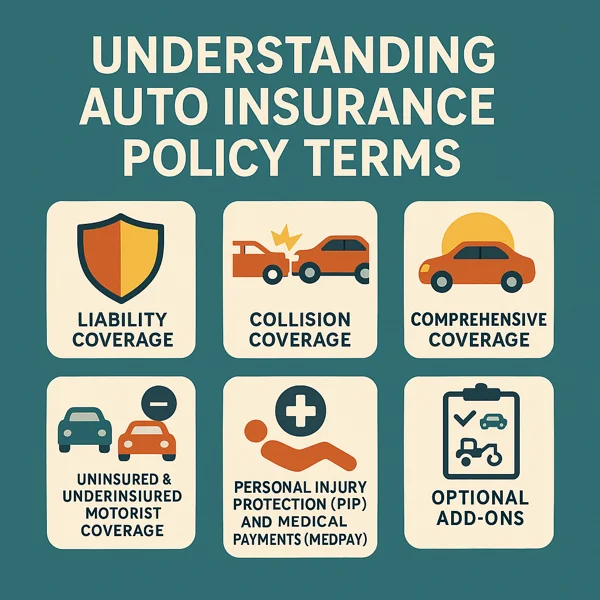
- Liability coverage protects your finances if you’re responsible for injuries or property damage in an accident.
- Collision and comprehensive insurance cover your own vehicle — whether it’s damaged in an accident or by non-collision events like theft or weather.
- Uninsured and underinsured motorist coverage fills gaps when the other driver lacks adequate insurance.
- PIP and MedPay cover medical expenses regardless of fault, offering essential protection in no-fault states.
- Optional add-ons like rental reimbursement, towing, or GAP insurance enhance convenience and fill unique coverage gaps.
- Regular reviews of your policy ensure coverage evolves with your life, vehicle, and financial goals.
- Optimizing coverage and discounts can save hundreds annually while maintaining strong protection.
Bottom line: The more you understand your auto insurance terms and options, the better equipped you are to make financially sound, confidence-backed decisions behind the wheel.
Introduction – Your Essential Guide to Understanding Auto Insurance
Auto insurance is one of the most important — and most misunderstood — parts of personal financial protection. Yet for many drivers, policy language feels like a foreign language of limits, deductibles, and exclusions. That confusion can lead to costly mistakes, underinsurance, or paying for coverage you don’t actually need.
This guide breaks down auto insurance into clear, practical terms — helping you understand not just what each coverage means, but why it matters to your financial security. Whether you’re a first-time car owner or reviewing a long-standing policy, this comprehensive explanation will give you the confidence to:
- Choose the right mix of coverages for your lifestyle.
- Avoid common policy pitfalls and hidden exclusions.
- Compare quotes intelligently across insurers.
- Align your protection with your financial planning goals.
Auto insurance isn’t just about complying with state law — it’s about ensuring one accident doesn’t derail years of financial progress. By the end of this guide, you’ll have a working command of the key terms, coverage options, and optimization strategies to make your policy work smarter for you.
Section 1: Core Auto Insurance Coverages
Understanding your auto insurance starts with mastering its foundation — the core coverages that protect both you and others on the road. Each component plays a distinct financial role, and knowing how they work together ensures you’re never under- or over-insured.
Liability Coverage: Protecting Others and Yourself
Liability coverage is the cornerstone of every auto policy. It pays for injuries or property damage you cause to others in an at-fault accident.
- Bodily Injury Liability covers medical expenses, rehabilitation, and potential legal costs for injured parties.
- Property Damage Liability pays for repairs or replacement of the other party’s vehicle or damaged property.
Tip: Choose limits that reflect your net worth — state minimums rarely cover serious accidents. Many financial planners recommend at least 100/300/100 ($100 k per person / $300 k per accident / $100 k property damage).
Collision Coverage: Repairing or Replacing Your Vehicle
Collision insurance pays for damage to your own car after striking another vehicle or object, regardless of fault.
- Often required by lenders on financed or leased vehicles.
- You’ll pay a deductible (typically $500–$1,000) before your insurer covers the remainder.
- A higher deductible can reduce your monthly premium but increases out-of-pocket cost after an accident.
Ideal for newer vehicles or when repair costs could strain your emergency fund.
Comprehensive Coverage: Non-Collision Damages
Comprehensive coverage—sometimes called “other-than-collision” insurance—protects your car from events beyond your control, including:
- Theft or vandalism
- Fire, flood, hail, or falling objects
- Collisions with animals
- Natural disasters or civil disturbances
Pairing comprehensive with collision provides what’s known as “full coverage” protection.
Uninsured & Underinsured Motorist Coverage: Filling the Gaps
Roughly one in eight drivers in the U.S. lacks insurance. This coverage protects you when an uninsured or underinsured driver causes damage or injury.
- Uninsured Motorist (UM) covers injuries and property damage if the at-fault driver has no insurance.
- Underinsured Motorist (UIM) bridges the gap when their limits are too low to cover your losses.
Required in many states and invaluable for protecting your finances against irresponsible drivers.
Personal Injury Protection (PIP) and Medical Payments (MedPay): Covering Medical Costs
Both cover medical expenses regardless of fault, but they function differently:
- PIP (Personal Injury Protection): Covers medical bills, lost wages, and sometimes essential services (like childcare) in no-fault states.
- MedPay: Provides a smaller layer of medical coverage in traditional fault states.
These benefits can supplement your health insurance and reduce immediate financial strain after an accident.
Optional Add-Ons: Rental Reimbursement, Towing, and More
Optional coverages enhance convenience and fill lifestyle-specific gaps:
- Rental Reimbursement: Pays for a rental car while yours is being repaired.
- Towing & Roadside Assistance: Covers emergency services such as battery jumps or flat-tire changes.
- Gap Insurance: Covers the difference between your car’s loan balance and actual cash value if totaled.
- Custom Equipment Coverage: Protects aftermarket upgrades like sound systems or custom wheels.
Evaluate these add-ons annually—small premiums can prevent major inconveniences later.
Section 2: The Financial Framework of Auto Insurance
Auto insurance isn’t just about coverage—it’s a financial contract built on risk-sharing and calculated protection. Understanding the money side of your policy helps you control costs, compare quotes intelligently, and avoid costly surprises when you file a claim.
Premiums: How Insurers Price Your Risk
Your premium is the amount you pay—monthly, quarterly, or annually—to keep your insurance active.
Insurers calculate it using a blend of personal factors (driving record, age, ZIP code, credit history) and vehicle factors (make, model, safety features, repair cost).
Key influences include:
- Driving behavior: accidents, claims history, and violations.
- Coverage choices: higher limits and lower deductibles raise premiums.
- Location: areas with high theft or accident rates cost more to insure.
Tip: Shop for quotes at least once a year. Market changes and improved credit can lead to lower premiums with the same protection.
Deductibles: Balancing Cost and Coverage
A deductible is what you pay out of pocket before your insurer covers the rest of a claim.
- Higher deductibles = lower premiums but more risk when filing a claim.
- Lower deductibles = higher premiums but less financial shock in an accident.
Example: With a $1,000 deductible and $4,500 repair bill, you pay $1,000 and your insurer covers $3,500.
Strategy: Align your deductible with your emergency savings. If you can’t afford to pay it comfortably, it’s too high.
Policyholders and Named Insureds: Who’s Covered
A policyholder is the person legally responsible for the policy and premium payments.
- Named insureds enjoy full coverage rights under the policy.
- Permissive users—those who borrow your car occasionally—are often covered automatically, but restrictions vary by insurer.
Review this section carefully before lending your car; coverage gaps can appear if someone not listed is involved in an accident.
Endorsements and Riders: Customizing Your Policy
Endorsements (or riders) are policy modifications that add, remove, or alter coverage terms.
Common examples include:
- Adding roadside assistance or rental reimbursement.
- Extending coverage for new equipment or modifications.
- Adjusting liability limits or deductibles mid-term.
These adjustments ensure your policy evolves with your needs—such as when you buy a new car or add a teen driver.
Exclusions: Understanding What’s Not Covered
Every policy lists exclusions, or situations where coverage won’t apply. Common ones include:
- Intentional damage or illegal activity.
- Using your vehicle for commercial ridesharing without proper coverage.
- Wear and tear, mechanical failure, or depreciation.
Always read the exclusions section—knowing what isn’t covered is just as vital as knowing what is.
Claims and Adjusters: Navigating the Settlement Process
When an accident occurs, you’ll file a claim to request payment for damages.
The insurer assigns a claims adjuster, who:
- Reviews your statement, police reports, and photos.
- Estimates damage costs and verifies policy coverage.
- Negotiates settlement amounts based on policy terms.
Keep documentation organized—photos, repair estimates, and receipts speed up claim approval.
The Underwriting Process: How Insurers Evaluate You
Underwriting is the insurer’s risk assessment stage. It determines:
- Whether to issue or renew a policy.
- What your premium will be.
- What coverage limits or restrictions apply.
Insurers rely on data like driving records, credit scores, and claim histories.
Drivers with a clean record and stable credit often qualify for preferred rates and renewal discounts.
The Role of Actuaries: The Math Behind Your Premium
Actuaries use statistical models to predict claim likelihood and cost.
They analyze:
- Accident frequency by driver demographics.
- Repair costs by vehicle model.
- Regional claim trends and inflation data.
Their work ensures the insurer stays solvent while keeping premiums competitive.
This process is why two similar drivers can see very different rates—each profile carries a unique statistical risk.
Section 3: Expanding Your Auto Insurance Vocabulary
Auto insurance comes with its own specialized vocabulary. Understanding these key terms allows you to read your policy like a professional—so you can identify hidden gaps, ask smarter questions, and make better coverage choices.
Total Loss: When Repairs Aren’t Worth It
A total loss occurs when your car’s repair cost exceeds its actual cash value (ACV) before the accident. In this case, the insurer pays the vehicle’s market value minus your deductible.
- Insurers use repair estimates and market data to determine this threshold.
- Some states define total loss using a Total Loss Ratio (TLR)—for example, 70% or 80% of ACV.
Example: If your car is worth $12,000 and repairs total $10,000, it may be declared a total loss. You’ll receive a payout for $12,000 minus your deductible.
Liability Limits: Knowing Your Coverage Cap
Your liability limit is the maximum amount your insurer will pay per claim or accident. It’s usually shown in a split format, such as 100/300/100, meaning:
- $100,000 bodily injury per person
- $300,000 bodily injury per accident
- $100,000 property damage per accident
Tip: Consider choosing higher limits than your state minimums. One major accident can easily exceed basic limits and expose your personal assets to lawsuits.
Policy Renewal and Lapse Risks
Auto insurance policies typically renew every six or twelve months.
- Your insurer may review your driving record and claim history before renewing.
- Allowing your policy to lapse (expire without renewal) can trigger higher premiums later or even license suspension in some states.
Always pay premiums before the renewal date—continuous coverage signals lower risk and maintains eligibility for loyalty discounts.
SR-22 Requirements: Proof of Financial Responsibility
An SR-22 is not insurance but a certificate of financial responsibility filed by your insurer with your state’s DMV.
It’s typically required after:
- DUI or reckless driving convictions
- Driving without insurance
- Serious at-fault accidents
SR-22 coverage often raises premiums and must be maintained for a set period (usually three years). Failure to maintain it can result in license suspension.
The Principle of Tort: Fault and Legal Liability
The principle of tort governs who pays for damages after an accident.
- In tort (fault) states, the at-fault driver’s insurance covers losses.
- In no-fault states, each driver’s PIP coverage pays their own medical bills regardless of fault.
Knowing your state’s tort system helps determine whether you need PIP, UM/UIM, or additional liability protection.
Indemnity: The Core Concept of Insurance
Indemnity means restoring you to your financial position before the loss—not profiting from it.
- Insurers reimburse only the value of what you lost.
- Policies exclude overpayment or intentional gain (known as “moral hazard”).
This principle ensures fairness while keeping premiums affordable for everyone.
Umbrella Policies: Extra Protection Beyond Auto
An umbrella policy provides additional liability coverage that kicks in once your primary auto or homeowners policy limits are exhausted.
- Typically sold in $1 million increments.
- Covers large lawsuits, serious injuries, or property damages beyond your auto limits.
Ideal for high-net-worth individuals or anyone with significant assets to protect.
Subrogation: How Insurers Recover Payouts
After paying a claim, your insurer may pursue the at-fault party to recover what they paid you—a process known as subrogation.
- This helps keep premiums lower by holding responsible parties accountable.
- You may receive a deductible refund if your insurer successfully recovers costs.
Always cooperate with your insurer’s investigation; it can speed up reimbursements.
Telematics and Usage-Based Insurance: Driving Data Meets Discounts
Telematics programs use in-car devices or mobile apps to track driving behavior—speed, braking, mileage, and time of day—to calculate personalized premiums.
- Safe drivers can save up to 30% through usage-based programs.
- Common examples: Progressive Snapshot®, Allstate Drivewise®, State Farm Drive Safe & Save®.
Caution: Aggressive driving or frequent night driving can increase your rates in some programs. Review terms before enrolling.
Section 4: Advanced Auto Insurance Concepts
Understanding advanced auto insurance concepts helps you go beyond the basics and optimize coverage for your financial situation. These details are where policies differ most — and where informed decisions can save you thousands after an accident or total loss.
GAP Insurance: Bridging the Loan-to-Value Difference
Guaranteed Asset Protection (GAP) insurance covers the difference between your car’s loan balance and its actual cash value (ACV) if it’s totaled or stolen.
- Without GAP, you could owe thousands on a car you no longer have.
- Often recommended for new cars, long loan terms, or low down payments.
- Typically costs between $50 and $150 per year and can be added by your insurer or financed separately through your lender.
Example: If your car is worth $25,000 but you owe $29,000 after an accident, GAP insurance covers the $4,000 difference.
Actual Cash Value (ACV) vs. Replacement Cost: Knowing What You’ll Get Paid
When your car is declared a total loss, insurers calculate your payout based on either:
- Actual Cash Value (ACV): The car’s market value minus depreciation.
- Replacement Cost: The amount needed to replace it with a comparable new model, without deducting for age or wear.
Most standard policies use ACV, but replacement cost coverage — often available as an endorsement — offers better protection against depreciation for new vehicles.
Understanding Policy Declarations and Parts
An auto policy typically includes several key sections, often summarized on your Declarations Page (“Dec Page”):
- Declarations: Lists your name, vehicle, policy number, coverage types, and limits.
- Insuring Agreement: Defines what the insurer promises to pay.
- Conditions: Explain your responsibilities, such as timely reporting and cooperation in claims.
- Exclusions: Outline what isn’t covered.
- Endorsements: Add or modify coverage terms.
Reviewing your Dec Page regularly ensures you understand exactly what’s covered and that no outdated vehicles or drivers remain listed.
The Role of an Insurance Agent or Broker
Insurance professionals come in two main forms:
- Captive Agents represent a single insurer (e.g., State Farm, Allstate). They know their company’s products deeply but can’t compare across competitors.
- Independent Agents/Brokers represent multiple insurers, helping you find the best rate and coverage fit.
Building a relationship with a knowledgeable agent can help you adapt coverage proactively as your life, assets, or risk tolerance change.
Policy Term and Renewal Cycles
A policy term defines how long your coverage lasts — usually six or twelve months.
- Your insurer reviews your record and updates pricing at each renewal.
- Significant rate changes may occur if your credit score shifts, you add a driver, or regional claim costs rise.
Always review renewal notices carefully — they often include changes in rates, discounts, or state-mandated coverage minimums.
GAP Analysis: Assessing Your True Coverage Needs
A GAP analysis in insurance doesn’t just refer to the loan coverage product — it’s also a financial planning process. It means assessing where your current coverage falls short of your actual risk exposure.
- Compare your liability limits to your total assets.
- Evaluate collision and comprehensive coverage relative to vehicle value.
- Adjust uninsured motorist and medical coverage based on local risks and health plan overlap.
Conducting an annual gap analysis ensures your policy evolves alongside your financial life.
Collision Deductible Waiver (CDW): When It Applies
A Collision Deductible Waiver removes your deductible obligation if you’re hit by an uninsured driver who’s found at fault.
- Particularly valuable in states with high uninsured driver rates.
- Usually applies only when you can identify the at-fault driver.
A small premium increase for a CDW can prevent large out-of-pocket costs after a no-fault collision.
These advanced concepts empower you to look beyond the premium and see your policy as a strategic financial tool — one that protects your wealth, not just your vehicle.
Section 5: Special Coverage Scenarios and Unique Cases
Auto insurance isn’t one-size-fits-all. Some drivers, vehicles, and situations require specialized coverage beyond standard policies. Understanding these unique scenarios ensures that your protection matches your personal and financial circumstances.
High-Risk Auto Insurance: Coverage for Risky Drivers
If your driving record includes multiple accidents, traffic violations, or a DUI, you may be labeled a high-risk driver. Insurers view these drivers as more likely to file claims, leading to higher premiums or limited options.
Common high-risk categories include:
- New or young drivers with limited experience
- Drivers with poor credit or coverage lapses
- Individuals with major traffic offenses
To stay insured and rebuild your profile:
- Maintain continuous coverage with no lapses.
- Complete defensive driving or DUI education programs.
- Avoid additional violations — time and consistency lower risk ratings.
Tip: Some insurers specialize in high-risk coverage and gradually lower premiums after clean-driving periods.
Classic and Antique Cars: Special Coverage Needs
Standard auto insurance undervalues classic or antique cars, which often appreciate over time rather than depreciate.
A classic car insurance policy offers:
- Agreed Value Coverage: You and the insurer agree on the car’s value upfront, avoiding depreciation disputes.
- Limited-Use Provisions: Lower premiums since these cars are rarely driven daily.
- Special Parts and Restoration Coverage: Protects rare or custom components.
Partnering with a specialty insurer ensures your collectible is valued for its uniqueness—not its Blue Book price.
Commercial Auto Insurance: Beyond Personal Policies
If you use your vehicle for business purposes, such as deliveries, client visits, or transporting tools, you likely need commercial auto insurance.
- Personal policies typically exclude business use.
- Commercial policies provide higher liability limits, property coverage, and coverage for multiple drivers.
Examples of who needs it: - Rideshare or delivery drivers
- Contractors and service professionals
- Small business owners using branded or work vehicles
Driving for Uber or Lyft? Consider hybrid rideshare coverage, which bridges gaps between personal and platform-provided policies.
Leased or Financed Vehicles: Meeting Lender Requirements
Leasing or financing a car introduces additional insurance requirements. Lenders want assurance that their collateral is protected.
- Most require comprehensive and collision coverage.
- Some mandate GAP insurance to cover depreciation losses.
- You must list the lienholder or leasing company on your policy.
Failure to maintain proper coverage may lead to “force-placed insurance,” where your lender buys a costly policy on your behalf and adds it to your loan.
Roadside Assistance and Add-On Protection Services
Even the best drivers face unexpected breakdowns. Roadside assistance ensures help is just a phone call away.
Services typically include:
- Towing and jump-starts
- Flat tire and lockout service
- Fuel delivery and emergency mechanical support
Consider bundling roadside assistance with your auto policy rather than relying solely on third-party providers for cost efficiency.
State-by-State Variations: Understanding Local Laws
Auto insurance rules and requirements differ widely across states.
Key variations include:
- Minimum liability limits: Some states require as little as $10,000 in property damage, others exceed $50,000.
- No-fault vs. tort systems: Determines who pays medical costs after an accident.
- PIP and UM/UIM requirements: Mandatory in certain jurisdictions.
Always review your state’s Department of Insurance website or speak with a licensed agent before relocating — crossing state lines can invalidate your existing coverage or create compliance gaps.
In these unique cases, customization is key. Whether you’re restoring a classic, running a small business, or rebuilding your driving record, the right coverage strategy ensures your policy fits your needs—not the other way around.
Section 6: Making Smart Auto Insurance Decisions
Auto insurance isn’t a “set it and forget it” product. Your coverage should evolve as your life, driving habits, and financial circumstances change. Making smart decisions means understanding how to evaluate your policy, ask the right questions, and adjust coverage before you need it — not after a costly surprise.
Applying Key Terms to Real-World Policy Selection
Now that you understand the vocabulary and mechanics of auto insurance, it’s time to put that knowledge to work. When comparing policies:
- Assess your personal risk factors — driving record, commute length, vehicle value, and local claim rates.
- Match coverages to your needs — young drivers may prioritize liability; newer vehicle owners should consider full coverage.
- Balance premiums and deductibles — a lower premium isn’t always a better deal if it leaves you financially exposed.
- Review exclusions — ensure you’re covered for the driving you actually do, such as business or rideshare use.
Pro tip: Use your existing financial plan as a guide — coverage should protect your net worth, not just your car.
Questions to Ask Your Insurance Agent
A good insurance agent should act as a risk advisor, not just a salesperson. Ask targeted questions such as:
- What discounts am I eligible for based on my driving history, occupation, or bundled policies?
- How will filing a claim affect my premium?
- Is roadside assistance included or an add-on?
- Do you offer accident forgiveness or new car replacement coverage?
- What’s the difference between this insurer’s claims satisfaction rating and competitors’?
Asking these questions helps you identify gaps, hidden fees, and policy fine print that can impact long-term cost.
Reviewing and Updating Your Policy Annually
Life changes — and your insurance should keep pace. Conduct an annual policy review to make sure your coverage still aligns with your situation:
- Bought or sold a vehicle: Adjust coverage to reflect your new asset value.
- Moved to a new area: Premiums often change by ZIP code.
- Improved your credit or driving record: You may now qualify for lower rates.
- Changed commute or work status: Fewer miles driven can reduce risk ratings.
Schedule your annual review near renewal time so you can compare updated quotes without losing continuous coverage discounts.
Handling Claims Confidently and Efficiently
Filing a claim can feel overwhelming, but preparation and clear communication make the process smoother.
- Document everything: Take photos, gather witness information, and get a police report.
- Notify your insurer promptly: Delays can complicate claims and risk denial.
- Get repair estimates: Compare the insurer’s estimate with a reputable mechanic’s quote.
- Stay professional: Maintain calm, factual communication with your adjuster.
Keep copies of all communications and receipts. A well-documented claim can be resolved faster — and may even influence future premium calculations positively.
Adjusting Coverage After Major Life Changes
Your auto insurance needs will change over time. Review coverage after events like:
- Marriage or adding a partner to your policy
- Teen drivers getting their licenses
- Buying or leasing a new vehicle
- Relocating across state lines
- Major financial changes (new job, retirement, business use)
Updating your policy proactively ensures uninterrupted coverage and may unlock multi-driver or multi-policy savings.
Making smart auto insurance decisions is about intentional management. When you approach your policy as a living financial tool — reviewed, optimized, and aligned with your goals — you not only save money but gain lasting peace of mind.
Section 7: Strategies to Optimize and Save
Understanding your policy is the foundation — but optimizing it is where real savings and financial efficiency begin. Strategic adjustments, technology tools, and timing can reduce your premiums without sacrificing coverage or protection.
Leveraging Discounts and Savings Opportunities
Nearly every insurer offers discounts for safe driving, bundling, or vehicle safety features. The key is knowing which ones apply to you.
Common discount categories include:
- Safe driver and accident-free discounts — maintain a clean record for 3–5 years.
- Good student or defensive driving course credits.
- Bundling home, renters, or life insurance policies with the same provider.
- Low-mileage or telematics-based programs.
- Safety feature savings for vehicles with airbags, anti-theft systems, or automatic braking.
Pro tip: Ask your insurer for a full list of available discounts annually. Some expire or change as your circumstances evolve.
Smart Policy Adjustments Without Reducing Coverage
Strategic fine-tuning can lower premiums while keeping your coverage strong:
- Raise your deductible if you can comfortably afford a higher out-of-pocket cost.
- Reassess optional coverages — if your car’s value has dropped significantly, you may no longer need full collision or comprehensive coverage.
- Review medical coverages if your health plan already offers robust protection.
A small reduction in unnecessary overlap can produce measurable long-term savings.
Bundling Auto, Home, and Life Policies
Policy bundling — combining multiple insurance types under one provider — often yields the largest percentage discounts.
- Typical savings range from 10–25% across all policies.
- It simplifies billing and reduces administrative costs for both you and the insurer.
Always compare bundled quotes against separate providers; the best rate combination isn’t always the same carrier.
Comparing Insurers: When and How to Shop Around
The insurance marketplace changes constantly. Rates fluctuate due to state regulations, inflation, and company risk models.
To shop effectively:
- Compare at least three quotes from reputable carriers.
- Look at claim satisfaction ratings, not just prices.
- Ensure consistent coverage limits and deductibles across comparisons.
- Use independent agents or aggregator tools to save time.
Timing tip: The best periods to compare rates are before renewal, after major life changes, or when your credit score improves.
Improving Your Risk Profile for Better Rates
Your risk profile determines how insurers perceive you — and directly impacts premiums.
To strengthen it:
- Maintain a clean driving record (no speeding, DUIs, or at-fault accidents).
- Monitor your credit score — many states allow it to influence insurance pricing.
- Avoid coverage lapses or gaps between policies.
- Consider installing telematics or anti-theft devices for proactive risk reduction.
Think of your risk profile as an “insurance credit score” — disciplined behavior over time earns you better rates and coverage flexibility.
Using Technology and Telematics for Savings
Modern insurance has gone digital — and smart drivers can use that to their advantage.
- Telematics programs track driving habits like speed, braking, and mileage through a mobile app or plug-in device.
- Usage-based insurance (UBI) adjusts premiums based on real behavior rather than averages.
- Pay-per-mile plans suit remote workers or occasional drivers.
Before enrolling, review privacy terms and confirm whether the program can also increase rates for aggressive driving or high-risk habits.
Managing Claims to Protect Your Premium History
Frequent claims, even for minor issues, can raise premiums or trigger nonrenewal. To protect your record:
- Only file claims when damages clearly exceed your deductible.
- Handle small repairs out-of-pocket to maintain a clean claims history.
- Review your insurer’s accident forgiveness policy, if available.
- Keep thorough documentation — honest and accurate reporting builds trust.
Treat claims as a financial tool, not a convenience — use them strategically to preserve your long-term savings potential.
Final Word: Optimization Is Ongoing
Optimizing your auto insurance isn’t a one-time task. The best strategy combines annual reviews, smart bundling, disciplined driving, and data-driven decision-making.
Each proactive step you take compounds over time — just like saving and investing — leading to stronger protection and lower lifetime costs.
Final Thoughts: Navigating Your Auto Insurance with Confidence
Understanding your auto insurance policy is more than reading fine print — it’s about protecting your financial future. Each section of your policy reflects real-world risks, and mastering these terms empowers you to make informed, cost-effective decisions.
By taking time to review your coverage annually, ask the right questions, and leverage available discounts, you turn your policy from a passive expense into an active financial safeguard.
Remember: your auto insurance should evolve with you — adapting as your car, lifestyle, and financial goals change.
Approach it with the same diligence you’d apply to any other investment in your security and peace of mind. When you understand the “why” behind the numbers, your policy becomes more than paperwork — it becomes a cornerstone of your personal financial plan.
Frequently Asked Questions (FAQs)
1. What’s the difference between comprehensive and collision coverage?
- Collision covers damage from hitting another vehicle or object.
- Comprehensive covers non-collision events like theft, fire, vandalism, or natural disasters.
Many lenders require both, but if your car’s value has declined, it may make sense to adjust coverage.
2. Is it worth paying for higher liability limits?
Yes. State minimums often fall short in serious accidents. Higher limits protect your savings, home equity, and future income from lawsuits — especially if you own significant assets.
3. Does my credit score affect my car insurance premium?
In most states, yes. Insurers use a credit-based insurance score to estimate claim likelihood. Improving your credit history can lead to meaningful rate reductions over time.
4. How can I lower my premium without cutting coverage?
- Bundle home or renters insurance with your auto policy.
- Raise deductibles modestly.
- Maintain continuous coverage and a clean driving record.
- Enroll in safe-driving or telematics programs for personalized discounts.
5. Should I file a claim for minor damage?
Not always. Small claims below or near your deductible can raise future premiums. Get a repair estimate first — you might choose to pay out-of-pocket to preserve your claims history.
6. How often should I shop around for auto insurance?
At least once a year, and any time your life changes — moving, buying a new car, adding a driver, or improving your credit score. Competitive markets mean better rates may always be available.
7. What happens if my policy lapses?
A lapse in coverage can trigger penalties, higher premiums, or license suspension. Always renew before expiration or switch providers seamlessly to maintain continuous protection.
Auto Insurance Shopping Checklist
Use this quick checklist before renewing or purchasing a new policy:
✅ Review Your Driving Profile
- Check for updates in your mileage, commute, or new drivers.
✅ Evaluate Vehicle Value
- Compare your car’s current market value to coverage levels.
✅ Assess Coverage Needs
- Liability: Enough to protect your assets
- Collision/Comprehensive: Based on vehicle age and value
- PIP/MedPay: Supplement health coverage
- Uninsured Motorist: Required in many states
✅ Ask the Right Questions
- What discounts apply to me?
- How do my deductibles affect premium cost?
- What’s excluded in this policy?
- Are there loyalty or multi-policy benefits?
✅ Compare at Least Three Quotes
- Use consistent coverage limits for apples-to-apples comparison.
✅ Review the Fine Print
- Read exclusions, limitations, and renewal terms carefully.
✅ Plan Annual Reviews
- Set a calendar reminder near renewal to reassess rates and coverages.
Closing Thought
Auto insurance is one of the few products that can both protect and penalize your finances. When approached strategically — through education, periodic review, and active management — it becomes a powerful financial safeguard rather than a simple monthly bill.
Smart drivers don’t just buy insurance — they understand it.
